BIOL214 Exam 2 - Phylogeny (Ch 4)
 Call Kai
 Learn
Learn Practice Test
 Spaced Repetition
 Match
Match Flashcards
 Knowt Play
1/50

There's no tags or description
Looks like no tags are added yet.
Name | Mastery | Learn | Test | Matching | Spaced | Call with Kai |
|---|
No analytics yet
Send a link to your students to track their progress
51 Terms
Evolution
accumulated inherited changes in a population over time
Population
group of individuals of the same spaces living in the same location
Microevolution
short term adaptations that result from changes in the environment
Macroevolution
the process of the development of new species from common ancestors
Phylogeny
history of descent with branching
like a genealogy that records family histories
Phylogenetic Tree
depicts the process of speciation
contains branches and nodes
Branching in a Phylogenetic Tree
represent diverging populations
branching order hypothesizes the evolutionary relationship within a group
Nodes in a Phylogenetic Tree
represent the last common ancestor before branching off
can be rotated without changing the evolutionary relationships of the groups
Tips in a Phylogenetic Tree
present-day species
Sister Groups
two taxons (groups) are considered to be each other’s closest relatives if they share a common ancestor not shared by any other group
sister groups are two taxons that are considered each other’s closest relatives
closeness is determined by seeing how recently the groups share a common ancestor
Monophyletic Group
includes a common ancestor and all of its descendants
only monophyletic groups reflect evolutionary relationships because they include the common ancestor and all of its descendants
Paraphyletic Group
includes and common ancestor and some, not all of its descendants
Polyphyletic Group
does not include the common ancestor
Classifications
Kingdom
Phylum
Class
Order
Family
Genus
Species
Characters
features that are compared when constructing a phylogenetic tree
can be similar due to:
common descent
convergent evolution
a character state is an observed condition of said character
Common Descent
an ancestor that had the same character state
Convergent Evolution
in which the character state evolved independently in two separate groups
Homology
characters are similar because of common descent
Homoplasy (Analogy)
similarities due to adaptations by different species
Synapomorphy
shared derived characters
shared by some, but not all, members of the group
Cladistics
phylogenetic reconstruction on the basis of synapomorphies
Outgroup
a group that falls on an earlier branch of the tree
used for comparison to the group we are studying
The Principle of Parsimony
the best-fit tree is the one with the fewest number of changes
minimizes the total number of independent origins of character states
Phylogenetic Trees with Genetics
variation in DNA and RNA can be used as character states
phylogeny can be determined by distance than synapomorphies
low distance indicates recency of common ancestry
Evolutionary Rates
If the rate of evolution varies, few changes may have occurred within one lineage and many in the other
unequal rates of evolution result in predicting incorrect phylogenetic relationships
rate constancy assumption is less likely to be violated when using molecular data (versus morphological data)
Using Fossils to Create Phylogenies
fossils allow us to calibrate phylogenies in terms of time
provide a record of extinct species
place evolutionary events in context with the Earth’s history
phylogenies hypothesize impressive morphological and physiological shifts through time
Fossil Types
Trace Fossil
Molds and Casts
Replacement
Petrified or Permineralized
Amber
Original Material
Molecular Fossils
Trace Fossil
any indirect evidence left by an organism
footprints, burrows, and fossilized feces
Molds and Casts
an impression of an organism
a cast is a mold filled with sediment
Replacement
the original material of an organism is replaced with mineral crystals that can leave detailed replicas of hard or soft parts
Petrified or Permineralized
empty pore spaces are filled in by minerals, such as in petrified wood
Amber
preserved tree sap traps an entire organism
sap hardens into amber and preserves the trapped organism
Original Material
mummification or freezing preserves original organisms
Molecular Fossils
DNA, proteins, and lipids
Burgess Shale
sedimentary rock formation that preserved the deep seafloor of 505 million years ago
fossil record of marine life is more complete because marine habitats are more likely to be places where sediments accumulate and become rock
Messel Shale
about 50 million years ago, this shale formed in a lake in what is now Germany
released toxic gases and suffocated local animals
their carcasses settled into oxygen-poor muds on the lake floor
retains impressions of fur and color patterning
Biogeography
study of the distribution of species and ecosystems in geographic space and through
Archaeopteryx Example
in 1861, German quarry workers discovered a fossil that is a famous example of a transitional form
lived 150 million years ago
skeleton shares many characteristics with dromaeosaurs
fossils found preserve evidence of feathers
close relationship between birds and dinosaurs
Tiktaalik
phylogenies hypothesize that all land vertebrates are descended from fish
fossils discovered in 2004
it had fins, scales, and gills
it also had wrist bones, fingers, and an amphibian-like skull
true neck, like tetrapods
What was Darwin’s brilliant insight?
all living things on Earth are related and can be depicted in a “Tree of Life”
evolution is a branching process
Phylogeny Definition
the evolutionary history of a lineage or lineages (populations, genes, or species)
Phylogenetic Tree Definition
a visual representation of a phylogeny
Reading a Phylogenetic Tree
Nodes: represent common ancestors for all descendent lineages
Clades: a common ancestor and all of its descendants (monophyletic groups)
Taxa: can be rotated around the nodes
Tip: the terminal end of an evolutionary tree, representing the species, molecules, or populations being compared
Evolutionary Reversal
reversion back to an ancestral character state
can happen though mutations
Polytomy
we cannot determine which members of these branches are most closely related
Neil Shubin and Colleagues…
predicted where transitional fossils would be found
Mid-Devonian rocks in Northern Canada
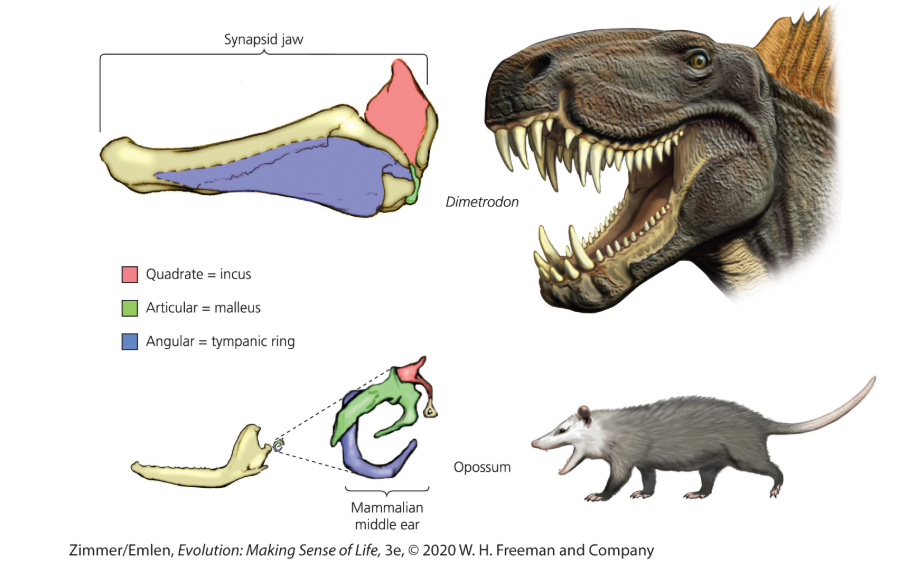
Mammalian Ear Bones are Homologous to…
bones of the reptilian jaw
Feathers Evolved Before Flight
exaptation (preadaptation)
a trait can evolve because it served a particular function, but it may come to serve another
feathers originally evolved for other function, such as species recognition
Exaptation (Preadaptation)
a shift in the function of a trait during evolution
natural selection co-opts a trait for a new function
a trait can evolve because it served a particular function, but it may come to serve another
Heterochrony
evolutionary change in form due to change in rate or timing of developmental events
a change in growth rate of parts can produce a new final shape
Paedomorphosis
a change of timing produces a sexually mature adult with juvenile features

