LA MED/SURG LAB
 Call Kai
 Learn
Learn Practice Test
 Spaced Repetition
 Match
Match Flashcards
 Knowt Play
1/292

There's no tags or description
Looks like no tags are added yet.
Name | Mastery | Learn | Test | Matching | Spaced | Call with Kai |
|---|
No analytics yet
Send a link to your students to track their progress
293 Terms
What is a focused PE?
- A PE in which an effort is made to detect all possible abnormalities that may be associated with a certain organ system or that may be related to the Ddx for a presenting complaint.
Normal equine RR?
- 12 to 24
How can one safely open a horse's mouth?
- Grasp the tongue in the interdental space to open the mouth
What can be evaluated with a horse's mouth open?
- Teeth
- Mucous membranes
- Sinus percussion (resonance is better appreciate with an open mouth)
The submandibular lymph nodes are often quite palpable in which horses?
- Young horses under 2 YO
Where is the facial artery best palpated in the horse? What about the transverse facial artery?
- Ventral aspect of the mandible
- Behind the eye
What should be palpated in the throatlatch region?
- The retropharyngeal or parotid lymph nodes
The thyroid gland is frequently palpated in which horses? What does it feel like?
- Frequently palpable in older horses
- Mobile, spherical, egg-like mass just caudal to throatlatch
Describe the normal filling and pulsation of the jugular vein.
- There should be no spontaneous filling
- Should not pulse more than 1/3 of the way up the neck with the head in a normal position
Where is the equine heart ausculted?
- Over the left cranioventral thorax in three locations: Over pulmonic, aortic, and mitral valves
Normal equine HR?
- 30 to 40 bpm
Boundaries of the equine lungs?
- Found within a triangle drawn between the point of the elbow, cranial to the tuber coxae, and at the tope of the scapula
How should the respiratory system be ausculted in horses?
- Lungs: Over at least 6 location on each side, ausculting a full breathing cycle (inspiration and expiration) in each location
- Over the distal trachea to check for any rattle suggesting discharge in airways
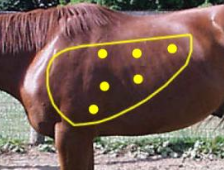
Typically, in a standing horse, what lung sounds are ausculted?
- Quite lung sounds may be heard in the cranioventral region
- May be heard to hear caudodorsal lung sounds without the use of a rebreathing bag
How should the equine abdomen be ausculted?
- In 2 locations on each side (4 abdominal quadrants)
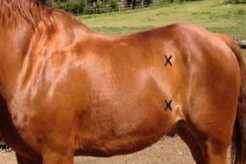
How is abdominal percussion performed?
- Flicking around the stethoscope head when it is placed onto the dorsal quadrants -> A high pitched ping may indicate gas distention
How are the digital pulses palpated in horses?
- First, roll fingers in the region of the neurovascular bundle to ID a "flicking" sensation" before gently placing fingers flat in that region to feel for a pulse
When does edema feel like upon palpation?
- Present where a pit remains after firm pressure with fingertips
Normal equine temperature?
- 99 to 100.8
What factors may affect menace?
- Loss of vision
- Loss of ability to blink
- Obtunded or young (<2 wk old) animal
How is a dazzle performed?
- A bright light is shone abruptly into the eye to cause a squint or blink, indicating the eye can perceive light
True or false: The presence or absence of a PLR indicates the present or absence of vision.
- False
What structures does a PLR assess?
- Retina
- Optic nerve
- Midbrain
- Oculomotor nerve
- Iris sphincter muscle
Vision assessments?
- Intact menace and dazzle
- Obstacles
- Moving objects near the eye
What is the function of the auriculopalpebral nerve?
- Motor to orbicularis oculi muscle
How is an auriculopalpebral nerve block performed?
- Feel side to side over the top of the zygomatic arch just behind the eye or just lateral to the highest point of the zygomatic arch
- Block with 25 G needle and 1-1.5 mL of local anesthetic
- Place the needle SQ parallel with and over the nerve and injecting with a fanning technique
- Place needle separate from syringe
What is the function of the supraorbital nerve?
- Branch of the trigeminal nerve providing sensory tot he medial 2/3 of the upper eyelid
How is a supraorbital nerve block performed?
- Palpate the supraorbital foramen on the flat surface of the bony orbit at a site above the junction of the middle and first thirds of the globe
- Block with 25 G needle and 1-1.5 mL of local anesthetic
- The needle is placed directly down into the foramen with a slight medial angle
- If the horse will not allow placement, a SQ block over the foramen may permit another attempt
- Place needle separate from syringe
When should Schirmer tear testing be used in horses?
- Chronic ulcers
- THO
How is a Schirmer Tear Test performed?
- Placed over the lower lid in the lateral region for one minute
- After the minute, the length of the moistening strip is measured and normal values are 14-34 mm
What ocular testing should be performed before administration of local anesthetic?
- Schirmer tear test
- Corneal culture
How is a corneal culture performed?
- A microbiologic culture swab or moist cotton swab is gently rolled on the sites of corneal ulceration or around the conjunctiva in the case of generalized conjunctivitis
Indications for corneal scraping?
- Complicated corneal ulcers
- Unusual corneal infiltrates and suspected stromal abscesses
How is a corneal scraping performed?
- After applying topical proparacaine, use the blunt base of a sterile scalpel to scrape at the edge and base of corneal ulcers or lesions
- Rest on the horse's face
- The scraping should be sufficient to depress the cornea
- Rub the sample onto a slide for drying and staining
How is fluoroscein dye testing performed?
- Non-diluted strip is applied -> Assess entire cornea for stain uptake using a cobalt light in a dim/dark room
How can fluoroscein stain testing be used to assess tear film breakup time?
- Time required for a dry spot to appear on the corneal surface after blinking
- The stain is applied and not flushed away, then the lid is manually closed and opened 3x and then held open to allow evaporation and the time until a dry spot develops is asessed
- A normal time is 10-12 seconds
A tear film breakup time under 10 seconds indicates what?
- Instability of the mucin later of the tear film
Uses of Fluoroscein staining?
- Assess for ulcerations/defects via stain uptake
- Seidel test
- Assess patency of nacolacrimal duct
- Assess tear film breakup time
Purpose of rose bengal dye testing?
- Assessment of tear film integrity
- Can stain fungus (keratomycosis) and some forms of viral or punctate keratitis
What pathology will lead to extensive staining with Rose Bengal is there is mucin deficiency?
- Dry eye
What is it important that a Fluoroscein stain test be performed before Rose Bengal staining?
- Rose bengal staining is toxic if applied to ulcerated cornea and should be diluted for use
Methods for assessing patency of nasolacrimal duct?
- Fluoroscein stain
- Insert a small catheter into the distal puncta of the nasolacrimal duct at the nostril and instill fluid to see if it can be moved to the eye once pressure is applied by finding to close and seal the puncta over the catheter
Methods for visual evaluation of the cornea and anterior chamber?
- Initially with a bright light source +/- head loupe OR a direct ophthalmoscope with a high setting (20+ diopters) to evaluate the superficial structures under magnification
- Slit lamp to identify depth/location of corneal lesions and assess anterior chamber
What diopter settings are used to assess the following structures?
A. Retina
B. Vitreous
C. Posterior lens
A. Anterior lens
A. 0
B. 2-5
C. 5-6
D. 6-7
What is aqueous flare?
- When the anterior chamber appears "cloudy" or "dusty" under slit lamp evaluation due to increased protein content in the anterior chamber
White or yellow corneal opacity generally suggests what?
- Neutrophil (or macrophage) infiltrate)
What is a "melting" cornea?
- A liquid, soft, or gelatinous region of the cornea
What are stromal abscesses?
- Regions of corneal infiltrate that are covered by intact epithelium and therefore do not have stain uptake despite corneal disease
Normal IOP?
- 16 to 30 mm Hg with up to 8 mm Hg difference between eyes
_________ can decrease IOP.
- Sedation
Low IOP can indicate what? High IOP can indicate what?
- Low -> Uveitis
- High -> Glaucoma, corneal infiltrate, operator error
How can one induce mydriasis in horses?
- 1% tropicamide, requiring about 15 to 20 mins for onset and has a duration of 8-12 hrs
- Atropine can be used for sustained dilation
Horses can develop nuclear sclerosis of the lens by what age?
- 7-8 YO
When is transpalpebral US indicated?
- When the cornea is opaque, there is exophthalmos, severe lid or conjunctival edema, or other situations where abnormalities cannot be evaluated by ophthalmoscopy alone
When looking at the retina, the reflective tapetum appears how? What about the non-reflective tapetum? What about the optic disc?
- Reflective tapetum is dorsal and appears blue-green
- Non-reflective tapetum is ventral and dark
- Optic disc is pink and circular
How may the retina appear in a horse with blue or light colored eyes?
- Can be uniformly red or non-pigmented
Superficial neovascularization appears _______ while deeper neovascularization appears __________-like.
- Branching
- Brush-like
Anterior synechia is adherence of the iris to the _______ while posterior synechia is adherence of the iris to the _________.
- Anterior -> Cornea
- Posterior -> Lens
What may be observed with optic nerve damage?
- Pallor of the optic disc
Purpose of a subconjunctival injection?
- Deliver drugs with specific purpose (corticosteroids, atropine, ABX)
How is a subconjunctival injection performed?
- A 25 G needle and syringe are used and placed attached together with fingers in position to inject immediately and one finger resting against the face
- Injection into the bulbar conjunctiva after topical Ax of cornea
- The tip of the needle is used to gently pick up and then advance a few mm into the conjunctiva
- Should result in immediately visible fluid bleb on top of the sclera
Purpose of anterior chamber injections?
- Acquire aqueous for cytology/culture or acute glaucoma control
- To inject TPA
How is an anterior chamber injection performed?
- Bulbar conjunctiva is cleaned with dilute betadine
- Site of entry is dorsal or dorsolateral at limbus with 27 to 30 G needle with syrnged attached
- Needle is flattened out and direct across the anterior chamber in front of the iris but behind the cornea so the tip of the needle is visible in the anterior chamber prior to aspirating or injecting

How is a vitreous chamber injection performed?
- Frontal and auriculopalpebtal block, topical Ax, plus topical phenylephrine
- 20 or 22G needle is placed through the dorsal or dorsolateral sclera 7-10 mm back from the limbus and directed at a 45 degree angle toward the retina to avoid the lens
How is nasolacrimal duct flushing performed?
- Duct can be entered using at om cat catheter, 16 or 18 G short IVC without needle in place, 5 Fr feeeding tube, or PE tubing
- Digital pressure is applied over the puncta once the tube is inserted several mm and 10-20 mL of eyewash or sterile saline is injected
Purpose of subpalpebral lavage placement?
- Allow repeated, frequent, or continuous (pump-based) administration of ophthalmic drugs and can remain in place for weeks
Where can subpalpebral lavages be palced?
- Placed in the central upper eyelid, very close to the orbit
- In the lower eyelid just near the medial canthus
To correct entropion, what suture patterns can be placed below the lower eyelid margin?
- Horizontal mattress
- Simple interrupted
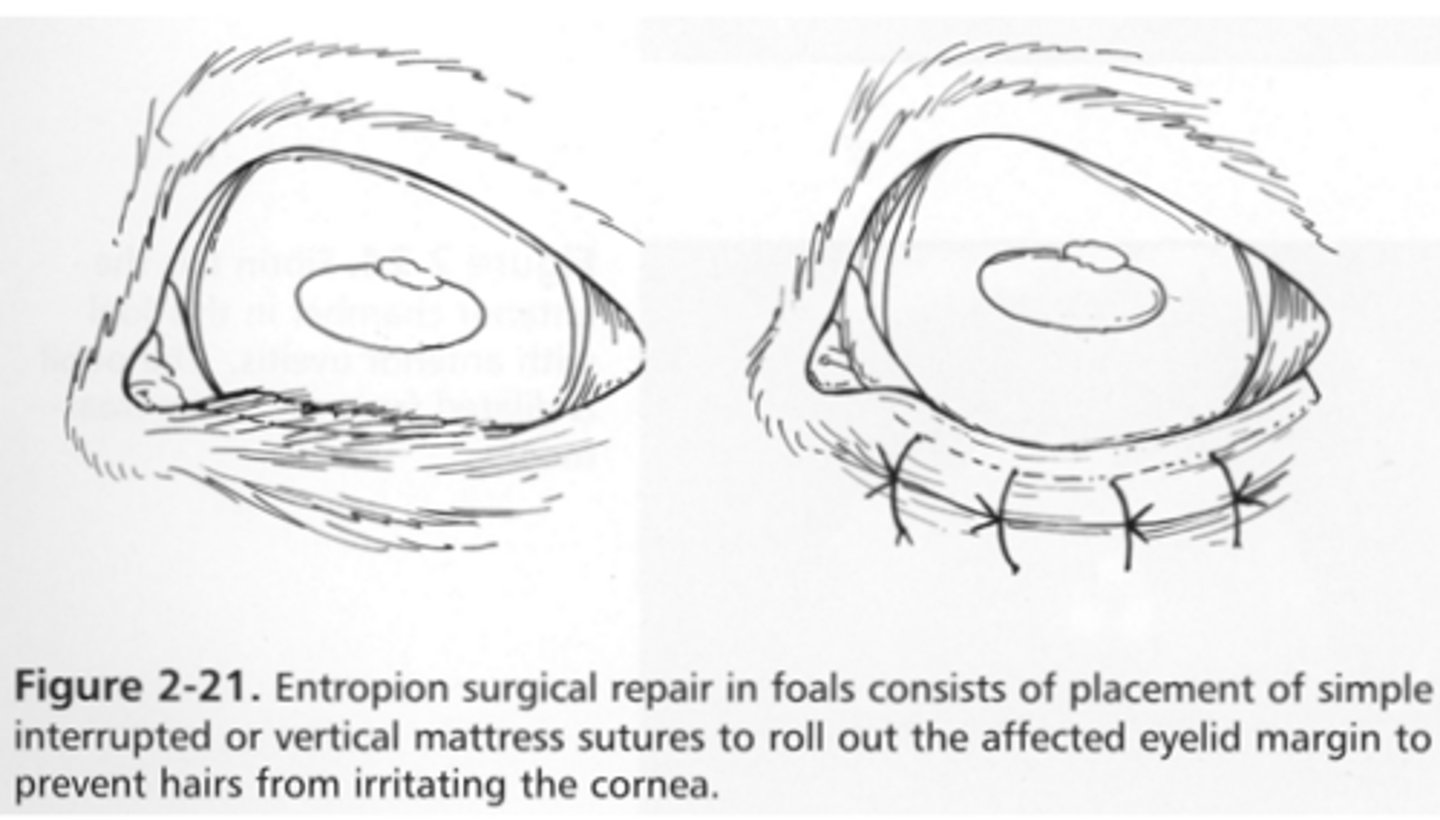
What suture material is used to correct entropion?
- 2-0 Nylon (Ethilon)
Describe the procedure for a conjunctival graft.
1) Lift the bulbar conjunctiva off the globe and incise ~1 mm behind the limbus, and continue parallel to the limbus. Then make an incision perpendicular to this, and then another parallel to the first incision (create three sides of a rectangle running parallel to the limbus)
2) Undermine the conjunctival flap created in step 1
3) Rotate the graft over the corneal defect and suture it to the cornea (simple interrupted sutures)
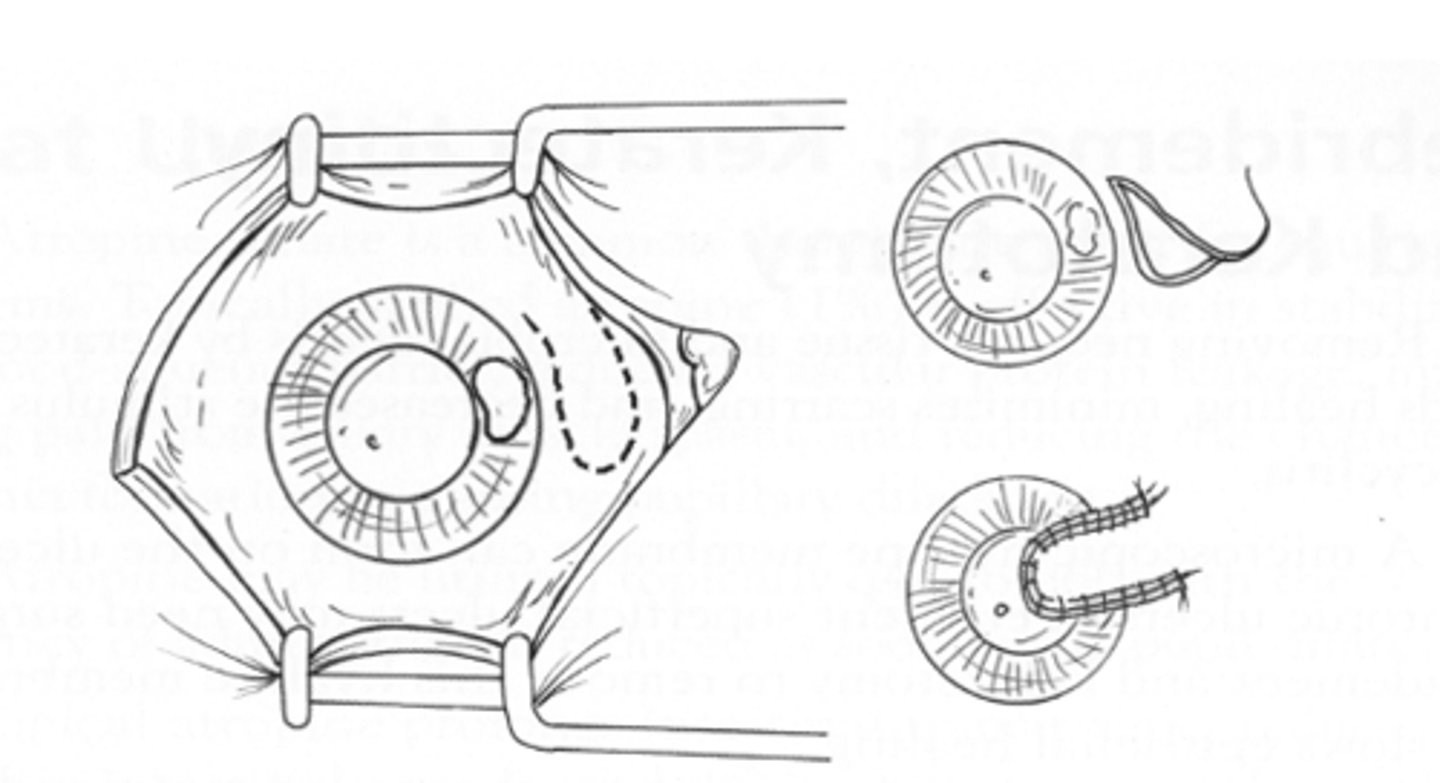
What suture material is used in a conjunctival graft?
- 4-0 absorbable
Describe the procedure for a transpalpebral exenteration.
1) Suture the eyelides closed (tarsorrhaphy) with a simple continuous pattern
2) Incise around the eyelid margin within 5 mm of the performed tasorrhaphy
3) Bluntly dissect posteriorly (don't penetrate the conjunctival sac)
4) Transect the optic nerve (+/- place right angle forceps along the optic nerve and vessels) using Metzenbaum scissors (+/- distal to the clamp)
5) Close the SQ tissue with a continuous pattern
6) Close the skin with simple interrupted sutures
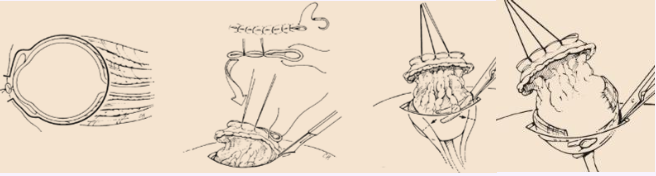
When suturing the eyelids closed during transpalpebral exenteration, how close should sutures be to the eyelid margin and why? What suture material is used for this step?
- Close to the lid margin (~5 mm) to prevent excessive removal of eyelids
- 0 non-absorbable suture
True or false: It is essential to perform ligation of optic vessels before transecting the optic pedicle.
- False; Ligation is usually not required
What suture material is used for closure of the SQ and skin during transpalpebral exenteration?
- SQ: 2-0 absorbable
- Skin: 0 Non-absorbable
Suture material and pattern for temporary tarsorrhaphy in the horse?
- Use #0 and #1 non-absorbable suture in a horizontal mattress pattern
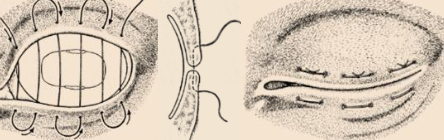
Describe the procedure for an eyelid laceration repair.
1) Close the conjunctiva with a continuous pattern (start at margin)
2) Close the skin with a simple interrupted pattern (margin first) or figure 8 pattern
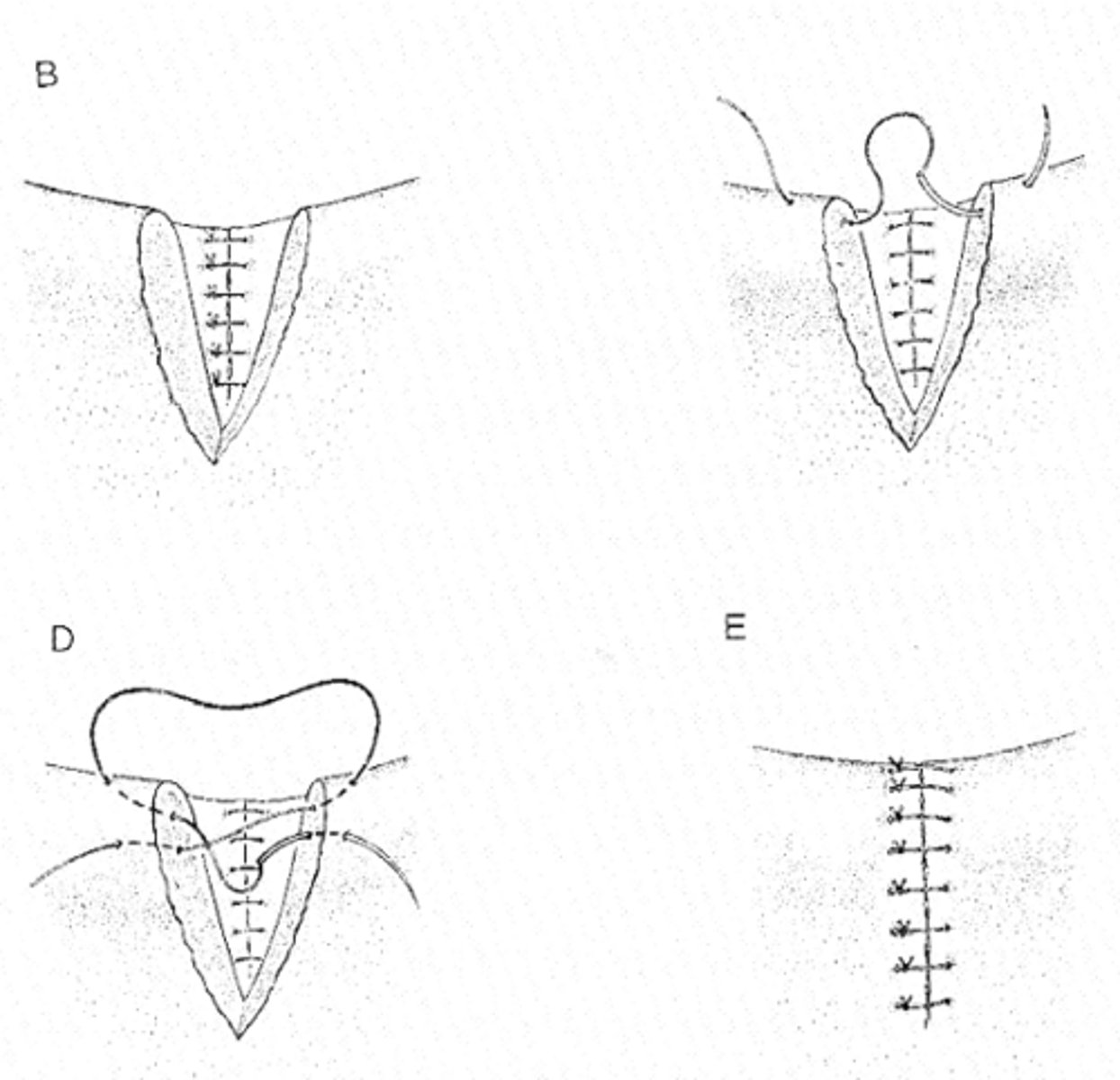
What suture material is used for eyelid laceration repairs?
- 5-0 absorbable
Describe the large colon and cecum on AUS.
- Inhabit large portion of abdomen
- 'hyperechoic', or white, and reflect the ultrasound so the wall or content can't be visualized clearly
Describe the small intestines on AUS.
- Liquid content and is usually able to be visualized in a few limited sites
True or false: Normal horses have a small amount of free peritoneal fluid which is 'anechoic', or black
- True
What is a common scanning frequency range for the majority of the adult equine abdomen?
- 3.5 to 5.0
Location to US right kidney?
- 14-17th ICS level with tuber coxae next to body wall and close to caudal lung (duodenum ventral and liver nearby)
Location to US left kidney?
- Medial to spleen, slightly below level of tuber coxae in paralumbar fossa in 16-17 ICS
Location to US liver?
- Left: 7-9 ICS ventrally
- Right: 6-15 ICS between diaphragm and right dorsal colon, ventral to lung
- The ventral border of the liver should not extend beyond the costo-chondral junction
Which portion of the liver is commonly atrophied in older horses?
- Right lobe
Where to US spleen?
- Caudal to stomach on left side, against the body wall, from the left ventral 8th ICS to the paralumbar fossa, and extends ventrally to midline
Where to US right dorsal colon? Does it have saccultations?
- Right 10-12 ICS
- No sacculations
Where to US stomach?
- Deep to spleen between 9-13 ICS at level of shoulder
Where to US deuodenum?
- Descending the right middle abdomen between liver and RDC
How frequently should the duodenum contract in normal horses?
- 1 to 4 times per minute
Were to US small intestine?
- Left and right inguinal regions, medial to spleen
Where to US large intestine?
- Hyperechoic arcing line in ventral and ventrolateral abdomen
Where to US cecum? Is it sacculated?
- Right paralumber fossa extending ventrally to midline
- Sacculated
Which portions of the equine colon are sacculated?
- Cecum and ventral portions
What are the areas of a flash scan for a rapid US to evaluate for colic?
- Area 1 (L): stomach
- Area 2 (L): Kidney and spleen
- Area 3 (L): left large colon
- Area 4 (L): jejunum
- Area 5 (R): Liver, right dorsal colon, duodenum
- Area 6 (R): Kidney, cecum duodenum
- Area 7 (Ventral): large intestine
- Area 8 (Thorax): right and left thorax
What is the effect of buscopan on AUS?
- Buscopan will make sluggish, misshapen small intestinal loops
Normally, the stomach should not extend beyond which rib?
- Beyond 13th rib
Ddx for edematous colon wall?
- Colitis or torsion
Ddx for distended or amotile small intestine? What about if it is edematous or there is a thickened small intestinal wall?
- Obstruction or strangulation
- Peritonitis or devitalization

