SOC 368 study guide/test prep
 Studied by 0 people
 Call with Kai
 Learn
Learn Practice Test
 Spaced Repetition
 Match
Match Flashcards
 Knowt Play
1/41

There's no tags or description
Looks like no tags are added yet.
Name | Mastery | Learn | Test | Matching | Spaced | Call with Kai |
|---|
No study sessions yet.
42 Terms
Crime as fascination & entertainment
conversation topic in everyday life
plentiful imagery in mass media (books, film & TV, internet
college enrollment numbers (still not sure how this one is connected)
Knowledge of crime
omnipresent imagery
opinions and knowledge
Is what we know correct?
Street (conventional, interpersonal) vs Suite (people at higher statuses committing crime) crime
Rape: Blitz (someone you don’t know) vs. Acquaintance
conventional crime: mostly violent?
Mass Media Trends
key source of knowledge for many
Bias
What is shown
what is NOT shown
WHO and WHAT is/are represented
Understanding Representation
media may accurately reflect reality - or distort it
which crimes are committed
by whom
who is victimized?
Representative depictions correspond to reality (1:1)
Un-representative depictions do not “line up” w/ reality (1:1 is distorted in some way)
Over-representation
amount depicted is larger than reality (violent crime)
murder and violent (interpersonal) crime
Inter-racial victimization
African American & Latinx folks as drug dealers
Strangers as perpetrators
Under-representation
the amount depicted is smaller than reality (property crime)
crime vs females & children by non-strangers
White collar offenses
African American & Latinx folks as victims
Accurate Patterns: family violence & sexual assault
Hate crimes
“Crime” is socially relative
acts are not inherently ‘criminal’
‘crime’ is an attributed quality
The meaning of ‘crime’ varies
Forms of Social variation
Historical
Variation in a society across time
Cross-cultural
difference(s) between 2 cultures
Intra-social/political (power) (can die for country but can’t have legal drink
variation w/i a society at 1 point in time
Crime & related phenomena are social
collective Reponses
crime waves and moral panics
social patterns (race, class, gender, sexuality
Offending
Victimization
Community and government responses
fear of crime
Crime as a sociological problem
“explain how patterns of crime arise from the interplay political, economic, social, and cultural forces
The unholy trinity
“one of criminology’s most important tasks is to examine the relationships in this triangle”
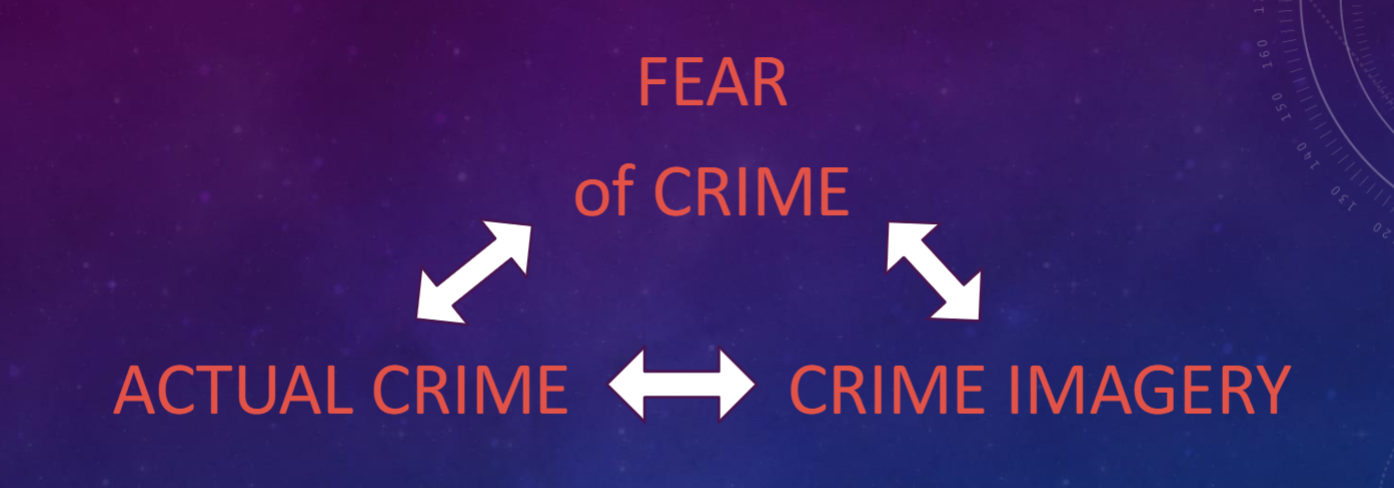
Fear of crime
experienced by individuals…but socially patterned
who has high rates?
what inc. fear of crime? (tv news consumption, % of African Americans in a neighborhood
Fear of crime affects communities
High f of C → low community participation & solidarity
Fear of crime as a social resource
campaign strategy
Scapegoating
support for harsh penalties & more surveillance
distraction
revenue stream & jobs (exacerbate crime to bring in more money)
Criminology
knowledge about study of crime
The big 3 of crimnology
law breaking
Reponses(s)
law making
Criminilization process
defining acts as a criminal
surveilling the behavior
If detected: Reponses to behavior
1 ongoing debate
CCP has contributed to a more rational and humane society OR CP operates to defend the interest of some at the expense of others
Politics
struggles over power
Definitions of Crime Shape the discipline
do we take the criminalization process for granted or do we problematize it
The Paradigms (n=2)
Legal
law defines what ‘crime’ is
very clear, easy to understand
overly narrow
ignore the politics of definition
Sociological approaches: goes beyond legal definitions
broader approach
uses criteria other than legal definitions
explores the policies of definitions
Stats are social constructions
data are produced by people
social dynamics shape data
Theory & concepts — including how we define crime - shape data
Research is scientific
well-established standardized techniques
research is a public endeavor
result? “objective” control over assertion
Critical consumption
all measures have strengths and weaknesses
Triangulation (use complimentary measures, multiple angles)
Findings are provisional (subject to revision)
Incidence vs. rate
rate is like a ratio (comparison is really easy and nice
incidence is
reliability and Validity
reliable is repeatable
validity is harder to determine, but it’s the truth value of a measure (Are you measuring what you think you’re measuring)
Reportability
likelihood of being reported to LE
crime-specific
Murder = the “gold standard”
Criminal Event(proto-criminal action)
events and action lack inherent meaning
multiple factors influence ‘event’ → ‘crime’
is LE aware of the event
Does LE “agree’
Legally defined crime
Follow the numbers
criminology & LE use multiple ‘kinds” of numbers
TRC (True rate of crime)
CKP (Crimes known to police)
Dark Figure (aka Dark number)
CCA (crimes Cleared by arrest)
Prosecutions
Convictions
know what they are & how they’re related
Official vs unofficial
this distinction is not about rigor, quality, or the relative import of the data
collected by government authority or not
Method & data type
quantitative and qualitative data
unofficial measures are more diverse
Method examples
victimization surveys
offender self-report
life course (longitudinal "‘following people across their lives”)
life history
Social observation
interviews
comparative-historical
Official Data
Police based: UCR, NIBRS
Victim-based: NCVS
National Crime Victimization Survey
produced by the BJS (Bureau of Justice Statistics-1972)
victim-based measure
sample survey interviews
probability sample (people are asked randomly)
many people, many households
Mens Rea
criminal mind (intent)
Actus reus
voluntary act (includes failure to act when one has a duty to act)
Culpability
legal blameworthiness
Legal consequence (Criminal)
Legal consequence (civil)
 Note
Note  Flashcards (234)