SJSU Gov Final
 Call Kai
 Learn
Learn Practice Test
 Spaced Repetition
 Match
Match Flashcards
 Knowt Play
1/233

There's no tags or description
Looks like no tags are added yet.
Name | Mastery | Learn | Test | Matching | Spaced | Call with Kai | Chat |
|---|
No analytics yet
Send a link to your students to track their progress
234 Terms
Roots of Interest Groups
growth of labor & trade
first national groups emerge in 1830s
business interests play a larger role after Civil War
begin to send lobbyists (people of influence) to Washington
made working conditions more humane
Progressive era leads to an explosion of groups
The Interest Group State
expansion of civil rights & groups in 1960s
declining power of organized labor
development of conservative & religious groups
evolution of new business groups dedicated to lobbying
History of Interest Group Formation
to seek influence in public policy
Interest Group Formation in the U.S
Social Clevages (factions)
Federalism (3 layers of gov’t)
Separation of powers (3 branches)
The decline of Politicial Powers
Interest Groups
organizations of people w/ shared policy goals entering policy process at several points to try to achieve their goals
Difference between Interest groups & parties
Political Parties: fight election battles
policy generalists
Interest Groups: do not field candidates for office but may choose sides
policy specialists
Interests Groups electoral support to Congress
provide info & policy/legislation support
making laws & policies after doing research → congress says yes
Interests Groups in Action
regulated by the gov’t
can lose tax-exempt
must register w/ Congress
must file financial reports status if lobby is “too much” or breaks rules
Theories of Interest Group Politics
Hyperpluralism & Subgovernments
Subgovernments
network of groups that exercise a great deal of control over specific policy areas
consist of interest groups, government agency, and congressional committees that handle particular politices (iron triangle)
Hyperpluralist Critique
groups have become too powerful as the gov’t tries to appease every interest (results in contradictory policies)
many subgovernments (iron triangle) aggravate the process (legislation contradictory)
What makes Interest Groups Successful?
Potential, actual, and collective groups
Potential Group
all the people who might be interest groups members because they share a common interest
Actual Group
the part of the potential group consisting of members who actually join
10 amendments/civil rights & liberties
Collective Group
something of value that cannot be withheld from a group member
teacher union (benefits)
Intensity of Interest Groups
single-issue groups: groups that focus on a narrow interest, dislike compromise, and often draw membership from people new to politics
may focus on emotional issue, providing a psychological advantage
encourages non-conventional means of participation (ex: protests)
Financial Resources of Interest Groups
not all groups have equal amounts of money
monetary donations usually translate into access to the politicians (phone call, meeting, or support for policy)
Wealthier groups have more resources
presumably have more access, but don’t always win on policy (overton window)
Interest Groups Bias:
americans join groups a lot out of a sense of civic duty & policy efficacy
joiners tend to be high-status, wealthy, have free time, and connections
Free-Rider Problem
some people don’t join interest groups bc they benefit from the group’s activities without officially joining
bigger the group, larger the problem
large groups are difficult to organize
Olsen’s Law of Large Groups
“The larger the group, the further it will fall short of providing an optimal amount of a collective good.”
Attempt to Overcome: provide selective benefits: goods that a group can restrict to those who pay their annual dues
Small interest Groups
better organized and more focused on the group’s goal
Multinational Corporations
successful because there are a few of them and have easier time organizing for political action
Consumer Interest Groups
different time getting significant policy gains bc the benefits are spread over the entire population
Public Interest lobbies seek…
“a collective good, the achievement of which will not selectively & materially benefit the membership activities of the organization”
Interest Groups in Action
provide credible information
organize public support/protest
donate money/jobs (Revolving door)
(these are their attempts at influence, we are interchanging lobbying groups w/ interest groups)
How Interest Groups try to shape Policy:
Lobbying: target congress through research, money (form or donate to superpacs), or testimony (research, facts, data, implement)
target bureaucratic agencies & the president
can use grassroots techniques (ex: petitions)
lobby courts through sponsorship or amicus briefs (letter to courts)
may also resort to protests & activism
Lobbying:
“communication by someone other than a citizen acting on his own behalf, directed to a government decisionmaker with the hope of influencing his decision.”
Two Types of Lobbyists
regular, paid employees of a group
temporary hires
Lobbyists
source of info
help politicians plan political startegies for: ideas & innovations, legislation campaigns
(mixed evidence as to whether lobbying works)
Electioneering
direct group involvement in the election process
groups can help fund campaigns, provide testimony, and get members to work for conadidates; some form PACS
Political Action Committee (PAC)
used by interest groups to donate money to candidates
help pay the bill for increasing campaign costs
most PAC money goes to incumbents (people already in office)
Election Activities
recruiting & endorsing candidates
organzing, get out to vote efforts
rating candidates & office holders
establishing political action committees
Litigation
if an interest group fails in one arena, the courts may be able to provide a remedy
interest groups can file amicus curiae briefs to influence a court’s decision
Class Action
lawsuits permit a small number of people to sue on behalf of all other people similar situated
Going Public
bc public opinion matters, groups try to:
cultivate a good public image to build a reservoir of goodwill w/ the public
use marketing strategies to influence public opinion of the group & its issues
advertise to motivate & inform the public about an issue
Types of Interest Groups
Economic Interest (labor, agriculture, business)
Environmental
Equality
Consumer & Public Interest Lobbies
Types of Organized Interests
public interest groups (Ex: Naral, NRA)
economic interest groups (Ex: AFL-CIO, NAM)
gov’tal units, who lobby for earmarks
political action committees (Ex: EMILY’S List)
multi-issue vs single-issue groups(stronger, focus on their economy)
Interest Group Bias
Business & Professional Groups
interest groups are more influential & better financed than others
don’t always represent the interests of their members
Understanding Interest Groups & the scope of the Gov’t
seek to maintain policies & programs that benefit them
continue to pressure government to do more things
What Influences the positions of Interest Groups?
general philosophy & specific goals
homogenity of the group
people’s motive for joining
the size of staff: staff(elites) often shape policy level of members activity/intensity
Pluralist Theory of Interest Group Politics
politics is mainly a competition among groups, each one pressing for its own preferred politics
Elite Theory of Interest Group Politics
societies are divided among class lines & an upper-class elite rules, regardless of the formal niceties of governmental organization
Hyperpluralist Theory of Interest Group Politics
groups are so strong that gov’t is weakened, extreme exaggerated form of pluralism
Formal Niceties
formal niceties = the polite, proper ways officials interact to keep things professional and orderly
Interest Groups & Democracy
Pluralist: believe that the public interest would prevail from this competition
Elite Theorists: point to the proliferation of business PACS as evidence of interest group corruption
Hyperpluralists: maintain that group influence has led to policy gridlock (contradictory policies)
Pluralism & Group Theory
groups provide a key link between the people & gov’t
groups compete and no one group will become too dominant
groups play by the “rules of the game”
groups weak in one resource may use another
lobbying is open to all so not a problem
Elites Theory (the denial of pluralism)
real power is held by the relatively few
the largest corporation hold the most power
other groups may win many minor policy battles, but elites prevail when it comes to big policy decisions
lobbying is a problem bc it benefits the few at the expense of the money
119th Congress
current meeting of the legislative branch of the U.S federal gov’t, composed of Senate & House of Representatives
House of Representatives
345 representatives (number of Rep., Dem., Libertarian, Independents vary every 2 years w/ elections)
Representatives represent about 710,000 people each and serve 2 year terms
eligible for retirement benefits, healthcare for life
The Senate
100 members (2 representatives per state regardless of population)
a senator represents between 1-37 million people, depending on state’s population
Senators serve staggered 6 year terms
in charge of foreign relations
Annual Salary of memebers of Congress
House of Rep.: $174,000
Speaker of House: $223,500
Party Leaders (same as Senate leaders): $193,400
Cost of Living Adjustments (COLA)
Congress decides its own pay.
Each year, members are set to get a small automatic raise (about 2%) to keep up with prices.
This raise happens automatically unless Congress votes to stop it.
27th Amendment says Congress cannot give itself an immediate pay raise.
But cost-of-living raises (COLA) don’t count as a real pay raise, so they can take effect right away.
Voters still get a say because members face elections.
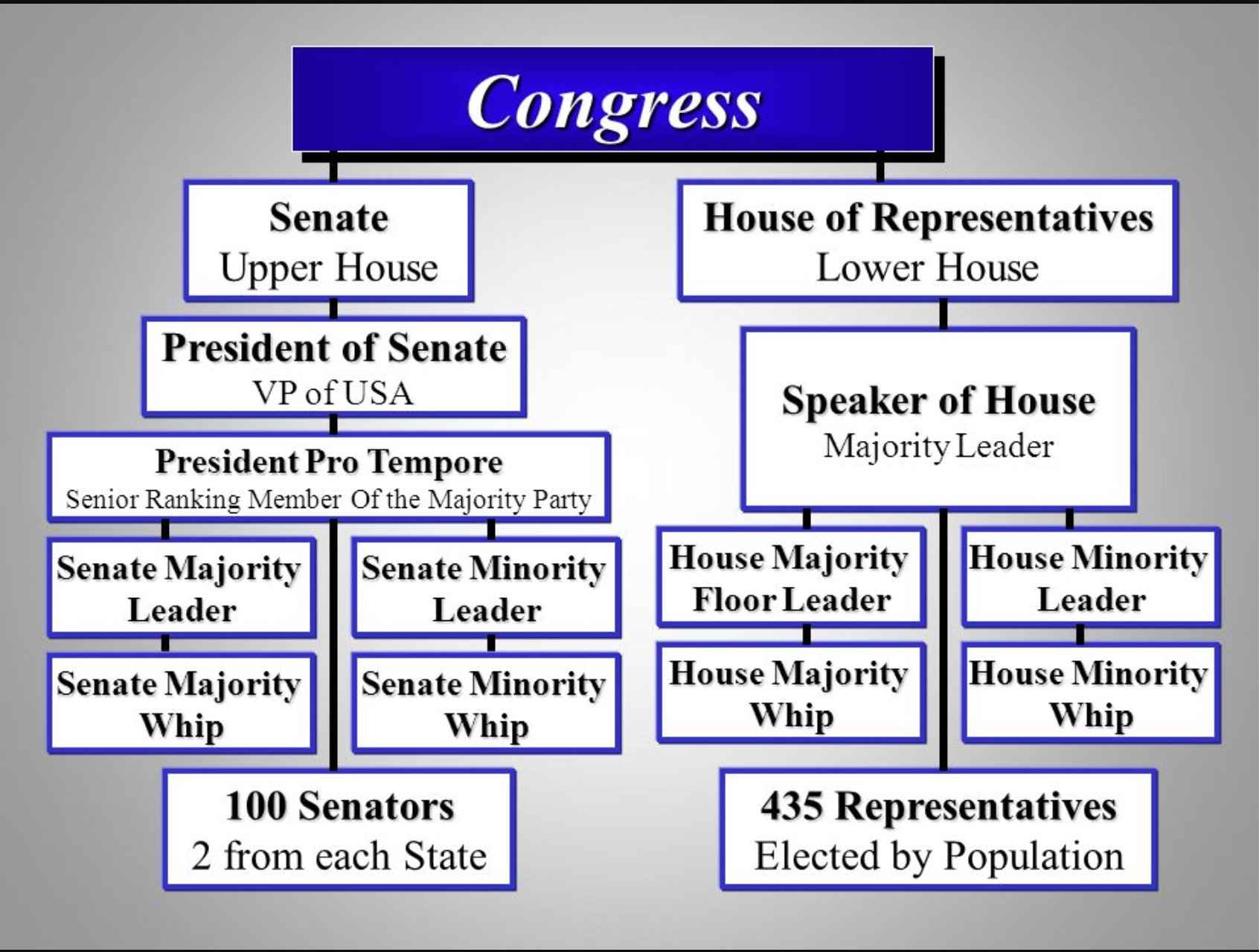
Speaker of the House (elected by House)
second most powerful voice in gov’t (1st is pres.)
3rd in line for Presidency
in charge of money & agenda
House Of Representatives
House is more structured and hierarchical than the Senate
Members usually show stronger loyalty to party leaders and vote more along party lines
House Rules Committee: Controls how bills are debated—sets the schedule, debate time, and what amendments are allowed (members chosen by the Speaker)
The House can impeach federal officials
All revenue (tax) bills must start in the House
Whip
an official political party, tasked to ensure party discipline in legislature
party “enforcers,” invite legislators to attend voting sessions & to vote according to the official party policy
The Senate
less disciplined & centralized (since smaller)
committees & party leadership more important in determining Senate legislative agenda
Filibuster
strategy unique to the Senate; opponents of a piece of legislation try to talk it to the death
Cloture: 60 members can vote to stop a filibuster
Senate President: Vice President
under Constitution, the VP must serve as Pres. of the Senate
may vote in the Senate in case of a tie, but not required to
Senate President Pro Tempore
takes over the chamber in VP’s absence, by custom the senator of the majority party w/ the longest record of continuous service
Committees & Subcommittees
most real work of Congress happens in committees
dominate policy-making
regularly hold hearing to investigate problems, possible wrongdoing, oversee executive branch
control congressional agenda
guide legislation from its introduction to its send-off for President’s signature
Standing Committee
separate permanent subject-matter committees in each house of Congress that handles bills in different policy areas
Subcommittees
smaller units of a committee created out of the committees & 4 subcommittees
Ex: House Committee on Judiciary (legal matters)
Subcommittee on Task Force on Antiturst, Administrative Law, Constitution, etc)
Property: subcommittee on crime, terrorism, and homeland security
Joint Committee
congressional committee on few subject-matter areas w/ membership drawn from both houses
oversee functions of Gov’t printing office & general printing procedures of the Federal Gov’t
Conference Committees
congressional committee formed to work out differences when the senate & the house pass a particular bill in different forms
party leadership appoints members from each house, result must be a single bill
Select Committees
congressional committees appointed for a specific purpose (temporary)
senate select committee on presidential campaign activities → watergate
Pork Barrel
Gov’t spending that mainly benefits a specific group’s interest often to gain political support
Legislative Oversight
Congressional Oversight keeps eye on government agencies to make sure they carry out laws properly, mainly through hearings
Check the legislative branch's oversight of the executive branch.
Committees regularly review how laws are being implemented and can pressure agencies or cut their budgets if they aren’t following Congress’s intentions
Why is there a 90% chance of getting re-elected? (Incumbents)
Advertising (not election ads):
Members of Congress promote themselves by staying visible to the public
serve their constituents: franking privilege (free mailing) to stay in touch
Credit Claiming:
help constituents directly (casework)
secure funding for local projects (pork barrel), often controlled by the party in power
Position Taking:
publicly state their views on issues to build positive image
Weak Opponents:
Challengers often unknown, inexperienced, poorly organized, or underfunded—though having more money doesn’t always cause victory
Gerrymandering:
Drawing district lines to give a political party or group an unfair advantage
The Voting Rights Act of 1965
States can’t draw districts that weaken the voting power of racial or language minorities.
- 1980s, Congress strengthened the law to require states to redraw such maps
Hunt v. Cromartie (1999)
Supreme Court approved a gerrymandering of a congressional district, ruling that it did not qualify as pure racial gerrymandering
determined that redistricting was based on prison populations (prison-based gerrymandering)
Prison-based Gerrymandering
Prisoners are counted as residents of the district where they’re incarcerated, even though they can’t vote
artificially inflates political representation in districts with prisons
Executive Powers (vested in President of the US)
Leads the executive branch
Can grant reprieves and pardons
Makes treaties (Senate approval required)
Appoints key officials (cabinet, ambassadors, judges; often needs Senate approval)
Delivers State of the Union updates to Congress
Can call special or emergency sessions of Congress
Appoints and can remove U.S. officers
Must swear to protect and defend the Constitution
Examples of Presidents Who Expanded the Executive Power
1793: George Washington & “Neutrality Proclamation” (Senate)
1803: Thomas Jefferson & Louisiana Purchase (Congress Purse)
1846: James Polk & Mexican War (Congress has power to declare War)
1861: Abraham Lincoln & Civil War (Congress has power to declare War)
2001: George W. Bush & war on terror (Pres. lied to Congress)
Constitution grants:
bureaucracy are in charge of all the complicated administrative actions associated w/ day-to-day operation of the gov’t w/ President policies in mind
ensures rules being followed
Presidential Roles
Chief Executive: administrators & executes the law & oversee the federal. bureaucracy
Head of State: ceremonial & symbolic (holidays)
Commander-in-Chief: negotiates & signs treaties, appoints diplomats, receives foreign officials
Chief Legislator: sets public agenda, veto power
Head of Party
Informal Sources of Presidential Power
Position: appoints power, control of national security apparatus
Prestige: bully pulpit, agenda-setting, national interests vs narrowly focused interests
Popularity: “going public,” rally-’round -the flag
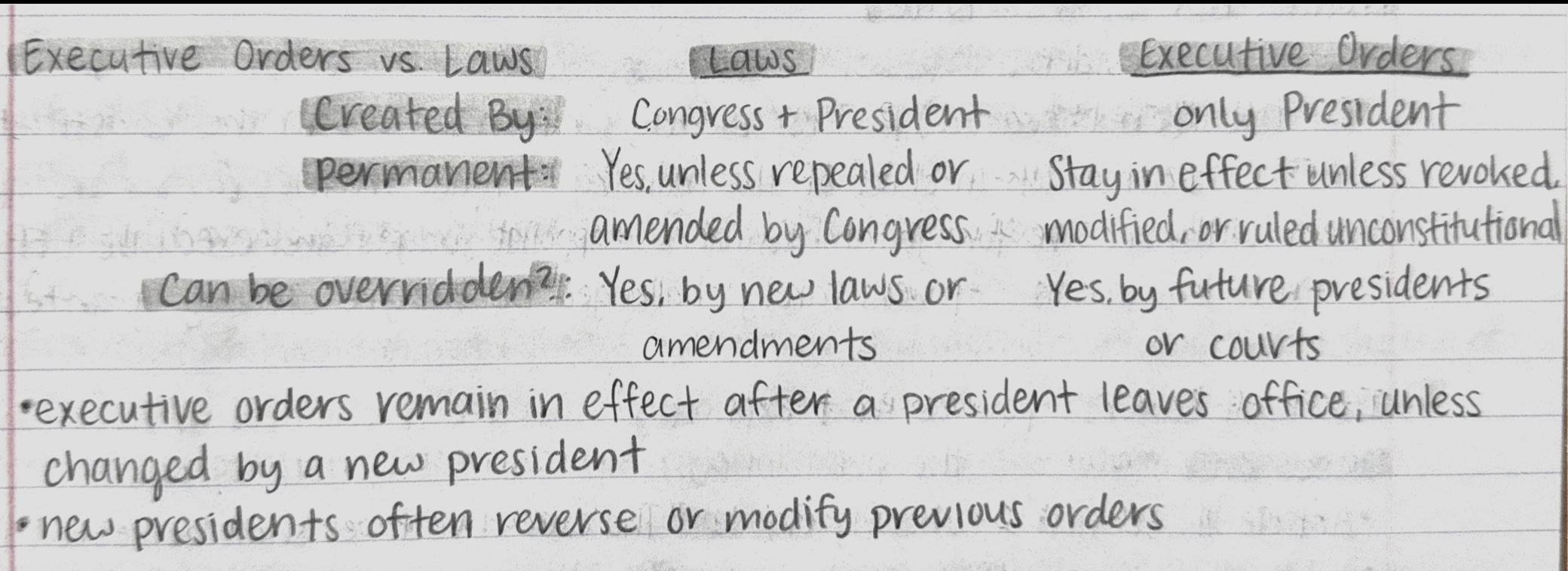
Executive Orders
legally binding orders given by Pres.
used to direct federal agencies & officials in their execution of Congressional laws or policies
“Hey Bureaucracy-interpret & execute law this way.”
Inherent Power derived from: Vesting Clause & Take care Clause
*due to more Congressional Gridlock, presidents feel more obligated to make more executive orders to pass legislation
“Executive Actions”
any informal proposals or moves by the president
vague & can be used to describe anything the President calls on Congress or his admin to do
most executive actions carry no legal weight
*Presidents can NOT execute laws due to their belief that it’s unconstitutional
Executive Privilege
President’s power to withhold information to protect national security, sensitive matters, or the public interest
Can include refusing to testify in hearings or court
Limit: Cannot be used to hide illegal actions or avoid embarrassment
Who checks the President?
Chief Executive, Commander-in-Chief, Chief Diplomat, Chief Legislator
*ultimate check on presidential power is impeachment & removal
Chief Executive check on President
the U.S senate must approve presidential appointments
Civil servants are protected from the president’s whims
Congress controls the federal budget
Commander-in-Chief check on President
only Congress can declare war
congress controls the military budget
War Powers Act (1973)
President must notify Congress within 48 hours of deploying troops
Troops can stay in combat for 60 days (plus 30-day withdrawal) without Congress approval
If Congress does not approve, troops must be withdrawn
Chief Diplomat check on President
the senate must ratify treaties
the senate confirms ambassadors
Formal powers of Congress during times of War
to declare war, grant letters of marque & reprisal
to raise & support armies
to provide & maintain a navy
provide for organzing, arming, disciplining, the militia
to provide for calling forth the militia to execute the laws of the union
The Role of Commander-in-Chief
president can do anything he wants & can ignore the laws - not the Constitution
above the law, is a King
Grover Norquist (anti-tax advocate who is founder and president of Americans for Tax Reform)
Presidential Powers
Executive Powers
Purpose: Run the executive branch
Expressed powers: Appoint officials, enforce laws
Inherent powers: Create the Cabinet
Executive orders: Direct federal agencies to carry out policies
Impact: Expanded executive branch from 4 to 15 departments over time
Emergency Presidential Powers
used during times of national crisis
allows presidents to act quickly, sometimes without congress
(increased use overtime)
Derived from: commander-in-chief authority, and executive powers
Ex: George W. Bush after 9/11 attacks
Congress’s War powers (Article I)
Military & Foreign Affairs
Only Congress can declare war
Controls military funding (“power of the purse”) – salaries, supplies, weapons, etc.
Can limit or authorize troop deployments (e.g., War Powers Act)
Ratifies treaties (Senate approval with 2/3 vote)
Confirms ambassadors and influences foreign policy
President’s War Powers
Commander-in-Chief
Leads the armed forces; powers are broad and not clearly defined in the Constitution
Can:
Send troops into battle
Negotiate peace
Deploy troops during national emergencies, civil unrest, or natural disasters
Bureaucracy
large complex administrative structure that handles the everyday business of an organization
Hiearchical Authority (Bureaucracy)
any organization that is built like a pyramid, with a chain of command running from the topy of the pyramid to the bottom
Job Specialization (Bureaucracy)
each bureaucrat, or person who works for the organization, has certain defined duties & responsibilites
Formalized Rules (Bureaucracy)
the bureaucracy does its work according to a set of established regulations & procedures
Civil Servants
Civil servants are more demographically representative of the U.S. population
Elected and appointed officials remain disproportionately white men
positions are obtained through merit-based, not campaign connections
Patronage or Spoil System
“to the victors belong the spoils”
principle not based on merit
elections or war
Development of Civil Service System (Pendleton Act of 1883)
Nonpartisan; hires and promotes based on merit (exams, skills, talent) rather than political connections
Government workers keep their jobs even when a new party takes office
The Hatch Act of 1939
prohibits civil servants form engaging in political activities
Political Appointees
each newly-elected pres. has the task of filling thousands of executive appointments
top jobs are listed in Plum Book, published by Congress
President launch a nationwide search for talented/accomplished individuals to fill these posts