The Central Nervous System
 Studied by 3 people
 Call with Kai
 Learn
Learn Practice Test
 Spaced Repetition
 Match
Match Flashcards
 Knowt Play
1/35

There's no tags or description
Looks like no tags are added yet.
Name | Mastery | Learn | Test | Matching | Spaced | Call with Kai |
|---|
No analytics yet
Send a link to your students to track their progress
36 Terms
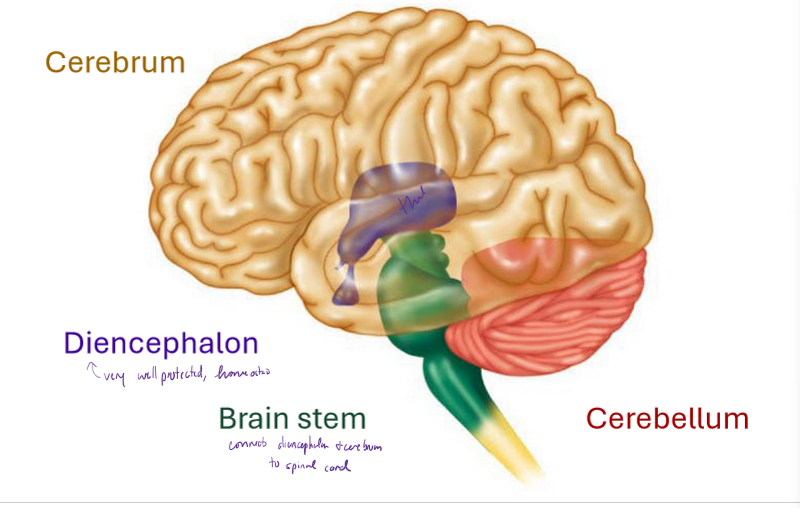
What are the 4 main parts of the brain?
cerebrum
diencephalon
brain stem
cerebellum
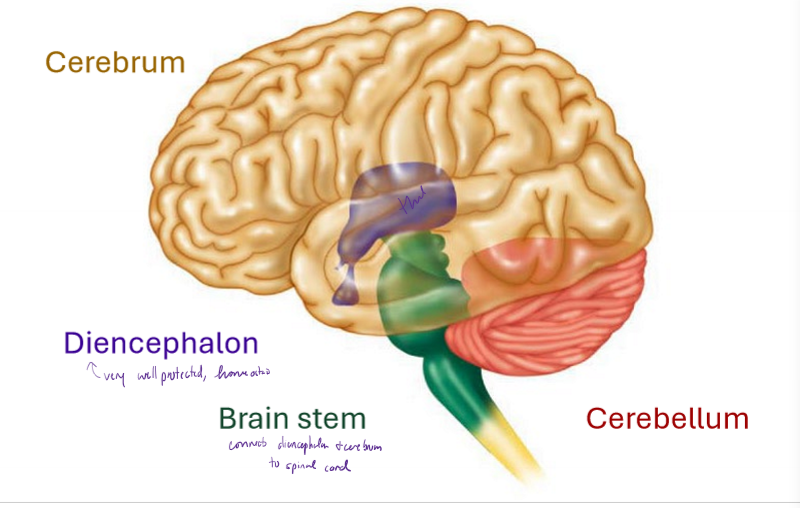
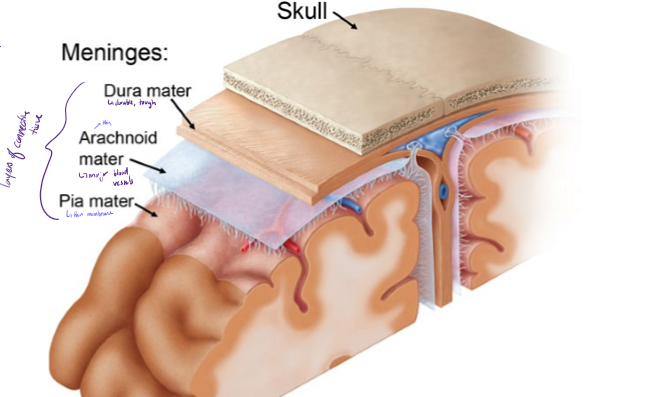
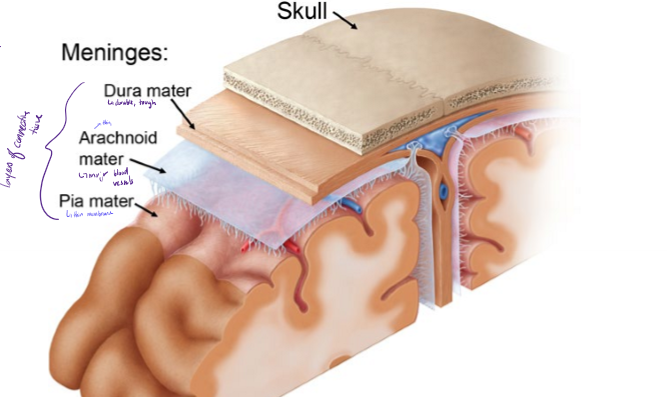
What are meninges?
connective tissues covering the brain to protect it
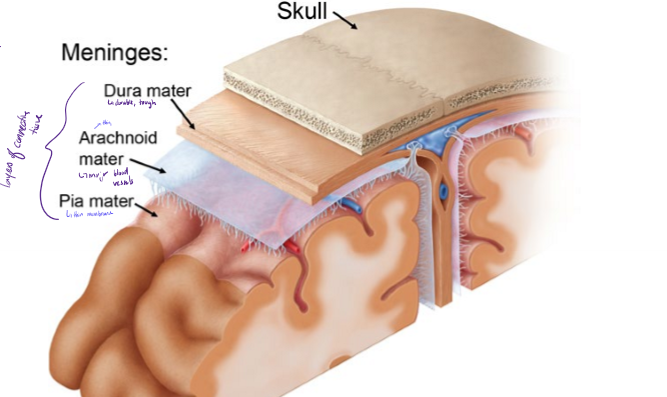
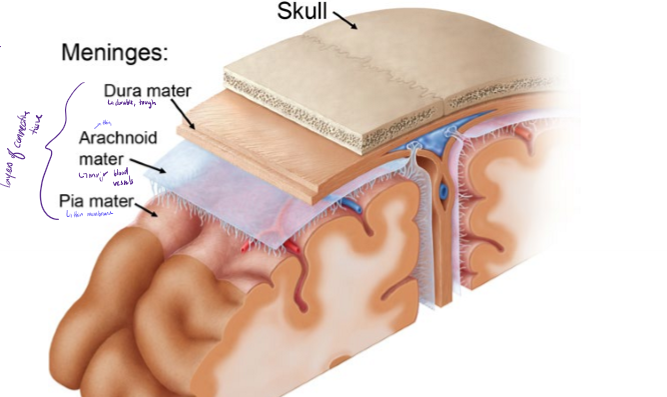
What are the meninges from most superficial to deepest? Describe them
dura mater - durable, tough
arachnoid matter - thin
pia mater - thin
layers of connective tissue
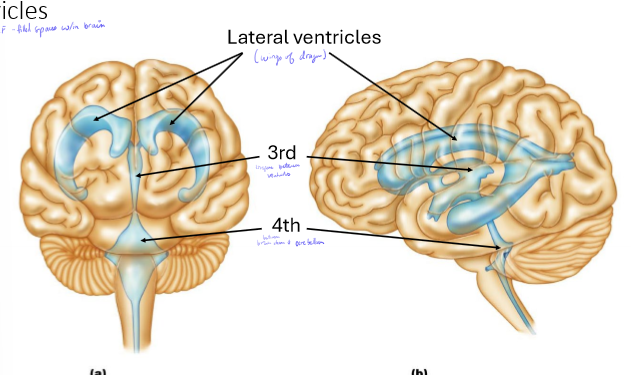
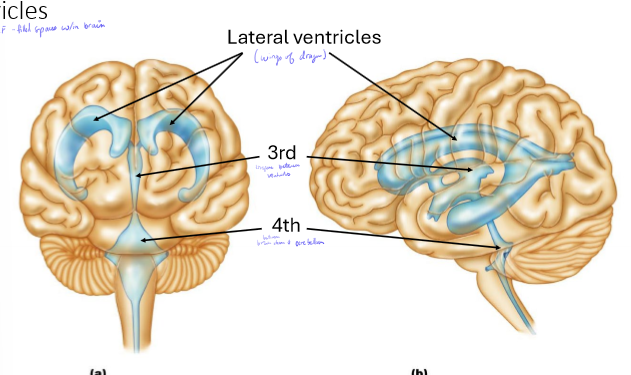
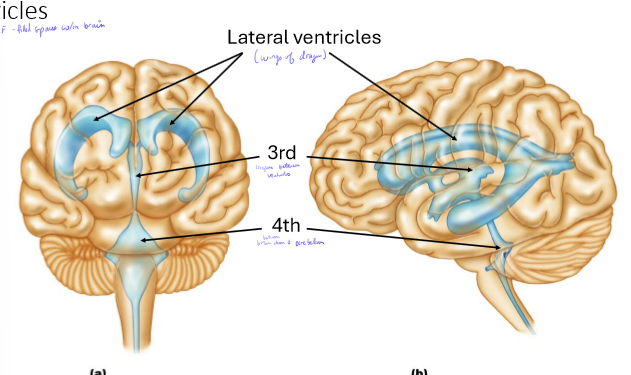
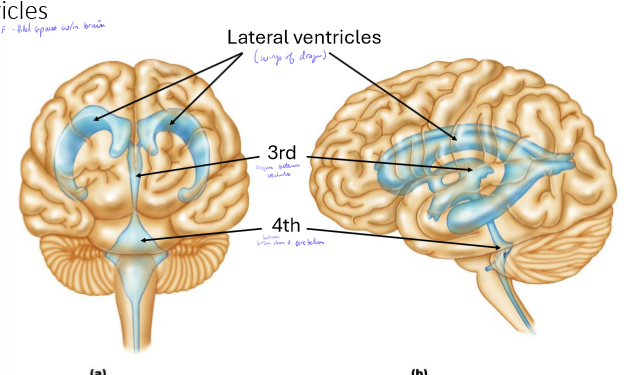
What are ventricles?
CSF filled spaces within the brain
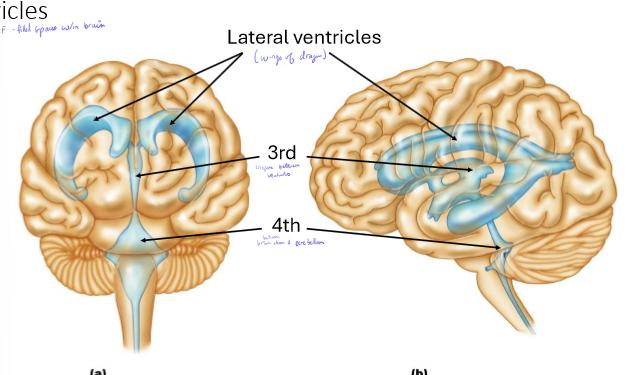
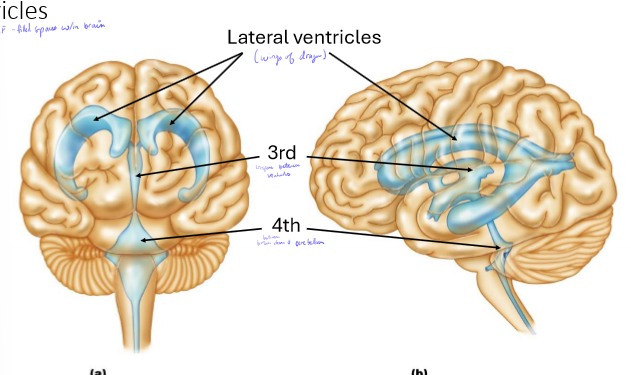
What are the main ventricles of the brain?
lateral ventricles - within cerebral hemispheres
3rd ventricles - in diencephalon behind thalamus
4th ventricles - between brain stem and cerebellum
What are the functions of the circulation of Cerebrospinal Fluid (CSF)?
protect/cushion the brain by allowing it to float
provides nutrients to ependymal cells
eliminates waste products
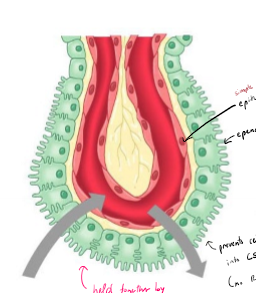
What is the choroid plexus?
blood vessels and the ependymal cells lining them
create CSF from things in blood
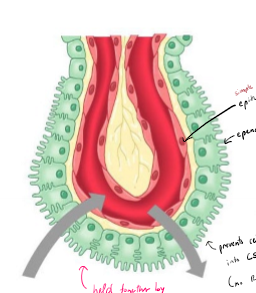
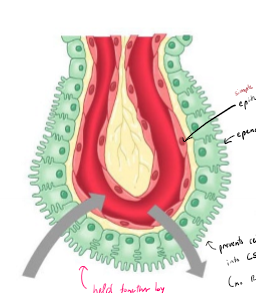
Describe ependymal cells in the brain
line blood vessels like epithelial cells
prevent cells from going into CSF, allow only liquid and gases
held together by tight junctions to stop paracellular movement
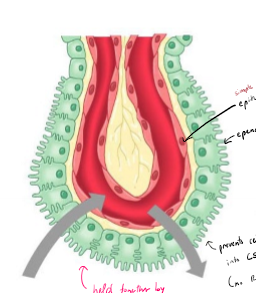
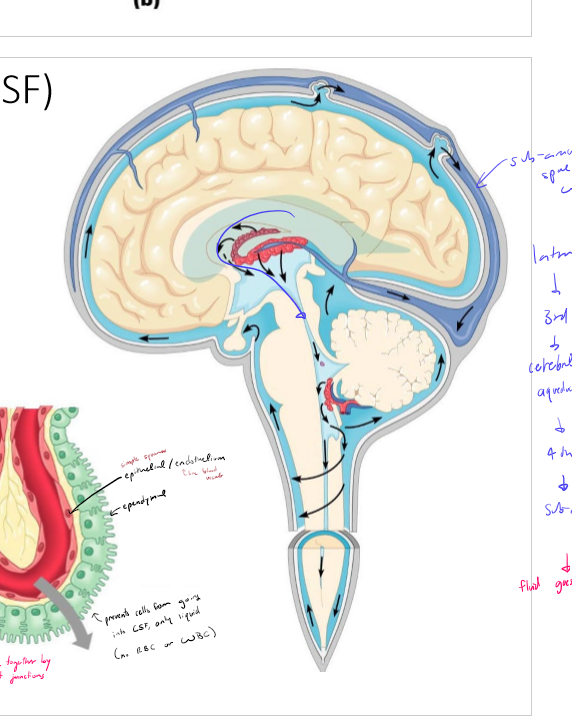
Describe the movement of CSF in the brain
created in the choroid plexus (blood vessels and ependymal cells) at the lateral ventricles
flows to third ventricle
to cerebral aqueduct
to fourth ventricle
to sub arachnoid space
back into blood through dura mater
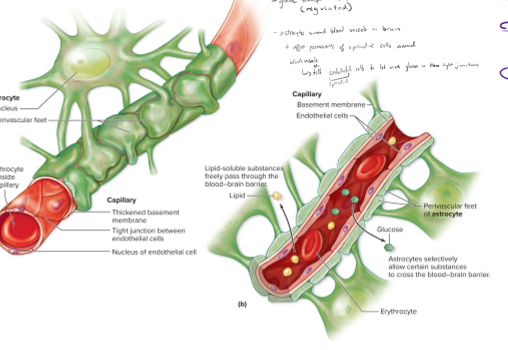
What is the blood brain barrier and what creates it?
provides constant and protected extracellular enviornment in the CNS
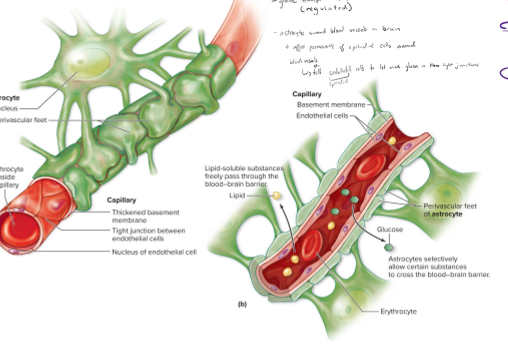
created by tight junctions between epithelial cells of blood vessels
thick basement membrane of capillary wall
astrocytes signal epithelial cellss, affecting the permeability of tight junctions
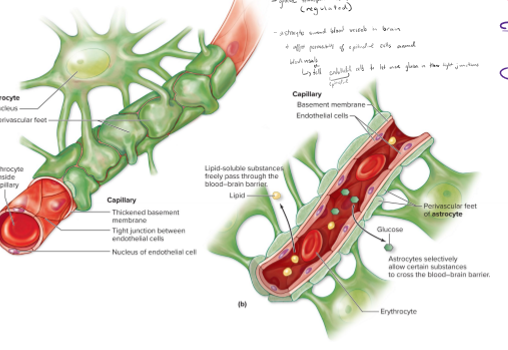
How do substances pass through the blood brain barrier?
lipid-soluble substances, ie, gases, alcohol, cross through
lipid-insoluble substances transported through, ie. glucose
What are the regions of the cerebrum and what do they control?
frontal lobe - cognition, personality, memory, thinking, voluntary motor control
insula
parietal lobe - sense of touch, spatial awareness, somatosensory
temporal lobe - processing hearing, language, forming memories
occipital lobe - visual cortex
What is gray matter in the brain?
cortex (collections of cell bodies along lining of brain)
basal nuclei (deep gray matter)
What is white matter in the brain?
tracts
commissures
Describe the primary motor cortex
superficial part of the frontal lobe
right side controls left side of body and vice versa
more neurons/space on cortex devoted to areas with more fine motor control
corticospinal tracts project into the spinal cord
What are corticospinal tracts?
nerves (axons) that carry voluntary motor commands from the motor cortex in the frontal lobe into the spinal cord
Describe the primary somatosensory cortex
superficial part of parietal lobe
each hemisphere receives sensory info about touch, temp, pain, itch, body position, from skin/joint/muscles from opposite side of the body
communicates with other parts of the brain through association neurons
more neurons/cortex space to process snesory info for more sensitive body parts
What are association areas in the brain?
areas that integrate inputs
give meaning to info received, store in memory, tie to experiences, decide on actions
where emotions and thoughts become conscious ex. putting words to things, thinking about what you want to do
often in the same lobe as associated cortex
What cortical areas are associated with language and where are they located?
broca’s area - motor output of being able to speak, in frontal lovelobe
wernicke’s area - understand language, in temporal lobe
Describe Receptive (Wernicke’s) aphasia and expressive (broca’s) aphasia
receptive - damage to wernicke’s area, meaningless speech, cant undersant
expressive - damage to broca’s area, understand but cant respond
What is basal nuclei?
deep grat matter
involved with motivation, motor planning, and attention
connect back to motor cortex to actually move
How is Parkinson’s disease caused by problems in the basal nuclei?
degeneration of dopamine-releasing neurons in the midbrain to the basal nuclei (essential for motor output)
basal nuclei deprived of dopamine become overactive, causing tremors and difficulty with intentional movements
What is white matter in the CNS, including the types of tracts?
axons
myelinated fibers bundled into tracts
association tracts - send signals between parts of cortex
commisural tracts - connect 1 side of the brain to the other (ex. corpus callosum)
projection tracts - connect cortex to other parts of the CNS (travel superior to inferior and vice versa)
What are the parts of the brain stem?
midbrain
pons
medulla oblongota
What are the parts of the diencephalon?
thalamus
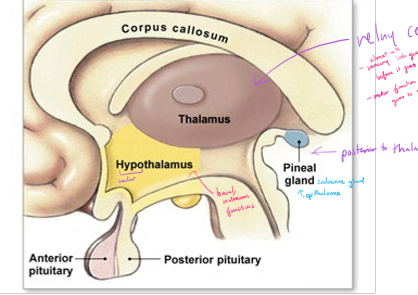
hypothalamus
pineal gland
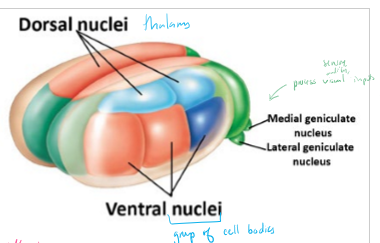
What does the thalamus do?
relay center in center of brain
almost all sensory info and some motor info goes to the thalamus before going to the cortex
process sensory, auditory, and visual inputs
full of groups of nuclei regulating different functions
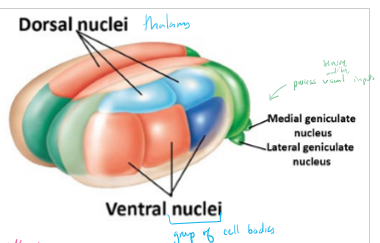
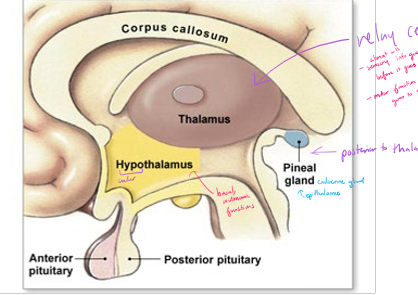
what does the hypothalamus do?
basal homeostasis and autonomic functions
different nuclei regions for regulating different
regulates feeding, fight/flight response, sex, energy balance (Feeding and metabolism)
water balance
body temp
sleep/wake cycles
reproduction
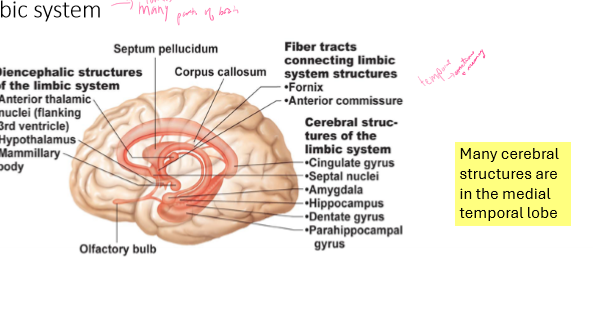
What is the limbic system?
multiple structures in brain connected through the fornix to the hypothalamus
process emotional experiences
important for learning and memory
can send signals to hypothalamus that can cause autonomic/physiological responses to emotional signals
What does the pineal gland do? Describe the hormone
makes melatonin
melatonin regulated by light, increases when its dark outside
light inhibits pineal gland hormone production
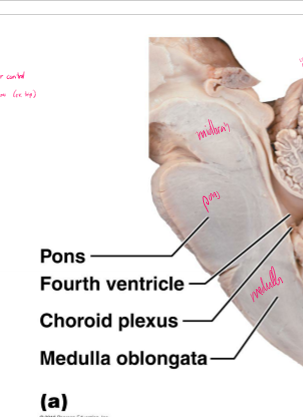
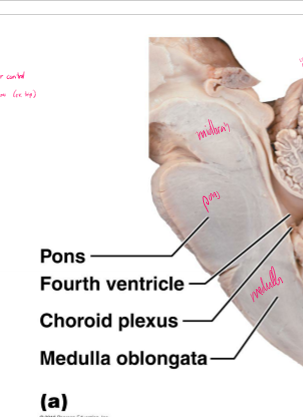
Describe the brainstem
brainstem nuclei involved with sensory or autonomic functions
project tracts run through to connect brain and spinal cord
Pons bridges brain stem and cerellum through fibers/axons/tracts
also has grey matter (nuclei)
regulates and maintains basic body functions like breathing
Describe the cerebellum
lots of surface area, lots of sulci and gyri
responsible for coordination of voluntary motor control, motor memory, final motor control, balance
What is an EEG?
measures collective graded potentials of nuclei in cortex (excitatory or inhibitory)
Describe the brain waves classes shown in EEGs and what they mean
alpha waves - awake but realzed, high frequency, low amplitude due to constant ISPS and ESPS
beta waves - awake but alert, veyr high frequency but lower amplitude due to constant ISPS and ESPS
theta waves - equalish signals, common in children
delta waves - deep sleep, very high amplitude due to all hyperpolarizing or all depolarizing potentials at the same tinem
Describe the main stages of sleep
REM sleep - all movement except eyes inhibited, high HR, brain activity has very high frequency like when awake
NREM sleep - movement occurs, HR is slower, most vivid dreaming
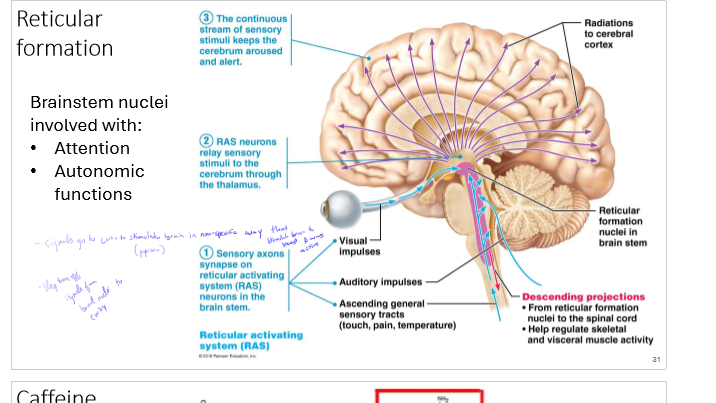
What is reticular formation?
brainstem nuclei involved with attention and autonomic functions
signals cortex in non-specific way to keep brain active ex. sitting in an area with lots stuff going on is overstimulation
sleep turns off signals from basal nuclei to cortex
Describe adenosine in the brain and its antagonist
adenosine - ATP byproduct that makes you sleepy, the more energy you use the more you make
caffeine - adenosine antagonist, blocks adensoine receptors to keep you alert
 Note
Note  Flashcards (102)