CompTIA A+ 220-1202 - 1.3 Windows Overview and Features
 Studied by 0 people
 Call Kai
 Learn
Learn Practice Test
 Spaced Repetition
 Match
Match Flashcards
 Knowt Play
1/20

There's no tags or description
Looks like no tags are added yet.
Name | Mastery | Learn | Test | Matching | Spaced | Call with Kai |
|---|
No analytics yet
Send a link to your students to track their progress
21 Terms
Windows 10
A single platform OS that would work across multiple devices, and it was released on July 29, 2015. Support for Home and Pro would end on October 14, 2025.
Windows 10 Home
A desktop edition of Windows 10 that is designed for home use including integration with Microsoft OneDrive and Windows Defender.
Windows 10 Pro
A desktop edition of Windows 10 that is designed for businesses including Remote Desktop support and BitLocker.
Windows 10 Pro for Workstations
An edition of Windows 10 for high-end desktops supporting more physical CPUs, up to 6TB of RAM, and Resilient File System support.
Windows 10 Enterprise
An edition of Windows 10 that is built for large implementations and volume licensing. It includes AppLocker, BranchCache, and Granular User Experience Control.
Granular User Experience (UX) Control
A feature of Windows 10 Enterprise that allows defining the user environment that is useful for kiosk and workstation customization.
Windows 11
An upgrade to Windows 10 that no longer supports 32 bit CPUs, and it was released on October 5, 2021.
Windows 11 Home
A desktop edition of Windows 11 that is designed for home use that integrates with Microsoft accounts including a Device Encryption that stores recovery information in the users Microsoft Account.
Windows 11 Pro
A desktop edition of Windows 11 that is designed for businesses that integrates with Active directory and includes BitLocker and Remote Desktop support.
Windows 11 Enterprise
An edition of Windows 11 built for large company deployments using Volume licensing and includes MDM and MAM. It supports Resilient File System for file management.
Active Directory Domain Services
A large centralized database of everything about every component connected to the network that can be distributed across servers for redundancy.
Windows Workgroup
A logical groups of network devices in which instead of managing everything on a central database, it manages each individual device as a single unit.
Work Desktops
A standardized desktop in which customization is very limited and has a common user interface across each device for easier management.
Home Desktop
A desktop type in which the user has full customization and complete flexibility. The background, UI, and font can be changed for personal use.
Remote Desktop Protocol
A protocol used to remotely connect to a device and interact with a desktop on a different device. It is not available on Home versions of Windows.
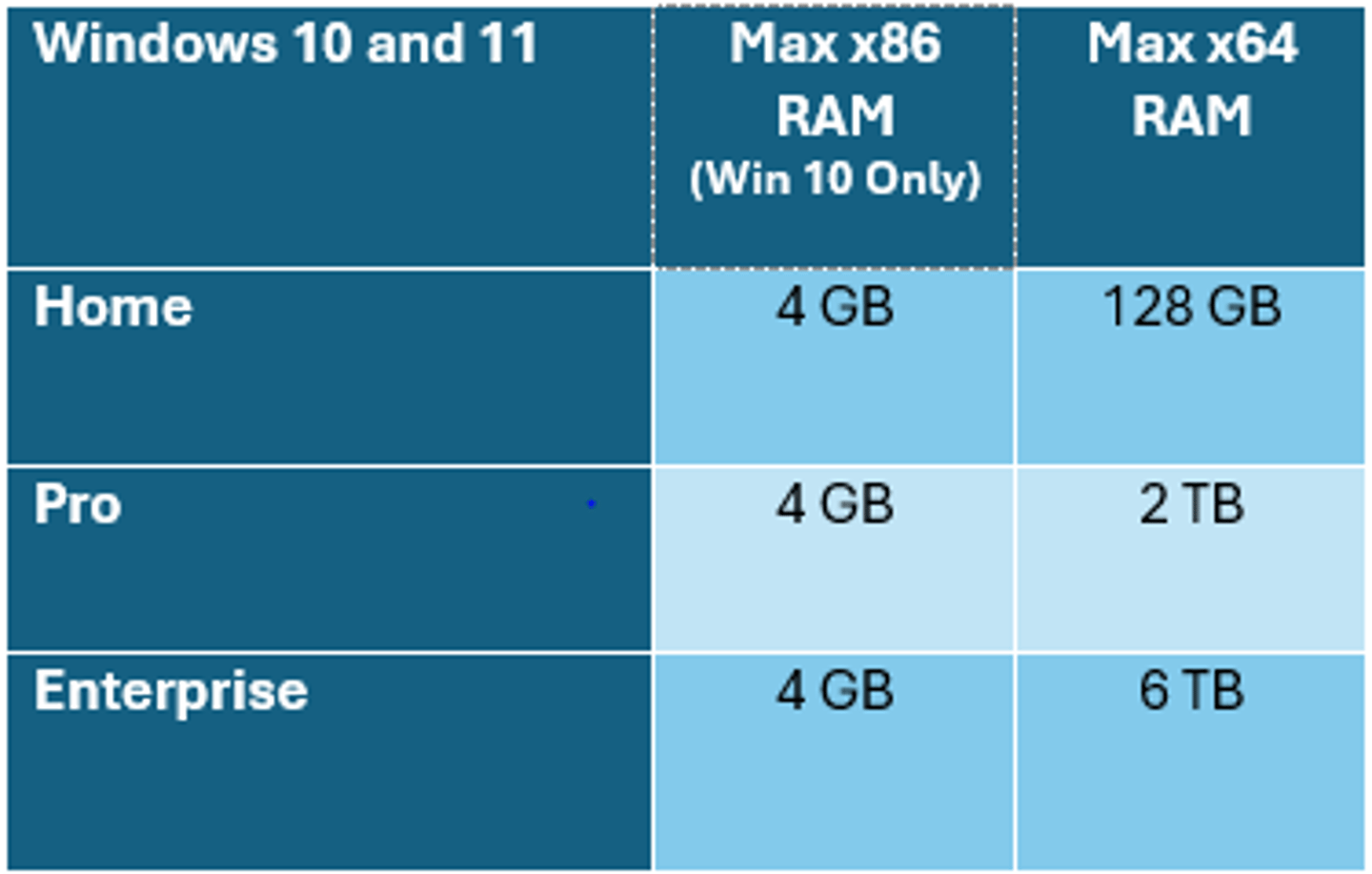
RAM Windows Support
Windows RAM is limited based on editions. More advanced editions allow additional RAM.
Encrypting File System (EFS)
An encryption technology for individual files and folders that is built-in to the NTFS file system.
BitLocker
A Windows feature that encrypts an entire drive.
Group Policy Editor
A centralized management of users and systems in which policies can be set on how systems can be used on the network.
Local Group Policy
A policy editor that manages the local device using gpedit.msc.
Group Policy Management Console
A policy editor that is integrated with Active Directory that allows all policies to be set on all of the devices on the network using gpmc.msc.
 Note
Note  Flashcards (64)