Unit 1 study guide
 Studied by 0 people
 Call Kai
 Learn
Learn Practice Test
 Spaced Repetition
 Match
Match Flashcards
 Knowt Play
1/129

There's no tags or description
Looks like no tags are added yet.
Name | Mastery | Learn | Test | Matching | Spaced |
|---|
No study sessions yet.
130 Terms
The whole sky rotates around us once per day.
what did humans perceive the daily motion of the sky (Sun, stars, Moon move east → west across sky) to be?
Earth is rotating on its axis once every 24 hours.
what was the daily rotation of the sky (Sun, stars, Moon move east → west across sky) ACTUALLY?
The Sun slowly shifts among the constellations during the year.
what did humans perceive the annual motion of the sun (Sun moves along the ecliptic over the year) to be?
Earth is orbiting the Sun once per year.
what was the annual motion of the sun (Sun moves along the ecliptic over the year) ACTUALLY?
Planets move against background stars, sometimes backward
what did humans perceive about planetary motion (planets wander + retrograde loops)?
Planets orbit the Sun at different speeds (retrograde)
what was the observed planetary motion (planets wander + retrograde loops) ACTUALLY?
a planet appears to move backward (east → west) against the stars because Earth is passing it or being passed in orbit.
What is retrograde motion?
They used celestial cycles for agriculture (flooding seasons), calendars, religion, navigation, and predicting omens.
Why did Egyptians and Babylonians care about celestial objects?
east to west
apparent motion: the sun, stars, and planets move from (slide 15)
the earth is rotating west to east on its axis
actual motion of the the sun, stars and planets moving in a 24 hour period
real motion; the earth goes around the Sun in a year, from west to east
the apparent motion is that the sun moves against the stars, along the ecliptic, from west to east (traversing the whole ecliptic takes a year.)
slide 34
the apparent motion is also that planets move along the ecliptic, a little bit every night, from west to east (traversing the whole ecliptic takes a year.)
clock + calendar + religious guide.
Why did Egyptians and Babylonians care about celestial objects?
in other words, the sky was their what?
The belief that natural objects (Sun, Moon, stars) have spirits or divine powers.
What is animism?
They viewed celestial bodies as gods or living beings.
How does animism relate to Egyptian/Babylonian cosmology?
It gave sky events religious meaning and helped explain the universe.
Why was animism important for their understanding of the cosmos?
Indirectly, by observing patterns on Earth.
How did ancient civilizations track the Sun's position along the ecliptic?
They shift along the horizon through the year, showing the Sun's changing place on the ecliptic.
What did sunrise and sunset positions tell ancient observers?
Shadow length and direction (using gnomons/obelisks) reveal the Sun's height in the sky.
How did noon shadows help ancient civilizations track the Sun?
They mark extreme or midpoint positions of sunrise/shadows, anchoring the Sun's yearly cycle.
Why were solstices and equinoxes important to ancient observers?
The Sun isn't visible against the stars during the day.
Why did ancient observers use indirect methods?
Carefully recording sky events over long periods.
What does systematic observation mean?
systematically recorded observations over long periods.
What essential scientific task did Egyptian/Babylonian astronomers already do?
It lets patterns emerge — the foundation of all science.
Why is systematic observation important?
it is the foundation of all modern science: collect data carefully and look for patterns.
why is it important that Egyptian/Babylonian astronomers systemically recorded observations over long periods?
1. animism/ supernatural agents
2. logic and models (even if inaccurate)
1. ancient civilizations used what to explain the universe?
2. as opposed to greeks who used what?
They used reason, logic, and geometric models instead of myth.
What was the key difference in the Greek approach to explaining the universe?
Natural causes, not supernatural ones.
What type of causes did the Greeks look for?
Internal consistency
What quality did Greek explanations aim for?
They built models to match observations, even if imperfectly.
How did Greeks try to connect their ideas to reality?
It used rational arguments and compared ideas to observations.
Why is the Greek approach considered an early step toward science?
1. fixed and unmoving
2. perfect, unchanging
3. perfect circles; constant speeds
4. nested spheres
Aristotle’s model assumed:
1. The Earth is _____ _____ ______ at the center.
2. The heavens are ________, _________ and made of a special substance (“aether”).
3. Celestial objects move in _________ _______and at _________ ________.
4. The universe is finite and arranged in __________ __________.
Aristotle's model
which model affirmed:
-A perfect, orderly, harmonious cosmos.
-Predictable circular motion.
1. imperfect
2. changing
3. moving
4. non-circular
Aristotle's model forbade:
1. ____________ shapes (no ellipses),
2. __________ skies (no new stars or changes),
3. Earth __________,
4. Any kind of irregular or _____-_______ planetary motion.
It explained what things were made of and how they move.
Why was Aristotle's model physically satisfying?
It placed Earth/humans at the center of the universe.
Why was Aristotle's model emotionally satisfying?
separated the corrupt Earth from the perfect, divine heavens.
Why was Aristotle's model religiously satisfying?
A way for divine motion (outer spheres) to influence Earth.
What religious mechanism did Aristotle's model include?
It linked celestial movements with earthly events.
Why did Aristotle's model have astrological value?
It used perfect circles and smooth, uniform motion.
Why did Aristotle's model have aesthetic value?
It used logic and observation.
Why did Aristotle's model have intellectual value?
Perfect circles + perfect heavens.
What made Aristotle's model simple and elegant?
It matched Greek ideas of cosmic perfection and order.
Why was Aristotle's model philosophically satisfying?
It explained both Earthly and celestial motion in one system.
Why was Aristotle's model comprehensive?
Aristotle was highly respected, so his ideas gained influence.
How did authority help spread Aristotle's model?
Nearly 2,000 years.
How long did Aristotle's model dominate?
Ships disappear hull-first; Earth's shadow on Moon is round.
What observation suggested Earth is spherical?
Earth is a sphere, not a flat disk.
What model did Greeks propose from Earth-shape observations?
Planets change brightness and show retrograde motion.
What observation showed planets move differently than stars?
Epicycles — circles-on-circles geometry.
What model did Greeks create to explain changing planetary motion?
Some seasons are slightly longer than others.
What observation showed seasons weren't perfectly equal?
The Sun’s orbit is off-center (eccentric).
What model did Greeks propose to explain unequal seasons?
Data forced changes to models.
What overall habit does this show about Greek science?
Greek Approach Example
In Greek science, the two parts of understanding were (a) Observation (data) and (b) Theoretical idea (model).
They collected observations.
Why were Greek astronomers considered "proto-scientists"?
They built mathematical models.
What else made Greek astronomers proto-scientists?
Natural laws + geometry.
What approach did Greek proto-scientists use to explain phenomena?
Using logic + observation together.
What part of their method resembled science?
All celestial motions must use perfect circles.
What assumption limited Greek astronomy about the heavens?
Earth cannot move.
What did Greeks assume about Earth that limited them?
Treating Aristotle’s ideas as untouchable truth.
What philosophical habit restricted Greek science?
They adjusted models to fit assumptions.
How did Greeks handle contradictions to their assumptions?
They rarely questioned their foundational assumptions.
Why weren't Greeks fully scientific?
Testing their assumptions themselves.
What key scientific step did Greeks not take?
100-170 CE
Claudius ptolemy
They kept adding fixes (epicycles, shifts, offsets).
What did astronomers do to the Ptolemaic model between Ptolemy and Copernicus?
To match new observations without questioning Aristotle's assumptions.
Why did they keep adding fixes to the geocentric model?
It became overly complicated and messy.
What was the result of constantly patching the model?
They did not redesign the model or rethink the basic assumptions.
What key step did astronomers fail to do in this period?
Mathematically tangled and losing its original "harmony."
What was the condition of the model by Copernicus' time?
medieval tradition based on logic, classification, and respect for ancient authorities, especially Aristotle.
What is scholasticism?
Order, structure, and rational argument.
What values are associated with scholasticism?
gave him a taste for mathematical harmony and systematic, orderly models.
How did scholasticism influence Copernicus?
Not a scientific movement; renaissance movement that valued individual and spiritual growth via the humanities (grammar, debate, history, etc)
What is humanism?
Critical reading, historical accuracy, and independence from medieval interpretations.
What did humanism emphasize?
pushed him to revisit ancient Greek ideas, like heliocentrism hints, instead of blindly accepting Ptolemy.
How did humanism influence Copernicus?
question the old model; seek a more elegant solution
together, scholasticism and humanism encouraged Copernicus to do what?
Not dramatically better.
Quantitatively, how much better was Copernicus' model?
humanism and scholasticism
two intellectual movements are reflected in Copernicus' De Revolutionibus;
He still used circular orbits and epicycles.
Why wasn't Copernicus' model much more accurate?
Much simpler structure — one Sun-centered system.
What was a major qualitative improvement of Copernicus' model?
Naturally, as Earth overtakes other planets.
How did Copernicus explain retrograde motion?
Planets arranged logically by distance from the Sun.
How did Copernicus improve planetary order?
Harmony and elegance in the cosmos.
What aesthetic value did Copernicus' model restore?
The weird equant point.
What Ptolemaic feature did Copernicus eliminate?
Planets appear brighter when closer to Earth.
Why did planetary brightness changes make more sense under Copernicus?
Explained without extra loops or epicycles.
How did Copernicus simplify retrograde motion?
A Sun-centered universe, removing Earth from the center.
What was Copernicus' revolutionary idea?
It challenged centuries of philosophy/theology and offered a simpler, more harmonious cosmic model.
Why was it revolutionary?
Not much better quantitatively—still used circles—but conceptually cleaner.
How accurate was Copernicus' model?
Mixed: admired the math, but many rejected the idea that Earth moves.
How did scientists react to De Revolutionibus?
Protestants attacked it; the Catholic Church was quiet at first, then opposed it later.
How did religious leaders react?
1. deductive reasoning 2. top-down
Scholastic approach:
-Relied on _______ __________: start with accepted truths (usually Aristotle, Scripture, or established authorities) and logically derive conclusions.
-Knowledge flowed __________ from premises that were rarely questioned.
1. authority 2. assumptions 3. systematic observation or experiments
Why Bacon criticized the scientific method:
1. It depended too much on ____________ and tradition, not on evidence.
2. It could produce logical conclusions, but if the starting ____________ were wrong, the whole system failed.
3. It didn’t require __________ __________ or ____________, so it wasn’t self-correcting.
1. inductive reasoning 2. bottom-up
Baconian method:
1. Emphasized __________ ____________: gather observations and experiments first, then build general principles from the data.
2. Knowledge flowed _________-_____, grounded in empirical evidence.
1. observation 2. inferred
Core idea of the baconian method:
1. Science should begin with careful _____________, measurement, and experimentation, not with assumptions.
2. General laws should be ____________ from repeated patterns in the data.
gather data from experiments/observations → generalize into principles → test.
The Baconian method worked by using inductive reasoning:
Reasoning from specific observations → forming a general rule.
What is induction?
Reasoning from a general rule → reaching a guaranteed specific conclusion.
What is deduction?
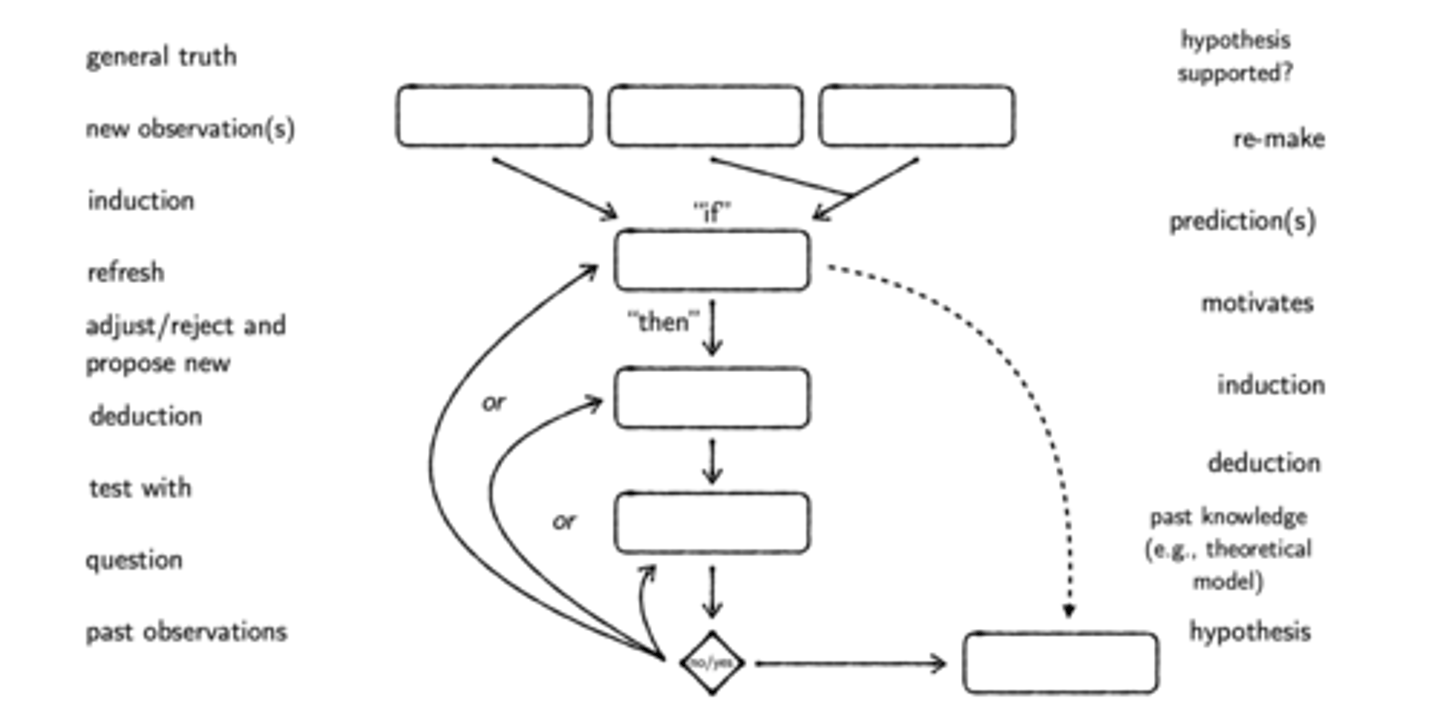
1. past observations 2. new observation(s) 3 . past knowledge (theoretical model
Top row (3 boxes):
Box 1:
Box 2 (middle):
Box 3:
These three feed into the next step using arrows.
 Note
Note  Flashcards (34)