Questions
 Call Kai
 Learn
Learn Practice Test
 Spaced Repetition
 Match
Match Flashcards
 Knowt Play
1/46

There's no tags or description
Looks like no tags are added yet.
Name | Mastery | Learn | Test | Matching | Spaced | Call with Kai |
|---|
No analytics yet
Send a link to your students to track their progress
47 Terms
Radio waves were first harnessed for communication by Gugliemo Marconi in the 1890s, a decade in which research into waveforms and radiation led to several discoveries. In this same decade, for example, x-rays were discovered by the German physicist Wilhelm Röntgen, and atomic radiation was studied and utilized by the physicist Marie Curie. Marconi was quick to see the potential of his own discovery, and radio communication soon spread around the world.
By the early twentieth century, a small but significant group of wealthy amateurs began to build and use radio sets to send and receive messages. The technology was especially popular among enthusiasts in the United States, with a radio enthusiast club formed at New York's Columbia University as early as 1908. The word 'ham' began to be used by professional or government radio operators initially as a derogatory term for amateur, derived from 'ham-fisted', implying that the enthusiasts were operating their equipment in a crude or flawed way. Gradually, however, the term became appropriated by the amateur radio community and became a badge of honour.
During the First World War, and for some years after, amateurs were banned from sending and receiving radio transmissions in the United States, but this changed when complaints were made to Congress, allowing amateurs to once again communicate with each other over the radio waves, leading to a thriving community of hobbyists. Some communication scholars have argued that this community, especially vibrant in the sixties and seventies, inspired the first experiments that created early forms of internet in the eighties; the inventor of one such early network, known as bitnet, specifically cited his childhood involvement in ham radio as a contributing factor in bitnet's development.
A term that begins to be used in a negative sense because of its association with food can develop over time so that it comes to be used as a sign of respect.
True, False, Can’t Tell
Can’t Tell
If the space station does not require essential repairs, none of the astronauts participate in a spacewalk.
If the space station requires essential repairs, the mission is at risk.
If no rescue craft is scheduled to travel to the space station, the mission is not at risk.
If any astronauts participate in a spacewalk, a rescue craft is scheduled to travel to the space station.
Yes or No
Yes
If the space station does not require essential repairs, none of the astronauts participate in a spacewalk.
If the space station requires essential repairs, the mission is at risk.
If no rescue craft is scheduled to travel to the space station, the mission is not at risk.
If the mission is not at risk, the space station does not require essential repairs.
Yes or No
Yes
All worpels are xylogs, but not all xylogs are worpels.
Some of the xylogs that are not worpels are mimbs, but no mimb is a worpel.
Some mimbs are xylogs.
Yes or No
No
The bar chart below shows the gross domestic product (GDP) and population density of five countries. The bubble chart shows each country's land area in millions of square kilometres.
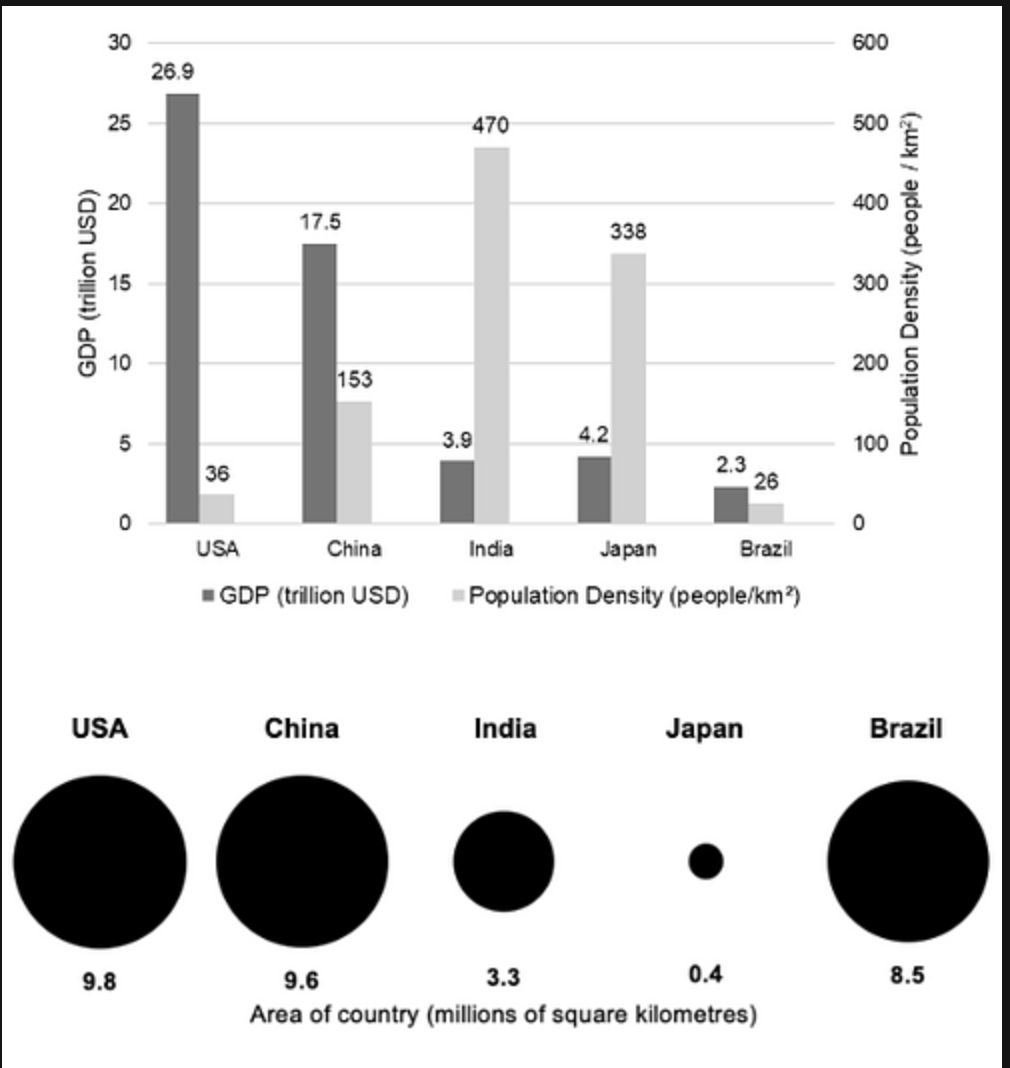
GDP per capita = GDP + total population
Japan's population is expected to decrease by 20% over the next decade, but its GDP is expected to grow by 10%. What would Japan's approximate GDP per capita be in ten years' time?
A. $28,478
B. $34,172
C. $42,714
D. $53,812
E. $60,491
C
A shop in north London specialises in Mediterranean foods. The graph shows the breakdown in sales of six types of olive oil in a recent month.
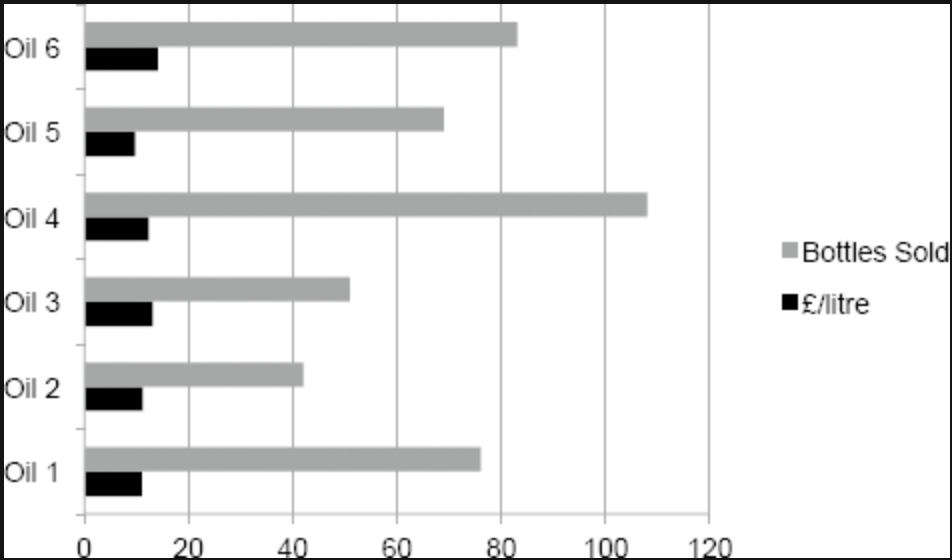
Oils 1 and 2 are Spanish, Oil 6 is Italian, the rest are Greek
Oil 6 is sold in a 500 ml bottle, Oils 2 and 3 are sold in 750 ml bottles, and the rest are sold in 1 litre bottles.
The shop's best-selling olive oil sold approximately how many more units than the shop's worst-selling olive oil?
A. 12%
B. 61%
C. 104%
D. 157%
Ε. 211%
D
Dayo, Lila, Harry, Kel and Lucas check out different types of books from the library: crime, history, biography, geography or young adult (in no order).
Each student also uses a library service: the internet or the photocopier.
Harry and the students who checked out the young adult and history books used the internet. Lila and the student who checked out the crime book used the photocopier. Dayo and Kel used different services; neither checked out the young adult book. The student who checked out the biography used a different service than Dayo and the student who checked out the young adult book.
Which of the following must be true?
A. Dayo checked out a crime book.
B. Harry checked out a geography book.
C. Lila checked out a young adult book.
D. Lucas checked out a biography book.
B
One of the oldest surviving Roman bread recipes was written in about 205 BC by the senator and farmer Cato the Elder. His recipe involved gradually adding water to coarse flour, then kneading thoroughly and baking under an earthenware cover - notably, the recipe includes no raising agent.
It was not until the second century BC that leavened bread became common in the Empire; this coincided with the conquering of Macedonia, which extends across parts of modern-day Greece and Albania. Bakers from the province became the first pistores, or professional bakers, and likely contributed to the burgeoning popularity of leavened bread among higher social classes.
In his writing, the Roman historian Pliny the Elder describes the use of leaven, a mixture of hydrated flour that is left to ferment and acts as a natural raising agent in bread. He explains that it can be made simply by keeping back a small amount of dough from bread made the day before and incorporating it into fresh dough. This gives the yeast that naturally occurs in flour enough time to propagate and ferment, creating small amounts of carbon dioxide that helps the bread rise. Pliny also provided instructions for a longer lasting leaven made from millet flour or wheat bran mixed with grape skins, which are naturally covered in yeast; he recommended drying the mixture into cakes that could be rehydrated when needed. He remarked that a modius of wheat - enough for ten days of bread - required eight ounces of leaven, as this was the practice of Greek bakers.
In excavations of Pompeii, the city that was buried following the eruption of Mount Vesuvius in 79 AD, archaeologists have found several well-preserved panis quadratus, a round leavened bread with a hole at the centre, named for the four grooves across the loaf's diameter that divided it into eight segments for easy sharing. The bread was imprinted with the stamp of the baker who made it and was tied with cords, probably to help carry the heavy loaves, which each weighed around 1.3 kilograms.
The bread preserved by a volcanic eruption acquired its name because:
A. one loaf was equal to the daily ration of bread for four people.
B. the weight of each loaf segment was equal to one quadratus.
C. bread loaves were large and provided food for several people.
D. of the signature left in each loaf by the person who baked it.
C
One of the oldest surviving Roman bread recipes was written in about 205 BC by the senator and farmer Cato the Elder. His recipe involved gradually adding water to coarse flour, then kneading thoroughly and baking under an earthenware cover notably, the recipe includes no raising agent.
It was not until the second century BC that leavened bread became common in the Empire; this coincided with the conquering of Macedonia, which extends across parts of modern-day Greece and Albania. Bakers from the province became the first pistores, or professional bakers, and likely contributed to the burgeoning popularity of leavened bread among higher social classes.
In his writing, the Roman historian Pliny the Elder describes the use of leaven, a mixture of hydrated flour that is left to ferment and acts as a natural raising agent in bread. He explains that it can be made simply by keeping back a small amount of dough from bread made the day before and incorporating it into fresh dough. This gives the yeast that naturally occurs in flour enough time to propagate and ferment, creating small amounts of carbon dioxide that helps the bread rise. Pliny also provided instructions for a longer lasting leaven made from millet flour or wheat bran mixed with grape skins, which are naturally covered in yeast; he recommended drying the mixture into cakes that could be rehydrated when needed. He remarked that a modius of wheat - enough for ten days of bread - required eight ounces of leaven, as this was the practice of Greek bakers.
In excavations of Pompeii, the city that was buried following the eruption of Mount Vesuvius in 79 AD, archaeologists have found several well-preserved panis quadratus, a round leavened bread with a hole at the centre, named for the four grooves across the loaf's diameter that divided it into eight segments for easy sharing. The bread was imprinted with the stamp of the baker who made it and was tied with cords, probably to help carry the heavy loaves, which each weighed around 1.3 kilograms.
Which of the following is a way in which leaven can be used to make bread, as explained by Pliny the Elder?
A. Before baking bread, some dough is removed and dehydrated so that it can be used in future loaves.
B. Natural yeast sources are combined with wet flour or bran and then mixed with wheat.
C. Grapes are dissected, then mixed into pre-made bread dough and left overnight to rise.
D. Uneaten bread is crumbled into a mixture of flour and fruit skins to encourage yeast growth.
B
One of the oldest surviving Roman bread recipes was written in about 205 BC by the senator and farmer Cato the Elder. His recipe involved gradually adding water to coarse flour, then kneading thoroughly and baking under an earthenware cover - notably, the recipe includes no raising agent.
It was not until the second century BC that leavened bread became common in the Empire; this coincided with the conquering of Macedonia, which extends across parts of modern-day Greece and Albania. Bakers from the province became the first pistores, or professional bakers, and likely contributed to the burgeoning popularity of leavened bread among higher social classes.
In his writing, the Roman historian Pliny the Elder describes the use of leaven, a mixture of hydrated flour that is left to ferment and acts as a natural raising agent in bread. He explains that it can be made simply by keeping back a small amount of dough from bread made the day before and incorporating it into fresh dough. This gives the yeast that naturally occurs in flour enough time to propagate and ferment, creating small amounts of carbon dioxide that helps the bread rise. Pliny also provided instructions for a longer lasting leaven made from millet flour or wheat bran mixed with grape skins, which are naturally covered in yeast; he recommended drying the mixture into cakes that could be rehydrated when needed. He remarked that a modius of wheat - enough for ten days of bread - required eight ounces of leaven, as this was the practice of Greek bakers.
In excavations of Pompeii, the city that was buried following the eruption of Mount Vesuvius in 79 AD, archaeologists have found several well-preserved panis quadratus, a round leavened bread with a hole at the centre, named for the four grooves across the loaf's diameter that divided it into eight segments for easy sharing. The bread was imprinted with the stamp of the baker who made it and was tied with cords, probably to help carry the heavy loaves, which each weighed around 1.3 kilograms.
Which of the following statements is best supported by the passage?
A. Cato the Elder wrote his recipe before baking became a viable profession in Rome.
B. Cato's bread recipe was targeted at those belonging to lower socioeconomic classes.
C. Cato recommended the use of clay cookware as his bread would not otherwise rise.
D. The first leavened bread in Rome was based on a recipe that Cato had made popular.
A
The invisibility of the translator refers to a concept, or a debate, within translation studies that first came to prominence during the 1980s. Scholars writing about the history of translation noted that, historically, the standard by which a translation of, for example, a literary work was praised was its ability to remain invisible; the gold standard was a translation that did not feel as though it was a translation, but that seemed to offer direct access to a text in another language. As a result of this standard, the skill and sensitivity needed to translate complex written works has been underplayed, with the belief that translation is simply a mechanical task of transliteration which, when done well, is invisible, leading to the devaluation of translation as a job. Remuneration for translators, especially literary translators, is often very low.
In contrast to this historic invisibility of the translator, scholars advocated for both a better appreciation of the skills and cultural awareness needed to translate a text from one language and culture into another, and also for a recognition of the complex nature of translation: that there is no such thing as a seamless or invisible translation as the process involves countless value judgements and word choices that can alter the meaning of a text as it passes into a new culture. This new generation of translators argued for an approach to literary translation that foregrounded the difficulty and foreignness of literary texts in a different language, rather than giving a false impression of direct access that elides the choices that have been made in order to make the text legible to a different culture.
Though these debates were sparked by issues surrounding the translation of literary works - for example, the need to acknowledge possible ethnocentrism when works from different cultures are made legible to English readers - the notion of the invisibility of the translator has spread to other areas in which the work of translators has ethical implications depending on how transparently, or not, it is conducted, for instance in courts of law and in meetings between political figures.
Using the evidence in the passage, which of the following statements is supported?
A. Some twentieth-century translators supported drawing attention to the fact that translated literature was originally written in another language.
B. Those who rejected the invisibility of the translator argued that a text could be translated seamlessly while still preserving its linguistic origins.
C. Modern translators are more likely to consider the cultural and linguistic background and impact of texts than their predecessors.
D. Opponents of invisible translation maintain that the translation methods used to domesticate a text should be clearly explained to readers.
A
The invisibility of the translator refers to a concept, or a debate, within translation studies that first came to prominence during the 1980s. Scholars writing about the history of translation noted that, historically, the standard by which a translation of, for example, a literary work was praised was its ability to remain invisible; the gold standard was a translation that did not feel as though it was a translation, but that seemed to offer direct access to a text in another language. As a result of this standard, the skill and sensitivity needed to translate complex written works has been underplayed, with the belief that translation is simply a mechanical task of transliteration which, when done well, is invisible, leading to the devaluation of translation as a job. Remuneration for translators, especially literary translators, is often very low.
In contrast to this historic invisibility of the translator, scholars advocated for both a better appreciation of the skills and cultural awareness needed to translate a text from one language and culture into another, and also for a recognition of the complex nature of translation: that there is no such thing as a seamless or invisible translation as the process involves countless value judgements and word choices that can alter the meaning of a text as it passes into a new culture. This new generation of translators argued for an approach to literary translation that foregrounded the difficulty and foreignness of literary texts in a different language, rather than giving a false impression of direct access that elides the choices that have been made in order to make the text legible to a different culture.
Though these debates were sparked by issues surrounding the translation of literary works - for example, the need to acknowledge possible ethnocentrism when works from different cultures are made legible to English readers - the notion of the invisibility of the translator has spread to other areas in which the work of translators has ethical implications depending on how transparently, or not, it is conducted, for instance in courts of law and in meetings between political figures.
A translated text in which the translator has been deemed to remain invisible is likely to:
A. reproduce the same grammatical quirks of the language in which the text was first written.
B. appear as though it were an original work and not a replication of a foreign-language text.
C. have been translated by the same person who wrote the piece in its original language.
D. consist of word-for-word translation that may appear unnatural but is more authentic.
B
To conceptualise unseen forces, researchers have long invoked thought experiments involving demons. These beasts aren't creatures of superstition. They are useful ideas that have had an important role in the advancement of science.
In the early 19th century, scientists built on the physics of Isaac Newton to understand the forces of nature, making it possible to calculate with precision the motions of atoms and planets or the forces of a steam engine. Taking those ideas to their logical conclusion, French mathematician Pierre-Simon Laplace proposed that some demonic intellect would be able to calculate the past and future of anything if it knew the precise location and trajectory of all particles and all forces acting on it. British mathematician Ada Lovelace was aware of Laplace's work, and in 1842 was arguably the first to speculate about whether computing programs could be considered thinking beings. Laplace's demon thus seeded a debate that continues 180 years later.
In 1867, Scottish physicist James Clerk Maxwell summoned another demon while trying to understand the statistical behaviour of gas particles. Maxwell's tiny demon operates a door between compartments in a gas-filled vessel, choosing when to allow molecules to pass from one side to the other. The demon can open the door for faster-moving molecules but leave the slower ones on the other side, thus heating up one compartment and cooling the other-decreasing entropy and thwarting the second law of thermodynamics. To some, Maxwell's ideas suggested the possibility of a perpetual-motion machine, or even of reversing time.
In practice, Maxwell's research informed improvements in the efficiency of engines and refrigerators. His demon also demonstrates the surprises that can arise from probabilities, because every once in a while, the rarest events do occur-such as only fast gas molecules spontaneously slipping through a hole.
It can be inferred that, in these examples, that a demon represents:
A. a rejection of and distrust in science.
B. a way to explain science to the very religious.
C. something invisible but powerful.
D. rare but possible events.
C
Collective decision making refers to how groups make decisions without centralised leadership. This occurs when groups are tightly functionally integrated, as in the case of social insect colonies or bee swarms with a single queen. It can also occur with unrelated individuals who prefer to stay within a group for individual benefit. In the latter case, the positive correlation between accurate decision making and group size is explained by larger groups having improved individual level abilities, and larger groups being more likely to contain better decision makers who dominate collective decisions.
Often, rapid decisions must be made about where to move or what behaviour to perform in uncertain and dangerous environments. Collective decision making must be synchronised and coordinated, with a common trade-off emerging between accuracy and speed. For example, when honeybees swarm, they must rapidly pick a suitable nest-site due to their limited energy reserves, risk of exposure to the elements, and need to maintain group cohesion. Decision making is also impacted by information uncertainty and conflicting preferences, particularly in groups which are not related.
In social insects, collective decision making can be especially sophisticated because individual behaviour and interactions have evolved to benefit the colony's reproductive success. This reduces inter-individual conflict and leads to such a tight functional integration that they are sometimes known as superorganisms. For example, ants use scent chemicals to coordinate foraging activities, shaping each other's behaviour through environmental modification.
Schools of fish are unrelated groups that primarily form to avoid predators by confusing them, and through the dilution effect, which states that the individual risk of being caught decreases as group size increases. Fish base movement decisions on local cues like pheromones, position, motion or changes in motion of others. They have a lateral line organ which senses water pressure changes and vibrations, meaning they can simultaneously change direction and avoid collisions. Their sensing ability is relatively local but influencers often naturally emerge, with certain fish taking a guiding role over directional changes.
According to the passage, migrating honeybees:
A. have a lower individual risk of predation.
B. cannot always pick the most appropriate place to nest.
C. often fail to maintain group cohesion.
D. have a single queen providing centralised leadership.
B
Collective decision making refers to how groups make decisions without centralised leadership. This occurs when groups are tightly functionally integrated, as in the case of social insect colonies or bee swarms with a single queen. It can also occur with unrelated individuals who prefer to stay within a group for individual benefit. In the latter case, the positive correlation between accurate decision making and group size is explained by larger groups having improved individual level abilities, and larger groups being more likely to contain better decision makers who dominate collective decisions.
Often, rapid decisions must be made about where to move or what behaviour to perform in uncertain and dangerous environments. Collective decision making must be synchronised and coordinated, with a common trade-off emerging between accuracy and speed. For example, when honeybees swarm, they must rapidly pick a suitable nest-site due to their limited energy reserves, risk of exposure to the elements, and need to maintain group cohesion. Decision making is also impacted by information uncertainty and conflicting preferences, particularly in groups which are not related.
In social insects, collective decision making can be especially sophisticated because individual behaviour and interactions have evolved to benefit the colony's reproductive success. This reduces inter-individual conflict and leads to such a tight functional integration that they are sometimes known as superorganisms. For example, ants use scent chemicals to coordinate foraging activities, shaping each other's behaviour through environmental modification.
Schools of fish are unrelated groups that primarily form to avoid predators by confusing them, and through the dilution effect, which states that the individual risk of being caught decreases as group size increases. Fish base movement decisions on local cues like pheromones, position, motion or changes in motion of others. They have a lateral line organ which senses water pressure changes and vibrations, meaning they can simultaneously change direction and avoid collisions. Their sensing ability is relatively local but influencers often naturally emerge, with certain fish taking a guiding role over directional changes.
According to the author, which one of the following conclusions can be drawn from the passage?
A. Collective decision making is generally used to aid in efficiently gathering food and resources.
B. Collective decision making is most commonly observed among social insects.
C. Competing priorities are more likely to shape collective decision making in schools of fish than swarms of honeybees.
D. Choices made by groups are generally more rapid but less accurate than those made by individuals.
C
The Old English epic poem Beowulf is best understood as a collection of memories about a legendary past, rather than a factual account. Beowulf is set in sixth century Scandinavia, two hundred years before the Viking Age proper, but is based on the literary idea of poetic time, rather than historical.. The only surviving manuscript dates from the late 1100s and is one of the oldest known English texts to survive, though it remained virtually unknown until it was translated in 1815. It remains unclear who wrote it, though it is thought a single author, possibly a monk, was the author. The plot is non-linear, creating dramatic irony and demonstrating how meaning and value are transferred through time. It is designed to be performed, but is also very complex on the page.
Beowulf contains themes of memory, glory and futility, which are imbued with both celebration and melancholy for a pre-Christian past. It highlights the changing ideals of kingship, from a warrior leader to an arbiter of peace. The monsters that feature, including the dragon, and the giant Grendel and his mother, can be seen as metaphors for the socially peripheral. Over the course of the story, Beowulf becomes increasingly more human and less bear-like, and his success in battle declines accordingly.
Many parallels have been found between the everyday objects and artifacts described in Beowulf and archaeological finds. However, there are several inaccuracies and inconsistencies in the portrayal of Viking Age Scandinavia contained within the text, including around funerary rites and the form and function of Danish mead halls. Monster hunting is represented in other stories from the time, and features heavily in contemporary Baltic iconography, particularly in images on helmets. Pools and bogs, which are where much of the conflict occurs in the poem, were also prominent symbolic liminal spaces, where artifacts were placed and people were buried.
According to the passage, some consider Beowulf an attempt in English to make sense of Scandinavian history and society.
A. True
B. False
C. Can't Tell
A
The Old English epic poem Beowulf is best understood as a collection of memories about a legendary past, rather than a factual account. Beowulf is set in sixth century Scandinavia, two hundred years before the Viking Age proper, but is based on the literary idea of poetic time, rather than historical.. The only surviving manuscript dates from the late 1100s and is one of the oldest known English texts to survive, though it remained virtually unknown until it was translated in 1815. It remains unclear who wrote it, though it is thought a single author, possibly a monk, was the author. The plot is non-linear, creating dramatic irony and demonstrating how meaning and value are transferred through time. It is designed to be performed, but is also very complex on the page.
Beowulf contains themes of memory, glory and futility, which are imbued with both celebration and melancholy for a pre-Christian past. It highlights the changing ideals of kingship, from a warrior leader to an arbiter of peace. The monsters that feature, including the dragon, and the giant Grendel and his mother, can be seen as metaphors for the socially peripheral. Over the course of the story, Beowulf becomes increasingly more human and less bear-like, and his success in battle declines accordingly.
Many parallels have been found between the everyday objects and artifacts described in Beowulf and archaeological finds. However, there are several inaccuracies and inconsistencies in the portrayal of Viking Age Scandinavia contained within the text, including around funerary rites and the form and function of Danish mead halls. Monster hunting is represented in other stories from the time, and features heavily in contemporary Baltic iconography, particularly in images on helmets. Pools and bogs, which are where much of the conflict occurs in the poem, were also prominent symbolic liminal spaces, where artifacts were placed and people were buried.
Beowulf was written five hundred years after it was set, explaining some of its inaccurate depictions of burials and mead halls.
A. True
B. False
C. Can't Tell
C
The Old English epic poem Beowulf is best understood as a collection of memories about a legendary past, rather than a factual account. Beowulf is set in sixth century Scandinavia, two hundred years before the Viking Age proper, but is based on the literary idea of poetic time, rather than historical.. The only surviving manuscript dates from the late 1100s and is one of the oldest known English texts to survive, though it remained virtually unknown until it was translated in 1815. It remains unclear who wrote it, though it is thought a single author, possibly a monk, was the author. The plot is non-linear, creating dramatic irony and demonstrating how meaning and value are transferred through time. It is designed to be performed, but is also very complex on the page.
Beowulf contains themes of memory, glory and futility, which are imbued with both celebration and melancholy for a pre-Christian past. It highlights the changing ideals of kingship, from a warrior leader to an arbiter of peace. The monsters that feature, including the dragon, and the giant Grendel and his mother, can be seen as metaphors for the socially peripheral. Over the course of the story, Beowulf becomes increasingly more human and less bear-like, and his success in battle declines accordingly.
Many parallels have been found between the everyday objects and artifacts described in Beowulf and archaeological finds. However, there are several inaccuracies and inconsistencies in the portrayal of Viking Age Scandinavia contained within the text, including around funerary rites and the form and function of Danish mead halls. Monster hunting is represented in other stories from the time, and features heavily in contemporary Baltic iconography, particularly in images on helmets. Pools and bogs, which are where much of the conflict occurs in the poem, were also prominent symbolic liminal spaces, where artifacts were placed and people were buried.
As the poem progresses, the titular character's military prowess and animalism declines, reflecting the process of aging.
A. True
B. False
C. Can't Tell
C
Should it be compulsory for all children to learn to cook at school regardless of their ability, aspirations or background?
Select the strongest argument from the statements below.
A. Yes, students who enjoy cookery lessons will be more engaged in learning about nutrition and healthy eating habits that will benefit them throughout their lives.
B. Yes, learning to prepare meals develops creativity and artistic expression whilst also building confidence in young people who succeed in these lessons.
C. No, children from families with strong culinary traditions already learn these skills at home and would find school cookery lessons repetitive.
D. No, forcing all children to cook ignores individual differences in motor skills and learning difficulties that make some pupils unable to participate safely.
D
To encourage people to write letters, should the post office reduce the price of stamps? Select the strongest argument from the statements below.
A. Yes, more people would use the post office if its services were not as expensive as they are now.
B. Yes, sometimes people write letters but cannot post them straightaway as they don't have a stamp.
C. No, reducing the price of stamps would encourage people to send more postcards and packages.
D. No, most people write emails instead of letters, and there is no charge for sending an email.
D
Blue holes are submerged sinkholes that formed on dry land during the last Ice Age when sea levels were much lower than they are today. Similar to blue holes are cenotes, which are inland sinkholes that are typically filled with freshwater. The Great Blue Hole off the coast of Belize is the largest blue hole currently known, measuring 300 metres in diameter and 120 metres in depth, while the deepest cenote is the Zacatón in Mexico with a depth of 339 metres. Measuring the exact depth of deeper blue holes can be difficult due to their uneven topology and the accuracy of the measuring equipment. For example, the Taam Ja' Blue Hole - which is over three times as deep as the largest blue hole - was measured using echo sounding. Echo sounding measures the amount of time a sonar signal takes to return to its emitter, but the speed of this signal is affected by the density of its transmission medium, and water density changes with depth.
In geology there are three main types of rocks: sedimentary, metamorphic and igneous, the latter two being insoluble in water. Sinkholes form when the overlying ground gives way above an eroded cavern where the rock has been dissolved by the groundwater. While not all sedimentary rocks can be eroded in this way, carbonates such as limestone, sandstone and chalk are particularly susceptible as they are basic - that is, they have a high pH and react readily with the naturally acidic components in groundwater, leading to dissolution over time. Carbonate sedimentary rocks do not react with the groundwater itself but rather the carbon dioxide that is dissolved within it, which lowers the water's pH. Stalagmites and stalactites are formed from dissolved carbonate rich water dripping from cave ceilings, and therefore cannot form underwater.
The Taam Ja' Blue Hole is over 400 metres deep.
A. True
B. False
C. Can't Tell
C
Blue holes are submerged sinkholes that formed on dry land during the last Ice Age when sea levels were much lower than they are today. Similar to blue holes are cenotes, which are inland sinkholes that are typically filled with freshwater. The Great Blue Hole off the coast of Belize is the largest blue hole currently known, measuring 300 metres in diameter and 120 metres in depth, while the deepest cenote is the Zacatón in Mexico with a depth of 339 metres. Measuring the exact depth of deeper blue holes can be difficult due to their uneven topology and the accuracy of the measuring equipment. For example, the Taam Ja' Blue Hole - which is over three times as deep as the largest blue hole - was measured using echo sounding. Echo sounding measures the amount of time a sonar signal takes to return to its emitter, but the speed of this signal is affected by the density of its transmission medium, and water density changes with depth.
In geology there are three main types of rocks: sedimentary, metamorphic and igneous, the latter two being insoluble in water. Sinkholes form when the overlying ground gives way above an eroded cavern where the rock has been dissolved by the groundwater. While not all sedimentary rocks can be eroded in this way, carbonates such as limestone, sandstone and chalk are particularly susceptible as they are basic - that is, they have a high pH and react readily with the naturally acidic components in groundwater, leading to dissolution over time. Carbonate sedimentary rocks do not react with the groundwater itself but rather the carbon dioxide that is dissolved within it, which lowers the water's pH. Stalagmites and stalactites are formed from dissolved carbonate rich water dripping from cave ceilings, and therefore cannot form underwater.
Given that the groundwater in a region is alkaline, a sinkhole would not form within a bedrock of chalk.
A. True
B. False
C. Can't Tell
A
Blue holes are submerged sinkholes that formed on dry land during the last Ice Age when sea levels were much lower than they are today. Similar to blue holes are cenotes, which are inland sinkholes that are typically filled with freshwater. The Great Blue Hole off the coast of Belize is the largest blue hole currently known, measuring 300 metres in diameter and 120 metres in depth, while the deepest cenote is the Zacatón in Mexico with a depth of 339 metres. Measuring the exact depth of deeper blue holes can be difficult due to their uneven topology and the accuracy cy of the measuring equipment. For example, the Taam Ja' Blue Hole - which is over three times as deep as the largest blue hole was measured using echo sounding. Echo sounding measures the amount of time a sonar signal takes to return to its emitter, but the speed of this signal is affected by the density of its transmission medium, and water density changes with depth.
In geology there are three main types of rocks: sedimentary, metamorphic and igneous, the latter two being insoluble in water. Sinkholes form when the overlying ground gives way above an eroded cavern where the rock has been dissolved by the groundwater. While not all sedimentary rocks can be eroded in this way, carbonates such as limestone, sandstone and chalk are particularly susceptible as they are basic that is, they have a high pH and react readily with the naturally acidic components in groundwater, leading to dissolution over time. Carbonate sedimentary rocks do not react with the groundwater itself but rather the carbon dioxide that is dissolved within it, which lowers the water's pH. Stalagmites and stalactites are formed from dissolved carbonate rich water dripping from cave ceilings, and therefore cannot form underwater.
It can be difficult to measure the depth of deep cenotes.
A. True
B. False
C. Can't Tell
A
Blue holes are submerged sinkholes that formed on dry land during the last Ice Age when sea levels were much lower than they are today. Similar to blue holes are cenotes, which are inland sinkholes that are typically filled with freshwater. The Great Blue Hole off the coast of Belize is the largest blue hole currently known, measuring 300 metres in diameter and 120 metres in depth, while the deepest cenote is the Zacatón in Mexico with a depth of 339 metres. Measuring the exact depth of deeper blue holes can be difficult due to their uneven topology and the accuracy of the measuring equipment. For example, the Taam Ja' Blue Hole - which is over three times as deep as the largest blue hole - was measured using echo sounding. Echo sounding measures the amount of time a sonar signal takes to return to its emitter, but the speed of this signal is affected by the density of its transmission medium, and water density changes with depth.
In geology there are three main types of rocks: sedimentary, metamorphic and igneous, the latter two being insoluble in water. Sinkholes form when the overlying ground gives way above an eroded cavern where the rock has been dissolved by the groundwater. While not all sedimentary rocks can be eroded in this way, carbonates such as limestone, sandstone and chalk are particularly susceptible as they are basic - that is, they have a high pH and react readily with the naturally acidic components in groundwater, leading to dissolution over time. Carbonate sedimentary rocks do not react with the groundwater itself but rather the carbon dioxide that is dissolved within it, which lowers the water's pH. Stalagmites and stalactites are formed from dissolved carbonate rich water dripping from cave ceilings, and therefore cannot form underwater.
Blue holes cannot contain stalagmites.
A. True
B. False
C. Can't Tell
B
Many economics theories and models are based on the idea that people within economic systems are rational actors, meaning that they will act according to their rational best interests. Some theorists have noted, however, that in daily life, irrational economic decisions are extremely common, based on emotion, prejudice, or even boredom, and these frequently throw the predictability and stability of economic systems into jeopardy, and the accuracy of economic models into doubt. One economist who tried to account for the presence of emotion and irrationality in economic systems was John Maynard Keynes; in a 1936 book, he coined the phrase animal spirits to refer to an economic decision based upon a spontaneous urge towards action, as opposed to a sober evaluation of the positives and negatives.
Keynes's idea was not an entirely new one; previous writers, such as the journalist Charles Mackay, had examined the irrational choices made by groups of people during economic cycles of boom and bust. Though the concept was not original, Keynes' phrase stuck, and is still used today by economists, especially to explain moments of high volatility when economic systems reach a tipping point, for example, panic selling of stocks and shares which turns into a crash, or a short-lived enthusiasm for a particular product or share which causes prices to rise and fall sharply, sometimes called a bubble. As well as commenting on these extreme economic situations, through his work on animal spirits, Keynes was also suggesting that raw economic data is not the only or even, sometimes, the best indicator of where a market will go. A business could be highly profitable, but if its sector, or the economy more widely, is blighted with fear about the future, then investment could easily dry up and the business could fail, despite being viable on paper.
What can be inferred from the passage about John Maynard Keynes?
A. He pioneered the idea that human emotion confounds economic models.
B. He proposed that commercial success does not solely depend on metrics.
C. He argued that we as humans are incapable of unbiased justifications.
D. He theorised that an awareness of animal spirits can aid decision-making.
B
Irish folklore encompasses the totality of the country's folk culture: the spiritual, symbolic and material.
Traditionally recounted at fireside gatherings, folktales formed a bridge between generations, preserving cultural identity and fostering a sense of belonging. Knowledge and skills were also transmitted, including herbal remedies for illness, basket weaving, and the creation of Brigid's crosses. The latter - small woven variants of the Christian cross - are hung from rafters on 1st February, St Brigid's feast day, and are thought to bring prosperity and protection throughout the year.
In Ireland, fairies are often regarded as descendants of Tuatha Dé Danann, a godlike race who were beautiful, powerful and in tune with nature, and are said to reside in sidhe fairy mounds ruled by monarchs, or in the Otherworld. Solitary fairies include Banshees - keening female messengers - and the Dullahan - a headless rider of a black horse - both of whom are omens of death. Shapeshifters also feature in Irish folklore: selkies transform from seals into humans by shedding their skin, and Puca metamorphosize into various animals, acting as dangerous and unpredictable protectors of harvests and bringers of chaos.
Rooted in ancient Celtic belief, Irish folklore has been adapted and maintained under successive colonial occupations, though Christian beliefs have become embedded in and entangled with it. For example, ancient pagan belief in the healing abilities of natural springs was reconstructed as faith in holy wells as associated with Catholic saints. On the other hand, folkloric belief in luck has endured without change: bad luck comes from felling fairy trees or bringing hawthorn blossoms into the home, whilst touching bullaun fairy stones can bring blessings or curses from the Otherworld.
Many medieval Irish sagas were compiled by the Irish folklore commission, established in 1935, preserving a range of heroic and tragic characters. Irish folklore has played a role in galvanising nationalist political movements: during British rule it provided inspiration and a cohesive national identity, with themes of transformation reflecting resilience and the overcoming of adversity.
Fairies in Irish folklore are powerful and ambivalent figures associated with a realm other than our own, both bringing and portending good luck and misfortune.
A. True
B. False
C. Can't Tell
A
Irish folklore encompasses the totality of the country's folk culture: the spiritual, symbolic and material.
Traditionally recounted at fireside gatherings, folktales formed a bridge between generations, preserving cultural identity and fostering a sense of belonging. Knowledge and skills were also transmitted, including herbal remedies for illness, basket weaving, and the creation of Brigid's crosses. The latter - small woven variants of the Christian cross - are hung from rafters on 1st February, St Brigid's feast day, and are thought to bring prosperity and protection throughout the year.
In Ireland, fairies are often regarded as descendants of Tuatha Dé Danann, a godlike race who were beautiful, powerful and in tune with nature, and are said to reside in sidhe fairy mounds ruled by monarchs, or in the Otherworld. Solitary fairies include Banshees - keening female messengers - and the Dullahan - a headless rider of a black horse - both of whom are omens of death. Shapeshifters also feature in Irish folklore: selkies transform from seals into humans by shedding their skin, and Puca metamorphosize into various animals, acting as dangerous and unpredictable protectors of harvests and bringers of chaos.
Rooted in ancient Celtic belief, Irish folklore has been adapted and maintained under successive colonial occupations, though Christian beliefs have become embedded in and entangled with it. For example, ancient pagan belief in the healing abilities of natural springs was reconstructed as faith in holy wells as associated with Catholic saints. On the other hand, folkloric belief in luck has endured without change: bad luck comes from felling fairy trees or bringing hawthorn blossoms into the home, whilst touching bullaun fairy stones can bring blessings or curses from the Otherworld.
Many medieval Irish sagas were compiled by the Irish folklore commission, established in 1935, preserving a range of heroic and tragic characters. Irish folklore has played a role in galvanising nationalist political movements: during British rule it provided inspiration and a cohesive national identity, with themes of transformation reflecting resilience and the overcoming of adversity.
The weaving of Brigid's crosses is an ancient pagan tradition intended to provide safety and good fortune, with the skills to create them being passed down via successive generations.
A. True
B. False
C. Can't Tell
B
Genuine Victorian furniture is better quality and more durable than modern British furniture. Furniture made after 1910 (i.e. after the end of the Victorian period) in the Victorian style is of inferior quality to the real article, and is generally less sturdy than modern furniture made in contemporary styles. Most of the Victorian furniture around today has been well looked after for over 150 years; nevertheless, it will often appear less pristine than newer styles.
If a piece of furniture is 130 years old and looks pristine, it could be genuine Victorian furniture.
A. Yes
B. No
A
Genuine Victorian furniture is better quality and more durable than modern British furniture. Furniture made after 1910 (i.e. after the end of the Victorian period) in the Victorian style is of inferior quality to the real article, and is generally less sturdy than modern furniture made in contemporary styles. Most of the Victorian furniture around today has been well looked after for over 150 years; nevertheless, it will often appear less pristine than newer styles.
Contemporary furniture made in England is not more durable than its Victorian counterpart, even if it is well looked after.
A. Yes
B. No
A
Genuine Victorian furniture is better quality and more durable than modern British furniture. Furniture made after 1910 (i.e. after the end of the Victorian period) in the Victorian style is of inferior quality to the real article, and is generally less sturdy than modern furniture made in contemporary styles. Most of the Victorian furniture around today has been well looked after for over 150 years; nevertheless, it will often appear less pristine than newer styles.
If furniture looks Victorian, it will often look less pristine than modern furniture.
A. Yes
B. No
B
Results from a recent study suggest that running speeds will vary based on the time of the run. Of runners studied who began a 10 kilometre run at 7.00 am, daily runners took on average 62 minutes to complete the run and those who run 3 times or less per week completed the run in an average of 74 minutes. The median time was 64 minutes for the first group and 79 minutes for the second group; the range for each group was 12 minutes and 16 minutes, respectively. According to the study, 3.00 pm to 6.00 pm is the optimum time period for running speeds, and can take up to 5 minutes off the average daily runner's running speed at their least efficient time.
If 7.00 am is the least efficient time to run, the average time for runners who run 3 times or less per week between 3.00 pm and 6.00 pm is 69 minutes.
A. Yes
B. No
B
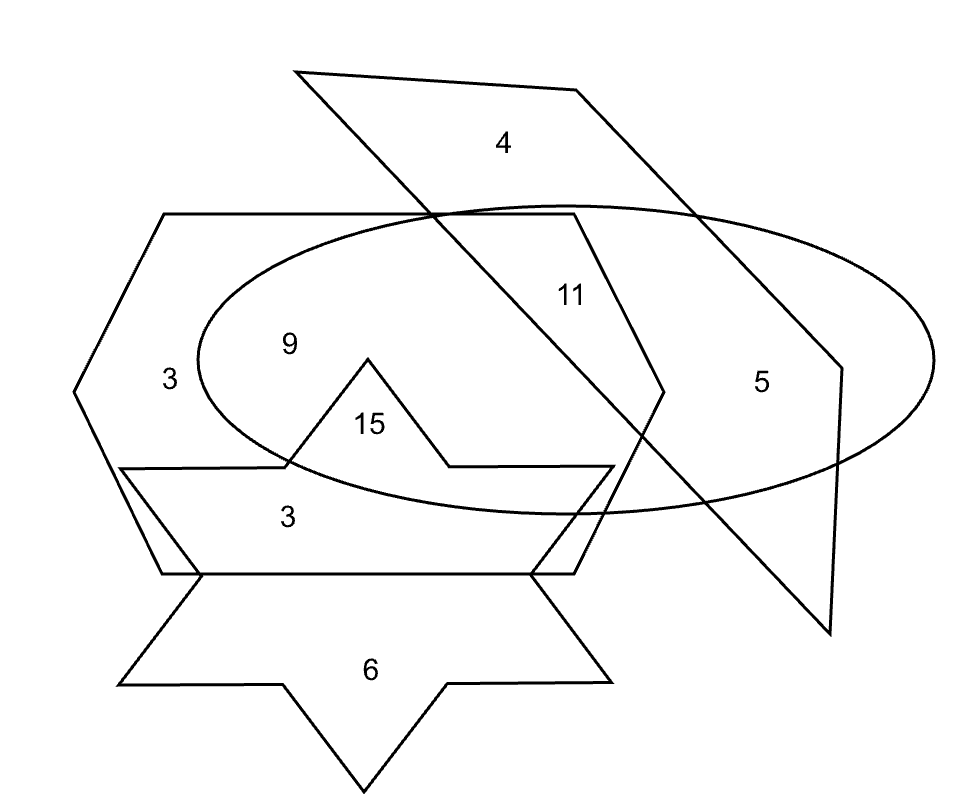
Management consultants were asked about the change management techniques they had utilised in their work over the last three months.
The hexagon represents the management consultants who used LEAN. The star represents the management consultants who used Six Sigma. The oval represents the management consultants who used Rapid Improvements. The trapezium represents the management consultants who used DMAIC.
Which of the following can be concluded from the diagram?
A. The most popular technique was Rapid Improvements.
B. One-third of consultants who used Six Sigma did not use any other change management techniques.
C. Every consultant who utilised LEAN also utilised Rapid Improvements.
D. 20% of consultants who used DMAIC did not use any other change management techniques.
D
An author has a choice between three options for publishing a new book, as shown below.
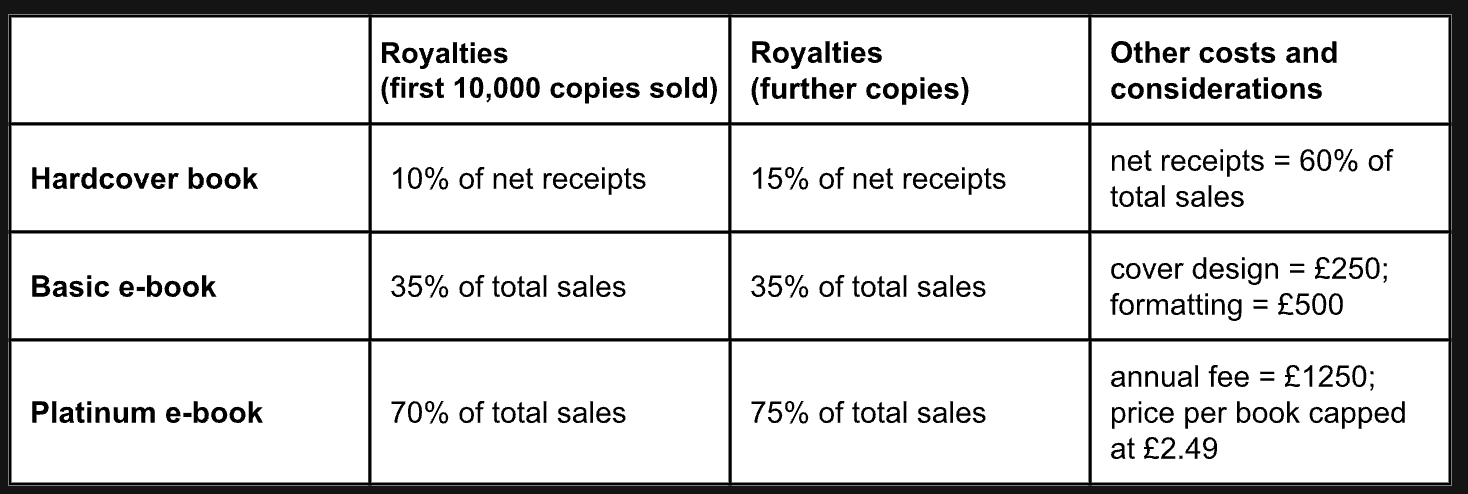
The author is only responsible for cover design and formatting costs under the Basic e-book option.
Only the Platinum e-book option includes an annual fee paid by the author, along with a cap on the price of each book sold.
What are the maximum possible royalties for a platinum e-book that sells 15,000 copies in its first year, after deducting any author fees or costs?
Α. £18,680
B. £23,017.50
C. £24,895
D. £25,517.50
Ε. £26,755
D
An author has a choice between three options for publishing a new book, as shown below.
The author is only responsible for cover design and formatting costs under the Basic e-book option.
Only the Platinum e-book option includes an annual fee paid by the author, along with a cap on the price of each book sold.
How much more could an author make in royalties in a year by selling 20,000 copies of a basic e-book at £5.49 each, than by selling the same amount of a platinum e-book at top price, after deducting for author fees and costs?
A. £2,320
B. £2,825
C. £3,070
D. £3,570
Ε. £3,675
B
Martha tracks her mobile data usage and download speed, recording them in the chart below.
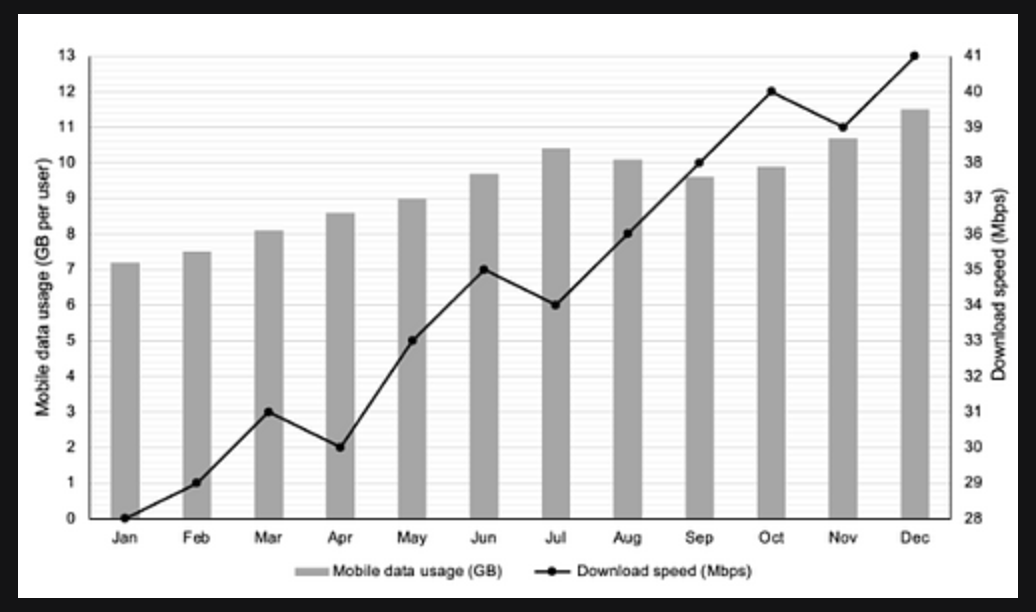
1 gigabyte (GB) = 8,000 megabits (Mb)
Download speed is given in megabits per second (Mbps).
Martha's mobile data plan costs her £12 per month and includes eight gigabytes of data. Any additional data that she uses is rounded to the nearest gigabyte and charged at £0.85 per gigabyte. VAT is charged at 20% of the total bill. What was Martha's total bill in March, including VAT?
Α. £12.85
Β. £13.11
C. £13.29
D. £14.40
Ε. £15.42
E
Letters written by Li Yao, a Cantonese man who had been working for the British in Guangdong and was arrested in 1814 by the Chinese authorities, to his British friend George Thomas Staunton provide an invaluable source for improving our understanding of the inner workings of the Canton trade. Staunton was one of two British members of his company who could read and write Chinese, along with the missionary Robert Morrison, meaning that he could collate all of Li Yao's letters without need for careful selection before they were eventually shipped back to England.
The exact extent of Li's role and his connection to the British are, in part, a mystery, particularly as the letters that were smuggled out of prison to Staunton carry a degree of self-awareness that they were going to be, at best, glanced at by prison guards, or at worst dissected by official authorities and used against him at court. One thing that is clear, however, is that he worked for Staunton's company and helped the British price tea at source. Foreign merchants were banned from travelling up the country, being confined to a small area around ports, and as such there was a demand for locals like Li Yao to inspect tea crops on their behalf and fix a favourable price. The legality of this was dubious; officials arrested Li speculatively, hoping to find evidence of opium smuggling to send him down on.
During the Li Yao incident, ultimate judicial decision-making ability lay with the emperor. Below him was a governor-general, followed by a provincial governor, provincial judge and provincial treasurer. Official records indicate that Li's case underwent a great deal of scrutiny within the legal system thanks to his connections to powerful British figures and a recent incident where British warships tried to loot American ships in Chinese waters as they were leaving port. Ultimately, after undergoing multiple rounds of interrogation alongside his wife, staff and associates, Li was sent into exile for the rather obscure crime of working as a lackey for a foreign company and then purchasing a government post.
Li Yao's letters are an important historical source but he might have been concealing the truth in them.
A. True
B. False
C. Can't Tell
A
Letters written by Li Yao, a Cantonese man who had been working for the British in Guangdong and was arrested in 1814 by the Chinese authorities, to his British friend George Thomas Staunton provide an invaluable source for improving our understanding of the inner workings of the Canton trade. Staunton was one of two British members of his company who could read and write Chinese, along with the missionary Robert Morrison, meaning that he could collate all of Li Yao's letters without need for careful selection before they were eventually shipped back to England.
The exact extent of Li's role and his connection to the British are, in part, a mystery, particularly as the letters that were smuggled out of prison to Staunton carry a degree of self-awareness that they were going to be, at best, glanced at by prison guards, or at worst dissected by official authorities and used against him at court. One thing that is clear, however, is that he worked for Staunton's company and helped the British price tea at source. Foreign merchants were banned from travelling up the country, being confined to a small area around ports, and as such there was a demand for locals like Li Yao to inspect tea crops on their behalf and fix a favourable price. The legality of this was dubious; officials arrested Li speculatively, hoping to find evidence of opium smuggling to send him down on.
During the Li Yao incident, ultimate judicial decision-making ability lay with the emperor. Below him was a governor-general, followed by a provincial governor, provincial judge and provincial treasurer. Official records indicate that Li's case underwent a great deal of scrutiny within the legal system thanks to his connections to powerful British figures and a recent incident where British warships tried to loot American ships in Chinese waters as they were leaving port. Ultimately, after undergoing multiple rounds of interrogation alongside his wife, staff and associates, Li was sent into exile for the rather obscure crime of working as a lackey for a foreign company and then purchasing a government post.
Only two members of Staunton's company had the ability to write Chinese.
A. True
B. False
C. Can't Tell
B
A watchmaking school tests four of its students' watch mechanisms for accuracy. If a watch gains time it is considered fast and if it loses time it is considered slow. After running the watches through testing they find the following:
Watch A: gains 5 seconds per hour
Watch B: gains 0.5 seconds per minute
Watch C: loses 2 seconds per hour
Watch D: loses 53 seconds per day
A student modifies watch B so that it runs 1% slower than before modification. How many seconds slow is it per hour?
A. 2 seconds
B. 3 seconds
C. 4 seconds
D. 5 seconds
E. 6 seconds
E
A watchmaking school tests four of its students' watch mechanisms for accuracy. If a watch gains time it is considered fast and if it loses time it is considered slow. After running the watches through testing they find the following:
Watch A: gains 5 seconds per hour
Watch B: gains 0.5 seconds per minute
Watch C: loses 2 seconds per hour
Watch D: loses 53 seconds per day
What is the mean time error over one week for the four watches?
A. 20 minutes, 51 seconds
B. 21 minutes, 33 seconds
C. 24 minutes, 11 seconds
D. 25 minutes, 15 seconds
E. 27 minutes, 27 seconds
E
Faced with the dilemma of wanting to continue to run industrial processes such as cement manufacturing while meeting self-imposed climate targets, governments around the world are turning to carbon capture, utilisation and storage (CCUS) technology that has been presented in some quarters as a magic bullet - but not without a hefty price tag and a level of project-on-project risk that alarms potential investors. Carbon capture projects cannot be activated without adequate storage infrastructure, yet in areas where no such projects are already ongoing, there is little appetite to develop, invest in and build this infrastructure.
Modularisation of the CCUS value chain, whereupon each step in the process from carbon capture to carbon storage is dealt with by different operators, is and will continue to be unavoidable, yet this brings with it more complexities and dangers regarding financial and legal liability for developers. Nowhere is this more apparent than in cross-border carbon transport projects, with bespoke agreements needed between the governments in question to ensure harmony across national and international regulatory frameworks. As CCUS becomes more modularised while also scaling up its operations, prices are expected to fall, incentivising deployment and overcoming the aforementioned issues that plague investors. Use of enhanced materials, the repurposing of existing infrastructure such as gas pipelines, as well as lower energy requirements will also aid this change.
Traditionally, carbon capture projects have been limited to relatively simple scenarios such as natural gas processing; these are not the kind of cutting edge, ambitious projects required to mitigate the worst effects of climate change. For this, technologies that are still at the demonstration or prototype stage will need to come to fruition. Study and development are needed to enhance capture efficiency, with advancements in chemical solvents such as hot potassium carbonate or ammonia, while studies in polycarbonate polyol production are needed to improve utilisation techniques. Even after overcoming financial and technological barriers, CCUS projects have been known to fail late into their development cycles due to opposition from local communities and environmental groups, meaning that the engagement of key stakeholders to ensure public support and influence popular perception of CCUS is yet another challenge facing its deployment.
Scientists will need to finish developing critical CCUS technologies rapidly if the most catastrophic impacts of climate change are to be avoided.
A. True
B. False
C. Can't Tell
C
Faced with the dilemma of wanting to continue to run industrial processes such as cement manufacturing while meeting self-imposed climate targets, governments around the world are turning to carbon capture, utilisation and storage (CCUS) technology that has been presented in some quarters as a magic bullet - but not without a hefty price tag and a level of project-on-project risk that alarms potential investors. Carbon capture projects cannot be activated without adequate storage infrastructure, yet in areas where no such projects are already ongoing, there is little appetite to develop, invest in and build this infrastructure.
Modularisation of the CCUS value chain, whereupon each step in the process from carbon capture to carbon storage is dealt with by different operators, is and will continue to be unavoidable, yet this brings with it more complexities and dangers regarding financial and legal liability for developers. Nowhere is this more apparent than in cross-border carbon transport projects, with bespoke agreements needed between the governments in question to ensure harmony across national and international regulatory frameworks. As CCUS becomes more modularised while also scaling up its operations, prices are expected to fall, incentivising deployment and overcoming the aforementioned issues that plague investors. Use of enhanced materials, the repurposing of existing infrastructure such as gas pipelines, as well as lower energy requirements will also aid this change.
Traditionally, carbon capture projects have been limited to relatively simple scenarios such as natural gas processing; these are not the kind of cutting edge, ambitious projects required to mitigate the worst effects of climate change. For this, technologies that are still at the demonstration or prototype stage will need to come to fruition. Study and development are needed to enhance capture efficiency, with advancements in chemical solvents such as hot potassium carbonate or ammonia, while studies in polycarbonate polyol production are needed to improve utilisation techniques. Even after overcoming financial and technological barriers, CCUS projects have been known to fail late into their development cycles due to opposition from local communities and environmental groups, meaning that the engagement of key stakeholders to ensure public support and influence popular perception of CCUS is yet another challenge facing its deployment.
According to the passage, research into polyols is necessary to make carbon capture more effective.
A. True
B. False
C. Can't Tell
B
Baird's tapirs, named as such for the biologist who documented them extensively, are herbivorous creatures belonging to the order Perissodactyla, or 'odd-toed ungulates', making them close relatives of horses and rhinoceroses. Of the three tapir species native to the Americas, they are the largest. Their hoofs, splayed to help with traction in muddy terrain, are made from oversized toenails, and they walk on the terminal bones of their toes, unlike how humans and most other mammals move, in a process known as 'unguligrade locomotion', upping their speed and stride length.
The colour of their fur ranges from a reddish brown to a dark brown above, and a paler shade on their underside, accompanied by white lips, white fringes circling their ears, and an occasional white patch on their chest, though these tend to fade with age. Despite the biological order they belong to, Baird's tapirs have three main digits and one smaller one on each forefoot, compared to just three on their hind feet. The elongated snout that they are best known for, called a 'prehensile proboscis', is formed by an extension of their nose and upper lip; it is used for everything from gathering food from the understory of the forest, to acting as a quasi-snorkel when in waters to dodge predators, or for detecting tactile stimuli.
Once born, Baird's tapirs tend to remain with their mothers for one to two years, during which time their mother will gently guide them using proboscis nudges. The relative stability of the tapir's habitat throughout seasons means that, unlike other tapir species, they form monogamous pairs for the long term, staying together as a family unit and defending a territory while moving and sleeping together, with both parents playing a role in raising offspring.
The point at which they reach reproductive maturity is not yet known, though it is known that Malayan and Brazilian Tapirs do so in thirty-six and twenty-three months, respectively.
Baird's tapirs use their long snouts to:
A. scare away any potential predators.
B. push their young offspring around.
C. help find bugs to eat on forest floors.
D. assist with breathing during thermoregulation in water.
B
Baird's tapirs, named as such for the biologist who documented them extensively, are herbivorous creatures belonging to the order Perissodactyla, or 'odd-toed ungulates', making them close relatives of horses and rhinoceroses. Of the three tapir species native to the Americas, they are the largest. Their hoofs, splayed to help with traction in muddy terrain, are made from oversized toenails, and they walk on the terminal bones of their toes, unlike how humans and most other mammals move, in a process known as 'unguligrade locomotion', upping their speed and stride length.
The colour of their fur ranges from a reddish brown to a dark brown above, and a paler shade on their underside, accompanied by white lips, white fringes circling their ears, and an occasional white patch on their chest, though these tend to fade with age. Despite the biological order they belong to, Baird's tapirs have three main digits and one smaller one on each forefoot, compared to just three on their hind feet. The elongated snout that they are best known for, called a 'prehensile proboscis', is formed by an extension of their nose and upper lip; it is used for everything from gathering food from the understory of the forest, to acting as a quasi-snorkel when in waters to dodge predators, or for detecting tactile stimuli.
Once born, Baird's tapirs tend to remain with their mothers for one to two years, during which time their mother will gently guide them using proboscis nudges. The relative stability of the tapir's habitat throughout seasons means that, unlike other tapir species, they form monogamous pairs for the long term, staying together as a family unit and defending a territory while moving and sleeping together, with both parents playing a role in raising offspring.
The point at which they reach reproductive maturity is not yet known, though it is known that Malayan and Brazilian Tapirs do so in thirty-six and twenty-three months, respectively.
Which of the following statements must be true?
A. The lack of seasonal variation in their habitats has caused physical adaptations.
B. Food is put into their bodies through their proboscises.
C. They were named after the notable naturalist Spencer Fullerton Baird.
D. Adults have different markings on their fur than their young.
D
Stop motion is an animation technique that involves photographing an object, moving it slightly, and then repeating this process until a larger movement has been completed. As with other forms of animation, these images are combined and played back to create the impression of real-time movement. This process relies on the same principle that underpins all filmmaking: that when viewing a sequence of images projected rapidly - such as frames of film played at the standard rate of twenty-four per second - the human brain ignores the gaps and perceives them as continuous. In contrast to live-action filmmaking, however, stop motion animation can take up to a thousand times as long as it would take the real event being depicted to occur, as animators must make painstakingly minute adjustments to each character (typically puppets or clay models), as well as any moving background scenery, between frames.
The first stop motion animations were also the earliest attempts at filmmaking, which involved capturing photographs of real people moving very slowly, a process generally referred to as 'pixilation'. Stop motion was eventually embraced as a form of special effects by the makers of otherwise live-action films, such as the famous use of a small, fur-covered metal armature - with a life-sized version for closeups - to depict the titular, impossibly large gorilla of the 1933 film King Kong. These methods were built upon by the animator Ray Harryhausen, whose 'dynamation' technique used real footage projected onto a screen behind the models to more seamlessly integrate stop-motion characters into scenes that also featured real actors.
As methods of model-making and photography developed, whole films began to be made using only stop motion, and it soon became a fully-fledged alternative to both more traditional methods of 2D animation and more recent forms of computer-generated 3D animation. Nowadays, it is most common for stop motion films to incorporate computer-generated 3D animated elements to create effects that would be particularly difficult to capture otherwise, such as the movement of water or fire, while maintaining a fully stop-motion approach to character and set design.
The characters in a stop motion animation appear to move smoothly because:
A. each individual frame of a stop-motion film is only made visible to the audience for a short duration.
B. the human brain is not able to perceive the blank spaces between two images that are viewed sequentially.
C. puppets and clay figures tend to have a smooth surface that hides positional discrepancies between frames.
D. each action is broken down into thousands of smaller, intermediate actions that are less easily discernible.
A
Stop motion is an animation technique that involves photographing an object, moving it slightly, and then repeating this process until a larger movement has been completed. As with other forms of animation, these images are combined and played back to create the impression of real-time movement. This process relies on the same principle that underpins all filmmaking: that when viewing a sequence of images projected rapidly - such as frames of film played at the standard rate of twenty-four per second - the human brain ignores the gaps and perceives them as continuous. In contrast to live-action filmmaking, however, stop motion animation can take up to a thousand times as long as it would take the real event being depicted to occur, as animators must make painstakingly minute adjustments to each character (typically puppets or clay models), as well as any moving background scenery, between frames.
The first stop motion animations were also the earliest attempts at filmmaking, which involved capturing photographs of real people moving very slowly, a process generally referred to as 'pixilation'. Stop motion was eventually embraced as a form of special effects by the makers of otherwise live-action films, such as the famous use of a small, fur-covered metal armature - with a life-sized version for closeups - to depict the titular, impossibly large gorilla of the 1933 film King Kong. These methods were built upon by the animator Ray Harryhausen, whose 'dynamation' technique used real footage projected onto a screen behind the models to more seamlessly integrate stop-motion characters into scenes that also featured real actors.
As methods of model-making and photography developed, whole films began to be made using only stop motion, and it soon became a fully-fledged alternative to both more traditional methods of 2D animation and more recent forms of computer-generated 3D animation. Nowadays, it is most common for stop motion films to incorporate computer-generated 3D animated elements to create effects that would be particularly difficult to capture otherwise, such as the movement of water or fire, while maintaining a fully stop-motion approach to character and set design.
What does the passage tell us about the production of hybrid live-action animated films?
A. It became possible thanks to methodological developments spearheaded by Harryhausen.
B. They used stop motion to depict things that could not be filmed using other methods.
C. The stop motion elements of such films were referred to by a name other than 'stop motion'.
D. They were technically the first type of film that was able to be produced of any kind.
B
Stop motion is an animation technique that involves photographing an object, moving it slightly, and then repeating this process until a larger movement has been completed. As with other forms of animation, these images are combined and played back to create the impression of real-time movement. This process relies on the same principle that underpins all filmmaking: that when viewing a sequence of images projected rapidly - such as frames of film played at the standard rate of twenty-four per second - the human brain ignores the gaps and perceives them as continuous. In contrast to live-action filmmaking, however, stop motion animation can take up to a thousand times as long as it would take the real event being depicted to occur, as animators must make painstakingly minute adjustments to each character (typically puppets or clay models), as well as any moving background scenery, between frames.
The first stop motion animations were also the earliest attempts at filmmaking, which involved capturing photographs of real people moving very slowly, a process generally referred to as 'pixilation'. Stop motion was eventually embraced as a form of special effects by the makers of otherwise live-action films, such as the famous use of a small, fur-covered metal armature - with a life-sized version for closeups - to depict the titular, impossibly large gorilla of the 1933 film King Kong. These methods were built upon by the animator Ray Harryhausen, whose 'dynamation' technique used real footage projected onto a screen behind the models to more seamlessly integrate stop-motion characters into scenes that also featured real actors.
As methods of model-making and photography developed, whole films began to be made using only stop motion, and it soon became a fully-fledged alternative to both more traditional methods of 2D animation and more recent forms of computer-generated 3D animation. Nowadays, it is most common for stop motion films to incorporate computer-generated 3D animated elements to create effects that would be particularly difficult to capture otherwise, such as the movement of water or fire, while maintaining a fully stop-motion approach to character and set design.
Using the information in the passage, we can infer that contemporary stop-motion animators:
A. are frequently employed as effects artists on computer-animated productions.
B. use 3D software to depict actions that would be impossible with clay figurines.
C. create elemental effects by mixing stop motion with live-action projections.
D. only work with voice actors on the stop-motion components of their films.
D
Stop motion is an animation technique that involves photographing an object, moving it slightly, and then repeating this process until a larger movement has been completed. As with other forms of animation, these images are combined and played back to create the impression of real-time movement. This process relies on the same principle that underpins all filmmaking: that when viewing a sequence of images projected rapidly - such as frames of film played at the standard rate of twenty-four per second - the human brain ignores the gaps and perceives them as continuous. In contrast to live-action filmmaking, however, stop motion animation can take up to a thousand times as long as it would take the real event being depicted to occur, as animators must make painstakingly minute adjustments to each character (typically puppets or clay models), as well as any moving background scenery, between frames.
The first stop motion animations were also the earliest attempts at filmmaking, which involved capturing photographs of real people moving very slowly, a process generally referred to as 'pixilation'. Stop motion was eventually embraced as a form of special effects by the makers of otherwise live-action films, such as the famous use of a small, fur-covered metal armature - with a life-sized version for closeups - to depict the titular, impossibly large gorilla of the 1933 film King Kong. These methods were built upon by the animator Ray Harryhausen, whose 'dynamation' technique used real footage projected onto a screen behind the models to more seamlessly integrate stop-motion characters into scenes that also featured real actors.
As methods of model-making and photography developed, whole films began to be made using only stop motion, and it soon became a fully-fledged alternative to both more traditional methods of 2D animation and more recent forms of computer-generated 3D animation. Nowadays, it is most common for stop motion films to incorporate computer-generated 3D animated elements to create effects that would be particularly difficult to capture otherwise, such as the movement of water or fire, while maintaining a fully stop-motion approach to character and set design.
According to the passage, which of the following statements does the author not believe?
A. A single minute of stop motion footage can take an animator several hours to capture.
B. Films made entirely using stop-motion techniques preceded the use of computer animation.
C. Miniature character models are filmed at short distances so that they appear to be full-scale.
D. Live action films trick the brain into perceiving intermittent movements as uninterrupted.
C

