Test 2 ( Chapter 6) A & P
 Call Kai
 Learn
Learn Practice Test
 Spaced Repetition
 Match
Match Flashcards
 Knowt Play
1/57

There's no tags or description
Looks like no tags are added yet.
Name | Mastery | Learn | Test | Matching | Spaced | Call with Kai |
|---|
No analytics yet
Send a link to your students to track their progress
58 Terms
Which type of cartilage is most plentiful in the adult body?
hyaline cartilage
Which of the following accurately describes a key difference between cartilage and bone tissue?
Cartilage grows in an interstitial manner; bone does not.
Which description of skeletal cartilage is INCORRECT?
Costal cartilages reinforce airways and support the external nose.
When chondrocytes in lacunae divide and form new matrix, it leads to an expansion of the cartilage tissue from within. This process is called __________.
interstitial growth
The pubic symphysis connects the two hip bones anteriorly and provides a little movement during childbirth. Choose the most appropriate tissue for this structure that is subjected to both pressure and stretch.
fibrocartilage
Which of the following is a function of red bone marrow
Hematopoiesis
Bones do NOT have a role in __________.
glycogen production
Which bones are incorrectly paired with the classification
Finger Bones: Short Bones
Which of the following pairs of terms is mismatched?
sternum: long bone
Which of the following bones are NOT a part of the axial skeleton?
upper limb
Which of the following statements regarding the skeleton is INCORRECT?
The axial skeleton includes the bones of the limbs.
Which of the following is found within the compact bone, but not within the spongy bone
Central Canal
Which cell type is found within lacunae
osteocytes
Which of the following is a bone marking described as a round or oval opening through a bone?
foramen
What is the structural unit of compact bone?
osteon
A homeostatic imbalance that activates these bone cells would lead to a loss of bone density.
Osteoclasts
Spongy bone contains ________.
trabeculae
The cell responsible for secreting the matrix of bone is the ________.
osteoblast
Which of these structures consists of hyaline cartilage?
epiphyseal plate
Which of the following does NOT occur during the events leading to the lengthening of a long bone?
Osteoblasts produce osteoid, which calcifies within fibrous connective tissue membranes.
Intramembranous ossification results in the formation of
cranial bones
What is intramembranous ossification?
the formation of bone from within fibrous membranes
What would be the physical sign that a bone cannot continue longitudinal growth?
The epiphyseal plates have fused.
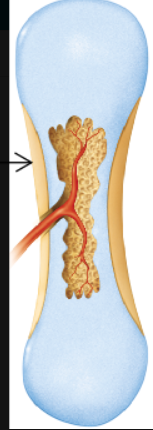
Which bone-forming process is shown in the figure?
endochondral ossification
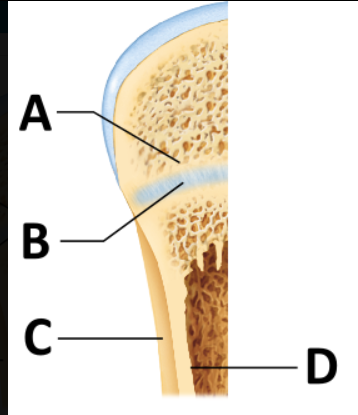
During bone growth, which significant event occurs at the surface indicated by the letter D?
bone resorption
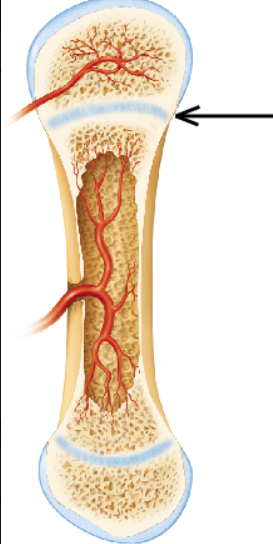
The arrow in the figure is pointing to which of the following structures?
the epiphyseal plate
Which of the following statements is true?
During endochondral ossification, hyaline cartilage is broken down and replaced with bone.
Which of the following results from the effects of parathyroid hormone (PTH)?
stimulation of osteoclast activity
Bone remodeling in response to mechanical stress is triggered by
signals produced by osteocytes in the affected bone
What controls bone remodeling?
mechanical stress and hormones
Which of the following is UNLIKELY to affect bone remodeling?
glucagon
Wolff's law is concerned with ________.
the thickness and shape of a bone being dependent on stresses placed upon it
Which hormone increases osteoclast activity to release more calcium ions into the bloodstream?
parathyroid hormone
The material that initially connects the broken ends of bones together is formed from
collagen fibers
The correct order (from start to finish) of fracture repair is __________.
hematoma formation, soft callus formation, bony callus formation, and bone remodeling
Which of the following are correctly matched?
open (compound) fracture; the fractured bone ends penetrate the skin
Which of the following statements is incorrect?
Paget's disease is caused by a vitamin D deficiency.
Which of the following pairings is correct?
Paget's disease; excessive and haphazard bone deposition and resorption
The central (Haversian) canal that runs through the core of each osteon is the site of ________.
blood vessels and nerve fibers
Which bone-forming process is shown in the figure?
endochondral ossification
Which of the following pairings is correct?
Paget's disease; excessive and haphazard bone deposition and resorption
What would be the physical sign that a bone cannot continue longitudinal growth?
an epiphyseal line
Which of the following cells are NOT correctly matched with their function?
osteocytes; produce new bone-forming cells
Which hormone is NOT matched with its correct function?
calcitonin; increases blood calcium levels
Ossification (Osteogenesis) is the process of ________.
bone formation
What is the term for the layers of bony matrix surrounding the vessels and nerve?
lamellae
Which of the following is NOT a function of the skeletal system?
communication
Which of the following pairs of terms is mismatched?
The main role of the axial skeleton is to help us manipulate our environment.
False; the axial skeleton primarily supports the head, neck, and trunk, and protects the brain and spinal cord.
Flat bones consist of a thin plate of spongy bone, called diploë, sandwiched between two layers of compact bone.
True
Which of the following diseases would most likely be associated with a disorder at A?
achondroplasia
Which of the following statements is true?
During endochondral ossification, hyaline cartilage is broken down and replaced with bone.
What is intramembranous ossification?
the formation of the bone from within fibrous membranes
When chondrocytes in lacunae divide and form new matrix, it leads to an expansion of the cartilage tissue from within. This process is called __________.
interstitial growth
What would be the physical sign that a bone cannot continue longitudinal growth?

