The social animal, cognition and prejudice
 Studied by 0 people
 Call with Kai
 Learn
Learn Practice Test
 Spaced Repetition
 Match
Match Flashcards
 Knowt Play
1/48

There's no tags or description
Looks like no tags are added yet.
Name | Mastery | Learn | Test | Matching | Spaced | Call with Kai |
|---|
No study sessions yet.
49 Terms
human traits that make us the social animal - perspective taking
increases ‘self-other overlap’
decreases negative responses to others
fosters social bonds and facilitates social coordination
Galinsky et al., 2000
narrative essay task (imagine you are …)
whether our identity links/connects to others
human traits that make us the social animal - empathy
empathic response = people engage more in altruistic behaviours (helping others without expecting anything in return)
women have more empathetic traits
human traits that make us the social animal - ToM/iterative perspective taking
levels of intentionality an individual maintains correlates with social network size
eg. i think she thinks he did this
social facilitation and inhibition
the presence of others affects our own behaviour
competition improves performance (Triplett)
social facilitation due to the mere presence of others/co-action (Allport)
drive theory - Zajonc (1965)
arousal impacts on performance, but only if you’re skilled at the task
factors for facilitation/inhibition
evaluation apprehension model (Cottrell, 1972)
self-efficacy beliefs (Sanna, 1990)
distraction-conflict theory (Baron, 1986)
attentional overload (Belletier et al., 2019)
evaluation apprehension model (Cottrell, 1972)
factors for facilitation/inhibition
audience not blindfolded + paying attention = social facilitation
audience not blindfolded + not paying attention = nothing
audience blindfolded = nothing
distraction-conflict theory (Baron, 1986)
people are a source of distraction from the task
attentional overload (Belletier et al., 2019)
people need to narrow their focus of attention down to a limited set of cues
audience effects
occur in a range of species (human effects are not as straight forward)
audience can fail to produce effects
even attentive audiences can fail to produce effects
complex tasks can be facilitated
models differ in the degree to which they can account for these phenomena
social psychology aims to actively bring some order to this seemingly chaotic research landscape
audience → awareness → distraction → attention → effect
social influence
people may not be passive, but actively stating opinions and judgements
Asch (1951) - majority influence
Sherif (1935) - the autokinetic effect/norm formation in groups
Moscovici (1976) - minority influence
judging colour transitions in groups of 6 (4 actual participants)
average conformity rate of 8.5% vs 0.5% baseline
should display:
consistent argument - committed over time and within group
investment - confidence in idea
autonomy - unbiased
neither too much rigidity or flexibility
minorities and majorities - dual-process model (Moscovici, 1980)
minority → shoft in internal views = deeper
dual process model - Moscovici (1980)
minority and majority influence
minority:
shift in internal views = deeper processing = conversion
majority:
superficial, public acceptance = compliance
social cognition
the study of how people make sense of other people and themselves
focuses on how ordinary people think and feel about others, and how they think others feel/think
long tradition in psychology from the 80s
attributions, attitudes, prejudice, impression formation
type of ‘social thinker’ to assume
naive scientist (elaboration high)
cognitive miser (elaboration low) - heuristic shortcuts
motivated tactician (elaboration selective)
activated actor (adds implicit and fast processing to above)
people differ from inanimate objects/stimuli because they are:
intentional causal agents
perceiving back (inherently interactive)
similar to self
self-conscious targets
characterised by lots of unobservable traits
changeable/potentially of use
very complex
asking for explanations
social categories
we make sense of others by applying labels to them
category-based processing occurs immediately upon perceiving the character
category confirmation = initial confirmatory categorisation
if this processing is unsuccessful:
category/attribute based impression
inconsistency resolution
use of initial discrepant information
disregard of discrepant information
integration into category
dual process models
easy solution to the problem
switch between the 2 when you have a good reason
eg. inconsistencies, importance, threats, rewards
impression formation
continuum model - Fiske and Neuberg (1990)
dual-process model - Brewer (1988)
persuasion
elaboration likelihood model (ELM) - Petty and Cacioppo (1986)
heuristic-systematic model - Chaiken (1987)
the elaboration likelihood model of persuasion example
assumption - people differ in how detailed they process content
need for cognition (NC)
eg. i find satisfaction in deliberating hard and for long hours
if people have high need for cognition, they should pay more attention to what they get told
how to apply social influence
marketed as the ‘science of persuasion’
diligently studied by fundraisers
goal: one-off compliance - maybe leading to longer-lasting attitude and behaviour change
end point: design successful funding campaigns
eg. Allison et al. (2017)
studied crowdfunding of business ventures, using the ELM as framework
turned 300+ real ventures into a funding experiment
factual information matters
for more experienced funders when more money is at stake
emotional cues matter
for less experienced funders with small sums at stake
prejudice
leads away from mere presence of others (facilitation/inhibition) or neutral disagreement (social influence) to active discrimination
a lot to do with categoricial processing
a ‘pre-judgement’
causes include developmental, cognitive, social explanations and social identity theory
a ‘pre-judgement’
any attitude, emotion or behaviour towards members of a group
directly/indirectly implies some negativity/antipathy towards this group
a subject evaluation/attitude, either positive or negative, towards someone
based on their group membership and hierarchical status relations between members
not based on the individual themselves, just what groups they associate with
consequences of prejudice - at level of perceiver
readiness to respond to target according to stereotype content
BIAS model - behaviour from intergroup affect and stereotypes
consequences of prejudice - at level of victim
stereotypes overshadow social interactions and turn into self-fulfilling prophecies
behavioural confirmation
you treat people according to a stereotype, then act accordingly
stereotype threat
you act in anticipation of being stereotyped
causes of prejudice - development explanations
interplay of education, upbringing and personality
prejudice levels stabilised by adolescence
causes of prejudice - cognitive explanations
schemata for objects
scripts for standard, common situations
stereotypes for groups
causes of prejudice - social explanations
powerful instrument to cement inequalities in a society
eg. social dominance theory
escaping prejudice
language perpetuates stereotypes, but only to an extent
so cleaning our language cannot be the full solution
stereotype
set of beliefs surrounding members of a social group
the content that gets evaluated and can lead to prejudice
or simply a justification for prejudice that’s already in place
akin to caricatures
we recognise something in the stereotypes, even though they may be absurd
stereotypes are a cultural phenomena, but stereotyping itself is an individual/psychological process
stereotypes contain the stuff that complements prejudice
morality and competence related traits
agency
individualism
masculinity
competence
communion
collectivism
femininity
morality
warmth and competence - Cuddy et al. (2008)
2 broad underlying dimensions for stereotype attributes
warmth and competence
the stereotype content model - Fiske et al. (2002)
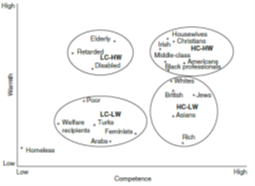
unfairness and problematic things about prejudice and stereotypes
wrong inference of individual attributes
denial of individual attributes
social sharedness increases social impact
less impact if from just 1 individual
discrimination
making a difference between people, based on their group membership
actual behavioural outcome of prejudice and stereotypes
real target variable
social dominance theory - Sidanius and Pratto (1995)
group-based inequalities are maintained through 3 types of intergroup behaviours:
aggregated individual discrimination
those higher up bully the ones below
behaviour asymmetry
strength is at the top of hierarchy
institutional discrimination
laws in favour of advantaged
these types of behaviour are fed and feed back to legitimising myths
hierarchy-enhancing eg. racist ideologies
hierarchy-attenuating eg. social, multiculturalism, universalism
the individual will endorse legitimising myths, depending on their social dominance and orientation (SDO)
measures of prejudice
self-report measures
overt and covert measurement of attitudes
explicit measures
implicit measures (open questions)
implicit association test (IAT)
self-report measures of prejudice
have issues of social desirability
random answers do not generate systematic effects
biased answers do not generate differences between experimental conditions
overt and covert measures of prejudice/attitudes
aka explicit and implicit measures
purpose is hidden or response is not easy to control eg. reaction time
sometimes low correlation between these measures
explicit measures of prejudice
classics in survey-based research
social distance
eg. i wouldn’t mind having X in my course, neighbourhood or as a relative
F-scale - Adorno et al. (1950)
eg. homosecuals are hardly better than criminals and ought to be severely punished
modern racism scale - McConahay et al. (1981)
eg. blacks are getting too demanding in their push for equal rights
symbolic racism 200 scale - Henry and Sears (2002)
eg. over the years, blacks have gotten more economically than they deserve
implicit measures of prejudice
they measure unconscious, automatic thoughts and beliefs
responses are not free from influence by other factors
white experimenters bring about stronger biases than black ones
thinking about counter-stereotypic group members as a mental imagery task before, reduces bias
means implicit bias can be influenced
implicit association test (IAT)
Greenwald et al. (1989)
related to priming procedures
makes use of semantic associations in memory
participants respond to 2 different social categories and to positive/negative attributions in a reaction time task
if implicit association exists, then they should respond faster when category and attribute share the same response key
 Note
Note  Flashcards (36)