Physics - space physics
 Call Kai
 Learn
Learn Practice Test
 Spaced Repetition
 Match
Match Flashcards
 Knowt Play
1/93

There's no tags or description
Looks like no tags are added yet.
Name | Mastery | Learn | Test | Matching | Spaced | Call with Kai |
|---|
No analytics yet
Send a link to your students to track their progress
94 Terms
What are the names of the planets?
Mercury, Venus, Earth, Mars, Jupiter, Saturn, Uranus, Neptune
What is space?
region beyond the earth's atmosphere where there is very little molecular activity
What are the different types of planets?
terrestrial (rocky) planets, gas giants and ice giants
What are terrestrial planets?
- planets composed primarily of rocks, metals, and solid surfaces
- Mercury, Venus, Earth, and Mars
What are gas giants?
- a large planet composed mainly of hydrogen and helium, featuring thick atmospheres, no defined solid surface, and many rings and moons
- Jupiter and Saturn
What are ice giants?
- a large planet composed primarily of elements heavier than hydrogen and helium, such as water, ammonia, and methane
- Uranus and Neptune
What is a solar system?
a star (the Sun) and all celestial objects orbiting it, held together by gravity
What are the stages of the life cycle of a normal-sized star?
nebula→protostar→main sequence→red giant→planetary nebula→white dwarf→black dwarf
What is the life-cycle of a normal-sized star?
1. A nebula collapses due to gravity
2. As it collapses, it heats up and forms a protostar
3. When the core gets hot enough, nuclear fusion of hydrogen to helium begins. This is the longest stage
4. When the star runs out of hydrogen, it expands and cools, becoming a red giant. Red giants fuse light atoms like helium to form heavy elements like iron
5. After all the nuclear reactions are over, the outer layers of the star are ejected into space, creating a planetary nebula. 6. The core is left behind as a hot, dense white dwarf, which will gradually cool and fade over billions of years and become a black dwarf
What is a nebula?
a cloud of gas and dust
What are nebulae mainly made up of?
hydrogen
What is a protostar?
An early-stage, hot, dense ball of gas and dust formed when gravity collapses a nebula
What causes a nebula to collapse?
gravity overcoming internal gas pressure, often triggered by external shocks like a nearby supernova, collision with another cloud, or passing stars
What is a main-sequence star?
- a stable, long-lasting phase in a star's life cycle where it fuses hydrogen into helium in its core
- This phase represents a state of equilibrium, where the inward force of gravity is perfectly balanced by the outward radiation pressure from nuclear fusion
What happens during the main sequence of a star?
a star stably fuses hydrogen into helium in its core
Why does the main sequence last the longest?
because it represents a stable, slow-burning, and highly efficient energy-producing phase, primarily hydrogen-to-helium fusion
Why do main-sequence stars need energy?
to maintain stability against its own gravity
What is a red giant?
The stage after the main sequence for a star with insufficient mass to go supernova.
What are planetary nebulae?
a glowing, expanding shell of ionised gas and dust ejected from a low-to-medium mass star (like our Sun) during the final stages of its life as it transforms into a white dwarf.
What is a white dwarf
the extremely dense, faint, Earth-sized core leftover from a dying low-to-medium mass star after it has exhausted its nuclear fuel and expelled its outer layers
Why are white dwarfs so hot?
because they are the exposed, collapsed core of a dead star, concentrating the sun's mass into an Earth-sized volume
What is a black dwarf?
a white dwarf that has cooled sufficiently that it no longer emits significant heat or light.
What are the colours of temperature?
black→red→yellow→white→blue
What are the stages of the life-cycle of a large star?
nebula→protostar→main sequence→red super-giant→super nova→neutron star/black hole
What is the life-cycle of a large star?
1. A nebula collapses due to gravity
2. As it collapses, it heats up and forms a protostar
3. When the core gets hot enough, nuclear fusion of hydrogen to helium begins. This is the longest stage
4. When the star runs out of hydrogen, it expands and cools, becoming a red super-giant, which is much bigger than a red giant. Red super-giants fuse light atoms like helium to form heavy elements like iron
5. It then suddenly collapses and forms a supernova
6. The remaining core will either collapse into a neutron star or a black hole if it is heavy enough
What is a supernova?
The colossal, bright explosion of a massive star at the end of its life cycle, throwing out dust, gas, and heavy elements into space
What is a neutron star?
- the dense core of neutrons left behind by a supernova
- They are formed when gravity crushes protons and electrons together.
What is a black hole?
a region of space having a gravitational field so intense that no matter or radiation can escape.
Why is the main sequence of larger stars shorter than smaller stars?
- their immense gravity creates higher core pressures and temperatures, causing them to fuse hydrogen into helium at a much faster rate than smaller stars
How are elements heavier than iron formed?
supernova
Why do stars shine?
because they are hot
Why are stars hot?
They produce energy through nuclear fusion
What is dark matter?
- an invisible, unknown form of matter that does not emit or reflect electromagnetic
- It makes up roughly 25-27% of the universe and is known to exist only through its gravitational effects, which hold galaxies together
What is a galaxy?
massive, gravitationally bound system consisting of billions of stars, gas, dust, and dark matter
What are satellites?
any object that orbits or revolves around a larger body in space, such as a planet or star
What are natural satellites?
- a satellite that is not man-made
- they orbit a planet, dwarf planet, or smaller body (such as an asteroid) rather than orbiting the Sun directly
What are man-made satellites?
a human-made object or spacecraft purposely placed into orbit around a celestial body, such as Earth
What are man-made satellites used for?
enable global communication (TV, internet), provide GPS navigation, track weather patterns, and monitor the environment
What are asteroids?
- small, rocky, or metallic bodies that orbit the Sun,
- primarily located in the main asteroid belt between Mars and Jupiter
What are comets?
Comets are-small body of ice, rock and cosmic dust that follows an elliptical orbit around the sun.
What are meteors?
a small body of matter from outer space that enters the earth's atmosphere, becoming incandescent as a result of friction and appearing as a streak of light.
What are near earth objects?
An object which passes close to the Earth's orbit
How do the planets orbit the sun?
elliptical orbits
What is an elliptical orbit?
An oval-shaped orbit ( Nearly circular)
What is a light year?
the distance light travels in one year (9.5 trillion km)
what are moons?
Natural satellites that orbit planets
What are dwarf planets?
celestial bodies orbiting the Sun that are massive enough to be rounded by their own gravity, but unlike planets, they have not cleared their orbital neighbourhood of other debris
What is the proof of the big bang?
cosmic background radiation from the explosion
What is a centripetal force?
a force that acts on a body moving in a circular path and is directed toward the centre around which the body is moving.
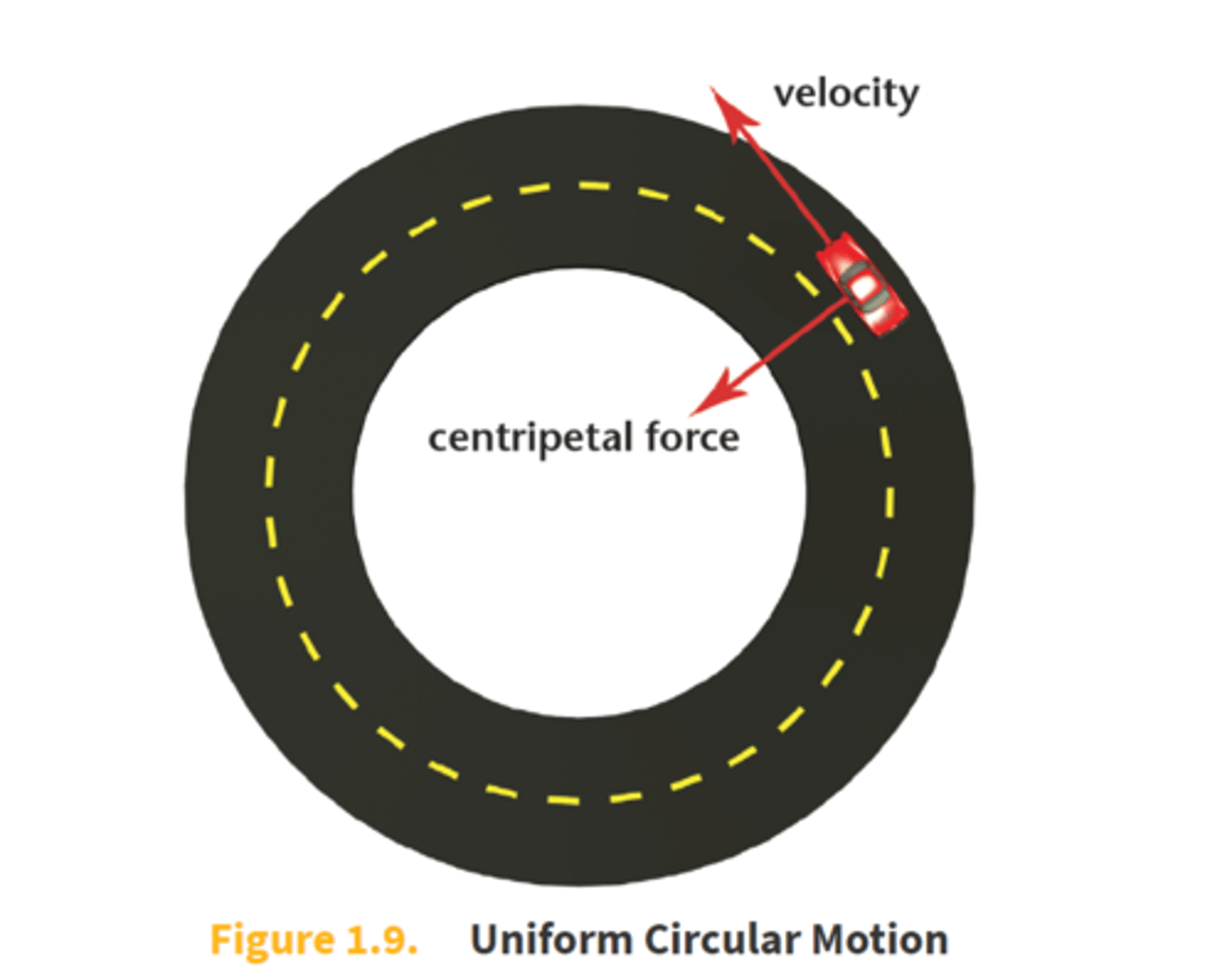
What does orbit mean?
To orbit means to move in a curved path around another object due to gravity.
Why don't planets fall into the sun?
- The gravity pulling inward and the forward motion (velocity) pushing them forward are balanced
- This creates a curved path.
What causes centripetal forces?
any real, inward-acting force (such as gravity, tension, or friction) acting perpendicular to an object's motion, forcing it into a circular path
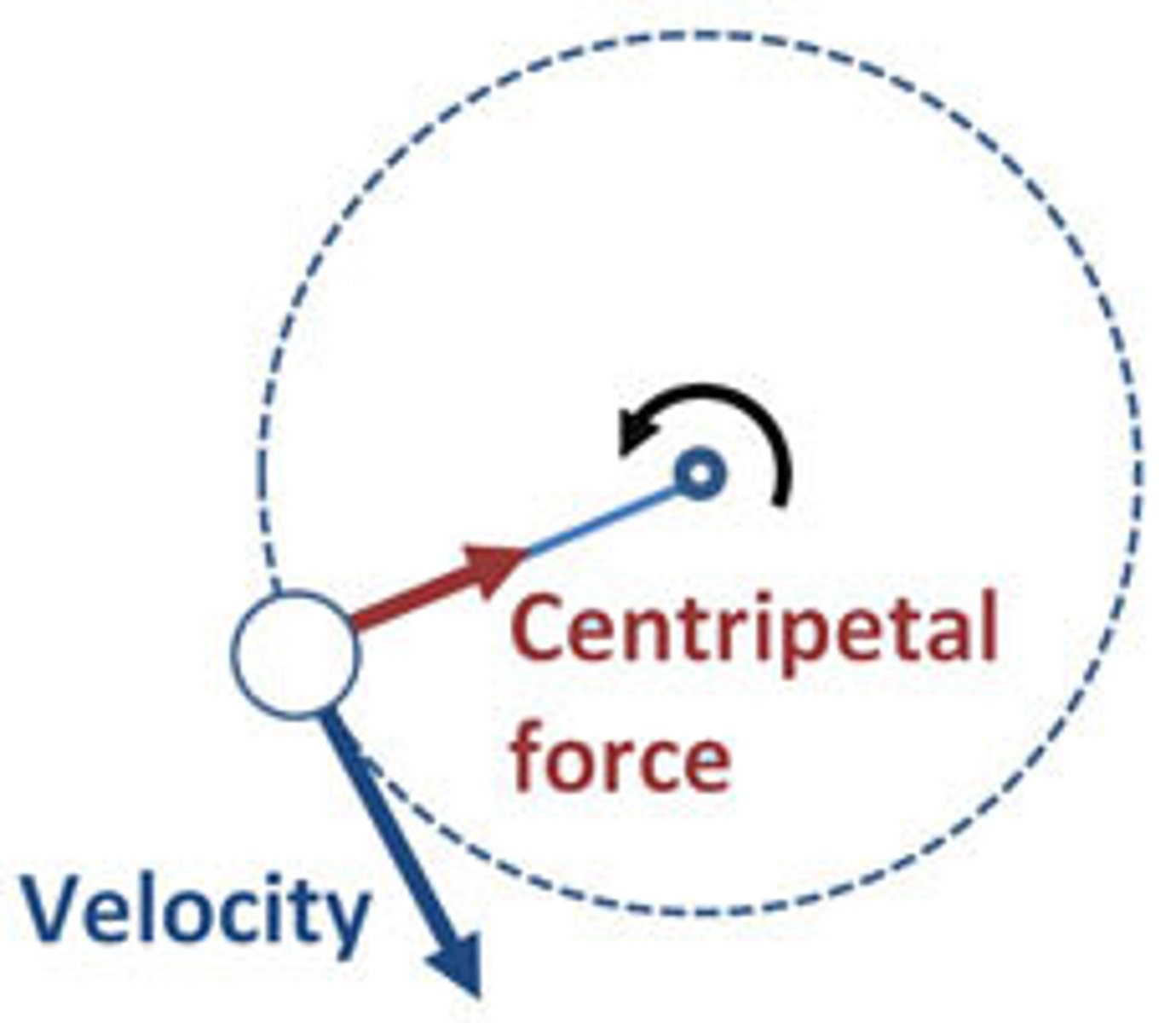
Where does the centripetal force act?
towards the centre of a circular path
Why does the speed of the planet in circular orbit not change?
- Gravity acts perpendicular to the direction of travel, pulling the planet inwards.
- Since no work is done by the force on the planet, the speed does not change.
Why does work done on an object change the speed?
because work is a transfer of energy, and in this case, energy is transferred to or from the object's kinetic energy store
Why does the velocity of the planet in a circular orbit change?
The velocity of a planet in a circular orbit changes because velocity is a vector quantity, meaning it depends on both speed and direction.
What is gravitational acceleration?
the rate at which an object speeds up when falling freely under gravity alone, with air resistance ignored
Why does the speed of the planet in eliptical orbit change?
because the strength of the Sun's gravitational pull varies depending on how far the planet is from the Sun
What happens when a planet moves closer to the sun?
its orbital speed increases significantly due to stronger gravitational pull
What happens to the centripetal force when the radius changes?
- Centripetal force is inversely proportional to the radius
- if the radius increases, the force decreases
Why do satellites close to the Earth lose speed?
due to atmospheric drag
What is a stable orbit?
- a usually circular, path where a satellite's orbital speed and radius are perfectly balanced against gravitational attraction.
- It prevents objects from either spiralling into the body they orbit or escaping into space, ensuring a consistent path.
Are elliptical orbits caused by centripetal forces?
Yes
Why do planets form elliptical orbits around the sun?
Planets form elliptical orbits, not perfect circles, because their initial velocity is not perfectly matched to the Sun's gravity, and due to interactions with other bodies
formula for centripetal force
Centripetal Force = (mass x velocity²) / radius
What gives planets their velocity?
their inertia, which would allow them to travel in a straight line
What is the Big Bang Theory?
the idea that all matter and energy in the universe began in an unimaginably dense state, and then space itself began expanding
What is the red shift?
the stretching of light towards longer, redder wavelengths from objects moving away from an observer
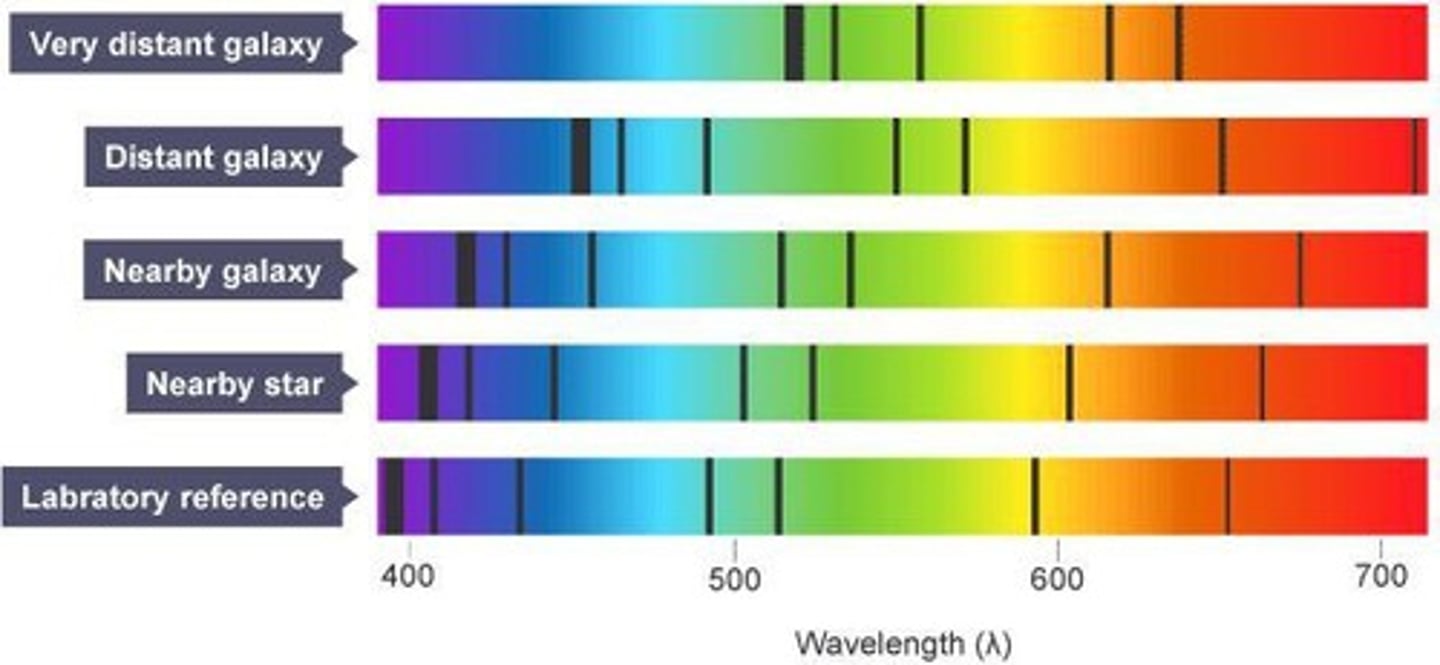
Why does the red shift happen?
- Red-shift happens when light from an object moving away from us is stretched.
- This makes the light's wavelength longer, so it shifts toward the red end of the spectrum.
What is the Doppler effect?
- the change in frequency or wavelength of a wave (sound or light) for an observer moving relative to the wave source.
- As the source approaches, waves compress, resulting in a higher pitch or frequency
- As it moves away, waves stretch, producing a lower pitch or frequency
What causes the red shift?
- it is caused by the Doppler effect
When a light source moves away:
- The waves get stretched out
- Wavelength increases
- Frequency decreases
Why does the frequency decrease when the wavelength increases?
- because they are inversely proportional
- Since the speed of a wave within a constant medium is fixed, a longer wavelength (distance between crests) means fewer waves pass a point per second, reducing the frequency.
How does red shift support the Big Bang theory?
The light from distant galaxies is redshifted. This shows that the universe is expanding.
This suggests everything was once:
- Much closer together
- In a single point at the beginning of the universe
What is the blue shift?
- If an object moves towards us, the wavelengths get shorter and the frequency increases.
- This is called blue-shift.
What causes the blue shift?
a light source moving towards an observer, compressing the light waves and shifting them to shorter, higher-frequency wavelengths
Why does light shift to red as it moves further away?
The expansion of the universe stretches the wavelength of light as it travels through space
What is kepler's first law?
planets orbit the Sun in an elliptical (flattened circle) path rather than a perfect circle
What is Kepler's second law?
- A line drawn from the Sun to a planet will sweep out equal areas during equal intervals of time.
- This means the planet moves faster when it is closer to the Sun and slower when it is farther away.
What is Kepler's third law?
- The square of a planet's orbital period is proportional to the cube of its average distance from the Sun.
- This explains why outer planets, which are farther from the Sun, take longer to complete an orbit.
What is the steady state theory?
- The original theory before the Big Bang theory
- As the universe expanded, new matter was created to fill in the empty gaps - keeping the density of the universe constant
- Violates the law of the conservation of mass
How did the universe start?
As an extremely hot and dense state
When did the Big Bang happen?
13.8 billion years ago
What happened after the Big Bang?
- The universe expanded and cooled
- Particles formed (protons, neutrons, electrons)
- Atoms formed (mainly hydrogen)
- Gravity pulled matter together to form stars and galaxies
What increases the red shift?
the faster a star or galaxy is moving (relative to you) the bigger the shift is
What does a larger red shift mean
that the light's wavelength has been stretched significantly by the expansion of the universe
What is the big freeze theory?
- The universe keeps expanding forever
- Stars eventually burn out
- Everything becomes cold and dark
What is the big crunch theory?
- Gravity could stop the expansion and pull everything back together
- The universe would collapse into a hot, dense state again
What is the big rip thory
Expansion speeds up so much that:
Galaxies, stars, and even atoms are pulled apart
What is cosmic microwave background radiation?
- high-energy gamma radiation left over from the Big Bang after the universe expanded and cooled
- Over time, the gamma rays stretched as the universe expanded and became lower-energy microwaves
How does CMBR support the Big Bang theory?
- The radiation is spread uniformly across the universe. This supports the idea that everything started from a single event (the Big Bang).
- The CMBR is very cold today (~2.7 K). This matches predictions of how much the universe should have cooled.
How did the CMBR form?
- Just after the Big Bang, the universe was extremely hot and dense
- As the universe expanded, it cooled down
- After about 380,000 years, atoms formed and radiation could travel freely
What would happen if the density of the universe is too low?
It will expand forever
What would happen if the density of the universe is too high?
The gravitational attraction of all the matter within it would eventually stop the expansion by the Big Bang
What is dark energy?
- a mysterious, unseen force or form of energy
- It acts as a pressure that causes the expansion of the universe to speed up, rather than slowing down, overcoming gravity's attempt to pull matter together

