microbiology chapter 2
 Studied by 0 people
 Call Kai
 Learn
Learn Practice Test
 Spaced Repetition
 Match
Match Flashcards
 Knowt Play
1/63

Earn XP
Description and Tags
chapter 2
Name | Mastery | Learn | Test | Matching | Spaced | Call with Kai |
|---|
No analytics yet
Send a link to your students to track their progress
64 Terms
archaellum
Archaellum (plural: archaella) – A motility structure found in archaea that functions like a bacterial flagellum, allowing the cell to swim, but it is structurally and genetically different from bacterial flagella.
Key points:
Made of archaellin proteins
Powered by ATP, not a proton motive force like bacterial flagella
Found only in archaea
capsule
Capsule – A gelatinous layer that surrounds the cell wall of some bacteria.
Functions:
Protects against desiccation and phagocytosis
Helps bacteria attach to surfaces
Often contributes to virulence (disease-causing ability)
chemotaxis
The movement of a cell or organism toward or away from a chemical stimulus.
Toward attractants (like nutrients)
Away from repellents (like toxins)
Common in bacteria and some single-celled eukaryotes.
cytoplasmic membrane
A thin, flexible barrier that surrounds the cytoplasm of all cells.
Functions:
Controls movement of substances in and out of the cell (selective permeability)
Site of energy production in prokaryotes
Supports membrane proteins for transport, signaling, and cell structure
dipicolinic acid
A molecule found in bacterial endospores that helps make them highly resistant to heat, chemicals, and desiccationby stabilizing spore DNA and proteins.
endospore
A dormant, highly resistant structure formed by some bacteria to survive harsh conditions (heat, chemicals, desiccation).
endosymbiotic theory
The idea that eukaryotic organelles like mitochondria and chloroplasts originated from free-living prokaryotes that were engulfed by ancestral eukaryotic cells.
flagellum
Flagellum (plural: flagella) – A long, whip-like appendage that enables cell motility.
Key points:
Found in bacteria, archaea, and some eukaryotes
Bacterial flagella are rotary and powered by a proton motive force
Eukaryotic flagella move in a whip-like fashion and are powered by ATP
gas vesicles
Protein-bound structures in some aquatic microbes that provide buoyancy, allowing cells to float or sink to optimal light or nutrient levels.
gliding motility
A type of movement on a solid surface where a cell slides smoothly without flagella or pili.
histones
Histones – Proteins found in eukaryotes and some archaea that package and organize DNA into chromatin.
lipopolysaccharide
A molecule found in the outer membrane of Gram-negative bacteria.
Key points:
Consists of lipid A, core polysaccharide, and O-antigen
Lipid A acts as an endotoxin, triggering immune responses in hosts
Contributes to membrane stability and protection against chemicals
lysosome
A membrane-bound organelle in eukaryotic cells that digests cellular waste, pathogens, and macromolecules.
magnetosome
A membrane-bound organelle in some bacteria that contains magnetic crystals (usually magnetite) to help the cell orient and navigate along magnetic fields.
morphology
The shape, size, and arrangement of cells or organisms.
nucleus
A membrane-bound organelle in eukaryotic cells that stores and protects DNA and controls cellular activities.
outer membrane
A double-layered membrane found in Gram-negative bacteria that lies outside the peptidoglycan cell wall.
peptidoglycan
A rigid, mesh-like polymer that forms the cell wall of most bacteria.
periplasm
he gel-like space between the cytoplasmic (inner) membrane and the outer membrane in Gram-negative bacteria.
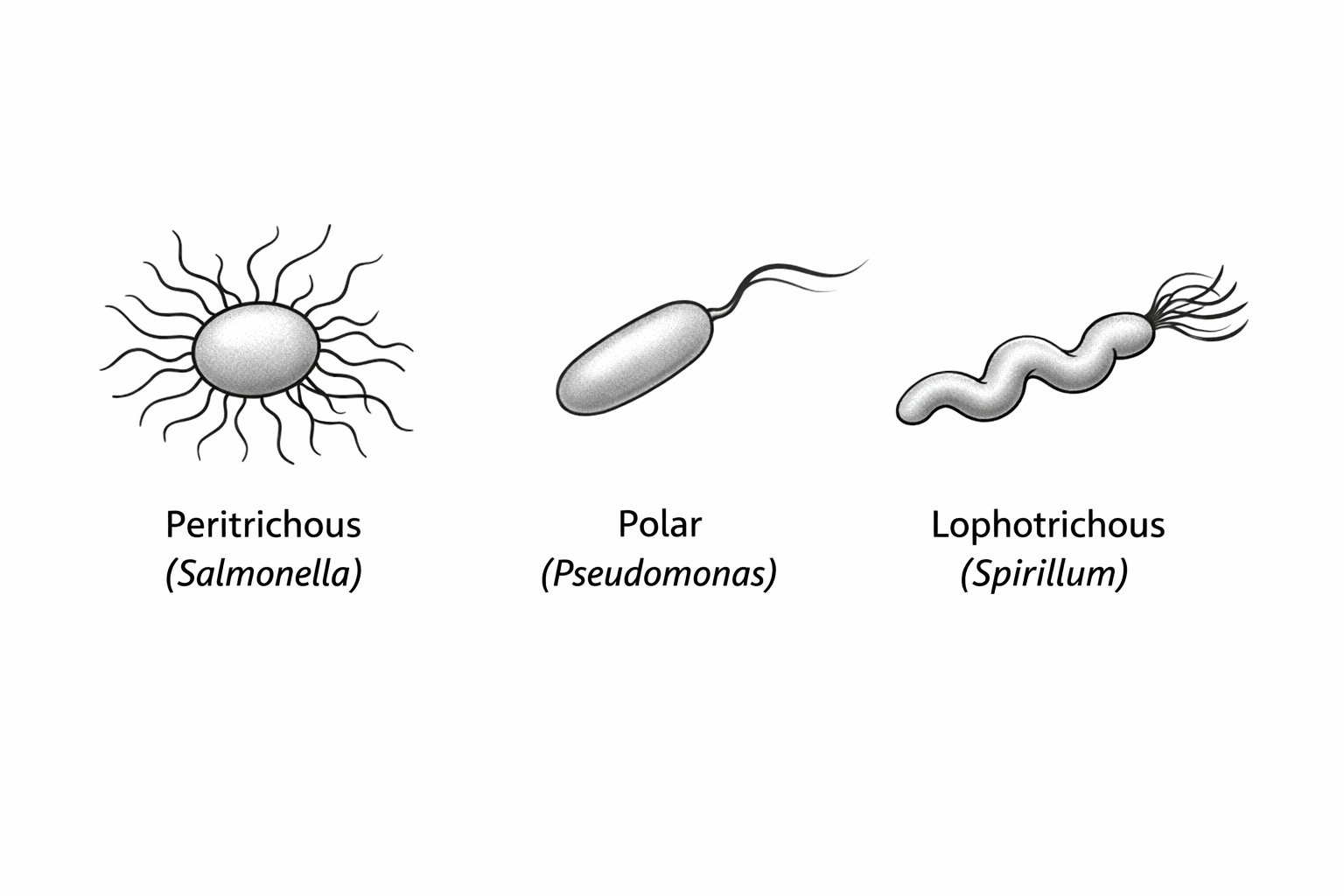
peritrichous flagellation
A flagellar arrangement in which flagella are distributed all around the surface of a bacterial cell.
phototaxis
The movement of a cell or organism toward or away from light.
pili
singular: pilus) – Hair-like appendages on the surface of many bacteria.
polar flagellation
A flagellar arrangement where one or more flagella are attached at one or both ends (poles) of a bacterial cell.
poly-B-hydroxybutyric acid (PHB)
A storage polymer produced by some bacteria to store carbon and energy.
Key points:
Accumulates as granules in the cytoplasm
Can be broken down when nutrients are limited
Biotechnologically important as a biodegradable plastic
s-layer
A crystalline layer of proteins or glycoproteins that covers the surface of some bacteria and archaea.
teichoic acid
A polymer of glycerol or ribitol phosphates found in the cell walls of Gram-positive bacteria.
how do cocci and rods differ in morphology? give an example of a bacteria with each morphology.
Cocci are spherical-shaped bacteria (example: Staphylococcus aureus).
Rods (bacilli) are elongated, rod-shaped bacteria (example: Escherichia coli).
using a microscope, could you differentiate a coccus from a spirillum? a pathogen from a nonpathogenic?
Yes, you could differentiate a coccus from a spirillum using a microscope because they have different shapes (coccus = spherical, spirillum = spiral).
No, you cannot reliably differentiate a pathogenic bacterium from a nonpathogenic one using a microscope alone, because pathogenicity depends on genetic traits and interactions with the host, not just cell shape or appearance.
draw the basic structure of a phospholipid bilayer and label the hydrophilic and the hydrophobic regions
Outside of cell
 O   O   O   O   O   ← Hydrophilic heads (polar)
 |   |   |   |   |
 |   |   |   |   |   ← Hydrophobic tails (nonpolar)
 |   |   |   |   |
 O   O   O   O   O   ← Hydrophilic heads (polar)
Inside of cellhow are the membrane lipids of bacteria and archaea similar and how do they differ
Both bacteria and archaea have membranes made of phospholipids that form a bilayer and serve as a selectively permeable barrier.
They differ in that bacterial lipids have fatty acids linked to glycerol by ester bonds, while archaeal lipids have isoprenoid chains linked by ether bonds, making archaeal membranes more stable in extreme environments.
describe the major functions of the cytoplasmic membrane
Acts as a selectively permeable barrier, controlling what enters and leaves the cell
Houses transport proteins for nutrient uptake and waste removal
Site of energy generation (electron transport and ATP synthesis in prokaryotes)
Anchors proteins involved in metabolism, signaling, and cell structure
why do bacterial cells need cell walls? do all bacteria have cell walls
Bacterial cell walls provide shape and rigidity and protect the cell from osmotic lysis (bursting due to water entering the cell).
Do all bacteria have cell walls?
No. Most bacteria do, but some (such as Mycoplasma) lack cell walls and instead rely on their cytoplasmic membrane for structure.
why is peptidoglycan such a strong molecule
These NAG–NAM glycan chains are what get cross-linked by peptides to give peptidoglycan its strength.
Peptidoglycan is a strong molecule because it forms a rigid, mesh-like network of long sugar chains that are cross-linked by short peptides.
describe the major differences between the cell walls of gram positive and gram negative bacteria.
Gram-positive bacteria have a thick peptidoglycan layer that contains teichoic acids and no outer membrane, which allows them to retain the crystal violet stain and appear purple.
Gram-negative bacteria have a thin peptidoglycan layer located in the periplasm, plus an outer membranecontaining lipopolysaccharide (LPS), causing them to lose the crystal violet stain and appear pink/red after counterstaining.
explain whether you expect the enzyme lysozyme to be equally effective against bacteria and archaea
Lysozyme is effective against many bacteria because it breaks the bond between NAG and NAM in peptidoglycan, weakening the bacterial cell wall.
It is not equally effective against archaea because archaeal cell walls do not contain peptidoglycan (they have different polymers or S-layers), so lysozyme has little to no effect on them.
what do the enzyme lysozyme and the antibiotic penicillin have in common
Both weaken peptidoglycan
Lysozyme breaks the NAG–NAM bonds, while penicillin blocks peptide cross-linking
Both can cause cell lysis in growing bacteria
They are effective against bacteria but not archaea or eukaryotic cells because those lack peptidoglycan.
describe the major chemical components in the outer membrane of gram negative bacteria
Lipopolysaccharide (LPS) – made of lipid A, core polysaccharide, and O-antigen
Phospholipids – form part of the membrane bilayer
Proteins (including porins) – allow passage of small molecules
These components provide structural integrity, selective permeability, and contribute to virulence.
what is the function of porins and where are they located in a gram negative cell wall
protein channels that allow small molecules and ions to pass into and out of the cell by diffusion.
Location:
They are found in the outer membrane of Gram-negative bacteria.
Porins help the cell control permeability while still allowing nutrients to enter.
what component of the gram negative cell has endotoxin properties
The endotoxin of Gram-negative bacteria is lipid A, which is a component of lipopolysaccharide (LPS) in the outer membrane.
what is pseudomurien and where is it found
A cell wall polymer similar to peptidoglycan but found in some archaea instead of bacteria.
Key points:
Made of N-acetylglucosamine (NAG) and N-acetyltalosaminuronic acid (NAT) linked by β-1,3-glycosidic bonds
Resistant to lysozyme and penicillin
Found in the cell walls of certain methanogenic archaea
what is the value of a cell having a capsule? what is the capsule composed of and where is it found?
Value/Function:
Protects bacteria from desiccation and phagocytosis by host immune cells
Helps bacteria adhere to surfaces and form biofilms
Can contribute to virulence (disease-causing ability)
Composition:
Usually made of polysaccharides, sometimes polypeptides
Location:
Surrounds the outside of the cell wall in some bacteria
how do fimbriae differ from pili
Fimbriae:
Short, thin, hair-like appendages
Mainly used for attachment to surfaces or host cells
Found in many Gram-negative bacteria
Pili:
Longer than fimbriae
Can be used for attachment, but especially for DNA transfer (conjugation)
Usually one or a few per cell, unlike fimbriae which are numerous
what is dipicolonic acid and where is it found
A chemical compound found in bacterial endospores that helps make them highly resistant to heat, desiccation, and chemicals.
Location:
Found inside the core of endospores, where it stabilizes DNA and proteins to maintain dormancy.
what is formed when an endospore germinates? what causes a cell to make endospores ?
When an endospore germinates: it returns to a vegetative (actively growing) bacterial cell.
What triggers endospore formation: harsh or unfavorable conditions, such as:
Nutrient depletion (lack of carbon or nitrogen)
Extreme heat, desiccation, or chemical stress
Endospores are a survival strategy, not a form of reproduction.
name two genera that produce endospores and how are they different?
Bacillus
Aerobic or facultatively anaerobic
Common in soil
Example: Bacillus anthracis (causes anthrax)
Clostridium
Obligate anaerobes
Found in soil and intestinal tracts
Example: Clostridium botulinum (causes botulism)
Difference: The main difference is their oxygen requirement: Bacillus can tolerate oxygen, while Clostridium cannot.
cells of salmonella are peritrichously flagellated, those of pseudomonas polarly flagellated, and those of spirillum lophotrichously flagellated, using a sketch, show how each organism would appear in a flagellar stain
what is archaella are where are they found
Motility structures in archaea that function like bacterial flagella but are structurally and genetically distinct.
Key points:
Found on the surface of archaeal cells
Made of archaellin proteins
Powered by ATP, not a proton motive force like bacterial flagella
Enable swimming and directional movement in liquid environments
what is positive and negative chemotaxis and where would you see each
movement of a cell in response to chemicals
Positive chemotaxis: movement toward a chemical attractant (e.g., nutrients).
Seen when bacteria swim toward food sources.
Negative chemotaxis: movement away from a chemical repellent (e.g., toxins).
Seen when bacteria avoid harmful substances.
what are the gram reaction, morphology and arrangement of the following bacteria? e coli, bacillus, staphylococcus, vibrio, treponema
Escherichia coli
Gram reaction: Gram-negative
Morphology: Rod (bacillus)
Arrangement: Single rods
Bacillus (genus)
Gram reaction: Gram-positive
Morphology: Rod
Arrangement: Chains (streptobacilli)
Staphylococcus (genus)
Gram reaction: Gram-positive
Morphology: Coccus
Arrangement: Clusters (grape-like)
Vibrio (genus)
Gram reaction: Gram-negative
Morphology: Curved rod (comma-shaped)
Arrangement: Single cells
Treponema (genus)
Gram reaction: Gram-negative–like (does not stain well with Gram stain)
Morphology: Spirochete (thin, spiral)
Arrangement: Single cells
how big is e coli? how big is staphylococcus?
Escherichia coli – about 1–2 µm long and ~0.5 µm wide (rod-shaped)
Staphylococcus – about 0.5–1.0 µm in diameter (spherical)
Rule of thumb for exams: E. coli is longer because it’s a rod; Staph is smaller and round.
compare and contrast gram positive and gram negative cells. draw a diagram of each and label the structures. what components are unique to each
Unique to Gram-positive
Teichoic acids
Very thick peptidoglycan
No outer membrane
Unique to Gram-negative
Outer membrane
Lipopolysaccharide (LPS / endotoxin)
Porins
Periplasmic space
what value do gas vesicles give to bacteria
Gas vesicles give bacteria buoyancy control, allowing them to float or sink to optimal positions for light, oxygen, or nutrients in aquatic environments.
what is the function of flagella? what are flagella made of ?
Flagella enable cell motility, allowing bacteria to move toward favorable conditions (nutrients) and away from harmful ones.
What flagella are made of:
Bacterial flagella are composed of the protein flagellin
Archaeal flagella (archaella) are made of archaellin
compare and contrast a prokaryotic and a eukaryotic cell. give examples of both. what are the functions of each of the components?
Prokaryotic vs. Eukaryotic cellsProkaryotic cells
No nucleus (DNA in nucleoid region)
No membrane-bound organelles
Usually smaller and simpler
Examples: Bacteria, Archaea (e.g., E. coli)
Eukaryotic cells
True nucleus containing DNA
Membrane-bound organelles present
Larger and more complex
Examples: Animals, plants, fungi, protists (e.g., human cells, yeast)
Cell components and their functionsShared by both prokaryotes & eukaryotes
Cytoplasmic membrane – controls what enters and leaves the cell
Cytoplasm – site of metabolic reactions
Ribosomes – protein synthesis
DNA – genetic information
Prokaryotic-specific components
Nucleoid – region where DNA is located
Cell wall (often peptidoglycan) – shape and protection from osmotic lysis
Flagella / pili (some) – movement and attachment
Eukaryotic-specific components
Nucleus – stores DNA and controls cell activities
Mitochondria – energy (ATP) production
Endoplasmic reticulum – protein and lipid synthesis
Golgi apparatus – modifies and packages proteins
Lysosomes – digestion and recycling
Chloroplasts (plants) – photosynthesis
how do prokaryotic and eukaryotic cells differ when it comes to reproduction? in general, how do bacteria, fungi, plants and animals reproduce
Prokaryotes reproduce asexually by binary fission; eukaryotes use mitosis and meiosis and can reproduce sexually or asexually.
explain endosymbiosis
A process in which one cell engulfs another living cell, and instead of digesting it, they form a mutually beneficial relationship.
Key idea:
This explains how mitochondria and chloroplasts evolved from free-living prokaryotes inside early eukaryotic cells.
do bacteria have cilia
No, bacteria do not have cilia.
Cilia are found only in eukaryotic cells and are used for movement or moving fluid across cell surfaces.
Bacteria move using flagella, pili, or gliding motility, not cilia.
how do bacterial endospores differ from fungal spores in function
Endospores = survival
Fungal spores = reproduction
what is phototaxis
The movement of a cell or organism toward or away from light.
 Note
Note  Flashcards (66)