INT NSC Taste and Smell
 Call Kai
 Learn
Learn Practice Test
 Spaced Repetition
 Match
Match Flashcards
 Knowt Play
1/38

There's no tags or description
Looks like no tags are added yet.
Name | Mastery | Learn | Test | Matching | Spaced | Call with Kai |
|---|
No analytics yet
Send a link to your students to track their progress
39 Terms
Sweet indicates?
High-calorie Foods
Savory taste signal a?
Protein Source
Salty and sour are important for?
Homeostasis
Bitter warns of?
Toxic constituents
Papillae previously called as taste buds are?
Tiny lumps of tissue to increase surface area of the tongue
The three types are?
Circumvallate (Back of Tongue)
Foliate (Middle of Tongue)
Fungiform (Tip/Front of Tongue)
Each Papilla holds more taste buds with ____-______ ___ ______ ____ with an opening called ______ ________
50-150 Taste Receptor Cells
Taste Pores
Each taste cells through taste pores will do what?
Extend fine cilia to come contact with tastants specific to one of the bast tastes
Taste cells have a lifespan of 10-14 days due to? they will be?
Them being exposed to the environment
Replaced by maturing taste cells surrounding it
What taste to infants prefer and hate?
Prefer Sweets, and Hate Bitterness
This idea will indicate the?
Maturation of the mechanisms of salt perception
At birth, newborns are insensitive to what taste?, as evolution takes place they will eat mild ______ substances due to the?
Salty Tastes
Salty Substances due to the Maturation of the Mecanisms of Salt pereption
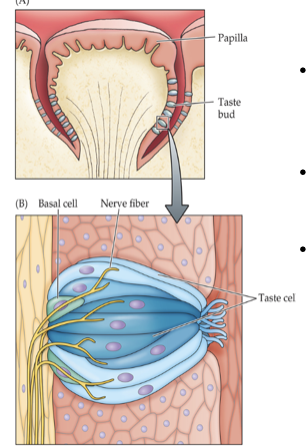
What is happening in this image?
A taste bud sits inside the wall of a papilla, and inside the taste bud you see taste cells sending signals to nerve fibers while basal cells at the bottom replace old taste cells
What is unique to each tastebud?
They are perceived through different receptor cells on same papilla using different cellular process
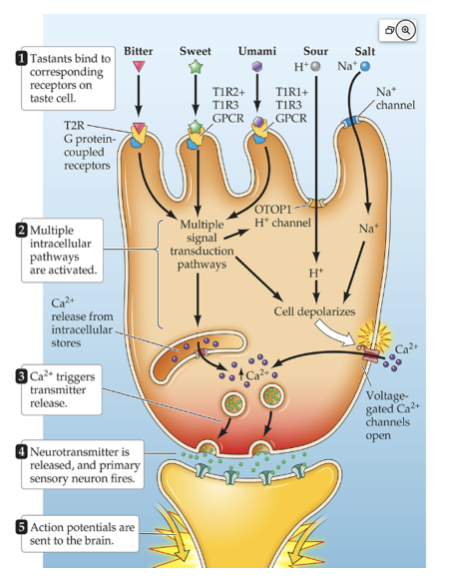
What does this image show for Chemical Mechanisms of Action?
Each taste bud contains multiple taste receptor cells, and each cell responds to one basic taste using its own signaling pathway. All pathways ultimately increase intracellular Ca²⁺ and depolarize the taste cell, causing neurotransmitter release and triggering an action potential in the sensory neuron.
What is Unique about Salt and Sour?
They are modulated through Ion Channels
Sour=H+
Salt=Na+
What is Unique about Bitter, Sweet, and Umami
They are modulated by G-coupled receptors
What nerves are important for carrying the Taste Sensation?
Facial Nerve (VII)
Glossopharyngeal (IX)
Vagus (X)
After the nerves carry those sensations, it will go towards the?
To the Midbrain, To the Solitary Tract, To the Thalamus, To the Gustatory Cortex (either Anterior Insula/ Frontal Operculum
What is Pattern Coding?
The brain identifies taste by comparing the relative firing patterns across many taste receptor cell axons, allowing subtle differences in taste to be distinguished.
What is Labelled Line Coding?
Each taste quality is carried by its own dedicated receptor cell and its own dedicated neural pathway, so the brain identifies taste based on which specific “line” is activated.
Olfactory
What are some facts about an Olfactory Receptor?
-Its a Bipolar Neuron
-It can be regenerated
With the Mucus lining it sits on a covering called the? and it will contain?
Olfactory Epithelium
contain Olfactory Receptor Cells,
The ends of Olfactory Receptor Cells have a? (Hint: Two Things)
Cilia extending into the mucus to capture smell information
Dendritic Knob
After the information is captured it will be pushed into the?
Olfactory Bulb
Opposite ends of the olfactory bulb are located in the?
Nervous System piercing through the Cribriform plate
The Cribriform plate acts as a barrier layer between what two things?
The Nose, and the Basal Layer of the brain
If the Cribriform plate was to accidentally break, what would occur?
The CSF fluid surrounding the brain can leak bringing rise to infection
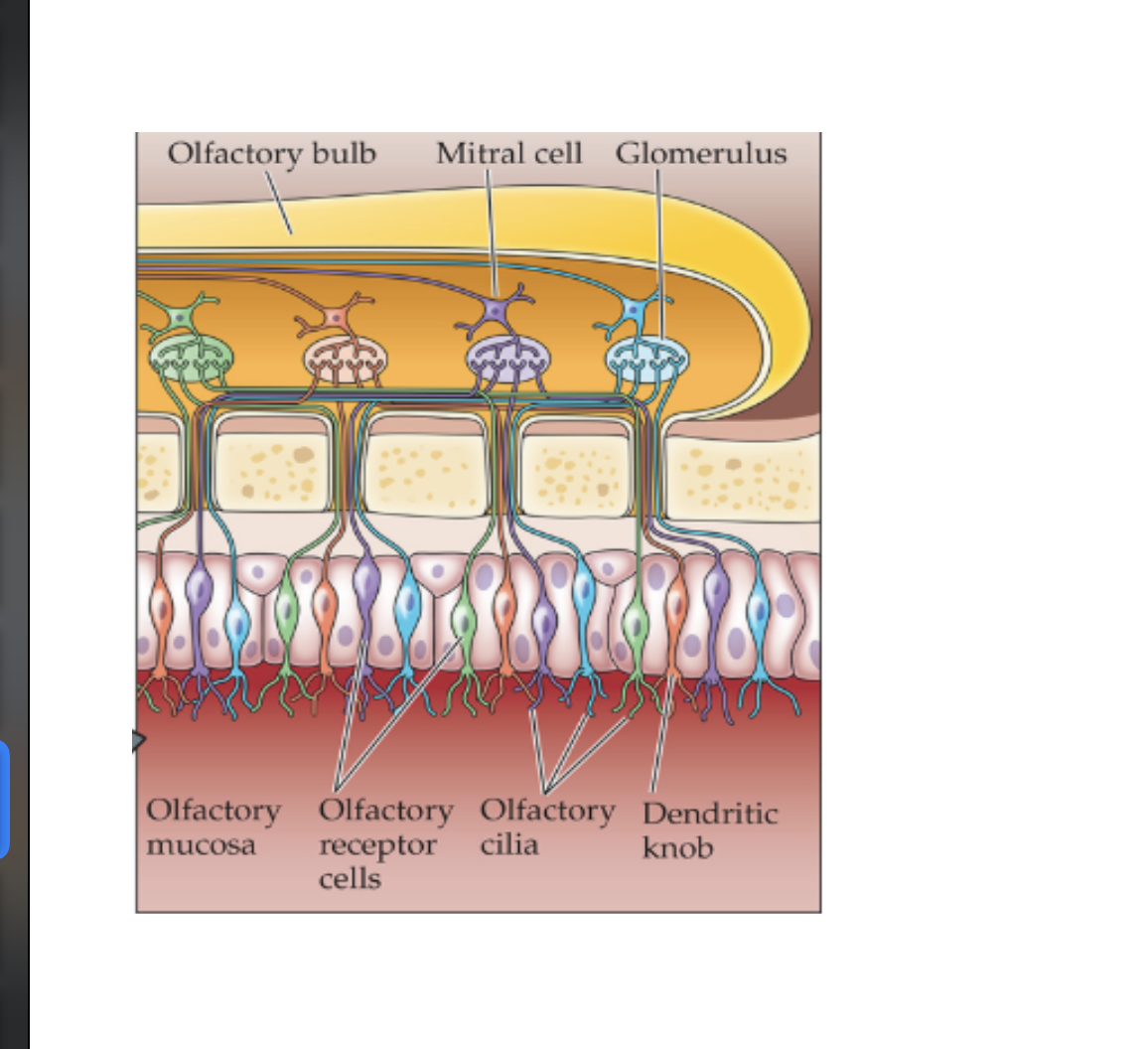
What is the Purpose of the Glomerulus, and the Mitral Cells
The Glomerulus is a cell located in the Olfactory Bulb with the main function of receiving similar signals from the ORN, and converging them to a strong signal, which the Mitral Cell will receive, refine, and send that signal.
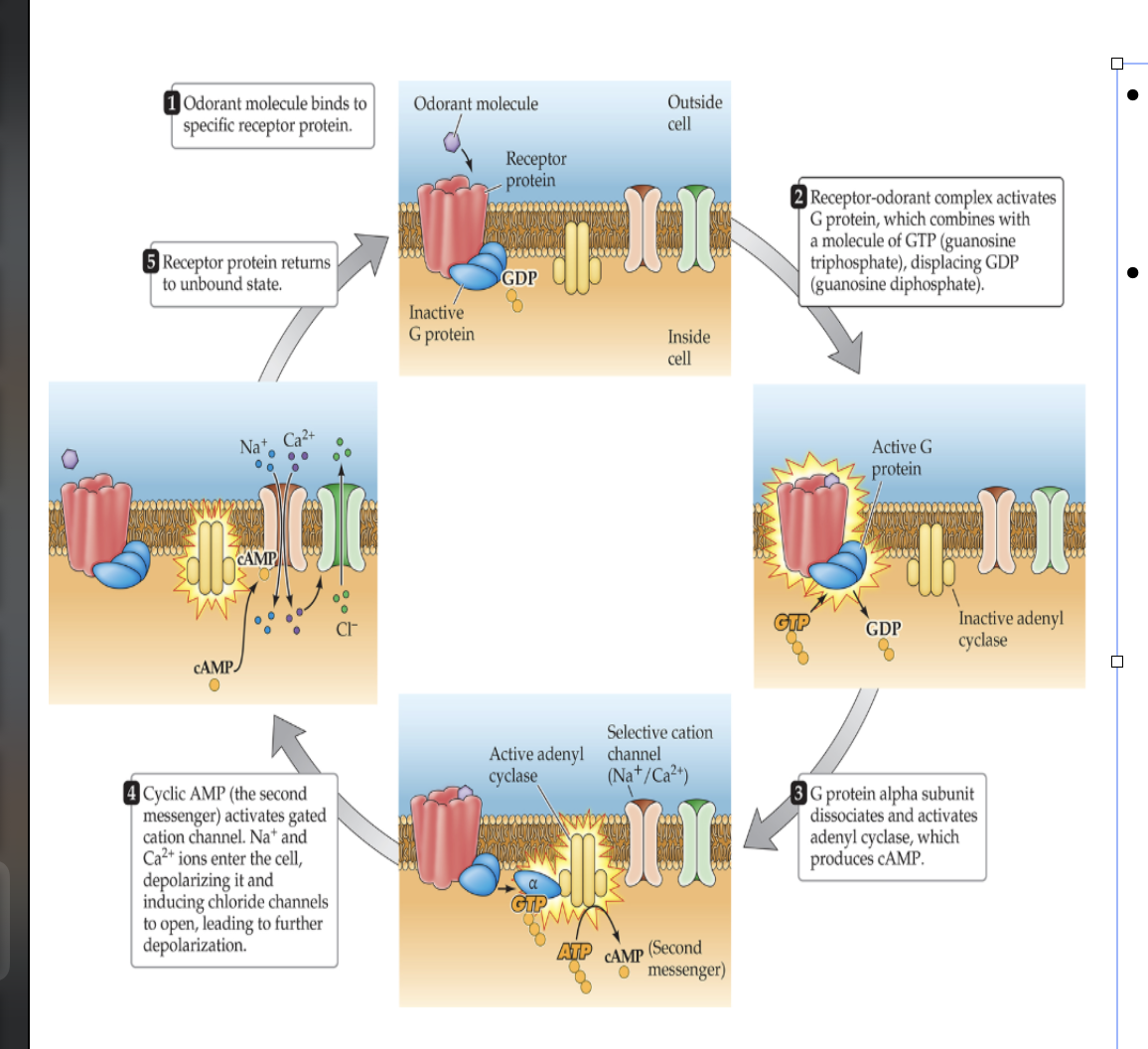
What is the Mechanism of Action of Odorant Molecules in Air?
Odorants will excite what on Olfactory Receptor Neurons?
Specialized Receptor Moleculues
Olfaction is a Pattern Coding Theory in which
400 kinds of Olfactory Receptors encodes for a combination of different kind of receptor molecules
Olfaction is what kind of process?
A G-protein coupled process
What is the process of the Olfactory Pathway to the Brain? (HINT: THIS IS THE REALLY LONG ONE, TRY YOUR BEST AT THE CONEPT)
1. Olfactory receptor neurons (ORNs) → Cribriform plate → Olfactory bulb
ORNs in the olfactory epithelium send their axons through the cribriform plate (as cranial nerve I) and terminate in the olfactory bulb.
2. Glomeruli receive ORN input
Inside the olfactory bulb, ORN axons converge onto glomeruli.
Each glomerulus receives input from ORNs that all express the same receptor type.
3. Mitral cells receive glomerular output
Within each glomerulus, ORNs synapse on the dendrites of mitral cells (and tufted cells).
Mitral cells are the main output neurons of the olfactory bulb.
4. Mitral cell axons form the olfactory tract
The axons of mitral cells leave the bulb as the olfactory tract, carrying the processed smell information deeper into the brain.
5. Projection to brain regions
Mitral cell axons project to several key areas:
Prepyriform (piriform) cortex – primary olfactory cortex
Entorhinal cortex – memory association
Amygdala – emotional responses
Hypothalamus – autonomic and behavioral responses
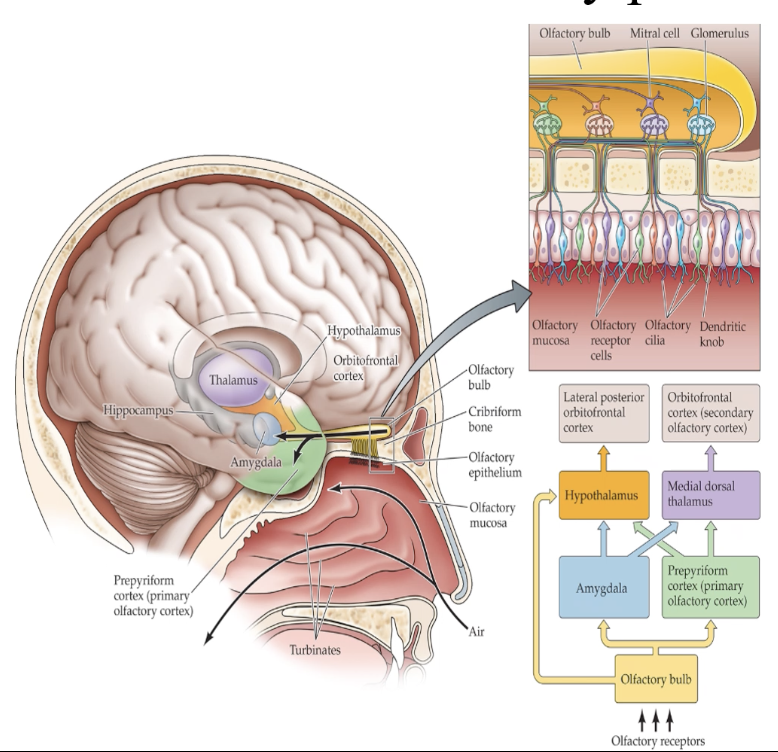
What is so special about smell?
It can synapse directly to Synapse, rather then passing through thalamus, amygdala, and hypothalamus
Vomeronasal System
Aids in detecting/capturing pheremones
What is a Pheremone?
A chemical signal released by one organism to attract other organs of same species
What is the New class of Receptors with the Vomeronasal System?
Trace Amine-Associated Receptors (TARR) specific for ORN which are specific for sex regulation by modulating pheromone expression

