3.5: Population growth and resource availability

0.0(0)
studied byStudied by 1 person
0.0(0)
call kaiCall Kai
learnLearn
examPractice Test
spaced repetitionSpaced Repetition
heart puzzleMatch
flashcardsFlashcards
GameKnowt Play
Card Sorting

1/11

encourage image

There's no tags or description

Looks like no tags are added yet.

Last updated 11:03 PM on 1/19/26
Name
Mastery
Learn
Test
Matching
Spaced
Call with Kai

No analytics yet

Send a link to your students to track their progress

12 Terms

1
New cards

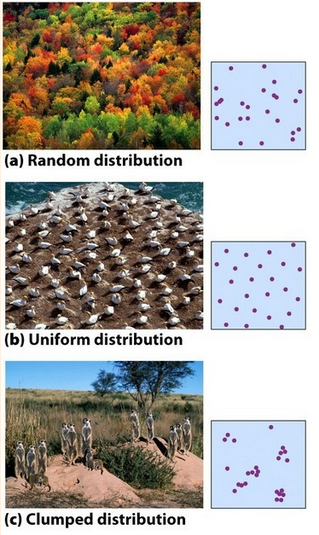
Population distribution

A description of how individuals are distributed with respect to one another.
<p>A description of how individuals are distributed with respect to one another.</p>
2
New cards

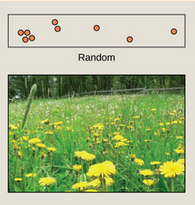
Random distribution

occurs with dandelion and other plants that have wind-dispersed seeds that germinate wherever they happen to fall in a favorable environment.
<p>occurs with dandelion and other plants that have wind-dispersed seeds that germinate wherever they happen to fall in a favorable environment.</p>
3
New cards

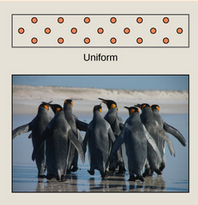
Uniform distribution

animals that maintain defined territories, such as nesting penguins, exhibit uniform dispersion.
<p>animals that maintain defined territories, such as nesting penguins, exhibit uniform dispersion.</p>
4
New cards

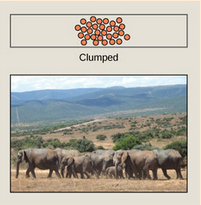
Clumped distribution

Schools of fish or herds of elephants. May also result when favorable conditions are localized, organisms will tend to clump around those, such as lions around a watering hole.
<p>Schools of fish or herds of elephants. May also result when favorable conditions are localized, organisms will tend to clump around those, such as lions around a watering hole.</p>
5
New cards

Metapopulation

A group of spatially distinct populations that are connected by occasional movements of individuals between them.
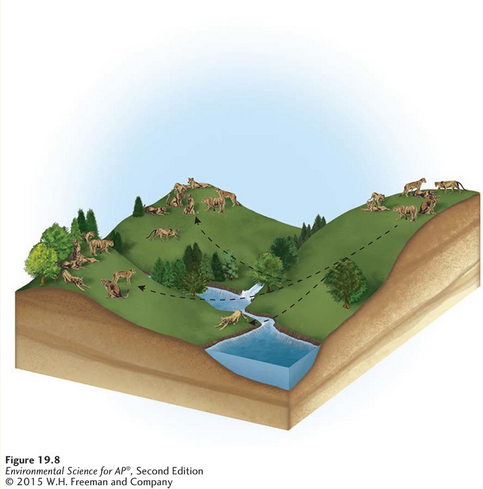
<p>A group of spatially distinct populations that are connected by occasional movements of individuals between them.</p>
6
New cards

Corridor

Strips of natural habitat that connect populations.

7
New cards

Sampling Populations

Sampling - is the process of collecting a representative group of a population or area to estimate characteristics of the whole, such as population size, density, or environmental conditions.

8
New cards

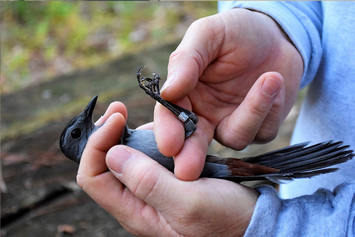
Capture, Mark, Release, Recapture

(Mark and Recapture Method)

Procedure:

  1. Capture a sample of animals from the population.

  2. Mark each individual with a unique identifier (tags, bands, or safe dyes).

  3. Release the marked animals back into their habitat.

  4. After a set time, capture another sample of animals and record how many are marked.

  5. Use the ratio of marked to unmarked individuals in the second sample to estimate the total population.

Advantages:

  • Allows scientists to estimate population sizes without needing to count every individual.

  • Effective for mobile or elusive species.

Limitations:

  • Assumes no significant migration, births, or deaths between samples.
<p><span style="background-color: transparent;"><span>Procedure:</span></span></p><ol><li><p><span style="background-color: transparent;"><span>Capture a sample of animals from the population.</span></span></p></li><li><p><span style="background-color: transparent;"><span>Mark each individual with a unique identifier (tags, bands, or safe dyes).</span></span></p></li><li><p><span style="background-color: transparent;"><span>Release the marked animals back into their habitat.</span></span></p></li><li><p><span style="background-color: transparent;"><span>After a set time, capture another sample of animals and record how many are marked.</span></span></p></li><li><p><span style="background-color: transparent;"><span>Use the ratio of marked to unmarked individuals in the second sample to estimate the total population.</span></span><br></p></li></ol><p><span style="background-color: transparent;"><span>Advantages:</span></span></p><ul><li><p><span style="background-color: transparent;"><span>Allows scientists to estimate population sizes without needing to count every individual.</span></span></p></li><li><p><span style="background-color: transparent;"><span>Effective for mobile or elusive species.</span></span></p></li></ul><p></p><p><span style="background-color: transparent;"><span>Limitations:</span></span></p><ul><li><p><span style="background-color: transparent;"><span>Assumes no significant migration, births, or deaths between samples.</span></span></p></li></ul><p></p>
9
New cards

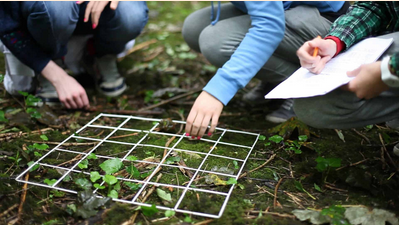
Quadrat Sampling

Procedure:

  1. Place a series of square frames (quadrats) randomly or systematically in the study area.

  1. Count all the individuals of the target species within each quadrat.

  1. Calculate the average number per quadrat and extrapolate to estimate total population.


Advantages:

  • Useful for studying species that are immobile or less likely to move (e.g., invertebrates).

  • Can provide data on density and distribution.

Limitations:

  • NOT effective for larger or mobile species.

  • Requires a large number of quadrats for accuracy. (sample size)
<p><span style="background-color: transparent;"><span>Procedure:</span></span></p><ol><li><p><span style="background-color: transparent;"><span>Place a series of square frames (quadrats) randomly or systematically in the study area.</span></span></p></li></ol><ol start="2"><li><p><span style="background-color: transparent;"><span>Count all the individuals of the target species within each quadrat.</span></span></p></li></ol><ol start="3"><li><p><span style="background-color: transparent;"><span>Calculate the average number per quadrat and extrapolate to estimate total population.</span></span></p></li></ol><p><br><span style="background-color: transparent;"><span>Advantages:</span></span></p><ul><li><p><span style="background-color: transparent;"><span>Useful for studying species that are immobile or less likely to move (e.g., invertebrates).</span></span></p></li></ul><ul><li><p><span style="background-color: transparent;"><span>Can provide data on density and distribution.</span></span><br></p></li></ul><p><span style="background-color: transparent;"><span>Limitations:</span></span></p><ul><li><p><span style="background-color: transparent;"><span>NOT effective for larger or mobile species.</span></span></p></li></ul><ul><li><p><span style="background-color: transparent;"><span>Requires a large number of quadrats for accuracy. (sample size)</span></span></p></li></ul><p></p>
10
New cards

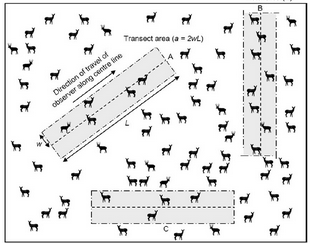
Transect Sampling

Procedure:

  1. Set up a line or strip (transect) across the study area.

  1. Record all individuals of the target species observed along the transect.

  2. Often combined with quadrats placed at intervals along the transect.

Advantages:

  • Useful for studying population gradients or changes across a habitat.

  • Provides a snapshot of species distribution.

Limitations:

  • Accuracy may vary depending on the width of the transect and the density of the population.
<p><span style="background-color: transparent;"><span>Procedure:</span></span></p><ol><li><p><span style="background-color: transparent;"><span>Set up a line or strip (transect) across the study area.</span></span></p></li></ol><ol start="2"><li><p><span style="background-color: transparent;"><span>Record all individuals of the target species observed along the transect.</span></span></p></li><li><p><span style="background-color: transparent;"><span>Often combined with quadrats placed at intervals along the transect.</span></span></p></li></ol><p></p><p><span style="background-color: transparent;"><span>Advantages:</span></span></p><ul><li><p><span style="background-color: transparent;"><span>Useful for studying population gradients or changes across a habitat.</span></span></p></li><li><p><span style="background-color: transparent;"><span>Provides a snapshot of species distribution.</span></span></p></li></ul><p></p><p><span style="background-color: transparent;"><span>Limitations:</span></span></p><ul><li><p><span style="background-color: transparent;"><span>Accuracy may vary depending on the width of the transect and the density of the population.</span></span></p></li></ul><p></p>
11
New cards

Remote Sampling (Camera Traps and Acoustic Surveys)

  • Purpose: Monitor elusive or nocturnal species

  • Method: Using motion-activated cameras (camera traps) or sound-recording devices (acoustic surveys) to capture images or sounds of animals. Often used for species that are hard to observe directly.
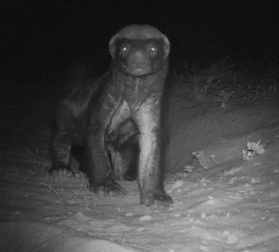
<ul><li><p><span style="background-color: transparent;"><span>Purpose: Monitor elusive or nocturnal species </span></span></p></li><li><p><span style="background-color: transparent;"><span>Method: Using motion-activated cameras (camera traps) or sound-recording devices (acoustic surveys) to capture images or sounds of animals. Often used for species that are hard to observe directly.</span></span></p></li></ul><p></p>
12
New cards

Inbreeding depression

When individuals with similar genotypes—typically relatives—breed with each other and produce offspring that have an impaired ability to survive and reproduce. Low genetic diversity.