A1.2,D1.1, D1.2, D1.3
 Studied by 7 people
 Call Kai
 Learn
Learn Practice Test
 Spaced Repetition
 Match
Match Flashcards
 Knowt Play
1/115

There's no tags or description
Looks like no tags are added yet.
Name | Mastery | Learn | Test | Matching | Spaced | Call with Kai |
|---|
No analytics yet
Send a link to your students to track their progress
116 Terms
DNA
deoxyribonucleic acid,
polymer that contains genetic material of all living organisms
Nucleic acid
Chains of representing monomers called nucleotides (macromolecule)
Nucleotides are the building blocks of DNA
Nucleotides join together
by condensation reaction called polymerisation
Viruses
infectious agents that are non living because they need a host to replicate
Viruses can
use RNA for their genetic material
Components of a nucleotide
Pentose sugar, simple sugar made of five carbon atoms
Nitrogenous base, molecule that contains nitrogen, acts as a base
Phosphate group, functional group made of phosphorus and oxygen
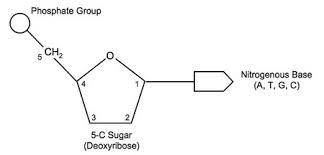
How nucleotide units link
Through a covalent bond to form a single strand of DNA or RNA
Bonds form between phosphate group of one nucleotide (5’ C has an -H) to the hydroxyl group (OH, attached to the 3’C) of another nucleotide.
Bonds and releases one water molecule
Forms a strong sugar phosphate backbone
Linking creates two ends, 5’ end with the phosphate group sticking out and 3’ end with the hydroxyl group sticking out
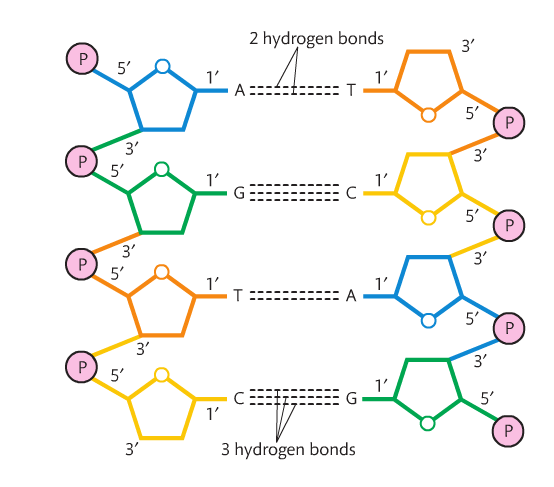
Bases in each nucleic acid
G- guanine T-thymine A- Adenine C- Cytosine U- Uracil
2 types of nitrogenous bases
Purine- Adenine and guanine (2 ring structure)
Pyrimidine- cytosine, thymine, uracil (1 ring structure)
Sequence of nitrogenous bases
form the genetic code in a strand of nucleic acid
DNA vs RNA bases
DNA: A-T, G-C
RNA: U-A, G-C
RNA vs DNA strands
RNA is single stranded nucleic acid
DNA double stranded molecule with helical shaped, 2 strands linked together by complementary base pairing of bases with hydrogen bonds, stabilises structure
Complementary base paining
Refers to the pairing of bases in DNA and RNA, that Adenine will always bond with its complement thymine, and G-C and A-U
Antiparallel
Refers to the two strands of DNA, one runs from 5’ to 3’ end, and the other from 3’ to 5’ end.
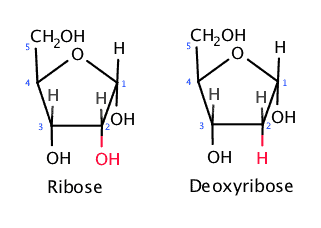
Differences between DNA and RNA
DNA pentose sugar deoxyribose vs RNA pentose sugar ribose.
DNA bases AGTC, RNA bases AGCU
DNA structure
double helix has two helical polynucleotide chains coiled around an axis. Bases are inside the helix and sugar phosphate backbone on outside.
During cell division
DNA undergoes cell replication, copying and doubling the DNA amount
Accuracy is critical to cell, base sequence must be the same
DNA codes for
Protein
Gene expression
Process by which the genetic code in the DNA is translated into a protein
Gene can be
expressed (switched on), or not expressed (switched off)
Complementary bases ensure that
the same protein is produced when the gene is expressed
DNA can be used as a
coding system to store large amounts of data because of enormous capacity as the four bases can be in any sequence in a given length.
Genetic code
Instructions in a gene in the form of base sequences that become translated into a functional protein
Replications
Copying of DNA to create a new DNA molecule
Transcription
Process in which the DNA is used as a template to produce RNA
3’ to 5’ is anti sense strand and this is where the mRNA will be copied from, start translating from the 3’ end as this would be the 5’ end for the mRNA
5’ to 3’ is the sense strand
Translation
Process in which the transcribed RNA is translated by the ribosomes to produce proteins
These three processes occur
in a 5’ to 3’ direction, must be consistent to ensure conservation of base sequence during copying , so same protein is always produced
5’ to 3’ direction
less energy needed for processes to take place in this direction, because of the enzymes, significant in processes, orientation
A-T
formation of 3 hydrogen bonds
G-C
formation of 3 hydrogen bonds
A-T
formation of 2 hydrogen bonds
If wrong bases pair
G-A will be too long
C-T will be too short
Complementary base pairing stabilises the DNA as the length of the base pairs are consistent in helix
Base pairing mistakes
identified because of incorrect length of pair and will be fixed, if mismatch persists will lead to structural instability at point of mismatch, can cause stopping of cell division and cell death
Nucleosome
Length of DNA wrapped around a core of 8 histones and a special histone H1 with linker that links multiple together around the H1 histone
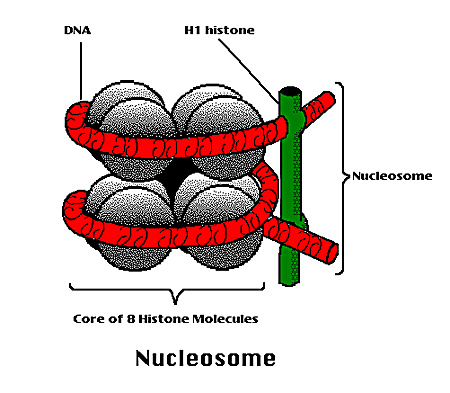
Eukaryotic DNA
found in the nucleus
associated with proteins called histones
Prokaryotic DNA
Bacteria DNA
found in cytoplasm
Lacks histones “naked DNA”
Nucleosomes form a
chromosome, repeatedly folding in on themselves to tighten and condense the packaged DNA, must fit large genomes of Eukaryotes in the nucleus
Appropriate access to DNA
Nucleosomes must do this so coils can be unwound and histones moved out of the way so DNA can replicate or be transcribed
Scientists deliberated whether genetic material was
DNA or proteins, they knew chromosomes played a role in heredity, but chromosomes have DNA and protein
Hershey Chase experiment
Used a bacteriophage (virus that infects bacterial cells)
Injects its DNA into bacterial cell while protein coat stays on outside
Used radioactive phosphorus and sulphur to label DNA and protein in the viruses
When bacteriophages that contained radioactive phosphorus (DNA) were allowed to infect non radioactive bacteria, all infected cells became radioactive and so did the next generation
When bacteria were infected with bacteriophages labelled with radioactive sulphur (protein) and virus coats were removed almost no radioactivity could be detected in the cells.
Since DNA caused formation of radioactive cells it must be the genetic material
Chargaff paper chromatography
Analysed samples of DNA using paper chromatography to separate components of DNA
measured the concentrations of ATGC
Found that the amount of A=amount of T and G=C, but it isn’t completely 50 50 between A-T base pairs and G-C, falsified the hypothesis that there were repeating sequences of base pairing, otherwise these concentrations would be 50 50
Supports double helix model and complementary base pairing
Cell division occurs
For growth or repair ( if a cell is damaged, new cells will be an exact genetic copy of those around them)
cells each need a copy of organisms DNA, acquire through DNA replication that occurs prior to cell division
Base sequences need to be copied exactly for new cells to function
DNA semi conservative
As one double strand of DNA is replicated, each new double strand produced has 1 original strand, and 1 strand of newly synthesised DNA.
Each original DNA strand acts as a template for new one, complementary base pairing ensures new strand of DNA is exact copy
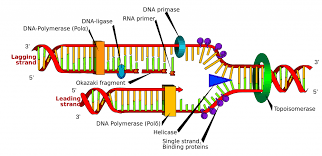
Helicase
Unwinds double helix and separated 2 DNA strands by breaking hydrogen bonds between bases
DNA primase
Attaches RNA primers made up of RNA nucleotides to template strand, only 1 required on leading strand, primers are needed regularly on the lagging strand due to discontinuous replication
DNA polymerase III
Assembles new strand of DNA placing free nucleotide in correct base sequence to template strand, only builds in 5’ to 3’ direction
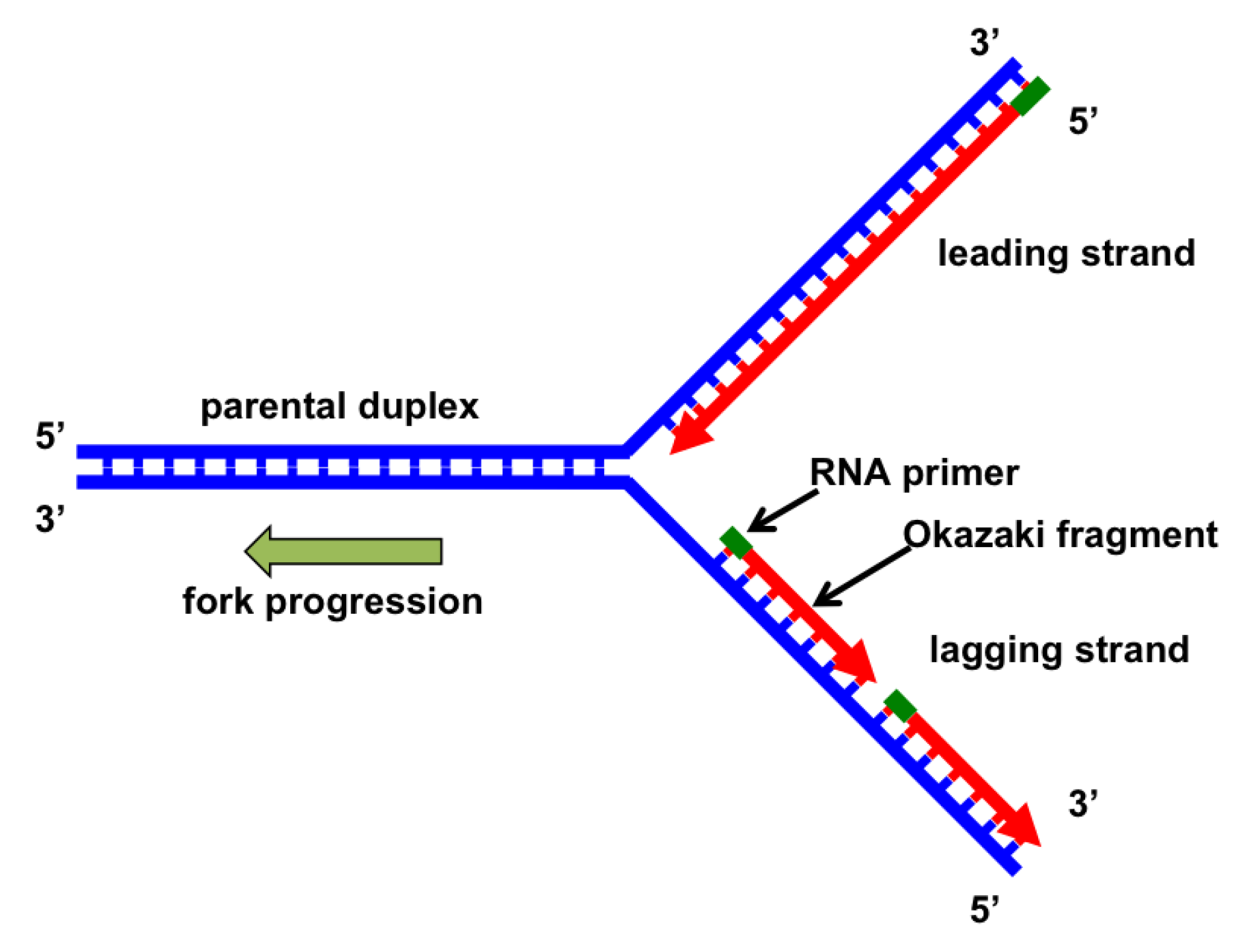
Leading strand vs. lagging strand
continuous vs discontinuous because its moving in the opposite way than the helicase is opening up replication fork, must work backwards and discontinuously, makes Okazaki fragments
DNA polymerase I
Removes RNA nucleotide primers and replaces them with correct DNA nucleotides
Ligase
Glue that catalyses bond formations between Okazaki fragments, makes lagging strand into normally functioning single strand
DNA proofreading
DNA polymerase III also proofreads newly formed DNA strand as it is being made, incorrect nucleotides removed and replaced, so cells avoid mutations that could lead to mutation
Triphosphates in DNA replication
Used in synthesis of RNA primers and used as energy source for enzymes needed to initiate and sustain DNA synthesis at the replication fork.
Nucleotides held together by
phosphodiester bonds, reason for directionality as they occur between 5’ end of one nucleotide and 3’ end of another
Due to directionality
only one strand can be replicated in the same direction as the helicase is unwinding the original strand, leading strand
Other strand is orientated in opposite direction does not allow DNA polymerase to move in the same direction as helicase, lagging strand discontinuous
New formed disconnected DNA- Okazaki fragments
the leading strand is the one where the replicated strand is moving in a 5’ to 3’ direction towards the replication fork, so the 3’ is by the replication fork
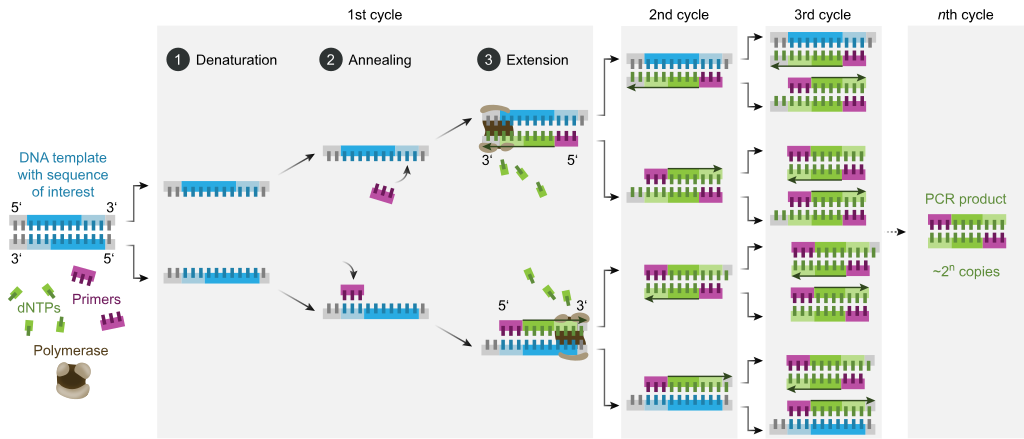
PCR
polymerase chain reaction
Techinique used to amplify small fragments of DNA that is used to work with DNA on crime scenes, clone genes, identify the dead
Desired section of DNA is placed in a reaction chamber containing
Free nucleotide triphosphate
Primers allowing replication to occur at any desired point
Heat stable version of DNA polymerase called tax polymerase (found in hot springs, bacteria that does not denature at hot temperature)
Steps of PCR
DNA heated to break hydrogen bonds which holds 2 strands of double helix together (denaturation phase)
Short primer sequences after cooling will bond to complementary sequences in DNA sample (annealing phase)
Bonding of primers allows taq polymerase to replicate DNA using the primer as a starting point (extension phase)
Once DNA has been replicated, DNA strands are heated to point of separations and process repeats
Each time a cycle occurs, amount of DNA doubles resulting in exponential growth. Provides ample copies for tests.
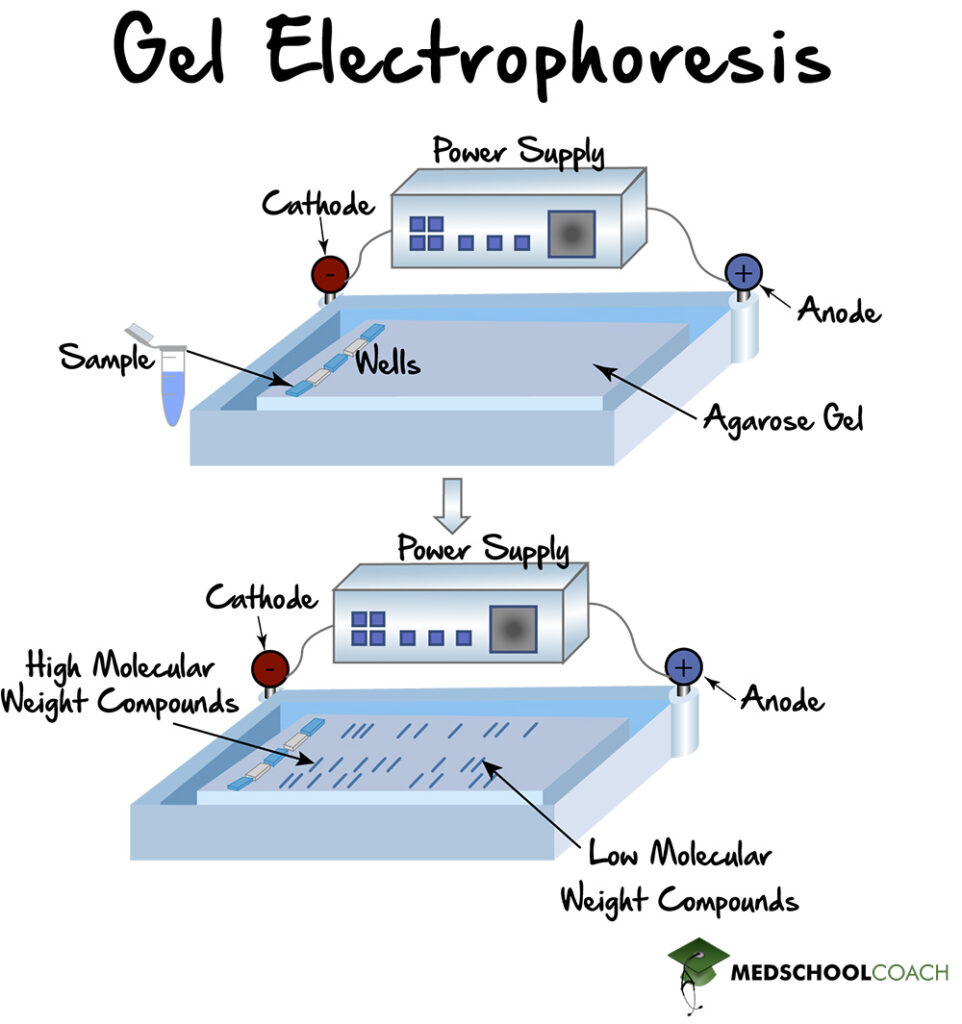
Gel electrophoresis
Used to identify key features of DNA
DNA molecules separated by
size and charge because DNA molecules are negatively charged and are attracted to the positive electrode in an electric field
To get DNA fragments to be short enough to be separated by electrophoresis
DNA is digested with enzymes called restriction endonucleases
cut the backbone of DNA double helix at highly specific sequences
Steps of gel electrophoresis
Samples with DNA fragments loaded into wells of the gel
Gel submerged into buffer solution, electric current is run through the gel
DNA samples begin near negative pole, to spread out as they are attracted to positive pole
Gel is porous, smaller DNA can slip through easier, they can travel further along gel in given period of time
One or more of wells filled with a DNA ladder, reference point for unknown fragments we already know the length of these samples so comparing the rest with these we know how long their’s are
Gel is dyed to see DNA fragments
shortest fragments in front and most charged
Transcriptions occurs
In nucleus
Enzyme responsible for transcription
RNA polymerase
Transcription 3 phases
1) Initiation- RNA polymerase binds to DNA at start of a gene. Then separates two strands by breaking hydrogen bonds to expose bases.
2) Elongation- RNA polymerase builds molecule of RNA on one of the DNA strands (anti sense strand) other strand not used (sense strand), moves along the DNA adding free RNA nucleotides to growing MRNA
3) Termination- Terminator sequence in DNA is reached and the mRNA is released detaches from the DNA strand and the two strands attach again
Remember uracil with air with adenine not thymine
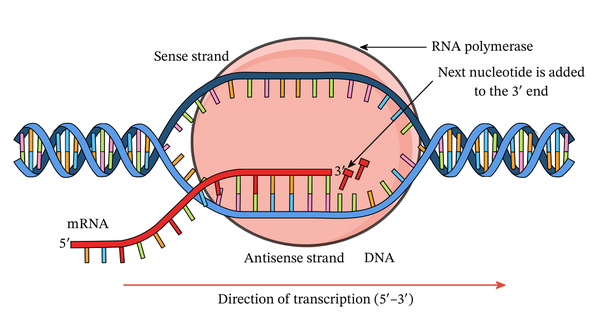
mRNA
messenger because DNA cannot leave the nucleus, so it sends messenger RNA to carry information from nucleus to cytoplasm.
The code found in mRNA
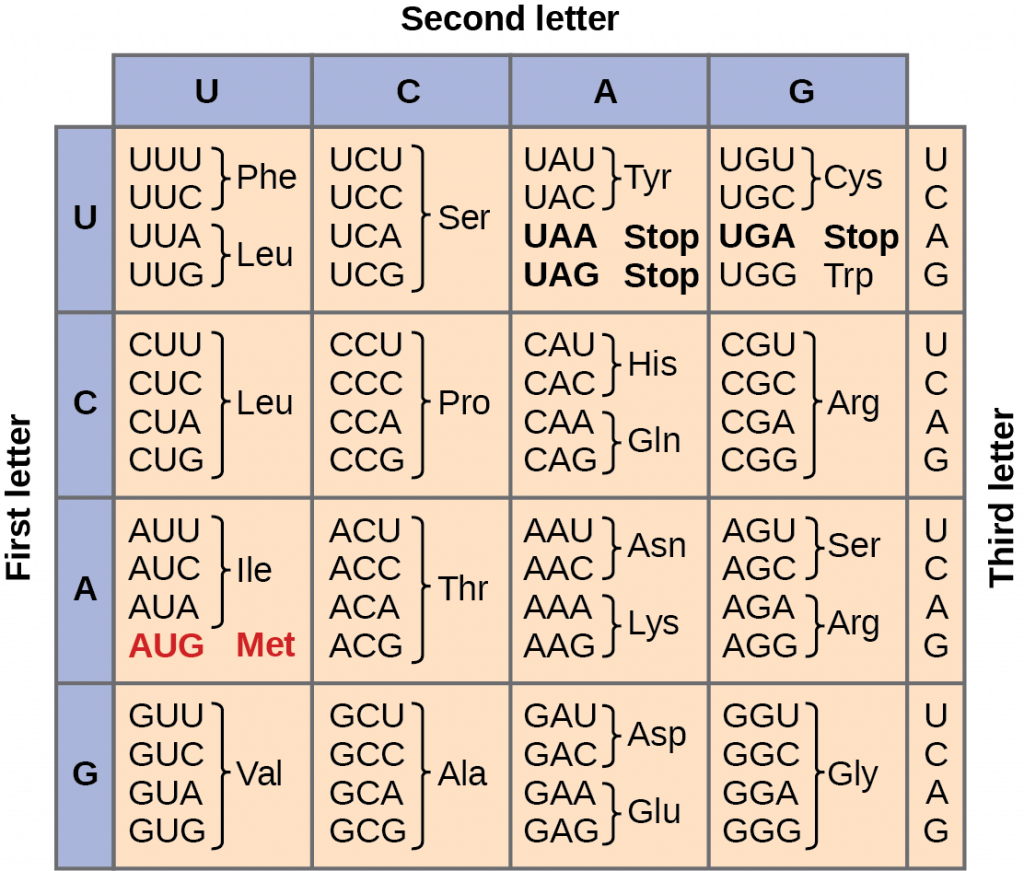
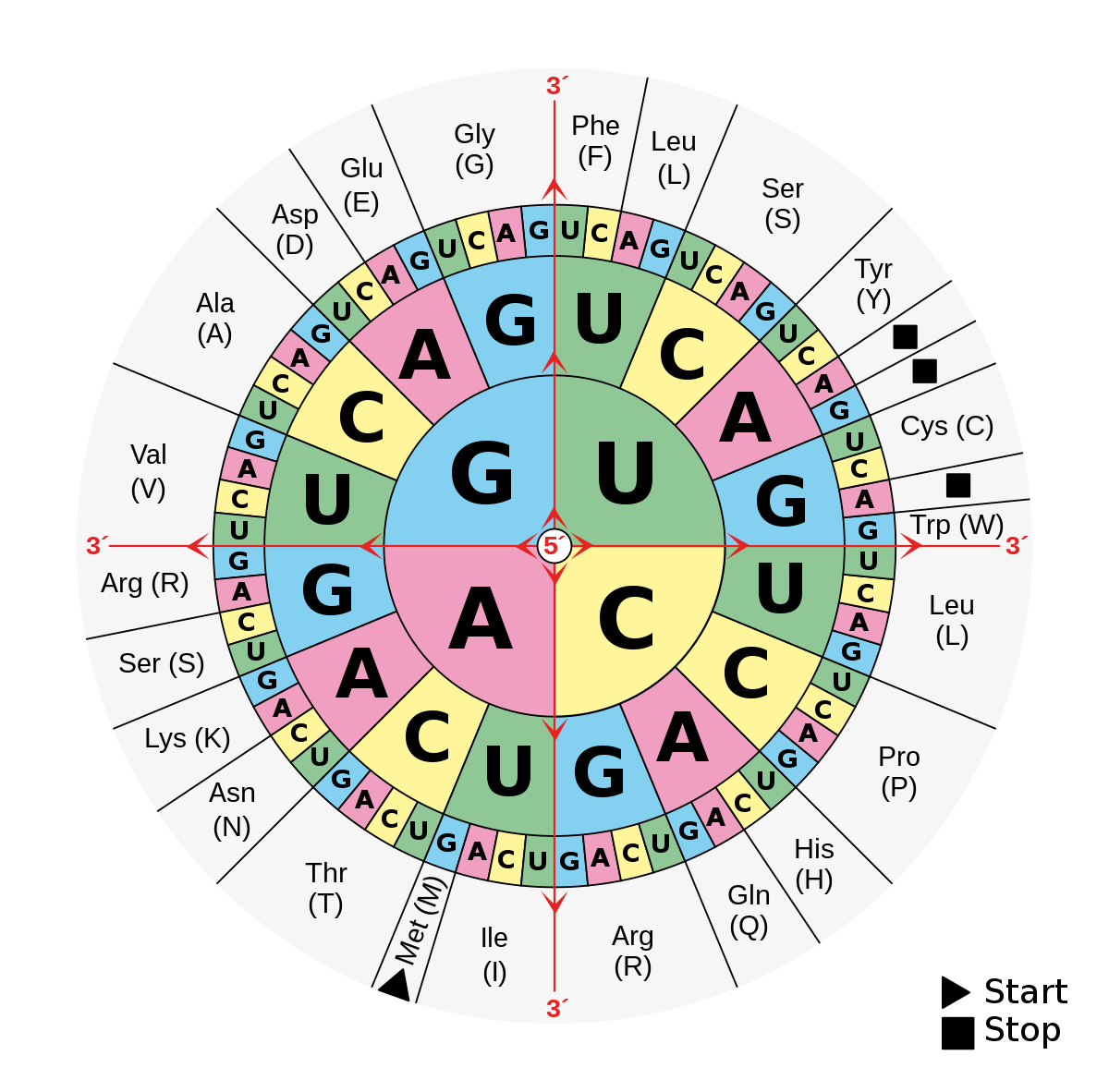
Read in groups of three, the codon, can be any three RNA bases in a sequence which is the code for the placement of a specific amino acid
Degeneracy of genetic code
Because there are 4 bases read in groups of three, 64 possible codons but only 20 amino acid, so multiple codons can code for the same amino acid
Start codon
AUG, tRNA hold methionine which is anti codon to start codon
Genetic code universal
Same codons code for same amino acid in every organism on earth, common ancestor
Table of mRNA codons
Circular table of mRNA codons
Promoter in transcription
mRNA primase is not able to bond to DNA at any point, on DNA just before a gene Is a region of code called the promoter, the TATA box.
At promoter transcription factors can bind allowing polymerase to bind and transcribe DNA
If transcription factors are missing the gene will not be expressed as transcription will not take place, promotor is area where gene can be switched on or off
Non coding DNA
DNA sequences that do not contain information to make a protein, but can be used to regulate gene expression
Introns: Base sequences that get removed at the end of transcription, don’t contribute to amino acid sequence
Telomeres: Repetitive sequences to protect end of chromosome, ensure DNA replicates correctly
Introns
where they are found and not found
DNA sequences containing no coding information but sometimes contain controlling sequences that regulate transcription of the gene
They are found in eukaryotes because they have a nucleus and transcription occurs in the nucleus, and these only get cut out after transcription, but not in prokaryotes since they do not have a nucleus and do not undergo transcription
Exons
DNA sequences that code for a polypeptide
Steps to modify mRNA to be used in translation
1) transcription
2) adding a poly a tail and a 5’ cap to protect mRNA from degrading because it is very vulnerable when it separates from DNA due to know hydrogen bonding)
3) splicing, remove introns and join axons to form mature mRNA using spliceosome to disassemble and remove introns and join exons
Alternative splicing
Splicing together of different combinations of exons allows one gene to code for different amino acids
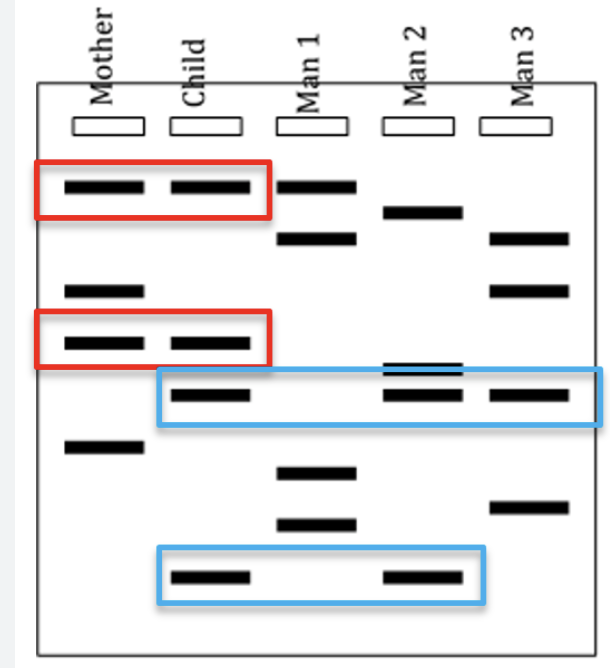
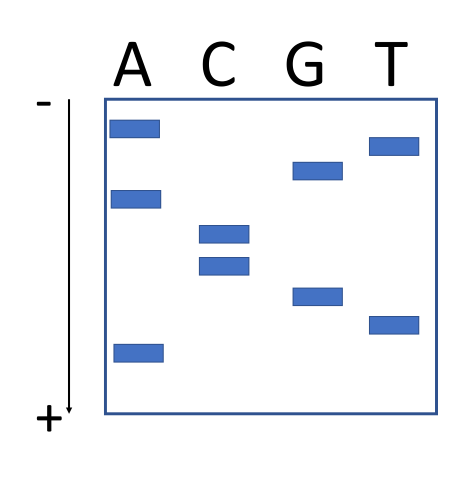
Reading code from gel electrophoresis
The ones closest to the positive pole are the shortest and the strongest charge. They were able to get the furthest from the positive pole because they are the smallest to fit through the pole quickest and had the strongest pull to the positive end. So the ones closest to that end are first in the code as they are the closest to the primer because its smallest. The longest will be the last in the code as they are far and large from the primer.
ARGCCAGTA
Once mRNA goes out of nucleus
goes to cytoplasm and translation takes place
Code from mRNA read
and used to synthesise polypeptides
Translation occurs at
ribosomes free in cytoplasm or attached to rough endoplasmic reticulum
Ribosome
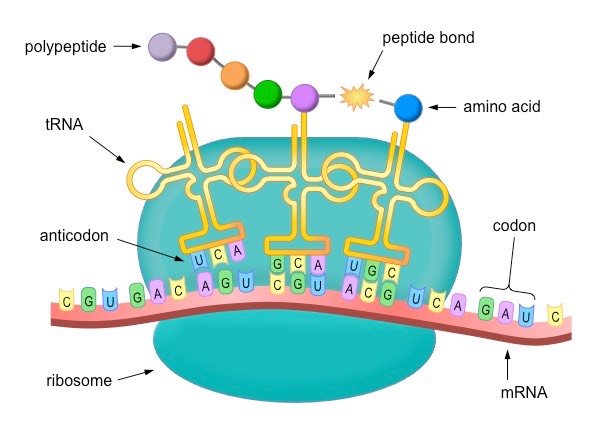
Site of translation, brings mRNA and tRNA together in correct orientation for process to occur.
Acts as an enzyme, 3 active site
small and large subunits, 3 binding sites for tRNA molecules
Small unit binds to mRNA, large unit binds up to to 2 tRNA
tRNA
single stranded RNA molecule, folds itself to form 4 leaf clover shape with double stranded regions
Each has corresponding amino acid.
Has anti codon, codon complementary to the codon on the mRNA
3 stages of translation
1) Initiation: AUG codon on mRNA allows ribosome subunit to bond to mRNA and translation to start
2) Elongation: ribosome shifts along mRNA one codon at a time, then a new tRNA comes carrying corresponding amino acid(A site), having the anti codon that matches the codon, it attaches and its amino acid polypeptide bonds to the polypeptide chain (on tRNA on P site) and moves previous tRNA molecule to the next position (E site) and shifts to P site making space for new tRNA molecule
3) Termination: process repeats many times until polypeptide complete and termination is required to stop, and all components disassemble
Mutations
Naturally occurring, important for genetic variation and evolution
Caused by mutagens
Caused by errors in DNA replication or repair
Happens during cell division
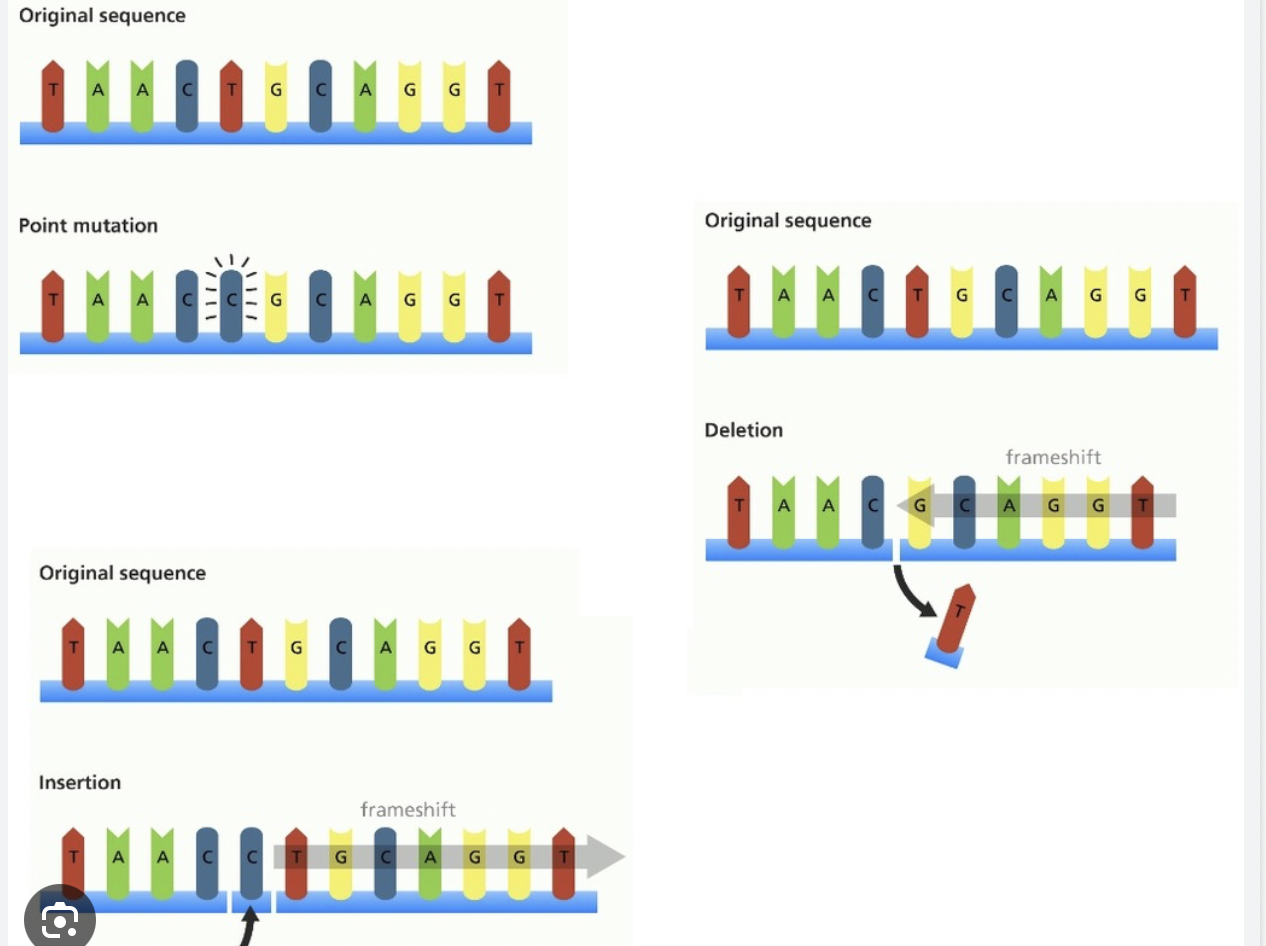
Point mutation
A single nucleotide in the base pair sequence is changed
Deleted, added, or replaced with another (substitution)
Insertion, deletion has significant effect due to frameshift, all codons following are effected
Single nucleotide polymorphism
Due to degeneracy of genetic code, sometimes a change in the base sequence produces a codon which codes for the same amino acid therefore there is no effect on the protein produced (silent mutation)
If mutation changed the codon to a stop codon
Would end the polypeptide chain early, protein is unlikely to be functional
Change to another amino acid
Lead to an effect on overall polypeptide
Chemical mutagens and mutagenic forms of radiation
Chemical mutagens- smoking and drinking
Growing body has a lot of cell division occurring, so risk of mutation from radiation of x rays has a big chance of causing mutation in a pregnant women’s baby
Gamma rays Uv rays
genome
entire set of DNA instructions found in a cell
Transcription first stage of
gene expression, gene expression can be turned on or off
semantic cells
do not divide or replicate, DNA base sequences must be conserved throughout life of cell
Modification of polypeptides into their functional state, as after a polypeptide is synthesised it may still not be in final functional state ex. insulin
Peptide based hormone
After translation its product is preproinsulin
Composed of a signal peptide, A chain, B chain, C peptide
Once pre pro insulin enters the rough endoplasmic reticulum, signal peptide is removed, now proinsulin
Disulfide bridges form between A and B chain
Pro insulin packaged into vesicles, moved to Golgi apparatus where C peptide is removed and mature insulin remains
Proteome
Total of all proteins made and used by the body
How we maintain our proteome
Constantly producing proteins, need a lot of amino acids to do this:
Can be supplied by our diet or
All proteins that are unneeded or damaged can be broken down and recycled for their amino acids, carried out by protein complex called proteosome
Keeps proteome healthy and complete
Mutations can
occur anywhere in the base sequence, but some bases have a higher probability of mutating than others
No natural cause is making a deliberate mutation, it just happens that certain environments can cause a mutation like UV rays, and certain mutations can be beneficial for the survival of a species, causing that mutation to become more popular amongst the species due to its area for reproduction
Gene mutations can occur in either
Semantic cells: all the cells in the body except for germ cells
germ cells: cells that give rise to egg or sperm
Somantic cells (cancer)
mutations in this cell can cause diseases during a person’s lifetime, like cancer
Cannot be passed down to offspring, mutations in semantic cell
Germ cell
mutations in this cell can be inherited and passed on to gametes (inherited mutations)
May alter chromosome number or gene sequence in the gametes, cause genetic disorders or susceptibility to disease
Variation
Natural diversity that exists among individuals within a species
Differences in traits, characteristics, and genetic makeup
Mutation is the original source of variation:essential for evolution by natural selection
 Note
Note  Flashcards (41)