Chapter 9: Forming Impressions
 Studied by 0 people
 Call with Kai
 Learn
Learn Practice Test
 Spaced Repetition
 Match
Match Flashcards
 Knowt Play
1/24

There's no tags or description
Looks like no tags are added yet.
Name | Mastery | Learn | Test | Matching | Spaced | Call with Kai |
|---|
No study sessions yet.
25 Terms
Attributions
The act of crediting a source or cause for certain behaviour
Situational Attribution
Dispositional Attribution
Situational Attribution
Attributing behaviour to the specific situations and not the personality traits of an individual
Dispositional Attribution
Attributing the behaviour to just being the personality of the individual and not a result of that specific situation
Social Comparison
People evaluate themselves relative to others can lead to feeling of inferiority/ intimidation if they are supposedly better
Actor-Observer Effect
We perceive ourselves differently compared to those we observe - we are more aware of the many circumstances/ situational factors contributing to our behaviour
Fundamental Attribution Error:
Self-Serving Bias:
Above-average Effect:
Fundamental Attribution Error
We have a tendency to over-estimate disposition attributed and under-estimate situational attributes especially when judging the behaviour of others
Collectivist Society: Less focus on an individual behaviour and more on community more likely to explain behavior to situational factors for others
Individualist Society: FOcus more on themselves, will more likely explain behaviour as dispositional instead of situational
Self-Serving Bias
We tend to view our personal successes as reflection of our true abilities and failures as being something from our circumstances
leads to above average effect
Above-average Effect:
a cognitive bias where people overestimate their own abilities and qualities compared to others
Attribution theories:
Attribution theories explain how individuals interpret and assign causes to behavior, both their own and others’.
Covariation theory (kelly):
How a behaviour can be attributed to either dispositional or situational factors - How behaviour changes across different conditions
Consensus: Do other people behave the same way in this situation?
High: situational
Low: dispositional
Distintiveness: Does the person behave this way in only this situation, or in many situations?
High: situational
Low: Dispositional
They act like this in other situations as well
Consistency: Does the person behave the same way over time in this situation?
High: either situational or dispositional
Low: Wider situational
Like its a very specific situation
Correspondence Inference theory:
we actively analyze a person’s behaviour to make inferences using three factors.
Degree of choice: amount of freedom the actor had to choosing their opinion or behavior
Expectation: the degree to which an individual behavior and a particular social role matches are expectation for that role
Defying expectation = more informative
Intended Consequence: the goals and motivation of an actor underlying their Behavior
Explicit Bias
a conscious, deliberate prejudice that someone is aware of and expresses
Implicit Bias
An unconscious, automatic attitude or stereotype that influences behavior without the person's awareness
Implicit biases develop from repeated exposure to societal stereotypes
Implicit Association Test (IAT):
Implicit Association Test (IAT):
Measures implicit biases by assessing response times in categorization tasks
Test: Told to categorize stimuli (words or faces) using paired response keys
Results:
Compatible pairing: categories associated in mind → faster, more accurate responses
Incompatible pairing: categories not associated → slower, more errors
BAcking: Causing amygdala activation, its a natural association in our minds
Cognitive Heuristics
mental shortcuts or rules of thumb that the brain uses to make decisions quickly and efficiently, especially under uncertainty → helps make quick decisions
Representativeness Heuristics:
Availability Heuristic
Representativeness Heuristics
A mental shortcut that involves judging the probability of an event based on how similar it is to a mental prototype or stereotype
Availability Heuristic
A mental shortcut where people estimate the likelihood of an event based on how easily examples come to mind
Can be effected by “illusory correlation” believing in a correlation that doesn’t actually exist
False Consensus effect:
We tend to believe more people share our views than they actually do
Helps protect our self esteem
Stereotypes
a widely held but oversimplified belief about a particular type of person or thing, which is often untrue and can be harmful
Illusory Correlation - CAN EFFECT IT
Illusory Correlation
when individuals believe that two variables are related even though there is no evidence for that relationship
Reinforces existing beliefs through selective attention to examples that confirm stereotypes.
PRejudice trends
Historical data: Prejudice against Black people has declined since 1930s.
Explicit bias: Most people now deny racial prejudice in surveys.
Implicit bias: Stereotypes remain unconsciously and can influence behavior.
THe IAT: People associated black people with negative workds and white people with psoitve words
They were faster at pairing “compatible pairings” like black with negative and white with positive
But when told to pair white with bad and black with good they took longer
This was even seen in people belonging to the group
Factors of Attractiveness
Proximity: how often we get to interact
Functional vs physical distance
Familiarity
Physical attractiveness
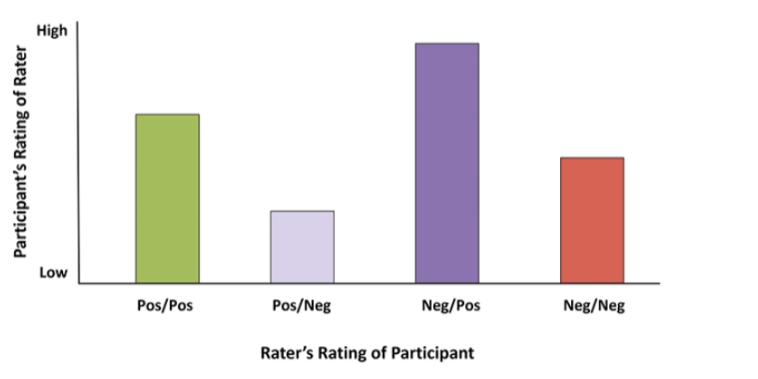
Others opinions of us
Self esteem boost → makes the other person seem better
Mere Exposure effect:
A tendency to perceive previous stimulus more favorable
just being exposed to it more
Halo effect
Tennessee to Tribute more positive characteristics to individuals that make a positive impression AKA more attractive
Others opinions of us - previous impressions
Previous impressions: influence how you feel
 Note
Note  Flashcards (60)