Mass Transfer & Hydrodynamics
 Studied by 0 people
 Call Kai
 Learn
Learn Practice Test
 Spaced Repetition
 Match
Match Flashcards
 Knowt Play
1/19

There's no tags or description
Looks like no tags are added yet.
Name | Mastery | Learn | Test | Matching | Spaced | Call with Kai |
|---|
No analytics yet
Send a link to your students to track their progress
20 Terms
Reynolds Number (Re)
Definition: The ratio of inertial forces to viscous forces in a flowing fluid. It indicates how much "momentum" the fluid has compared to how "sticky" it is.
Utility: * Determines if the flow is Laminar (smooth) or Turbulent (chaotic).
Essential for selecting the correct empirical correlations to calculate mass transfer coefficients.
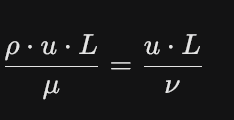
Schmidt Number (Sc)
Definition: The ratio of momentum diffusivity (kinematic viscosity) to mass diffusivity. It compares how fast velocity "spreads" versus how fast molecules "spread."
Utility: * Relates the thickness of the hydrodynamic boundary layer to the concentration boundary layer.
It is a property of the fluid and the diffusing species (independent of flow velocity)
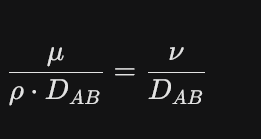
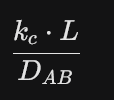
Sherwood Number (Sh)
Definition: The ratio of convective mass transfer to the rate of diffusive mass transfer. It is the mass transfer analog of the Nusselt number (Nu) in heat transfer.
Utility: * Used to determine the convective mass transfer coefficient (kc).
Most mass transfer problems involve solving for Sh using Re and Sc.
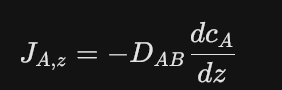
Fick’s First Law of Diffusion
Definition: A law stating that the molar flux of a species is proportional to its concentration gradient. It assumes that mass moves from areas of high concentration to areas of low concentration.
Utility: * Used to calculate the diffusive flux (JA,z) in a steady-state system.
It defines the fundamental relationship used to find the diffusion coefficient (DAB).
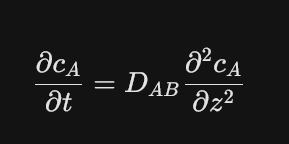
Fick’s Second Law (Transient Diffusion)
Definition: An extension of Fick's first law that describes how concentration changes over time at a specific position.
Utility: * Essential for non-steady-state problems, such as predicting how long it takes for a gas to penetrate a solid.
Used in industrial applications like semiconductor doping or the drying of materials.
General Molar Flux (Total Flux)
Definition: The total movement of a species relative to a fixed coordinate system, combining both molecular diffusion and bulk flow (convection).
Utility: * This is the "master equation" for mass transfer problems.
It accounts for the fact that species A is not just diffusing, but is also being "carried along" by the overall velocity of the fluid mixture (Vz).

Mass Transport Limitation
A state where the reaction rate is limited by how fast reactants can reach the electrode surface.
Utility: This is the "bottleneck" your project aims to solve using pulsatile flow.
Pulsatile Flow
A non-steady fluid flow where the velocity varies periodically with time.
Utility: Used in RECHARGE to disrupt "boundary layers" (stagnant fluid) and enhance mixing at the electrode surface.
Pressure Drop (ΔP)
The loss of pressure as electrolyte moves through the porous electrode. High pressure drop requires more pumping power, lowering overall efficiency.
Boundary Layer
A thin layer of stagnant fluid near the electrode surface where reactant concentration is lower than in the bulk fluid.
Euler Number (Eu)
Definition: The ratio of pressure forces to inertial forces.
Utility: Used to characterize pressure losses in a flowing system, especially across valves or orifices.

Weber Number (We)
Definition: The ratio of inertial forces to surface tension forces.
Utility: Important in multiphase flows, such as droplet formation or bubbles, where surface tension dominates.

Froude Number (Fr)
Definition: The ratio of inertial forces to external gravitational forces.
Utility: Crucial for free-surface flows (like waves or open channels) and predicting ship resistance.

Continuity Equation
Definition: A statement of the Law of Conservation of Mass for a fluid.
Utility: Ensures that the mass flowing into a system equals the mass flowing out (assuming no accumulation).

Bernoulli’s Principle
Definition: For an inviscid, incompressible fluid in steady flow, the sum of pressure, kinetic, and potential energy remains constant along a streamline.
Utility: Explains how fluid speed increases as pressure decreases (e.g., airplane wings, venturi meters).

Navier-Stokes Equations
Definition: A set of partial differential equations that describe the motion of viscous fluid substances.
Utility: The "master equations" for all fluid mechanics; used to solve for velocity and pressure fields.

No-Slip Condition
Definition: The assumption that at a solid boundary, the fluid has zero velocity relative to the boundary.
Utility: Explains why boundary layers form and why fluid "sticks" to the walls of pipes.
Shear Stress (τ)
Definition: The component of stress coplanar with a material cross-section. In fluids, it is the force per unit area required to slide one layer of fluid over another.
Utility: Directly related to the dynamic viscosity of the fluid.

Boundary Layer Thickness (δ)
Definition: The distance from a solid surface to the point where the fluid velocity reaches 99% of the "free stream" velocity.
Utility: Helps in calculating drag and predicting when flow will separate from a surface.
 Note
Note  Flashcards (53)