Chapter 19 - Revolutions in Politics
 Studied by 0 people
 Call Kai
 Learn
Learn Practice Test
 Spaced Repetition
 Match
Match Flashcards
 Knowt Play
 Podcast
1/70

There's no tags or description
Looks like no tags are added yet.
Name | Mastery | Learn | Test | Matching | Spaced | Call with Kai |
|---|
No study sessions yet.
71 Terms
What was the Taking of the Bastille? (give the date too and say the LEADER and what he did!)
1789; This was when a group of angry Parisians led by Pierre Francois Palloy attacked this royal prison (called the Bastille), freeing all seven prisoners and destroying the building, ridding it of its symbolic worth.
Palloy ended up taking the pieces of the bastille and building mini-ones, spreading them all throughout Europe and showing people this “freedom relic” that resulted from repression. He even created paperweights, medals, jewelry, and even busts of revolutionary heroes such as Marquis de Lafayette to represent this new freedom.
Name the three GENERAL factors that contributed to revolution in British North America, France, and Haiti…
There were many political and economic changes that gradually destoyed the state authority.
Many strong Enlightenment ideas were spread throughout these territories, even though many writers tried staying away from politics.
Tons of financial crises generated by warfare
Prior to reform, what did each class look like in the 18th century European society?
It consisted of nobles, various middle class groups (professionals, merchants, guild masters), and peasants/urban laborers.
The nobles were the largest landowners (owned ¼ of the agricultural land in France), exempt from direct taxation, and the exclusive rights to bear swords and use gold thread in their clothing.
Most of the middle class enjoyed rights that allowed them to monopolize their economic activity.
The peasants/urban laborers were the majority of the population and recieved the harshest taxation and rigged of many privileges.
During the 1750s, there was a HUGE spike in population that was seem in Europe. What did people do in terms of social change?
Since there was a massive boost in population, it become more difficult to find affordable food and living space. As a result, many people, including women and children, worked longer hours and worked harder (this challenged the customs of village life!).
ADDITIONALLY, economic growth only increased the gap between the rich and poor. While the poor were struggled with rising prices, investors become filthy rich from overseas trade and rural manufacture (e.g., trade of enslaved Africans and product of slave labor).
How did the bourgeoisie start to rise? (Hint: there’s two paragraphs here!)
In the 1750s when rising prices were common, proud nobles would marry wealthy, educated commoners, creating this mixed elite.
This also largely came from the shift from landed aristocracy and city merchants into trade and the rising middle-class bureaucrats/merchants who bought landed estates and noble titles.
Talk about the social change in terms of racism…
Many European colonies enforced slavery to increase its trade. By the late 18th century, European law stated that only Africans and people of its decent were subject to slavery (even free people of color were subjected to harsh restrictions like the propety they could own, who they could marry, or the clothes they wore).
Many people had growing demands for liberty and equality. Discuss this by using a specific example from the French Revolution.
People started to demand individual human rights and were known as Liberals. They wanted to end censorship, obtain sovereignty, and freedom from judges that obeyed orders.
The Declaration of the Rights of Man and of the Citizens was issued at the beginning of the French Revolution and proclaimed that liberty is “being able to do anything that doesn’t harm another person.”
Who were the two most important Enlightenment references for 18th-century liberals? Why?
John Locke & Montesquieu
Locke believed taht England’s political tradition rested on “the rights of Englishmen” and on a representative government (Parliament). He said that if a government overstepped its function of protecting someone’s natural rights, then it becomes tyranny.
Montesquieu believed similar things and was inspired by the Glorius Revolutoin, which put sovereignty in Parliament. He said that the judicial nobility offerd the best defense of liberty against despotism.
Who did many liberalistic ideas appeal to?
It was mainly the educated middle class like the bourgeoisie and A TINY BIT toward the hereditary nobility as formulated by Montesquieu.
What were some drawbacks to liberal ideas? Did it actually mean democracy? What about others places? Did all people agree?
Many drawbacks included the misleading idea of democracy. Liberal thinkers wanted MEN who OWNED LAND—those with a “stake in society”—to vote for representatives.
People across Europe disagreed about this. Some wanted suffrage for all males, others for females and free people of color.
ALL OF THIS contributed to a revolution!
How did the Seven Years’ War affect the urge for Revolution?
It affected many nations, but the two major parties were France and Britain. The British gained tons of land and a colonial empire, but suffered from A TON OF WAR DEBT (hey American Revolution are you at the door?). The French were completely humiliated in both North America, coming away with only some Caribbean islands. They were also in severe debt and both nations raised taxes like crazy! Protests started breaking out that demanded for reform.
What did classical liberalism look like (hint: American Revolution).
It showed the world what the strengths and limits of it were. Liberty meant individual freedoms and political safeguards, but it also meant a representative government without a one person one vote. It did not mean equal rights for slaves, indigenous peoples, or women.
Specifically, abolishionist movements in the 1780s led to emancipation laws across north states, but slavery remained in the South, causing a stir in the Constitutional Convention of 1787. The result was the 3/5 compromise (you know what this is!).
What was the significance of Abigail Adams?
When drafting a new Constitution for the US after the Articles of Confederation ultimately failed, she wrote “Remember the Ladies,” signalling some of the issues that lie with liberalism (no voting for women). Her plea wanted more women’s rights and wanted to participate in the political system.
What was by far the BIGGEST influence on the French Revolution?
This is a joke question! It was the American Revolution! Hundreds of French soldiers served alongside the Americans, like Marquis de Lafayette, and returned with a love for liberty and republicanism.
What was the biggest thing that the French Revolution fought for? Why? What factors influenced it (hint: there’s two!)
People wanted to resolve the financial difficulties that were put in place from the War of Austrian Succession and the Seven Years’ War. They also wanted nobles to finally pay taxes for the first time.
FIRST PART:
However, many courts denied this request, known as the Parlement (actual spelling haha). The noble judges of these Parelements resisted the tax reforms. And, when efforts were made but failed in 1776, the government was forced to finance their expenses, creating TONSSSSS of national debt and leading them on the verge of bankruptcy in 1786.
SECOND PART:
Louis XV only made things worse. He significantly hurt France socially. He refused to take communion because his adultery put him in a state of sin. He was being desacralized by his “aura” view of God
What happened after Louis XV’s death? Who came in and what did they start by doing?
Louis XVI rose to power and tried reviving the struggling economy by imposing a tax on all landed property. He also wanted to form provincial assemblies to administer the tax. THIS DID NOT WORK and was shut down by Parelement, saying he didn’t have that authority.
The Parlement stated that he needed approval of the Estates General, which hadn’t met since 1614 (it was now 1787).
The king originally tried to get out of this by tryuing to exile the judges; however, that didn’t work and resulted in tons of protests. As a result, he was forced to call for the Estates General in 1788.
Who was present at the Estates General in 1788? Why and how were they elected?
This was a meeting from the three estates (clergy, nobility, and everyone else). Each estate would elect delegates at a local then regional level.
The clergy estate elected mostly priests rather than church leaders which showed their dissatisfaction with the church hiearchy. The noble estate elected people primarily from the provinces where novles were less wealthy, more devout, and more numerous. Finally, the commoners (third estate) elected lawyers and governemnt officials, with few people representing business and the poor.
What did the Estates General HOPE to talk about as heard across all three estates? (THIS IS NOT WHAT ACTUALLY HAPPENED!)
All three estates wanted to remove absolutism and replace it with a constitutional monarchy where laws and taxes would require approval from the Estates General. There was also a strong emphasis that individual liberties would be guaranteed by law and that economic regulations would be loosened.
What ACTUALLY happened at the Estates General?
In 1789, 1200 delegates from three estates met in Versailles and despite hopes for serious reform, the General focused over voting procedures and how each estate should vote. Essentially, they said that the two privileged estates could always outvote the third.
Following what had happened during parts of the Estates General, like the voting restrictions, what did people respond with?
The third estate was outraged. People like Emmanual Joseph Sieyes wrote What Is the Third Estate? arguing that the nobility was a tiny, overprivileged minority and that the third estate had the true strength over France.
This issue become so widespread across the third estate that they created the National Assembly in June 1789 and met in a large indorr tennis court to pledge the Tennis Court Oath, pledging not to disband until they were recognized and had written a new constitution.
How did Louis XVI respond to the National Assembly?
Seeing that he was losing control over the situation, he sent 18k troops to bring them under control. He was planning to use violence to restore absolutist control.
In 1789, it was just horrible in France because of the delegates in Versailles! What made it even worse?!
There was a horrible grain harvest in 1788 that caused the price of bread to soar and inflation spread quickly. As a result, 150k out of the 600k people lost their jobs in Paris in 1789.
Describe the painting by Jacques-Louis David and the Tennis Court Oath!
This was painted two years after the Tennis Court Oath and included delegates from the third estate taking the oath in a dramatic manner, symbolizing their unity. There were many people faced toward a central figure.
What was the first physical demonstration that happened in terms of a revolution? What was the result by Louis?
Several hundred peopel stormed the Bastille to obtain weapons and free prisoners. As a result, Louis reinstated his finance minister (which he fired earlier to become more absolutist) and withdrew the troops from Paris. This FINALLY RESULTED in the National Assembly being free to continue its work (no more troops!).
What was the Great Fear? What led to it?
The Great Fear was a period of panic in France after many peasant uprisings took place against nobles to seize the French countryside and to revolt.
Essentially, after the storming of the Bastille, many peasants started to ransack manor houses, burn federal documents, and rose against their land-lords.
What came out of the Great Fear in terms of the National Assembly?
They stated that all old noble privileges (peasant serfdom, exclusive hunting rights, no taxes, right to make peasants work on roads (corvee) were abolished. The National Assembly then created the Declaration of the Rights of Man and of the Citizen, calling into effect the liberal revolutionary ideals of equality.
Some people were STILL struggling worse than ever, even after the Declaration of the Rights of Man and of the Citizen. Who were they and what they do?
Most of them were the poor and hungry of France. After the fall of the Bastille, the economic crisis only worsened. Women especially could no longer look to the church for aid and as a result, 7k marched from Paris to Versailles to demand action and INVADED the Palace of Versailles, demanding the King to Return to Paris. They killed a few people and tried searching for Marie Antoinette, but ultimately failed to progress that far.
What happened in terms of the National Assembly over 1789-91?
In June 1790, the Assembly abolished the nobility and in July, the King swore to uphold the yet-unwritten Constitution to establish the constitutional monarchy. While the king was still the head of state, all lawmaking power was in the National Assembly, which was elected by Frnech males who had the property requirements.
In September 1791, the Constitution was passed, legalizing divorce and broadening women’s rights to inherit property and obtain financial support for illegitimate children (still excluded from office and voting).
What were some criticisms of the Constitution written September 1791 in France?
A small number of men and women believed all French citizens should recieve equal rights and suffrage. Politically active women formed clubs, wrote pamphlets, and petitioned the National Assembly.
Olympe de Gouges, a self-taught writer and woman, protested the evils of slavery and the injustices toward women. In September 1791, she published Declaration of the Rights of Woman, which echoed the previously written Declaration of the Rights of Man and of the Citizens, to say that women too were born free and remain equal to man.
He book and advocacy, while powerful today found little sympathy.
When the National Assembly finally finished their revolution, what did they focus on/do? (Hint: 3 things)
They reformed the provinces into 83 departments of relatively equal size
They prohibited guids and works’ associations and abolsihed internal customs fees to promote the economic liberty.
They imposed a radical reform over religious life. The Assembly gave religious freedom to a small minority of French Protestants and Jews. They nationalized the Catholic Church and abolsihed monasteries and used church property as collateral to create a new paper currency.
What were some of the international thoughts about what had just happened in France after 1791? (Hint: two people w/ 3 books; don’t include kings/nobles here)
Some people in Europe and the United States responded with some support. Some liberals and radicals saw the triumph of liberty over despotism; others viewed it as dangerous.
Edmund Burke was a British statesman who wrote Reflections on the Revolution in France, saying that the principles of liberty and rights shouldn’t be taken that far. Instead, there should be emphasis on inherited traditions and privileges from social stability.
Another writer was Mary Wollstonecraft, who wrote an attack on the revolution titled A Vindication of the Rights of Man (1790) and two years later A Vindication of the Rights of Woman. Like de Gouges, she wanted equal rights for women and advocated for coeducation in the sense that women would become better wives and mothers, good citizens, and economically independent.
What did kings and nobles of other nations think about the French Revolution?
Many of them were incredibly scared of it spreading, especially after seeing that the royal family of France was arrested in 1791 for trying to flee.
Some nations, like Austria and Prussia, saw this arrest as an outrage (given that they were both crowned). Two months later, they issued the Declaration of Pillnitz, saying they would interfere in France to restore Louis XVI’s rule.
How did the people of France respond to the Declaration of Pillnitz?
Many of them held representative debates called the Legislative Assembly, which contained prosperous, well-educated middle class men. And, since the National Assembly said sitting deputies were ineligible for re-election, many of the delegates belonged to the Jacobin Club (members who were radical republicans).
In response, these Jacobins and others formed a patriotic opposition, saying that “we will incite a war of people against kings.” And, following this, they declared war on Francis II of Austria in 1792.
Describe the conflict after war was declared on ______ of Austria…
Francis II; During the conflict, Prussia helped Austria to crush parts of France, forcing them to retreat with that First Coalition of revolutionary battles. Additionally, the duke of Brunswick issued a manifesto, saying that they would destroy Paris if harm came to the royal family.
Throughout this manifesto, the Legislative Assembly declared the country in danger, and many patriotic volunteers rallied to the capital, where they captured and imporisoned the king at the Tuileries (fearing the result of that Manifesto).
What officially started the second revolution in France? (short flashcard :D)
It was marked by the imprisonment and suspension of Louis XVI after many volunteers ransacked him at Tuileries.
What were the September Massacres? (Where did this even start from?!)
The September Massacres was a series of killings by French crowds where they traveled to the prisons and killed jaile dpriests and aristocrats.
This largely came out of what Austria and Prussia were plotting for in the 1792 conflict. There were many rumors coming from Prussia, like the idea they would support anti-revolution efforts.
What happened immediately following the September Masscres?
The National Convention, which replaced the Legislative Assembly, proclaimed France as a republic where the people, instead of the monarch, held sovereign power.
The Jacobins were increasingly divided into two groups in late 1792. What were they and what were some similarities/differences?
It was separated into the Girondists and the Mountain (that was headed by Robespierre and Georges Jacuqes Danton).
The division emerged after convicting Louis XVI and determining whether he should be killed. The Girondists accepted guit, but didn’t want death (the Mountain wanted death and succeeded by a small majority).
Despite that difference, both groups wanted to continue the “war against tyranny.” After stopping the Prussians at the Battle of Valmy in September 1792, the French armies invaded many other cities and effectively took the entire Austrian Neetherlands by November 1792.
Everywhere the French went, like into German Rhineland, Savoy, etc, they plundered the treasures and took food/supplies. They wre starting to be viewed as foreign invaders. To make that even worse, the National Convention, already at war with Austria and Prussia, declared war on Britain, Spain, and the Dutch Republic.
After declaring war on basically all of France, what happened within it? Were people supportive?
Inside of France, many people—devout catholics, royalists—in the Brittany region didn’t want to go to war.
Additionally, there was an evergrowing divide betwene the Girondists and the Mountain. The laboring poor and the petty traders, known as the sans-culottes demanded radical political acction to defend the Revolution. Seeing an opportunity, the Mountain, joined with e sans-culottes to lead an uprising on the Convention, capturing 29 Girondists and ultimately passing all power to the Mountain (innate: Robespierre & Georges Jacques Danton).
After the Mountain become the “big-wig” Jacobin group in France, we started to see the emergence of _______. What were some of his efforts while in power? What did people not like?
Robespierre; In power, he formed the Committee of Public Safety in April 1793 which gave him any power needed to defned the Revolution.
That first step was EXTREMELY controversial and uprisings in cities revolted against the committee’s power. EX: Counter-revolutionary forces in Vendee won many victors, effectively forcing the Convention to fall back to the areas around Paris.
Even though defeat seemed immeinent after the Venee rebellion, what happened to allow Robespierre to keep going?
It sounded like luck, but at this time (1792-93), the French had tons of success in the economy, revolutoinary terror, and strong nationalism throughout the state in wartime. This is what allowed them to retain the Austrian Netherlands and other cities (like the German Rhineland)
How did Robespierre “keep going” after the rebellions? (this flashcard will talk about what HE actually did!)
He was able to advance his Committee of Public Safety in 1793-94 by collaborating with the sans-culottes, who continued to support fair prices and a moral economic order. This allowed Robespierre to establish a planned economy with an egalitarian social overtones (every human had the same moral worth).
His economic plan had the government set maximum prices for key products, fixing the price of bread in Paris at levels the poor could afford.
The government also told the people what to produce—uniforms, boots, saddles, arms—for the war effort. This was similar to socialism!
ALL OF THIS WAS THE GROUND-WORK for the Reign of Terror!
What was the Reign of Terror (don’t talk about how it happened!)?
This was a period that enforced republican beliefs and practices. It was larged commanded by Robespierre, who used his Committee of Public Safety to try “enemies of the nation” for political crimes. Around 50k French men and women were executed or died in prison and around 300k were arrested.
Additionally, many Jacobins also suppressed women’s participations in political debate, which they perceived as disorderly. Specifically, the National Convention declared on October 30, 1793 that the clubs and societies of women were prohibited, with Olympe de Gouges sent to the Guillotine in November.
The third element of the Committee’s program was to bring a cultural revolution that would transform royalists into republican citizens. By doing this, they started to promote secular festiavls to support republicanism (think of the plate showing a festival of the cult of a supreme being with liberty under it).
This was all done to appearently save the revolution.
How did Robespierre die?
After extending the political rant of the Reign of Terror, Robespierre sent many long-standing collaborators to the guillotine, including Georges Jacques Danton. And, with many radicals/moderates believing they were next, they captured Robespierre when he tried speaking at the National Convention on the 9 Thermidor (date to France’s new calendar).
What happened after the death of Robespierre?
It created a period called the Thermidorian Reaction, which carried ideas similar to the early Revolutoin. The new leaders of government put an end to the reign of terror and returned representative government, rule of law, and liberal economic policies. As a result, prices rose sharply and severly restricted the sans-culottes.
What did the new National Convention do after July 28th 1794 (death of Robespierre), AKA how was it set up?
They wrote a new constitution to guarentee their economic position and political supremacy. This new constitution greatly reduced the number of men eligible to vote by implementing a hefty property requirement. Finally, it had a bicameral legislature, with a Council of 500 serving as the lower house that initiated legistlation and the Council of Elders (~250 men) acting as the upper house to approve new laws.
Then, to prevent a Robespierre copy-and-paste, they created the Directory, which was an executive power team of 5 men.
How did Napoleon Bonaparte actually gain power?
There was a lot of weariness about the Directory, so in 1799, Napolean led a coup d’etat to violently overthrow the directory with a small group. The reasoning specifically came from the idea that it was an ineffective program, with Abbe Sieyes’ motto “Confidence from below, authority from above.”
How did Napoleon appleal to the people of France?
He did this by appeasing powerful groups in France, like offering them favors in return for loyal service (this was known as the Napoleonic Code). This helped to reassure the principles of the 1789 revolutoin: equality of all male citizens and security of wealth/private property.
To appease to the peasants, he helped to defend the gains in land they had won during the Revolution and by establishing the Bank of France in 1800.
What were some of the early goals of Napoleon in terms of the governmental structure?
Napoleon created a new imperial nobility by granting amnesty to 100k emigres on the condition that they would return to France and take loyalty. This allowed him to reward his most talengted generals and officials.
He also helped top restore the Catholic Church so that it could serve as social stability. After negotiating with Pope Pius VII, he signed the Concordat of 1801, which reestablished the church in France.
How were women treated under Napoleon?
They lost many of the gains they made in the 1790s. Under his code, they became dependents of either their fathers or husbands and they could not make contracts or have bank accounts in their names. Under Napoleon, he re-established a family monarchy, where the power of the husband/father was absolute.
Describe Napoleon’s invasion of Russia…
He entered with around 600k troops (1/3 were French) and isntead of wintering in Smolensk to avoid death, Napoleon foolishly pushed on toward Moscow. The great Battle of Borodino that followed was a draw, but Napoleon still refused to negotiate to order a retreat. It was after 5 weeks that he finally agreed to retreat from the scorched and abandoned city. It was the Russian army, the Russian winter, and the starvation that cut his army into pieces. 570k men had either died or become prisoner.
What happened after Napoleon’s war efforts failed in Russia?
He rushed to Paris to try and build another army. However, he refused to let France live at its historic size, which was an offer from Austria’s prime minister. After denying this, Austria and Prussia deserted Napoleon and joined Russia and Great Britain in the Treaty of Chaumont. These powers united to defeat the French emperor.
As a result, they sent Napoleon to a small island called Elba off the coast of Italy. There, he raised a small following and went back to Paris to try and take back power from Louis XVIII (who was just put back in). After initial success, Napoleon was back, but all of his allies in France were against him and after a conflict known as the Hundred Days, they crushed his forces at Waterloo, finally ending his reign.
Give me some of the context of the Saint-Domingue… (essentially, you’re saying why it’s not surprising people wanted to revolt)
There was an incredible ratio of Africans (and mixed-africans) toward white people. Unfortunately, since this was France’s most profitable caribbean island, it was also the most enslaved, so many legal and economic conditions favored the whites.
It was also found that white people could increase profits by completing ignoring morality (like providing food, medical care, etc) and instead, just opting to buy another slave when one died. To make it worse, the 1685 Black Code was intented to support humane treatment, but almost nobody enforced it.
While some slaves were able to find freedom in the mountains with a group of “maroons,” it was rare for individuals with TOTAL african decent (more common for mixed-race children to receive freedom, especially under the 1685 Black Code which said they were equal to whites).
What inspiration did people on Saint-Domingue gain from France for a revolution?
Many individuals heard about the news of abolitionist movements in France which created hopes that the mother country might grant them freedom. Additionally, free people of color looked in Paris as a means to gain equal status with whites.
Who was Vincent Oge and what did he do?
He was a free man of color that returned to Saint-Domingue with aspirations to win rights for his people. He raised an army of several hundred and sent letters to the Provincial Assembly of Saint-Domingue, demanding political rights for all free-citizens. When this DIDN’T happen, he turned to violence. Even though some efforts were successful, he was ultimately defeated, tortured, then executed.
However, his story was heard by the National Assembly, which empathized with Oge and granted political rights to free people of color born to two free parents who possessed enough property. Though this was put into place, it was never accepted by the governor in Saint-Domingue, so violence once again insued.
How did the actual slave revolt happen in Saint-Domingue?
It started by tons of slaves meeting at night in August 1791, where they discussed ideas about a mass insurrection. They found out that many had experience in some sort of combat, like civil war in Kongo, running away, slowingdown work on slavery. All of them had some reason and some sort of experience.
Revolts began on August 22 and throughout the next month, many sugar and coffee plantatoins were destroyed.
What did France do in response to the insurrections that were happening in August/September of 1791?
They responded by granting full citizenship to free people of color, hoping that they would win the loyalty of free people and their aid in defeating the slave rebellion.
What started happening on the island of Hispanola in 1793?
The Spanish, which had occupied the eastern part, started to get into conflicts with the British and relied on slaves to help fight them off. The British, seeing an island with vast wealth, started to take over parts of the French and Spanish colonies. As a result, the National Convention promised freedom to slaves who fought in France. And by October 1793, slavery was abolished throughout the colony (this was kind of just a cover-up of the insurrections!).
Who was Toussaint L’Ouverture?
He was a freed slave who originally joined the revolt in Saint-Domingue and then helped to support the French war effort. After gaining control of the colony from the British in 1796, he became the commander of the western province of Saint-Domingue.
How did L’Ouverture gain control of the entire Saint-Domingue colony?
Originally, he had only had the western part, but seeing that tensions were rising between him and Andre Rigaud, another general, civil war broke out (1799) when L’Ouverture invaded the south. He was able to win and gained complete control.
How did the French respond to the civil outbreak that T’Ouverture won?
Napoleon ended up sending General Charles-Victor-Emmanuel Leclerc to lead an expedition to crush L’Overture. In 1802, he ordered the arrest of L’Overture and sent him to France, where he died in 1803.
As a result, it was up to Jean Jacques Dessalines to reunite the resistance, which did. On January 1st, 1804, Haiti declared independence of Saint-Domingue and wrote a constitution in 1805.
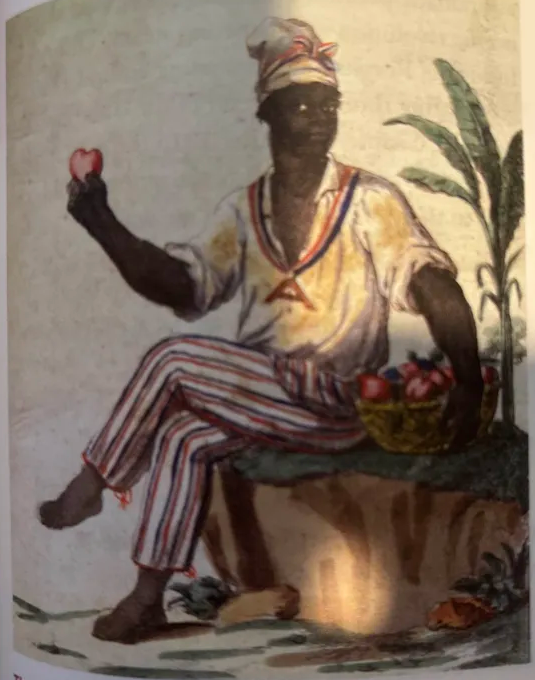
What was the painting that depicted a black person eating fruits from a basket? What did it represent?
That was a painting called Moi Libre Aussie (or I am Free), which depicted a former slave enjoying their new freedom by eating fruits from a filled basket. You can clearly see a blue French flag and cap. It shows that these slaves were no longer subjected to the suffering and oppression caused by slavery prior to abolition after 1791.
Discuss the two major treaties that Napoleon helped to produce…
The Treaty of Luneville
The Treaty of Amiens
For the Treaty of Luneville, this was signed after peace feelers were sent to Austria and Great Britain (members of the Second Coalition). These armies ended up defeating the Austrians and this treaty was signed, which gave up Austria’s Italian possessions and its German territory west of the Rhine.
For the Treaty of Amiens, this was signed in 1802, after the British lost in several conflicts. This allowed France to control the former Dutch Republic, the Austrian Netherlands, west bank of the Rhine, and most of Italy.
Describe Napoleon’s third coalition (give context too!)…
Napoleon was driven to continue territorial gain and hoped to secure Great Britain next; however, he wasn’t able to as his fleet in the Mediterreanian was destroyed at the Battle of Trafalgar in late 1805.
This conflict led Austria, Russia,and Sweden to join with Britain to form the Third Coalition against France. However, all forces were no match for France. Francis II of Austria lost tons of territory and Alexander I of Russia had to retreat, facing too many losses.
He also used these conflicts as a way to finally secure western Germany, declaring himself the “protector” of it.
Describe how the Treaty of ____ came to be with Napoleon (this was against Prussia and Russia!)
Tilsit (1807); This treaty was the result of Napoleon’s forces crushing the Prussians and Russians in 1806 at the city’s of Jena and Auerstadt. After winning a third major victory, this time with Russia in the mix, Alexander I was ready to discuss peace and the treaty was signed.
This treaty had Prussia lose half of its population and Russia accepted Napoleon’s reorganization of western and central Europe, promising to enforce his economic blockade against the British.
What was Napoleon’s Grand Empire and what were the three parts?
This Grand Empire was essentially the term to describe the amount of land Napoleon controlled over Europe (it was like all of it!).
The three parts included:
The ever-expanding France, which controled today’s Belgium, Netherlands, northern Italy, and German territories west of the Rhine
The number of dependent satellite kingdoms, where Napoleon placed members of his family to rule
The independent, but allied states of Russia, Prussia, Austria.
What was Napoleon’s Continental System?
This was essnetially a blockade where no British ships could dock at a port controlled by the French. This was meant to halt all trade between Britain and continental Europe, thereby crushing their economic system.
ADDITIONALLY, tons of nations across Europe had to support this through treaties w/ Napoleon (e.g., Treaty of Tilsit).
What did the actual people of Europe think about Napoleon’s Grand Empire?
In France and her satellites, Napoleon led a revolutionary principle where he aboliushed feudal dues, serfdom (benefited the middle class & peasants).
He had high taxes and required tons of men for its conquests. This caused heavy patriotism and nationalism.
Areas BESIDES France and her satellites didn’t react the same way. In Spain, after Napoleon replaced King Ferdinand III with his brother Joseph Bonaparte, many Catholics, monarchists, and patriots rebelled against Napoleon (1808). Then, the British were able to help the Spanish after pushing Napoleon’s troops to the mountains, trapping them.
IT WAS THE SPANISH CONFLICT that revealed how much of a failure Napoleon’s Continental System was.
Give me the names of the Jacob-Jaques David’s works this unit 🙂
The Intervention of the Sabine Women (1799)
Sabines (left) are trying to take back their daughters who are on the right. Demonstrates women on the right DON’T necessarily want to go back, fighting their way to stay in France, a place of new freedom. The women (Hersillia) is child of the King of the Sabines and hubans of the Roman empire and begs them to stop, who even seem semi-hesitant. The women here are demonstrating that they are filled with purpose, of motherhood. This violence is only going to effect the children.
Oath of Horatii (1783)
Suggested women could only think about the personal, while the men stood tall, strong, raising their arms together to demonstrate purpose.The women were merely victims of the circumstances.
The Death of Socrates (1787)
Socrates is poisoning himself after being accused of corrupting adolescents of Athens. He questioned authority and was given a choice—either die or be exiled. Wanting to stay true to his values, he died for the success of his ideal version of a republic.
Andromache Mourns Hector (1783)
Showed the lament that women displayed and demonstrated that your duty toward the state is the highest priority, even over your children.
Lictors Bringing to Brutus the Bodies of His Sons (1789)
Showed lictors bringing the dead bodies back to the families. You can clearly see Brutus unphased by the event and the women, fainting and distraught by what they saw.
Think TOTAL
Some people weren’t happy about what was going on and what happened with the Estates General. Be specific here, who wasn’t and what did they do?
The majority of people that weren’t happy included the lower class—peasants, urban workers. As a result, they created the Cahier of the Third Estate of Dourdan, which included a list of complaints and some solutions.
You can even think of The Awakening of the Third Estate political cartoon, which displayed the third estate getting pushed down (figuratively), then a huge fight, knocked down again, and finally getting up, emerging as the power.
What was the painting that displayed the killer’s reaction to the Death of Marat? What did it signify?
This was called Charlotte Corday After the Murder of Marat (1863) which showed her demeanor being much different than the typical lamenting you would see in David’s paintings (e.g., Lictors Bringing to Brutus the Bodies of His Sons). Charlotte looks like she’s finally going to fix and resolve all of these issues.
This had her, a woman, being viewed as the hero by killing such a radical that could have killed 100k lives.
 Note
Note  Flashcards (120)