Evolution
 Call Kai
 Learn
Learn Practice Test
 Spaced Repetition
 Match
Match Flashcards
 Knowt Play
1/127

There's no tags or description
Looks like no tags are added yet.
Name | Mastery | Learn | Test | Matching | Spaced | Call with Kai |
|---|
No analytics yet
Send a link to your students to track their progress
128 Terms
Soft inheritance
environmental forces can cause organisms to develop traits within their lifetime that are passed to offspring (not very true)
Charles Darwin (Origin of Species) 5
1.populations have tremendous growth potential (still remain stable)
2.natural populations must be limited (struggle to exist)
3.individuals are variable (not all the same)
4.offspring resemble parents (variation is heritable)
5.individuals best suited to enviornment survive and reproduce
evolution
change in genetic compositionof a population over time
Natural selection
evolutionary process by which individuals best adapted to their envirornment survive and reproduce
Evidence of evolution
-artificial selection
-homology
-vestigal structures
-fossils
-molecular biology
-direct observations and experimental evidence
Artifical selection
selective breeding of organisms by humans
Homology
similar features from shared ancestry
Vestigal structures
structures that have lost original functions
fitness
relative survival and reproductions sucess of an individual compared to other in population
Favored phenotypes become…
more common in future generations
adaptation
hertiable trait that evolved in a population through natural selection
Evolutionary processes
mutation
gene flow
genetic drift
non-random mating
more about mutations
-mutations arise randomly, low, constant
-10-9 changes
-large populations contain huge numbers of mutations
-mutation generate genetic variation—> material for evolution by natural selection
Gene flow
-transfer of alleles between populations
-through migration of individuals or movements of gametes
-changes allele frequency in a populationn
(birds crossing over mountain into other population)
Genetic drift
random change in allele frequency over time
bugs with specfic allele die randomly
-larger effect on small populations
-population bottleneck +founder effect
GD-Bottleneck effect
large decrease in population size where only a few individuals survive will result in randsom loss of genetic diversity
-little left and reproduce and lower diversity
GD-founder effect
-small group of individuals establishes a new population resulting in a random sample of original population’s alleles
-group leaves big population and is a random sample of og
Non-random mating
-type of sexual selection
-occurs when individuals choose mates with particular phenotypes
-changes allele frequency
sexual selection
can occur when individuals of one sex mate preferringly w individuals of another sex NOT random
Allele frequency
p=number of copies of the allele in pop/ total number of copies of all alleles in the pop
hardy weinberg
-simple equation to show that allele frequencies in a pop do not change when no evolution occuring
H-w assumptions
-no mutations
-no selections
-no gene flow
-random mating
-population size is infinite
natural selection graphs
stabalizing, directional, disruptive,
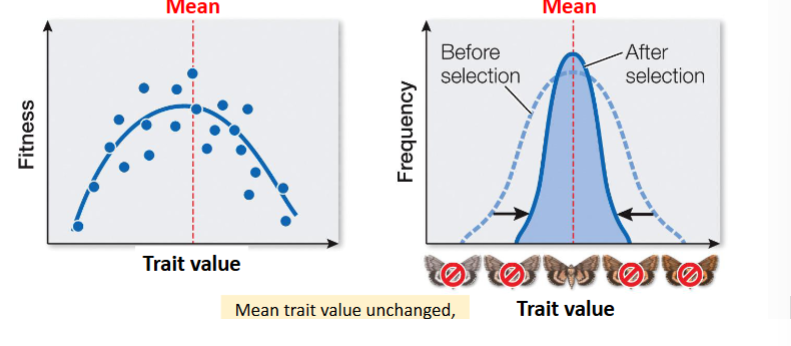
Stabilizing
occurs when mean phenotype has higher fitness than the extreme (before and after selection)
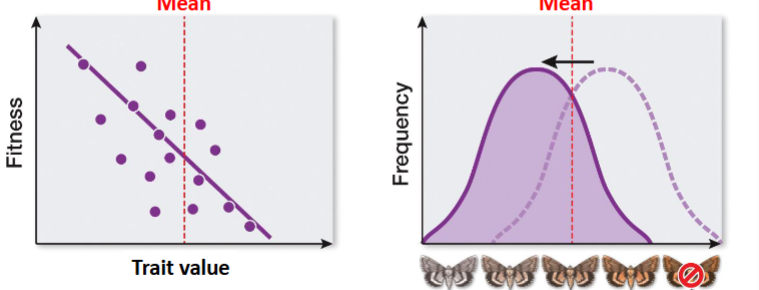
Directional
occurs when extreme phenotype has higher fitness than the average phenotype
-mean value shifts
-traits disappear and gene variation can be reduced
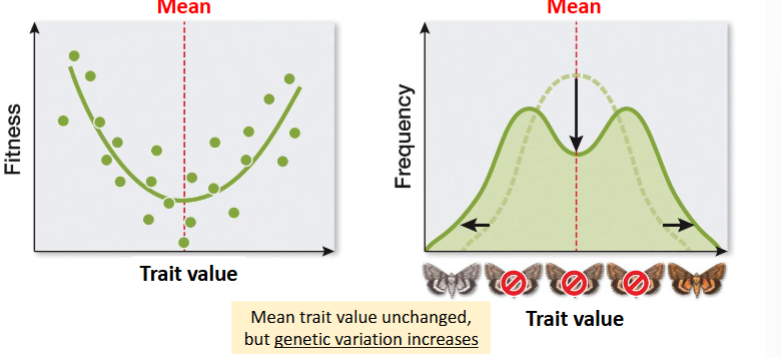
Disruptive
both phentoypes have higher fitness than the mean\
-unchanged, but genetic variation increases
Maintaining genetic variation
-diploidy
-heterozygote advantage
-temporally varible selection
-spatially variable selection
Diploidy
hides recessive allele in heterozygotes, preserving genetic variation
C over c, hides c
Heterozygote advantagte
heterozygotes have higher fitness than homozygotes, maintainng multiple alleles in population for breeding
Temporally variable selection
changing enviornments favor different phenotypes at different times, no fixed alleles
-want small beak birds one time want big beak birds another
Spatially varible selection
occurs when different local enviornments favor different phenotypes (dark mouse in datk cave, light mouse in sand)
Evolution constrained by…
physics and chemistry
genetic variation (no genetic variation= no evolution)
history
trade offs
Evolutionary history
the origins of a trait can restrict it from evoling differently
-our eye used to need to protect the cones so we see less color and stuff—> this cant evolve
Trade offs
a trait that improves fitness in one area reduces fitness in another
-hip sizes
Chapter 20
Biological classification
-classification based on observable traits
-taxa-named group of an organisms
-taxonomy- describe, name and classify organisms into groups 1
Phylogeny
evolutionary history of a group of organismsph
phylogenetic tree
diagrammatic hypothesis about evolutionary relationships among species
Node
connection from common acestor and splits off (the split off)
Root
oldest common ancestor
horizontal branching order +length
over time
vertical branching order
nothing- can switch branches
sister taxa/clades
lineages that share most recent common ancestor
clade
group that includes an ancestor and ALL descendantsm
monophyletic
(a clade)- ancestor and ALL descendants
paraphyletic
contains common ancestor and some descendants (one branch not included)

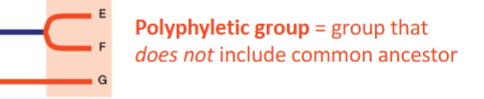
polyphyletic
groups that does not include include common ancestorco
common traits used for phylogeny
morphological traits
molecular traitsm
morphological traits
-prescene, size, shape, other body parts
molecular traits
DNA and protein sequences
build a tree
compare traits among taxa, group taxa that share the mpst traits derived traits together, identify shared derived traits that indicate common ancestry
Plesiomorphy
ancestral trait for a particular clade
apomorphy
derived or changed trait for a particular clade
synamorphy
dervies trait that is shared by members of a clade (NEW)
-used to identify clades and reveal patterns of shared evolutionary history
Problems making a tree
-homoplasy
Homologous traits
have shared similar evolutionary origins
analogous traits
evolve independently for same function (convergent evolution)
evolutionary reversal
lineage reverts to an ancester trait
(whales return to aquatic animals even though a mammal)
parisomy principle
best phylogenetic tree requires the fewest evolutionary changes
trees can be used trace…
origins of behaviors such as mae preferences
molecular clock
methods that uses rates of genetic change to estimate evolutionary time
-study timing of historical and recent events
Chapter 21
more time since divergence…
more sequence differences
homologous sequences
sequence shared among species due to common ancestry (even if changed)
sequence alignment
allows us to compare homologous DNA positions across origanisms and identify evolutionary changes
number of changes among sequences are underestimated because of…
-multiple substitution
-coincident substitution
-parallel sub
-back sub (reversion)
multiple sub
multiple one nucleotide change over time
coincident substitution
mutation in same spot over time into 2 diff nucleotides
parallel substitution
mutation in same spot over time into same nucleotide
back substitution
revert back to ancestral sequence
synonymous sub
no phenotypic effect, no amnio acid change
neutral to natural selection so they accumlate over time
nonsynonymous
alter protein function
-Most delete
-some neutral
-some benefical
rates of nonsynonymous…
typically lower than rates of synonymous sub
-most sub happens in pseudogenes
rate of non syn to syn=
neutral, purifying selection, positive selection
<1
purifying/stabalizing selection
=1
neutral
1>
positive selection/directional selection
neutral
mutations spread or disappear by chance
positive selection
natural selection favors benefical mutation
purifying selection
natural selection removes harmful mutation
aligned sequences can be summarized using…
similarity matrix that counts similarity and differences between species
purifying selection in
most codons
pathogen binding sites experienece
positive selection
Genome evolution creates new traits
-genome size variation
-recombinant
-lateral gene transfer
-gene duplication
genome size varies, most variation is
noncoding DNA
recombinant
sexual recombination generates new genetic combinations
-avoids deleterious accumulation of mutations that can cause asexual repro (muller’s ratchet)
lateral gene transfer
moves genes across species boundaries, introducing novel functions that can rapidly alter evolutionary trajectories
duplcated genes can
retain same function (increase gene product)
diverge in expression (different tissues/times)
become pseudogenes (be eliminated, new function)
diversify functions
whole duplication of genome
-evole special functions in different tissues
Chapter 22
morphological species
group of organsims that are morphologically distinct from other groups
-different species look the same? members of same species look different
biological species
group of interbreeding populations that are reproductively isolated from other groups
repro iso
share a distinct gene pool
-needed for divergence and speciation
P: new allele that causes repro incompatibility cannot spread in population
problems w/biological species
-asexual species
-ring species that travel and isolate and reneter
-fossils cant breed
speciation
splitting one population into two that are reproductively isollated from one another
Dobzhansky-Muller
-explains evolution of reproductive isolation, harmless mutations can be harmful when combines across populations
physical boundary can caus ancestral population to become seperated (aa + bb)—> result in gene flow among populations
seperated populations evolve independently (Aa or Bb)
they become fixed in the divergent populations
reproductive isolation increases w degree of genetic divergence
hybrids have low fitness or dies or infertile
more genetic divergence…
more reproductive isolation
allopatric speciation
-occurs when populations becomes geographucally seperated or isolated by physical barriers OR
-most common mode of speciation
allopatric 2
individuals at the edge of a population become isolated by a barrier (peripheral isolaitonsy
sympatric speciation
occurs when repro isolation develops between segments of a population WITHOUT any ohysical barrier
-polyploidy
-disruptive selection

