chapter 25 - eukaryotes
 Studied by 2 people
 Call Kai
 Learn
Learn Practice Test
 Spaced Repetition
 Match
Match Flashcards
 Knowt Play
1/43

There's no tags or description
Looks like no tags are added yet.
Name | Mastery | Learn | Test | Matching | Spaced | Call with Kai |
|---|
No analytics yet
Send a link to your students to track their progress
44 Terms
Fossil record of early eukaryotes
chemical evidence of eukaryotes have been rocked in rocks 2.7 bya
Earliest unambiguous eukaryote fossils date back to 1.8 bya
Multicellular eukaryotes arose around 1.3 bya
Consequence of endosymbiosis
through DNA sequences, suggests eukaryotes are combination organisims with some of their genes and cellular characteristics derived from archea and bacteria
Origins of eukaryotic features
Mostly all from archea
mitochondria, metabolic genes and ER are from bacteria
ER is from both
Endosymbiosis
Mitochondria and plastids were formerly small prokaryotes living in larger host cells
Endosymbioant
Cell that lives within a host cell
Serial endosymbiosis
Supposed mitochondria evolved before plastids through sequence of endosymbiotic events
prokaryotic ancestor of mitochondria and plastids probably gained entry to host cell as undigested prey or internal parasites
Serial endosymbiosis steps
1.infolding plasma membrane
Engulfed aerobic bacterium
Cell with nucleus and Endomembrane system
Engulfed photosynthetic bacterium
Ancestral prokaryote →Host cell →ancestral eukaryotes→ancestral photosynthetic eukaryote
Endosymbiosis of algae
-plastid bearing lineage of protists evolved into red algae and green algae
most likely they underwent secondary endosymbiosis, where they were ingested by a heteroeukaryote
results in new plastids
What did evolution of eukaryotic cells allowed for
Evolution of eukaryotic cells allowed for greater rage of unicellular forms
Metazoans
Multicelllualrity evolved and gave rise to algae, plants, fungi and animals (metazoans)
this is the second ave of diversification
Earliest multicellular eukaryotes
were in forms of colonies (collection of connected cells but have no cellular differentiation)
What is the origin of animals
Ctenophores
originally thought as sponges were the frist animal
Why did we believe sponges were the first animal
morphological and molecular evidence points to chanoflagellates as closested living relative of animals
In which sponges were made of a colony of chanoflagellates
4 supergroups of eukaryotes
Excavate
SAR
Archaeplastida
Unikota
3 types of excavata
Diplomonads, parabasalids and euglenozoans
Diplomonads and parabasalids
Are a type of excavata that live in anaerobic environments
Lack plastids
Have modified mitochondria called mitosomes
Derive energy anaerobically like glycolysis
Have 2 equal sized nuclei and multiple flagella
Are often parasitic
Parabasalids
type of excavata
Reduced mitochondria called hydrogen domes that generate some energy anaerobically
Ex. Trichomonas vaginalis, pathogen causing yeast infections
Euglenozoans
type of excavata including predatory heterotrophs, photosynthetic autotrophs and pathogenic parasites
Have a spiral or crystalline rod in their flagella beside their ring of microtubules
Has 1 - 2 flagella emerging from a pocket at end of the cell
Can be autotrophic and heterotrophic
Has kinetoplastids and euglenids
Kinetoplastids
A clade with single mitochondrion with a mass of DNA called kinetoplast
includes free living considers of prokaryotes in fresh water, marine and moist terrestrial ecosystems
Includes trypanosoma
Trypanosoma
Kinetoplastid causing sleeping sickness
transferred through kissing bugs, by taking blood meal on face and then dropping their feces
Charles Darwin had this
3 types of SAR
Stramenopila
Alveolata
Rhizaria
2 major groups of stamenopila
Diatoms and brown algae
Diatoms
Unicellular algae with 2 part glass like wall of silica
Are a type of stramenopile
reproduce mainly asexually and sometimes sexually
Major component of phytoplankton
Fossilized diatom walls make up the diatomaceous earth
Brown algae
Type of stramenopiles
multicellular and marine
Include seaweeds
Most complex multicellular anatomy of all algae
form kelp forests
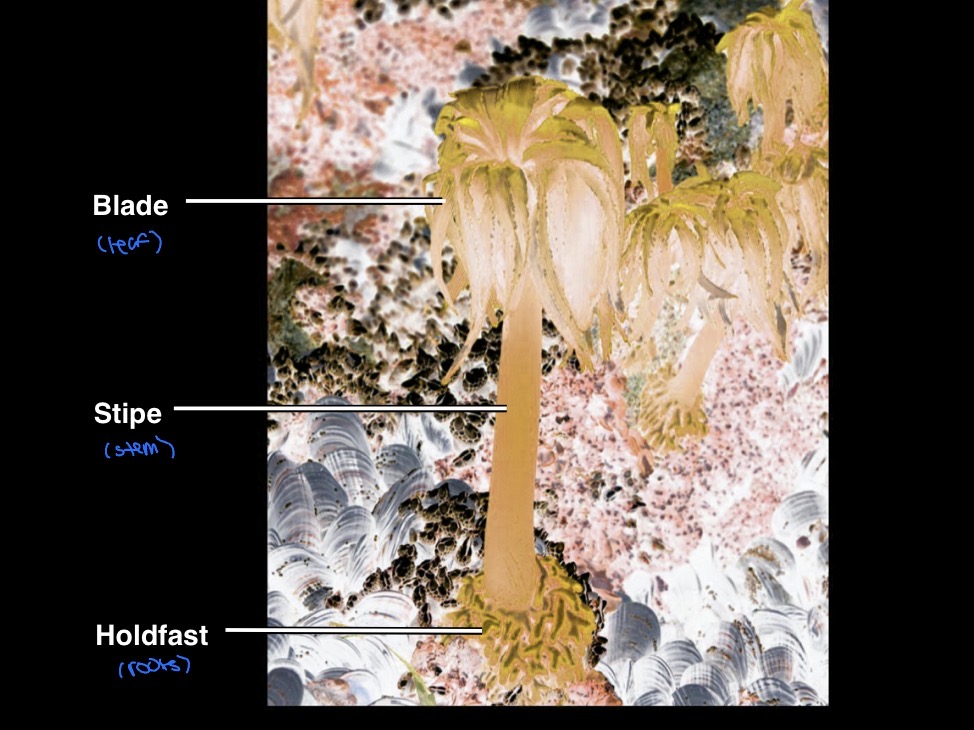
Brown algae strcuture
Algal body called thallus, is plantlike but lacks true roots, stems and leaves
has a root like holdfast that anchors the stemlike stipe to support the leaflike blades
Alveolates
clade in SAR
Has membrane bounded sacs called alveoli under the PM
Includes photosynthetic and heterotrophic protists
3 types of alveolates
Dinoflagellates
Apcomplexans
Cilliates
Dinoflagellates
Part of alveolates
Has characteristic shapes reinforced by internal plates of cellulose
Aquatic mixotrophs and heterotrophs
Abundant components of marine and fresh water phytoplankton
Red tides
Toxic dinoflagellate blooms
Apicomplexans
part of alveolates clade
Parasites of animals derived from algae causing serious diseases
apex has specialized organelles to penetrate host
Has nonphotossynthetic plastid called apicoplast
Has sexual and asexual stages requiring 2 or more different host to complete
Apicomlexan plasmodium
Parasite causing malaria, carried by anopheles mosquitos
needs both mosquito and human to complete life cycle
Ciliates
part of alveolates clade
Large and varied group of protists
Use cilia to move and feed
Most are predators of bacteria and other protists
Rhizarians
part of SAR
Includes amoebas that move and feed using pseudopodia, forams/foraminiferans for having porous multicellular shells called tests
3 types of archaeplastida
Red algae
Green algae (chlorophytes and Charophytes)
Plants
Red algae
type of archaeplastida
Is red due to pigment called phycoerythrin, that masks the green pigment chlorophyll
Is greenish red in shallow waters and dark red in deep waters
Multicellular and are the most abundant large algae in coastal waters in the tropics
Chlorophytes
type of green algae
Live in fresh water, and marine
Unicellular, colonial and multicellular forms
Reproduce sexually using bi flagellated gametes that have cup shaped chloroplasts
6 types of unikonta
Tubulinids
Slime molds
Nucelariids
Fungi
Chanoflagellates
Animals
Amoebozoans
part of unikonta
Are amoebas with lobe or tube shaped pseudopodia
Mostly heterotrophs that eat bacteria or other protists
Opisthokonts
type of unikonta
Diverse group of eukaryotes including animals, fungi and several groups of protists like nucleariids
Structural and functional diversity of protists
unicellular, colonial and multicellular forms
Are simplest eukaryotes but are very complex at the cellular level
Most protists are aquatic
Many feeding behaviors (photoautrotrophs, heterotrophs, mixotrophs, etc)
Producers
Organisims that use energy from light to convert CO2 to organic compounds, forming the base of food webs
carried out primarily by protists and photosynthetic protists in aquatic communities
What percentage of photosynthesis do protists and plants make up
30% aquatic protists, 20% photosynthetic prokaryotes and 50% plants
Examples of symbiotic protist
Photosynthetic dinoflagellates are food providing symbiotic partners of coral
Wood digesting protists inhabit the cut of many termites, allowing them to digest wood
Giardia
Protist causing beaver fever
 Note
Note  Flashcards (43)