Free Will, Self-actualisation & Maslow's Hierarchy
 Call Kai
 Learn
Learn Practice Test
 Spaced Repetition
 Match
Match Flashcards
 Knowt Play
1/14

Earn XP
Description and Tags
Name | Mastery | Learn | Test | Matching | Spaced | Call with Kai | Chat |
|---|
No analytics yet
Send a link to your students to track their progress
15 Terms
What is the humanistic approach?
An approach to understanding behaviour that emerged in the 1950s, largely as a result of the work of Carl Rogers and Abraham Maslow. It emphasises the importance of subjective experience and each person’s capacity for self-determination.
It became the ‘third force’ in psychology - alongside behaviourist and psychodynamic approaches
What did the humanistic approach concern itself with?
Explanations of ‘healthy growth’ in individuals.
As opposed to the psychodynamic approach, which dealt with the ‘sick half’ of psychology
How does the humanistic approach differ from most other approaches in psychology?
It focuses on:
Conscious experience rather than on behaviour
Personal responsibility (belief that individuals are actively responsible for their own behaviour, thoughts, and personal growth)
Free will rather than on determinism
Discussion of experience (therapy; encouraging individuals to talk openly about their experiences, thoughts etc.) rather that the use of experimental method (being analysed, diagnosed, or conditioned)
What are the key assumptions of the humanistic approach?
Each individual is unique
Humans have free will
Science (scientific methodology) shouldn’t be used to explain behaviour
Humans should be viewed holistically and not reduced to their parts
Psychology should study the individual case (idiographic) rather than the average performance of groups (nomothetic)
People are motivated to self-actualise - people are good and have an innate need to make themselves (reaching full potential) and the world better
No Animal studies - doesn’t tell us anything about the unique properties of humans
What is free will?
The notion that humans can make choices over their behaviour and aren’t determined by biological or external forces.
How is the belief of free-will in the humanistic approach a direct opposition to the behaviourist and biological approaches?
Because they see behaviour as a response to either internal biological processes or to external conditioning by the environment.
What is self-actualisation?
The desire to grow psychologically and fulfil one’s potential - becoming what you are capable of.
What is the person-centred approach?
As active agents we are all unique, thus psychology should concern itself with the study of subjective experience rather than general laws.
Which is why humanistic reject more scientific models that attempt to establish general principles of behaviour.
Who is Maslow and what did he believe?
One of the founders of the humanistic movement in psychology. One of his main interests was in what motivates people. He created a hierarchy of needs to show what motivates our behaviour.
In order to achieve our primary goal of self-actualisation, a number of other deficiency needs must be first met
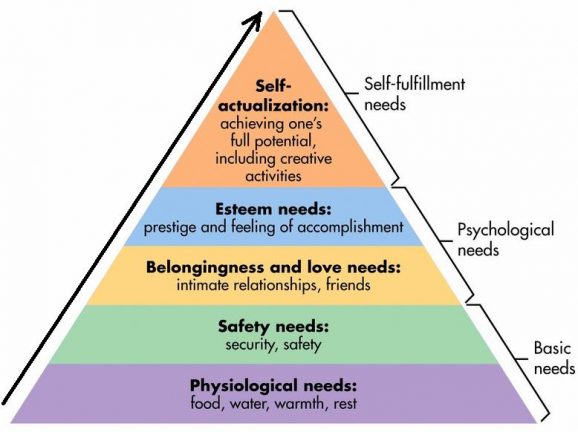
What is Maslow’s ‘hierarchy of needs’?
A five-levelled hierarchical sequence.
The first 3 levels are known as deficiency needs (D-needs)
The top level is known as growth or being needs (B-needs)
In order to self-actualise you must reach and be secure at each of the lower stages
You don’t have to reach self-actualisation to be happy, but you must be moving towards it to be healthy
What are the five stages of Maslow’s ‘hierarchy of needs’?
Self Actualisation (self-fulfilment need) - achieving one’s full potential, including creative activities
Esteem Needs (psychological need) - positive self-image, achievement, mastery of a skill, reputation, prestige and feeling of accomplishment
Belongingness and Love Needs (psychological need) - supportive network, e.g. intimate relationships, friends
Safety Needs (basic need) - security, protection, a degree of predictability, freedom from persecution, e.g. security, safety
Physiological needs (basic need) - all life-supporting, essential elements, e.g. food, water, warmth, rest
How does the psychodynamic reject attempts to break up behaviour and experiences into smaller components (reductionism)?
Other approaches are reductionists, explaining behaviour through simple processes
The humanistic approach is more holistic, arguing that behaviour can only be understood by considering the whole person and their subjective experience, giving it greater validity by considering meaningful human behaviour within its real-world context
How is the psychodynamic approach optimistic (strength)?
Brings the person back into psychology and promotes positive image of the human condition
Freud saw humans as slaves to their past and claimed all of us existed somewhere between common unhappiness and absolute despair
Humanistic psychologists see all people as basically good, free to work towards the achievement of their potential, and in control of their lives
Offers a refreshing and optimistic alternative to other approaches
What are the limitations of the humanistic approach?
May be culturally biased
Many key ideas of the humanistic approach e.g. individual freedom, autonomy and personal growth, would be much more associated with individualist cultures such as the USA
Countries with more collectivist tendencies emphasise the needs of the group and interdependence
In such countries, the ideals of humanistic psychology may not be as important as in others (e.g. self-actualisation)
It’s possible that this approach doesn’t apply universally and is a product of the cultural context within which it was developed
How have some writers accounted for cultural differences in their work of the humanistic approach?
For example, in a later development to his theory, Maslow did acknowledge that, for some people, needs may appear in a different order or may even be absent altogether. Therefore, indicating that some aspects of humanistic psychology could be applied to a variety of cultures.