APES MIDTERM
0.0(0)
Studied by 9 people0%Exam Mastery
Build your Mastery score
 AP Practice
Supplemental Materials Call Kai
Call KaiCard Sorting
1/83

Earn XP
Description and Tags
Last updated 11:33 PM on 11/2/22
Name | Mastery | Learn | Test | Matching | Spaced | Call with Kai |
|---|
No analytics yet
Send a link to your students to track their progress
84 Terms
1
New cards
a
As energy is used and transformed it gradually becomes _____ quality and ____ concentrated
a. Lower; less
b. Lower; more
c. Higher; less
d. As energy is used it doesn't become transformed; there is no change in quality and it stays the same concentration
e. Higher; more
a. Lower; less
b. Lower; more
c. Higher; less
d. As energy is used it doesn't become transformed; there is no change in quality and it stays the same concentration
e. Higher; more
2
New cards
a
Spaces between sand particles give sandy soil
a. Good drainage
b. The ability to hold water
c. Low permeability to air
Selected:d. Low permeability to waterThis answer is incorrect.
e. The ability to store minerals
a. Good drainage
b. The ability to hold water
c. Low permeability to air
Selected:d. Low permeability to waterThis answer is incorrect.
e. The ability to store minerals
3
New cards
a
Which of the following reactions represents cellular respiration?
a. glucose + oxygen → water + carbon dioxide + energy
b. water + carbon dioxide + energy → glucose + oxygen + water
c. nitrogen + oxygen + glucose → methane + carbon dioxide
d. water + carbon dioxide → glucose + oxygen + water + energy
e. nitrogen + carbon dioxide + energy → methane + oxygen
a. glucose + oxygen → water + carbon dioxide + energy
b. water + carbon dioxide + energy → glucose + oxygen + water
c. nitrogen + oxygen + glucose → methane + carbon dioxide
d. water + carbon dioxide → glucose + oxygen + water + energy
e. nitrogen + carbon dioxide + energy → methane + oxygen
4
New cards
b
Which of the following is the most correct definition of soil?
a. A complex of minerals that provide energy for plant growth.
b. A complex mixture of organic matter, minerals, air and water.
c. An elaborate mixture of organic matter and minerals.
d. A mass of dead organic matter and detritus; dirt.
e. All of these adequately describe soil.
a. A complex of minerals that provide energy for plant growth.
b. A complex mixture of organic matter, minerals, air and water.
c. An elaborate mixture of organic matter and minerals.
d. A mass of dead organic matter and detritus; dirt.
e. All of these adequately describe soil.
5
New cards
c
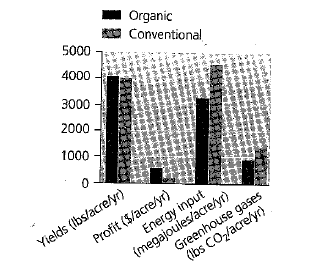
A major conclusion that can be made from the evidence comparing organic and conventional farming is
a. organic farming produces more greenhouse gases.
b. conventional farming has a proven history.
c. organic farming methods should be more widely considered because of numerous, proven benefits.
d. conventional farming is more economical yet more environmentally problematic.
e. organic farming methods are more challenging to institute; however, energy inputs are greater.
a. organic farming produces more greenhouse gases.
b. conventional farming has a proven history.
c. organic farming methods should be more widely considered because of numerous, proven benefits.
d. conventional farming is more economical yet more environmentally problematic.
e. organic farming methods are more challenging to institute; however, energy inputs are greater.
6
New cards
c
(?) The soil sample that would have the largest runoff after a rainfall event would be
a. sand.
b. sandy clay.
c. silty clay.
d. sandy loam.
e. silt loam.
a. sand.
b. sandy clay.
c. silty clay.
d. sandy loam.
e. silt loam.
7
New cards
c
Rill erosion leads to
a. Wind erosion
b. Sheet erosion
c. Gullying
d. Soil compaction
e. Salinization and waterlogging
a. Wind erosion
b. Sheet erosion
c. Gullying
d. Soil compaction
e. Salinization and waterlogging
8
New cards
d
The motion of a rock rolling downhill is known as ______ energy.
a. Mechanical
b. Latent
c. Potential
d. Kinetic
e. Electrical
a. Mechanical
b. Latent
c. Potential
d. Kinetic
e. Electrical
9
New cards
a
Which of the following is not found in soil?
a. All of these are found in soil
b. Insects and fungus
c. Insects and bacteria
d. Nematodes and bacteria
e. Fungus and arthropods
a. All of these are found in soil
b. Insects and fungus
c. Insects and bacteria
d. Nematodes and bacteria
e. Fungus and arthropods
10
New cards
b
Photosynthesis is the process of converting _____ into ______ energy
a. Solar energy; kinetic
b. Solar energy; chemical bond
c. Solar energy; heat
d. Chemical bond energy; potential
e. Chemical bond energy; kinetic
a. Solar energy; kinetic
b. Solar energy; chemical bond
c. Solar energy; heat
d. Chemical bond energy; potential
e. Chemical bond energy; kinetic
11
New cards
c
Soil organisms usually stay
a. spread uniformly throughout all horizons.
b. near the middle in the B horizon.
c. close to the surface in the A horizon.
d. about half stay close to the surface in the A horizon and the other half stay deep below the surface in the C horizon.
e. deep below the surface in the C horizon
a. spread uniformly throughout all horizons.
b. near the middle in the B horizon.
c. close to the surface in the A horizon.
d. about half stay close to the surface in the A horizon and the other half stay deep below the surface in the C horizon.
e. deep below the surface in the C horizon
12
New cards
a
The smallest particle that exhibits the characteristics of a chemical element is known as a(n)
a. Atom
b. Phase of matter
c. Microorganism
d. Molecule
e. Isotope
a. Atom
b. Phase of matter
c. Microorganism
d. Molecule
e. Isotope
13
New cards
c
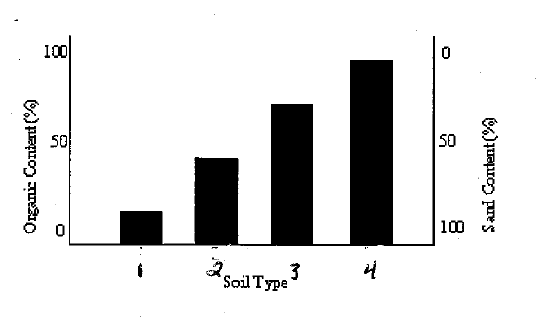
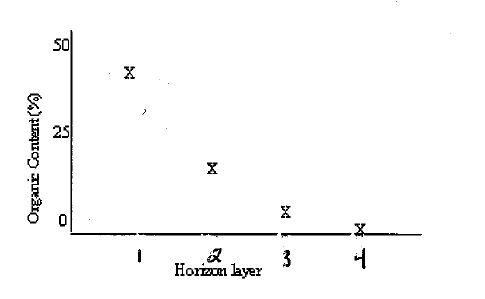
In the graph below, which soil type has the most humus?
a. 2
b. 3
c. 4
d. 1
e. It is impossible to tell with the provided data
a. 2
b. 3
c. 4
d. 1
e. It is impossible to tell with the provided data
14
New cards
c
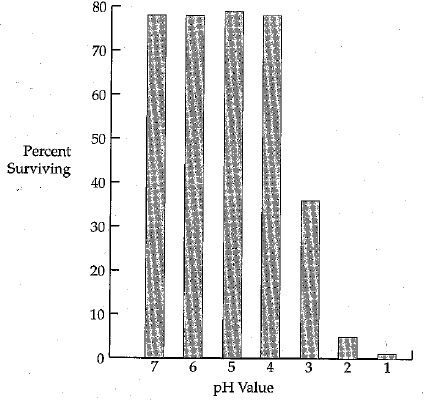
Which of the following hypotheses would the data below fail to reject?
a. There is a significant difference in the percent of eggs surviving in waters with a ph of 7 compared to a pH of 6.
b. There is no difference in the pH of water when fish eggs survive the experimental treatment.
c. There is a significant difference in the survivorship of fish eggs when found in waters with a pH of 4 compared to eggs found in waters with a pH of 2.
d. There is no difference in the percent of eggs surviving in water with a pH of 1 compared to water with a pH of 6.
e. Fish eggs survivorship is the same in waters that range from a pH of 1 to a pH of 7.
a. There is a significant difference in the percent of eggs surviving in waters with a ph of 7 compared to a pH of 6.
b. There is no difference in the pH of water when fish eggs survive the experimental treatment.
c. There is a significant difference in the survivorship of fish eggs when found in waters with a pH of 4 compared to eggs found in waters with a pH of 2.
d. There is no difference in the percent of eggs surviving in water with a pH of 1 compared to water with a pH of 6.
e. Fish eggs survivorship is the same in waters that range from a pH of 1 to a pH of 7.
15
New cards
e
The parent material layer of a soil is composed of weathered
a. Soil
b. Residual aluminum and iron
c. Organic detritus and roots
d. Humus
e. Rock fragments
a. Soil
b. Residual aluminum and iron
c. Organic detritus and roots
d. Humus
e. Rock fragments
16
New cards
e
The distinction between an organic compound and an inorganic compound is that organic compounds contain
a. All of these
b. Nitrogen
c. Oxygen
d. Water
e. Carbon
a. All of these
b. Nitrogen
c. Oxygen
d. Water
e. Carbon
17
New cards
a
Soil leaching involves
a. Rainwater seeping through soil and dissolving nutrients.
b. The microorganisms and their movements through the soil to aerate it.
c. The accumulation of organic matter in the uppermost soil layers.
d. All of these
e. The elimination of pore space in soil.
a. Rainwater seeping through soil and dissolving nutrients.
b. The microorganisms and their movements through the soil to aerate it.
c. The accumulation of organic matter in the uppermost soil layers.
d. All of these
e. The elimination of pore space in soil.
18
New cards
d
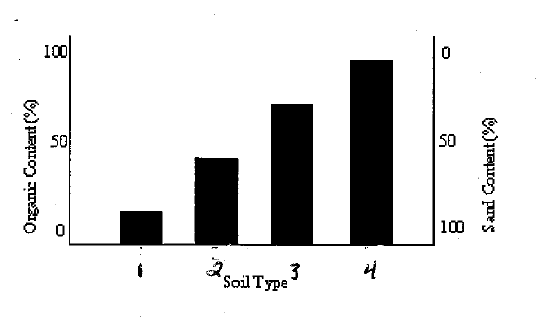
In the graph below, which soil type has the highest sand content?
a. 3
b. 4
c. It is impossible to tell with the provided data
d. 1
e. 2
a. 3
b. 4
c. It is impossible to tell with the provided data
d. 1
e. 2
19
New cards
b
What component makes soil sticky, elastic and impermeable?
a. Sands
b. Clay
c. A large particle size
d. Living organisms
e. Organic matter
a. Sands
b. Clay
c. A large particle size
d. Living organisms
e. Organic matter
20
New cards
e
The numbers 1, 2, 3, and 4 on the graph above represent different horizons in a soil. The numbers represent, in order
a. Topsoil; parent material; bedrock; topsoil
b. Bedrock; subsoil; parent material; topsoil
c. Parent material; topsoil; subsoil; bedrock
d. Subsoil; parent material; bedrock; topsoil
e. Topsoil; subsoil; parent material; bedrock
a. Topsoil; parent material; bedrock; topsoil
b. Bedrock; subsoil; parent material; topsoil
c. Parent material; topsoil; subsoil; bedrock
d. Subsoil; parent material; bedrock; topsoil
e. Topsoil; subsoil; parent material; bedrock
21
New cards
e
________ are the primary water-insoluble components of cell membranes.
a. Proteins
b. Carbohydrates
c. Nucleic acids
d. Acids
e. Lipids
a. Proteins
b. Carbohydrates
c. Nucleic acids
d. Acids
e. Lipids
22
New cards
b
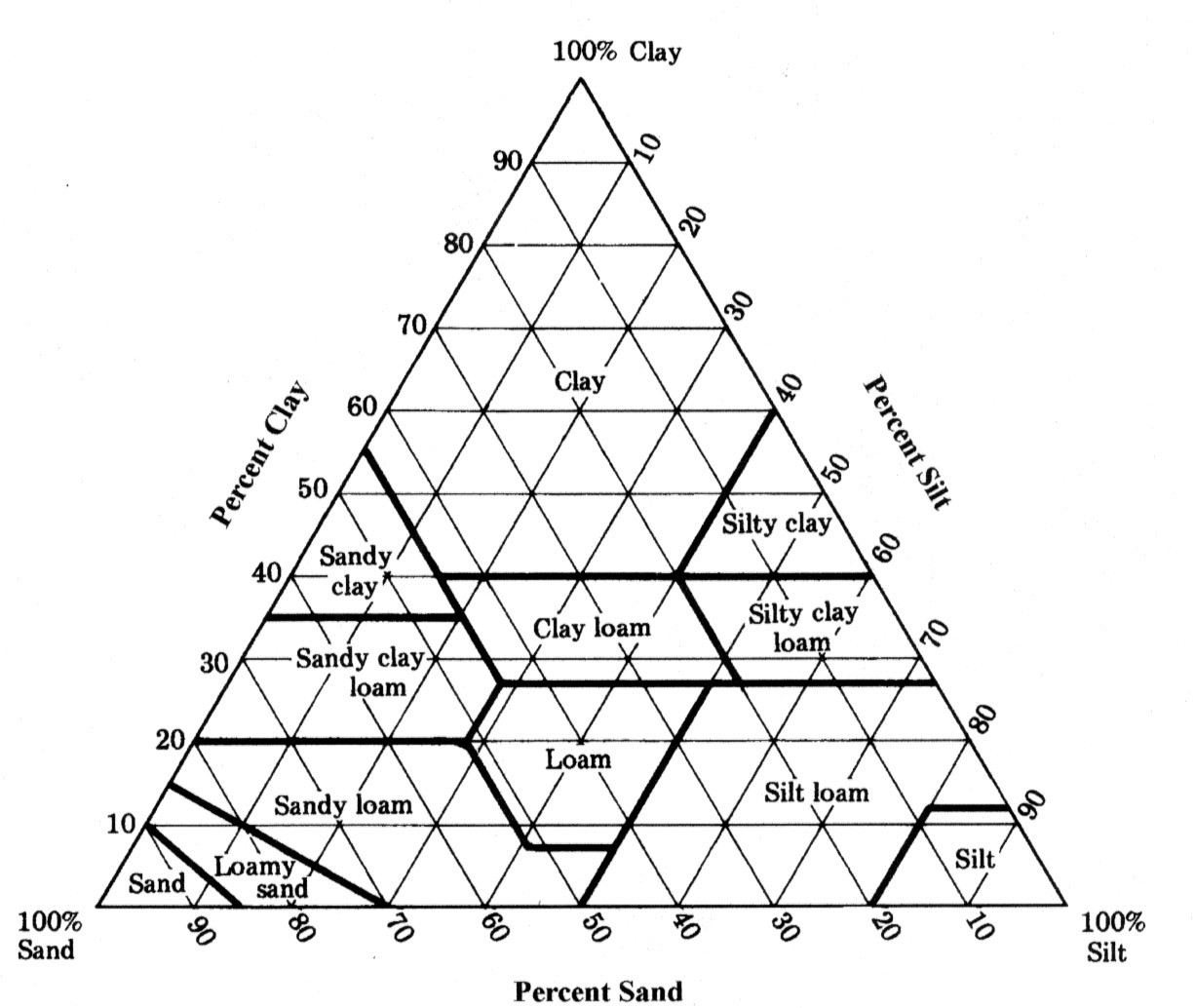
If a soil sample was determined to be composed of 20% sand, 60% silt, and 20% clay, the soil type would most closely resemble
a. silty clay.
b. silty loam.
c. silty clay loam.
d. sandy clay.
e. sandy clay loam.
a. silty clay.
b. silty loam.
c. silty clay loam.
d. sandy clay.
e. sandy clay loam.
23
New cards
e
Wind erosion is most likely to cause problems in
a. Protected, arid region.
b. Forested grazing lands on high mountains.
c. Fertile river bottoms with annual floods.
d. Agricultural regions in the far north.
e. Open, arid regions.
a. Protected, arid region.
b. Forested grazing lands on high mountains.
c. Fertile river bottoms with annual floods.
d. Agricultural regions in the far north.
e. Open, arid regions.
24
New cards
b
The first law of thermodynamics and the law of conservation of matter are similar in that
a. Both energy and matter are recycled through biological systems
b. Under normal circumstances neither energy nor matter is created or destroyed
c. Under normal circumstances energy and matter are destroyed as they pass through biological systems
d. The first law of thermodynamics and the law of conservation of mater are not similar
e. Both energy and matter flow in a one-way path through biological systems
a. Both energy and matter are recycled through biological systems
b. Under normal circumstances neither energy nor matter is created or destroyed
c. Under normal circumstances energy and matter are destroyed as they pass through biological systems
d. The first law of thermodynamics and the law of conservation of mater are not similar
e. Both energy and matter flow in a one-way path through biological systems
25
New cards
e
Proof in science is always
a. An Impossible goal
b. Changing very quickly
c. Beyond question
d. Firmly established
e. Open to question or new evidence
a. An Impossible goal
b. Changing very quickly
c. Beyond question
d. Firmly established
e. Open to question or new evidence
26
New cards
e
The hydrologic compartment that contains the greatest amount of fresh water is
a. Living organisms and biomass
b. Clouds in the atmosphere
c. Groundwater
d. The Great Lakes
e. Ice caps and glaciers
a. Living organisms and biomass
b. Clouds in the atmosphere
c. Groundwater
d. The Great Lakes
e. Ice caps and glaciers
27
New cards
d
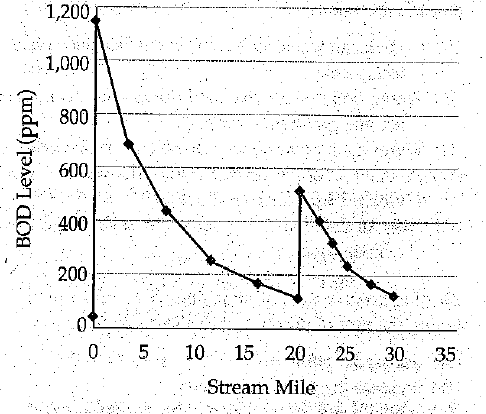
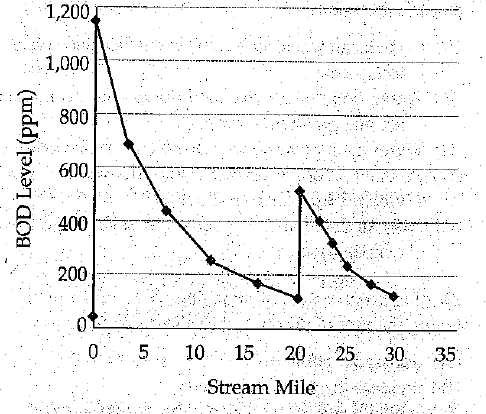
An oxygen sag occurs most often
a. Seven to nine miles downstream from a pollution source
b. At any of the above places
c. After the water recovers from the pollution source
d. Immediately downstream of a pollution source
e. Immediately upstream of a pollution source
a. Seven to nine miles downstream from a pollution source
b. At any of the above places
c. After the water recovers from the pollution source
d. Immediately downstream of a pollution source
e. Immediately upstream of a pollution source
28
New cards
d
Cultural eutrophication results from
a. The disappearance of tributary streams
b. Natural topography
c. A change in animal life as well as plants
d. Human activity including farming, logging, and mowed lawns
e. Natural sediment and nutrient levels
a. The disappearance of tributary streams
b. Natural topography
c. A change in animal life as well as plants
d. Human activity including farming, logging, and mowed lawns
e. Natural sediment and nutrient levels
29
New cards
d
______ is to point source of water pollution as ______ is to nonpoint source of water pollution
a. Power plant effluent; underground coal mine drains
b. Golf course runoff; atmospheric deposition
c. Atmospheric deposition; golf course runoff
d. Power plant effluent; golf course runoff
e. Golf course runoff; power plant effluent
a. Power plant effluent; underground coal mine drains
b. Golf course runoff; atmospheric deposition
c. Atmospheric deposition; golf course runoff
d. Power plant effluent; golf course runoff
e. Golf course runoff; power plant effluent
30
New cards
b
Withdrawal is the total amount of water
a. Lost in transmission, due to evaporation or leakage
b. Taken from rivers, lakes or aquifers
c. Used in manufacturing or agriculture
d. Altered or polluted in human activities
e. Lost due to chemical transformation of human use
a. Lost in transmission, due to evaporation or leakage
b. Taken from rivers, lakes or aquifers
c. Used in manufacturing or agriculture
d. Altered or polluted in human activities
e. Lost due to chemical transformation of human use
31
New cards
a
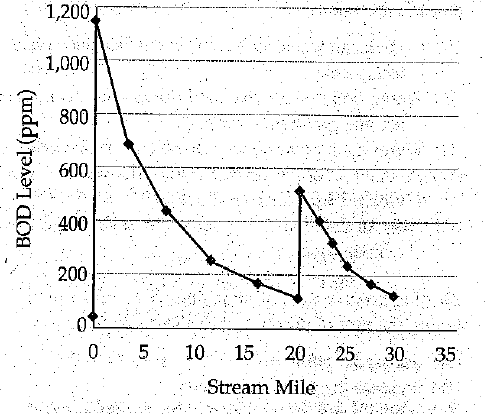
The BOD at mile 10 is approximately
a. 300 ppm
b. 175 ppm
c. 50 ppm
d. 700 ppm
e. 200 ppm
a. 300 ppm
b. 175 ppm
c. 50 ppm
d. 700 ppm
e. 200 ppm
32
New cards
b
Harmful algal blooms appear to be linked to unusually high levels of nutrient pollution. Which of the following is the most likely source of nutrient pollution in a river drainage system associated with an algal bloom?
a. a large shopping mall
b. chicken and hog farms
c. a nuclear power plant
d. a coal-fired power plant
a. a large shopping mall
b. chicken and hog farms
c. a nuclear power plant
d. a coal-fired power plant
33
New cards
d
Withdrawal of groundwater often causes subsidence. Subsidence is a situation where
a. Water quality and water tables fall
b. Withdrawals exceed recharge rates
c. Wells dry up
d. Porous rocks settle and ground level falls
e. Aquifer volume decreases sharply
a. Water quality and water tables fall
b. Withdrawals exceed recharge rates
c. Wells dry up
d. Porous rocks settle and ground level falls
e. Aquifer volume decreases sharply
34
New cards
d
The highest priority of the Clean Water Act is to provide
a. funds to increase recycling participation
b. guidance in toxic chemical disposal
c. funds to reclaim old strip mines
d. policies to attain fishable and swimmable waters in the United States
e. policies to lessen the amount of oil spills in the ocean
a. funds to increase recycling participation
b. guidance in toxic chemical disposal
c. funds to reclaim old strip mines
d. policies to attain fishable and swimmable waters in the United States
e. policies to lessen the amount of oil spills in the ocean
35
New cards
b
Which of the following activities is most directly related to the dead zones in the Gulf of Mexico just west of the Mississippi River?
a. barge traffic on the Mississippi River
b. farming in the Midwest
c. extensive shrimp fishing
d. burning coal to generate electricity in the Midwest
a. barge traffic on the Mississippi River
b. farming in the Midwest
c. extensive shrimp fishing
d. burning coal to generate electricity in the Midwest
36
New cards
e
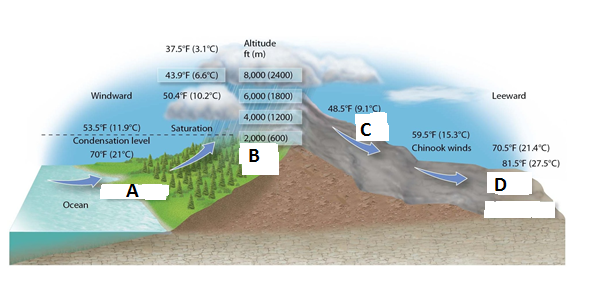
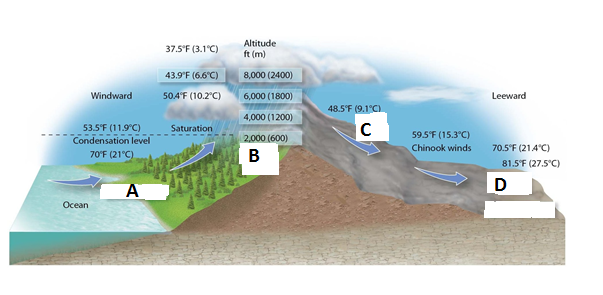
The rainiest or snowiest zone on the mountain in the diagram above would be in the area marked
a. From C to D
b. At C and at D
c. From B to C
d. At A and at D
e. From A to B
a. From C to D
b. At C and at D
c. From B to C
d. At A and at D
e. From A to B
37
New cards
a
A small neighborhood pond averaging about 3 meters in depth reveals all the signs of cultural eutrophication, most likely from runoff of lawn fertilizers used by the residents. The water is very cloudy and oxygen levels remain very low, resulting in few fish that can survive. To provide some opportunities for the neighborhood kids to regularly catch fish, the neighborhood association decides to purchase, install, and run a large water fountain in the middle of the pond.
How could this water fountain help address the eutrophication of this pond? The water fountain will
a. increase the oxygen levels of the pond.
b. kill most of the algae in the pond.
c. remove nutrients from the pond.
d. encourage the growth of submerged vegetation.
How could this water fountain help address the eutrophication of this pond? The water fountain will
a. increase the oxygen levels of the pond.
b. kill most of the algae in the pond.
c. remove nutrients from the pond.
d. encourage the growth of submerged vegetation.
38
New cards
e
Primary sewage treatment involves
a. Removing all bacteria
b. Making water transparent again
c. Making water usable for agriculture
d. Removing all organic matter from water
e. Removing solids from water
a. Removing all bacteria
b. Making water transparent again
c. Making water usable for agriculture
d. Removing all organic matter from water
e. Removing solids from water
39
New cards
a
Which of the following best describes the type of pollution at mile 0?
a. Point source
b. Thermal inversion
c. Deep Well
d. Secondary pollution
e. Acid deposition
a. Point source
b. Thermal inversion
c. Deep Well
d. Secondary pollution
e. Acid deposition
40
New cards
b
Tertiary sewage treatment is designed to remove
a. Dissolved organic compounds
b. Nitrates and phosphates
c. Large solids
d. Sludge
e. Suspended solids
a. Dissolved organic compounds
b. Nitrates and phosphates
c. Large solids
d. Sludge
e. Suspended solids
41
New cards
c
When natural waters are overloaded with plant nutrients, such as nitrate and phosphate ions, they become
a. Oligotrophic
b. Mesotrophic
c. Eutrophic
a. Oligotrophic
b. Mesotrophic
c. Eutrophic
42
New cards
a
In 1998, a change in the approach of water quality was initiated by _____ with an emphasis on ______
a. The EPA; watershed management
b. A series of epidemics that inspired action; watershed management
c. Decreases in water withdrawal for industrial uses; cost-benefit analysis
d. The EPA; cost-benefit analysis
e. Industry; cost-benefit analysis
a. The EPA; watershed management
b. A series of epidemics that inspired action; watershed management
c. Decreases in water withdrawal for industrial uses; cost-benefit analysis
d. The EPA; cost-benefit analysis
e. Industry; cost-benefit analysis
43
New cards
b
Water enters groundwater by
a. Sublimation
b. Infiltration
c. Interception
d. Transpiration
e. Entering the runoff stream
a. Sublimation
b. Infiltration
c. Interception
d. Transpiration
e. Entering the runoff stream
44
New cards
a
The Ogallala Aquifer supplies water to _______ and once held more water than the surface water ______
a. The central plains states; in the world
b. The Rocky Mountain states; in the United States
c. Most of New England; in the United States
d. Arizona and Las Vegas; in the United States
e. California's Central Valley; in the world
a. The central plains states; in the world
b. The Rocky Mountain states; in the United States
c. Most of New England; in the United States
d. Arizona and Las Vegas; in the United States
e. California's Central Valley; in the world
45
New cards
d
The rain shadow on the mountain in the diagram above would be in the area marked
a. From A to B
b. At A and at B
c. At A and at D
d. From C to D
e. From B to C
a. From A to B
b. At A and at B
c. At A and at D
d. From C to D
e. From B to C
46
New cards
e
Coliform bacteria populations are routinely monitored in drinking water supplies, swimming pools, and at beaches because these bacteria
a. Usually live in pesticide-contaminated water
b. Are more difficult to find in water
c. Are especially toxic to animals
d. May mutate into severely pathogenic strains
e. Indicate the presence of more harmful pathogenic bacteria in the water
a. Usually live in pesticide-contaminated water
b. Are more difficult to find in water
c. Are especially toxic to animals
d. May mutate into severely pathogenic strains
e. Indicate the presence of more harmful pathogenic bacteria in the water
47
New cards
b
The main reason that surface water pollution has largely decreased in the United States since the 1970's is
a. The discovery of newer technology that makes it cheaper not to pollute
b. The Clean Water Act
c. The emphasis in 1950 of watershed management
d. Decreases in water withdrawal for industrial uses
e. A series of epidemics that inspired action
a. The discovery of newer technology that makes it cheaper not to pollute
b. The Clean Water Act
c. The emphasis in 1950 of watershed management
d. Decreases in water withdrawal for industrial uses
e. A series of epidemics that inspired action
48
New cards
b
Humans use fresh water primarily for
a. mining and industrial processes.
b. agricultural irrigation.
c. electrical production.
d. residential heating, cooking, and plumbing.
e. global nuclear power energy production.
a. mining and industrial processes.
b. agricultural irrigation.
c. electrical production.
d. residential heating, cooking, and plumbing.
e. global nuclear power energy production.
49
New cards
a
A watershed is ________.
a. the area of land from which rainfall drains into rivers or lakes
b. a term used to describe water stored underground
c. an inland basin that connects to another inland basin
d. a river that drains into the sea
e. the water held in the atmosphere prior to returning to Earth in the form of rainfall
a. the area of land from which rainfall drains into rivers or lakes
b. a term used to describe water stored underground
c. an inland basin that connects to another inland basin
d. a river that drains into the sea
e. the water held in the atmosphere prior to returning to Earth in the form of rainfall
50
New cards
c
The discharge from a nonpoint source of pollution is
a. Usually less polluting than point sources
b. Generally easier to regulate than a point source
c. Highly seasonal in quantity
d. Less damaging than other sources of pollution
e. Usually constant throughout the year
a. Usually less polluting than point sources
b. Generally easier to regulate than a point source
c. Highly seasonal in quantity
d. Less damaging than other sources of pollution
e. Usually constant throughout the year
51
New cards
a
Best practical technology (BPT) is legally required for all
a. Point source polluters
b. Common toxic pollutants
c. Priority toxic pollutants
d. Municipal planning officers to control urban runoff
e. Pollution and polluters
a. Point source polluters
b. Common toxic pollutants
c. Priority toxic pollutants
d. Municipal planning officers to control urban runoff
e. Pollution and polluters
52
New cards
c
The BOD test is designed to directly measure
a. how rapidly the water is moving
b. the amounts of coliform bacteria
c. the rate at which oxygen is being consumed by microorganisms
d. how much light can pass to the bottom of the stream
e. the amount of nitrates in the water
a. how rapidly the water is moving
b. the amounts of coliform bacteria
c. the rate at which oxygen is being consumed by microorganisms
d. how much light can pass to the bottom of the stream
e. the amount of nitrates in the water
53
New cards
d
Which of the following holds the highest levels of oxygen?
a. warm water in a muddy pond along a dirt road in Nebraska in June
b. warm water near the surface of a marsh in Everglades National Park in May
c. cool, slowly flowing water in an open stream in Ontario in August
d. cold water at the base of a waterfall that is formed from melting snow in Oregon mountains in July
a. warm water in a muddy pond along a dirt road in Nebraska in June
b. warm water near the surface of a marsh in Everglades National Park in May
c. cool, slowly flowing water in an open stream in Ontario in August
d. cold water at the base of a waterfall that is formed from melting snow in Oregon mountains in July
54
New cards
d
Transpiration is the way plants
a. Respire using water
b. Return large amounts of water from the atmosphere to the ground
c. Absorb water from the atmosphere
d. Return large amounts of water to the atmosphere
e. Absorb water from the ground
a. Respire using water
b. Return large amounts of water from the atmosphere to the ground
c. Absorb water from the atmosphere
d. Return large amounts of water to the atmosphere
e. Absorb water from the ground
55
New cards
e
A method of increasing water supplies that has been successful, and expensive, is
a. Towing icebergs by ship from polar regions
b. None of these methods are successful
c. Cloud seeding
d. Altering the climate's convection currents
e. Desalinization by reverse osmosis
a. Towing icebergs by ship from polar regions
b. None of these methods are successful
c. Cloud seeding
d. Altering the climate's convection currents
e. Desalinization by reverse osmosis
56
New cards
c
Why is there a need to reeducate people about the role of fire in natural systems?
a. People are still throwing away cigarette butts that can start forest fires
b. People are starting fires in wilderness areas to make the area available for logging
c. People don't understand that fire is a natural part of many biological ecosystems
d. People are well educated about fire and don't need to be reeducated
e. People who camp are not putting their campfires out causing fires in inaccessible areas
a. People are still throwing away cigarette butts that can start forest fires
b. People are starting fires in wilderness areas to make the area available for logging
c. People don't understand that fire is a natural part of many biological ecosystems
d. People are well educated about fire and don't need to be reeducated
e. People who camp are not putting their campfires out causing fires in inaccessible areas
57
New cards
d
A "de facto" wilderness is an area that
a. Was once developed but no longer has human development
b. Is gradually returning to wilderness conditions
c. Contains only small human settlements
d. Is wild but not legally recognized nor protected
e. Is legally classified as wilderness
a. Was once developed but no longer has human development
b. Is gradually returning to wilderness conditions
c. Contains only small human settlements
d. Is wild but not legally recognized nor protected
e. Is legally classified as wilderness
58
New cards
a
Biological reserves are areas that allow countries to
a. set aside critical habitats to ensure the survival of species
b. control the flow of rivers and storm waters
c. provide grazing land in order to ensure economic growth
d. concentrate agricultural production in one area
e. obtain needed minerals from underground mines
a. set aside critical habitats to ensure the survival of species
b. control the flow of rivers and storm waters
c. provide grazing land in order to ensure economic growth
d. concentrate agricultural production in one area
e. obtain needed minerals from underground mines
59
New cards
b
Which of the following types of forest harvest methods is closest to ecosystem based management principles?
a. selective cutting and clear-cutting
b. shelter-wood cutting and selective cutting
c. clear-cutting followed by burning the cut areas
d. clear-cutting and shelter-wood cutting
a. selective cutting and clear-cutting
b. shelter-wood cutting and selective cutting
c. clear-cutting followed by burning the cut areas
d. clear-cutting and shelter-wood cutting
60
New cards
e
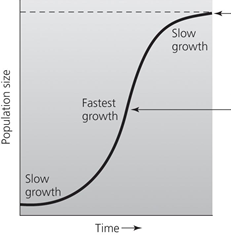
Most forest resource managers aim to maintain resource populations ________ of the pictured curve.
a. at the bottom
b. to the left
c. at the top
d. to the right
e. in the middle
a. at the bottom
b. to the left
c. at the top
d. to the right
e. in the middle
61
New cards
e
The section of the forest labeled C is referred to as the
a. Canopy
b. Forest floor
c. Subcanopy
d. Shrub layer
e. Understory
a. Canopy
b. Forest floor
c. Subcanopy
d. Shrub layer
e. Understory
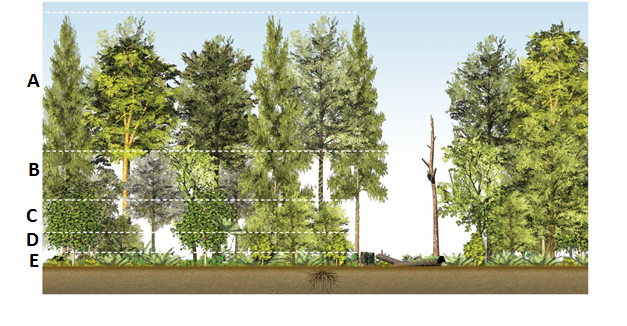
62
New cards
b
In the process of selective cutting, loggers
a. Cut all trees in only 30% of a forest
b. Cut some of the mature trees every 10-20 years
c. Take all small vegetation as well as trees
d. Take only small trees
e. Only use horses or mules to skid out the logs.
a. Cut all trees in only 30% of a forest
b. Cut some of the mature trees every 10-20 years
c. Take all small vegetation as well as trees
d. Take only small trees
e. Only use horses or mules to skid out the logs.
63
New cards
a
In the diagram above, which of the islands would probably be more susceptible to an extinction of one of its terrestrial species?
a. 4
b. 2
c. 5
d. 3
e. 1
a. 4
b. 2
c. 5
d. 3
e. 1
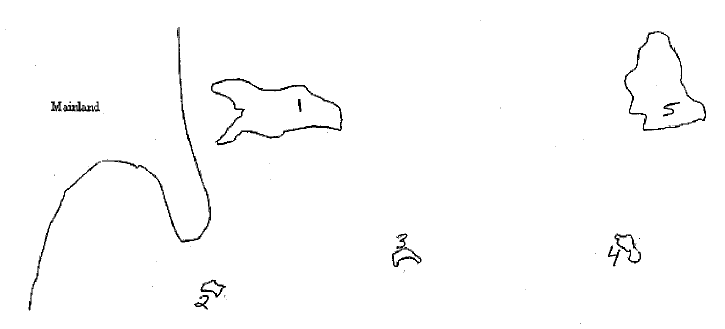
64
New cards
b
Old-growth forests are notable for containing species that
a. Are exotic in North America
b. Are highly adapted to their special environment
c. Migrate long distances to feed in the old-growth forests
d. Are found in other North American forests, in very different environmental conditions
e. Have an unusually high market value
a. Are exotic in North America
b. Are highly adapted to their special environment
c. Migrate long distances to feed in the old-growth forests
d. Are found in other North American forests, in very different environmental conditions
e. Have an unusually high market value
65
New cards
c
Which of the following correctly describes conservation easement?
a. This practice prevents the breakdown of stream banks.
b. This agreement allows a developer to add new land to a housing project with little input from neighbors.
c. This is a binding agreement that preserves land from further development in exchange for tax write-offs.
d. It is a process that conserves soil from erosion.
e. This is a method of building a landfill to minimize runoff.
a. This practice prevents the breakdown of stream banks.
b. This agreement allows a developer to add new land to a housing project with little input from neighbors.
c. This is a binding agreement that preserves land from further development in exchange for tax write-offs.
d. It is a process that conserves soil from erosion.
e. This is a method of building a landfill to minimize runoff.
66
New cards
c
Restoration ecology is similar, at least in part, to stewardship and management. However, the main distinction that sets restoration ecology apart from stewardship and management is
a. A philosophy that humans will not be able to "fix" a system
b. That humans are a part of the system
c. Direct human intervention for a predetermined end
d. A philosophy that nature will heal without intervention
e. The use of modern technological tools such as geographic information systems
a. A philosophy that humans will not be able to "fix" a system
b. That humans are a part of the system
c. Direct human intervention for a predetermined end
d. A philosophy that nature will heal without intervention
e. The use of modern technological tools such as geographic information systems
67
New cards
d
The fragmentation of natural habitats in the conversion of land for human uses creates
a. focused regions where careful wildlife management can actually increase biodiversity.
b. less edges and more continuous habitat.
c. habitats that favor species that grow slowly or have naturally unstable populations.
d. habitat breaks that favor species that thrive at the edges of ecosystems.
e. more opportunities to preserve wildlife in many small parks.
a. focused regions where careful wildlife management can actually increase biodiversity.
b. less edges and more continuous habitat.
c. habitats that favor species that grow slowly or have naturally unstable populations.
d. habitat breaks that favor species that thrive at the edges of ecosystems.
e. more opportunities to preserve wildlife in many small parks.
68
New cards
e
World deserts are
a. Increasing because of the increase in global carbon dioxide
b. Decreasing as world climate becomes wetter
c. About the same in area but have many threatened species of plants
d. Decreasing becomes of massive reforestation
e. Increasing because of logging and grazing
a. Increasing because of the increase in global carbon dioxide
b. Decreasing as world climate becomes wetter
c. About the same in area but have many threatened species of plants
d. Decreasing becomes of massive reforestation
e. Increasing because of logging and grazing
69
New cards
e
he amount of interior area in a preserve is important because
a. All of these
b. It is more economical to buy large land areas
c. Humans and other hardy species encroach on preserve margins
d. Many threatened species cannot survive environmental conditions on preserve margins
e. Both "Humans and other hardy species encroach on preserve margins" and "Many threatened species cannot survive environmental conditions on preserve margins" are correct answers.
a. All of these
b. It is more economical to buy large land areas
c. Humans and other hardy species encroach on preserve margins
d. Many threatened species cannot survive environmental conditions on preserve margins
e. Both "Humans and other hardy species encroach on preserve margins" and "Many threatened species cannot survive environmental conditions on preserve margins" are correct answers.
70
New cards
c
Compared to forests using ecosystem based management, commercial forests managed for maximum sustainable yield of commercially valuable species will
a. create more acid rain.
b. produce a greater variety of wood.
c. have greater erosion problems.
d. support more biological diversity.
e. be more resistant to pests.
a. create more acid rain.
b. produce a greater variety of wood.
c. have greater erosion problems.
d. support more biological diversity.
e. be more resistant to pests.
71
New cards
d
Efforts to repair or reconstruct ecosystems are known as
a. Land stewardship
b. Conservation reserve programs
c. Mitigation
d. Restoration ecology
e. Landscape ecology
a. Land stewardship
b. Conservation reserve programs
c. Mitigation
d. Restoration ecology
e. Landscape ecology
72
New cards
a
The SLOSS dilemma involves controversy over ________.
a. habitat fragmentation and preserve design
b. controlled burns
c. drilling for oil in ANWR
d. government subsidies to farmers
e. tax dollars spent to build roads in national forests
a. habitat fragmentation and preserve design
b. controlled burns
c. drilling for oil in ANWR
d. government subsidies to farmers
e. tax dollars spent to build roads in national forests
73
New cards
e
Corridors have the potential to effectively enlarge which of the following?
a. Preserve areas
b. Genetic pools
c. Feeding ranges
d. Areas of refuge against natural disasters (e.g. fire)
e. Corridors have the potential to enlarge all of these
a. Preserve areas
b. Genetic pools
c. Feeding ranges
d. Areas of refuge against natural disasters (e.g. fire)
e. Corridors have the potential to enlarge all of these
74
New cards
d
"Forest management" means planning for
a,. Building the maximum biodiversity in a forest
b. A continual increase in forest complexity
c. Old-growth status in the managed forests
d. Sustainable harvests and forest regeneration
e. Gaining maximum, quick profit from trees
a,. Building the maximum biodiversity in a forest
b. A continual increase in forest complexity
c. Old-growth status in the managed forests
d. Sustainable harvests and forest regeneration
e. Gaining maximum, quick profit from trees
75
New cards
e
Developed countries produce ________ of all industrial wood and account for _______ of its consumption
a. More than half; less than half
b. More than half; about 80%
c. Less than half; about half
d. Less than half; about 20%
e. Less than half; about 80%
a. More than half; less than half
b. More than half; about 80%
c. Less than half; about half
d. Less than half; about 20%
e. Less than half; about 80%
76
New cards
b
"Edge effects" are a particular problem when ________.
a. wildlife corridors are developed in urban landscapes
b. formerly large habitats are reduced to small fragments
c. trying to manage and protect island biodiversity
d. forests undergo biodiversity changes as a result of climate change
e. preserves have a very large area and a roughly circular shape
a. wildlife corridors are developed in urban landscapes
b. formerly large habitats are reduced to small fragments
c. trying to manage and protect island biodiversity
d. forests undergo biodiversity changes as a result of climate change
e. preserves have a very large area and a roughly circular shape
77
New cards
a
Which of the following is not a benefit of fire in natural settings?
a. Creates open space for exotic weeds to gain access to interior parts of the forest
b. Removes fuel to prevent large, catastrophic wildfires
c. Creates habitat for species such as elk, deer and grouse
d. Creates space for new plants to germinate
e. Speeds up nutrient cycling by turning old vegetation to ash
a. Creates open space for exotic weeds to gain access to interior parts of the forest
b. Removes fuel to prevent large, catastrophic wildfires
c. Creates habitat for species such as elk, deer and grouse
d. Creates space for new plants to germinate
e. Speeds up nutrient cycling by turning old vegetation to ash
78
New cards
d
The area effect of the equilibrium theory of island biogeography suggests that ________.
a. the number of individuals of each species decreases as the size of the island increases because competition decreases population sizes
b. the total number of species increases as an island is further from the mainland; it is easier to speciate
c. the number of species decreases with increasing island size; all else being equal, larger islands contain fewer species
d. the number of species increases with the size of the island; all else being equal, larger islands contain more species
e. organism size (large or small) is what most affects the number of individuals of each species
a. the number of individuals of each species decreases as the size of the island increases because competition decreases population sizes
b. the total number of species increases as an island is further from the mainland; it is easier to speciate
c. the number of species decreases with increasing island size; all else being equal, larger islands contain fewer species
d. the number of species increases with the size of the island; all else being equal, larger islands contain more species
e. organism size (large or small) is what most affects the number of individuals of each species
79
New cards
d
Which part of a nature preserve has the most intensive human impact?
a. There is no human impact in a biosphere reserve
b. In the core zone
c. In the buffer zone
d. In the multiple use zone
e. There is the same amount of human impact throughout the biosphere reserve
a. There is no human impact in a biosphere reserve
b. In the core zone
c. In the buffer zone
d. In the multiple use zone
e. There is the same amount of human impact throughout the biosphere reserve
80
New cards
b
The primary aim of the U.S. Forest Service has been to provide
a. Wildlife habitat
b. Timber to logging companies
c. The benefits of forests for current and future populations
d. Fire patrols to protect ancient forests
e. Public recreation and education
a. Wildlife habitat
b. Timber to logging companies
c. The benefits of forests for current and future populations
d. Fire patrols to protect ancient forests
e. Public recreation and education
81
New cards
e
A disadvantage of monoculture forestry is that it is
a. Difficult to harvest with clear-cut methods
b. Takes more time to replant
c. Difficult to replant
d. Economically inefficient
e. Susceptible to pests and diseases
a. Difficult to harvest with clear-cut methods
b. Takes more time to replant
c. Difficult to replant
d. Economically inefficient
e. Susceptible to pests and diseases
82
New cards
e
Landscape ecology includes many perspectives that, at least in part, ecology that is more traditional has held in the past. However, one distinction between landscape ecology and traditional ecology is the inclusion of
a. Modern technological tools
b. An ecocentric philosophy
c. A philosophy of the dynamic nature of the ecosystem
d. A systems perspective
e. Humans in the system
a. Modern technological tools
b. An ecocentric philosophy
c. A philosophy of the dynamic nature of the ecosystem
d. A systems perspective
e. Humans in the system
83
New cards
a
Economically, monoculture forestry is advantageous for the loggers because
a. It produces large quantities of a single type of tree for a particular use, such as building timber or paper pulp
b. It is labor-intensive and thus increases job opportunities for local people
c. A mix of different trees leads to a good resource base if the market for one type of timber falls
d. The increase of wildlife diversity is beneficial to the tourism industry
e. High levels of pesticides and herbicides may be needed, therefore there is more money spend and in the system
a. It produces large quantities of a single type of tree for a particular use, such as building timber or paper pulp
b. It is labor-intensive and thus increases job opportunities for local people
c. A mix of different trees leads to a good resource base if the market for one type of timber falls
d. The increase of wildlife diversity is beneficial to the tourism industry
e. High levels of pesticides and herbicides may be needed, therefore there is more money spend and in the system
84
New cards
e
Most commercial loggers prefer "clear-cut" harvesting because it
a. Is the most efficient way to get valuable small timber without disturbing the larger early successional trees
b. Is the most environmentally sustainable type of harvest
c. Is the most effective way to refresh soil with rain and sun
d. Does not waste any trees
e. Is the most efficient and cheapest harvest method using large, fast machinery instead of costly labor
a. Is the most efficient way to get valuable small timber without disturbing the larger early successional trees
b. Is the most environmentally sustainable type of harvest
c. Is the most effective way to refresh soil with rain and sun
d. Does not waste any trees
e. Is the most efficient and cheapest harvest method using large, fast machinery instead of costly labor

