Damped Oscillation [Part-II]
 Studied by 0 people
 Call Kai
 Learn
Learn Practice Test
 Spaced Repetition
 Match
Match Flashcards
 Knowt Play
1/11

There's no tags or description
Looks like no tags are added yet.
Name | Mastery | Learn | Test | Matching | Spaced | Call with Kai |
|---|
No analytics yet
Send a link to your students to track their progress
12 Terms
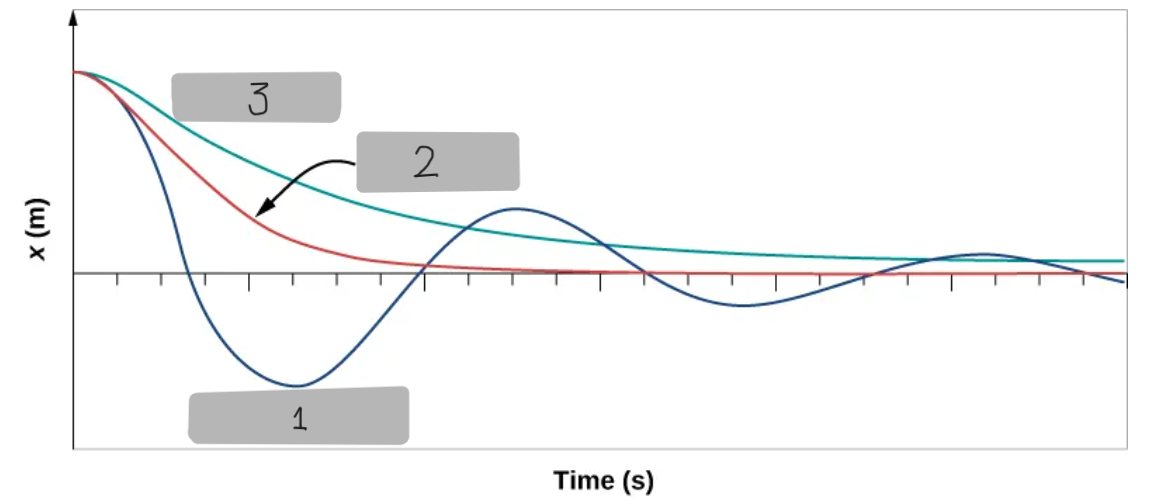
b^2 < 4mk
(1)
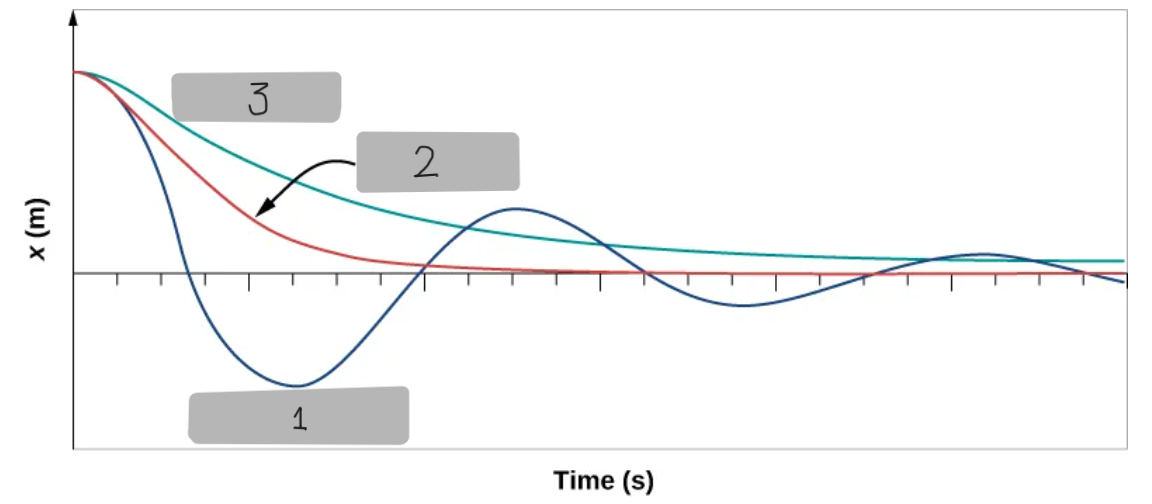
b^2 = 4mk
(2)
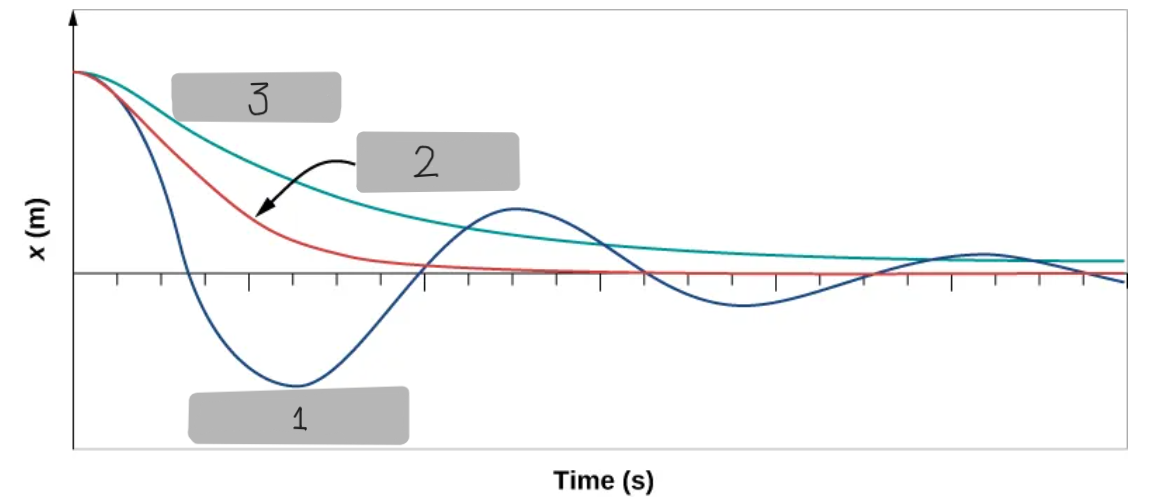
b^2 > 4mk
(3)
The term ((k/m) - (b/(2m))^2) becomes negative, making the angular frequency imaginary, which means no oscillations occur. The system only decays exponentially toward rest.
What happens when the damping constant becomes very large?
Because damping opposes motion. If it’s too strong, it slows the system so much that it cannot oscillate, it will just slowly move toward equilibrium instead of swinging back and forth.
Why must damping be small for oscillations to occur?
angular frequency, ((k/m) - (b/(2m))^2)^1/2
As the damping increases, the _________________,decreases since damping weakens the effective restoring force. The motion becomes slower as b increases in……………
The damping constant must be less than the critical value
What condition must be met for a system to oscillate?
b < (4mk)^1/2
Mathematical representation of the damping value being less than the critical value.
((k/m) - (b/(2m))^2)^1/2
Formula for the angular frequency in a damped oscillator
Underdamped Motion
When damping is small
b < (4mk)^1/2
the system oscillates with gradually decreasing amplitude
Most real systems, such as a mass on a spring in air, follow this motion
Critically Damped Motion
Occurs when b = (4mk)^1/2
The system returns to equilibrium as quickly as possible without oscillating
This is desirable in systems like shock absorbers in vehicles
Overdamped Motion
Occurs when b > (4mk)^1/2
The system does not oscillate and returns to equilibrium slowly,
taking longer than in the critically damped case.
 Note
Note  Flashcards (41)