Lecture 6-Cellular Structure of Eukaryotic cell
 Studied by 0 people
 Call Kai
 Learn
Learn Practice Test
 Spaced Repetition
 Match
Match Flashcards
 Knowt Play
1/53

There's no tags or description
Looks like no tags are added yet.
Name | Mastery | Learn | Test | Matching | Spaced | Call with Kai |
|---|
No analytics yet
Send a link to your students to track their progress
54 Terms
1) Cells can’t depend on diffusion to supply interior of cell with nutrients
2) External cell membrane would be insufficient to house enough bioenergetic complexes
Problems of large cell size(2)
1.) Endomembranes increase membrane surface area w/o increasing cell volume
2.) Enclosed certain metabolic activities increase [enzyme] and [substrates] allowing rxns to go faster
3.)Allows for different environments within cells. Ex: low acidic pH in lysozymes
4.) protects cytoplasm from harmful compounds. (Ex: lysosomes-hydrolytic enzymes and peroxisomes-peroxide)
4 Advantages of organelles
cellulose(algae) and chitin(fungi)(no peptidoglycan)
Eukaryotic cell wall composed of *blank and *blank
Not sensitive to chloramphenicol and streptomycin(unlike prokayotes)
How do Eukaryotic ribosome react to chloramphenicol and streptomycin
Actin, Tubulin, etc
Cytoskeletal proteins of eukarya
Composed of a(alpha) and B(beta) tubulin
What are eukaryotic cells flagella composed of?
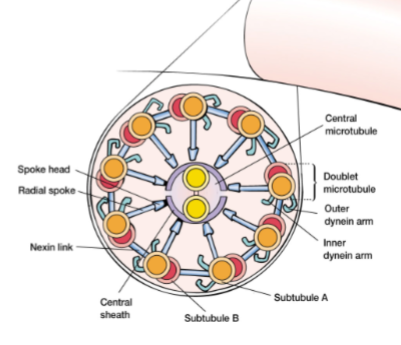
• Microtubules, tubulin
• Nine pairs + two arrangements
Structure of eukaryotic flagella and cilia
Plants, algae, fungi
What eukaryotic groups have cell walls?
• Carbohydrates: cellulose, chitin, glucan, mannan.
• No peptidoglycan, antibiotic such as penicillin and cephalosporin do not affect eukaryotic cells.
What are the main carbohydrate and peptidoglycan components of eukaryotic cell walls?
penicillin and cephalosporin
What two antibiotics have no effect of eukaryotic cell walls due to their lack of peptidoglycan?
Sterols
unique to eukaryotic plasma membranes
• Proteins.
– Peripheral proteins.
– Integral proteins.
– Transmembrane proteins
Three types of Proteins in Eukaryotic Plasma Membranes
Phagocytosis
_____________: Pseudopods extend and engulf particles.
Pinocytosis
____________: Membrane folds inward bringing in fluid and dissolved substances
-Allows ingestion and export of things that are too large to be accomodated by a channel or pore
Why is endocytosis and exocytosis important?
membrane-spanning protein complexes
Bacteria do not perform endocytosis or exocytosis*. They import and export material through __________________________
endocytosis
Viruses that attack eukaryotic cells exploit ___________ to gain entry to
the cell.
pathogens and symbionts
In a few cases, bacteria are endocytosed by eukaryotic cells, but
instead of being digested, evade the lysosome and live within the host
cell. Two examples of this are
Cytoplasm
Substance inside plasma and outside nucleus
Cytosol
Fluid (soluble) portion of cytoplasm
Microfilaments, intermediate filaments, microtubules
3 main components of the cytoskelton in Eukaryotes
Cytoplasmic streaming
Movement of cytoplasm throughout cells
Nucleus
Organelle that contains chromosomes
ER
Organelles that are in the Transport network
Golgi Complex
Membrane formation and secretion organelle
Lysosome
Organelle that works as digestive enzymes
Vacuole
Brings food into cells and provides support
Mitochondrion
Cellular respiration
Chloroplast
Photosynthesis organelle
Peroxisome
Oxidation of fatty acids; destroys H2O2
Ribosome and Centrosome
2 Eukaryotic non-membrane bound organelles
Centrosome
Consists of protein fibers and centrioles, plays important roles in cell division.
Nuclear membrane (double membrane)
Nuclear pore, transport control
Nucleolus, ribosome RNA synthesis
Repository of genetic information (chromatin, DNA bound by histones)
List 4 bullet points about the Nucleus
70S
Ribosomal components of chloroplasts and mitochondria
Extensive network of membranous sacs or tubules
Rough ER, ribosome
Smooth ER, no ribosome attached
Protein and lipid synthesis
Transport of material
List 5 bullet points of the Endoplasmic Reticulum
Membranous organelle made of cisternae stacked on each other
Involved in modification, packaging, and secretion of materials for various purposes
List 2 bullet points of the Golgi Complex
• Membrane-bound vesicles found in most eukaryotes
• Involved in intracellular digestion
• Contain hydrolases, enzymes which hydrolyze molecules and function best under slightly
acidic conditions
• Maintain an acidic environment by pumping protons into their interior
List 4 bullet points of the Lysosomes
Yoshinori Ohsumi
Who discovered autophagy(self-eating) in 2016 and Received a Nobel Prize
-Double Membraned
-Inner membrane is folded as cristae
-Many enzymes that involve cellular respiration are on cristae
-DNA(genome)
-70S ribosome
-Energy production
List the 6 bullets that describe the Mitochondria
-Site of TCA cycle
-Site where ATP is generated by electron transport and oxidative phosphorylation
-About the same size as bacterial cells
-Reproduce by binary fission as do bacterial cells
-Critical roles in the regulation of cell death and innate immune system
6 more bullet points about the Mitochondria
-contains porins similar to the outer membrane of Gram-negative bacteria
Outer membrane structure of mitochondria
-highly folded to form cristae(s. crista
-location of enzymes and electron carriers for electron transport and oxidative phosphorylation
Inner membrane of mitochondria
-ribosomes(same size as bacteria)
-mitochondrial DNA(may be circular like bacteria)
-enzymes involved in TCA and enzymes for catabolism of fatty acids
What 3 things are in the matrix enclosed by inner membrane?
-Site of photosynthetic reactions
• Pigment-containing organelles observed in plants and algae
• Surrounded by double membrane
• 70S, DNA genome, binary fission
List 4 bullet points about Chloroplast
Endosymbiotic Theory
The theory that:
-Mitochondria were bacteria
-Chloroplasts were cyanobacteria
-Infected or engulfed by other species
-Ended up living together
Mitochondria and Chloroplasts contain:
-same size, shape and binary fission of bacteria
-Circular DNA genome
-70S ribosome
list all evidence for the endosymbiotic theory
Lynn Margulis
scientist who discovered Endosymbiotic Theory
cyanobacterial
Chloroplasts contain DNA similar to ______________ DNA, leading scientists to believe that they were ingested by eukaryotic cells
proteobacterium (or the proteobacterium attempted to infect it)
Early in cellular evolution, a larger cell ingested a
________________. This developed into the mitochondria
-Different membranes
-Archaeal ribosomes similar to eukaryotic ribosomes
-Many archaea live in harsh environments
-Separate domain
List all the reasons why Archaea are different from bacteria
-Archaea
-Bacteria
-Mitochondria and Chloroplasts of Eukaryotes
What organisms have 16s rRNA gene sequence?
D. peptidoglycan
The plasma membrane of eukaryotes contains all of the following except
A. phosphoglycerides.
B. sphingolipids.
C. sterols.
D. peptidoglycan
E. All of the choices
Which of the following is a function of the
mitochondrion?
A. Tricarboxylic acid cycle enzyme
reactions.
B. Electron transport.
C. ATP synthesis.
D. Regulation of cell death and innate
immune responses
E. All of the choices
c. 30S + 50S
Prokaryotic ribosomes are composed of two
subunits of what sizes?
a. 20S + 50S
b. 30S + 40S
c. 30S + 50S
d. 40S + 60S
 Note
Note  Flashcards (47)