ENGLISH LINGUISTICS II: Coherence I – Explaining Sense (Continuity in Text)
 Studied by 0 people
 Call with Kai
 Learn
Learn Practice Test
 Spaced Repetition
 Match
Match Flashcards
 Knowt Play
1/18

Earn XP
Description and Tags
Vocabulary flashcards covering coherence, frames, scripts, macrostructures, and related concepts from the lecture notes on Continuity in Text.
Name | Mastery | Learn | Test | Matching | Spaced | Call with Kai |
|---|
No study sessions yet.
19 Terms
Coherence
the mutual accessibility and relevance of concepts and the relations among them in the textual world.
Semantic continuity created by the reader’s interpretation and world knowledge; depends on context.
concept : definition + 4 types of primary concepts
An idea of knowledge in the mind that forms part of a larger frame.
A clear idea in the mind (e.g., dog, school)
objects : a stable identity and constitution (e.g. tree, ground, bike, lock)
situations: objects in their current states (e.g. bike getting stolen)
events: a situation or a state within a situation (e.g. bike was gone)
actions: events brought about by an agent (e.g. jump, hit, realize, park)
Relations
links between concepts which appear together in the textual world; coherence can be interpreted as a structure of concepts and their relations to one another
Clause Relations
Clauses can be reduced to core propositions that show basic meaning, usually combining a reference (who/what) with a predication (action/event). = reference + predication (e.g., person + action).
Eve jumped from the tree. She hit the ground only to realize that the bike she had parked there was gone. Locks are great gadgets if you remember to take one with you.
2. LIST OF PROPOSITIONS 1 Eva jump tree | 2 Eva hit ground | 3 Eva realize bike gone | 4 Eva parked bike | 5 Eva forgot locking
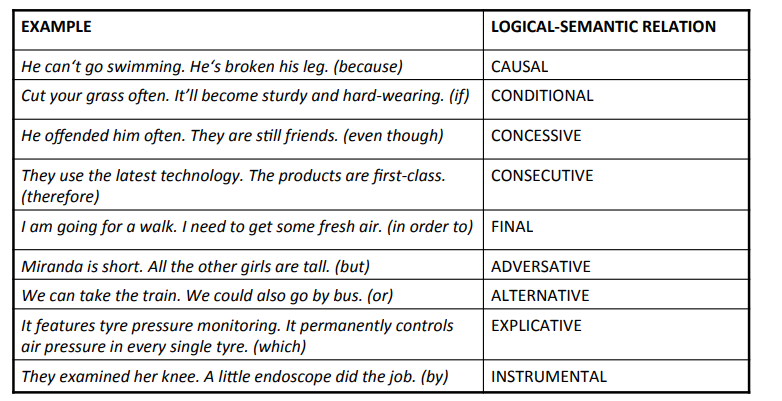
Clause/ semantic Relations
Logical- sematic Relations
Frame and script theory
understanding relies on stored knowledge structures (schemata). A frame is a mental structure for a concept (e.g., restaurant), while a script is the typical sequence of events within it (e.g., enter → order → eat → pay). Scenarios cover broader knowledge patterns.
FRAMES – SCRIPTS – SCENARIOS
① FRAME: “our knowledge about concepts” (ibid.), e.g. skiing equipment
② SCRIPT: “our knowledge about the roles people have in a specific situation” (RENKEMA 2004: 237), e.g. skier, lift operator, skiing instructor
③ SCENARIOS: “our knowledge about the ordering of activities” (ibid.), e.g. riding a ski lift
Semantic Frame
a structured mental framework of connected concepts, experiences, and knowledge that underlies a word or expression, providing context and influencing how we interpret meaning
Slot/Filler
every frame has characteristic ‘slots’ which can be provided with ‘fillers’,e.g. university slots: courses, lecture hall, library, students etc.)
Script: definition + 4 elements of scripts
a typical process or sequences of actions including all necessary objects and the acting subjects, i.e. ‘slots’ (e.g. ‘eating out in a restaurant’)
① PROPS: all the objects and places in the script (e.g. table, menu, food, bill)
② ROLES: the people ac*ng in the script (e.g. guest, waiter, cook)
③ENTRY CONDITIONS: precondi*ons/situa*on at the beginning (be hungry, have money)
④ RESULTS: effects at the end of the script (be full, be pleased)
SCENES (AS KNOWLEDGE – FRAMES AS LINGUISTIC ELEMENTS)
Coherent segments of human experience(e.g., a classroom, a meal, a meeting), including visual situations, interactions, scenarios, institutions, actions, or imaginations. Frames are the linguistic systems linked to these scenes.
Macrostructure- Macro-proposition
summary meaning, The overall meaning of a text. Readers build macrostructures by summarizing individual sentences into a main theme or topic, using inference rules. It contrasts with microstructure, which focuses on sentence-level details.
e.g.
Macro-rule 3
deletion/selection
generalization
construction.
Deletion/Selection(macro-rule)
all irrelevant, non-‐essential propositions are deleted, the relevant, most significant statements are selected from the overall text structure > A girl passed by. She was wearing a dress. The dress was yellow. -‐-‐> A girl passed by
Generalization(macro-rule)
details are summarized in more general statements > John was playing with his car, Mary was building a sand castle, and Sue was blowing soap bubbles. -‐-‐> The children were playing.
Construction(macro-rule)
a macro-‐proposition is constructed from various micro-‐proposi3ons by inferring content from frame and script knowledge > John went to the staKon. He bought a Kcket, started running when he saw what Kme it was, and was forced to conclude that his watch was wrong when he reached the pla\orm. -‐-‐> He missed the train.
Superstructure
A conventional schema gives a text its overall form (e.g., story, news report, argument); about how that content is organized.
Genre
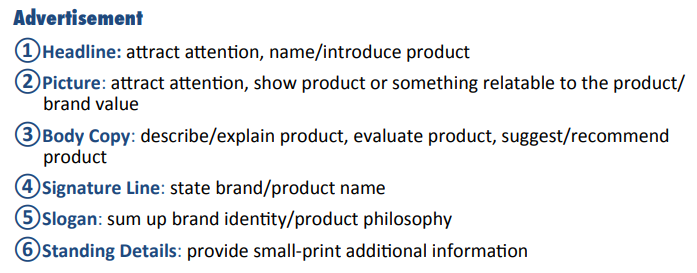
A conventional text type defined by typical content, communicative purpose, and expected stages of organization (e.g., a news article, recipe, or academic essay).
Letter-to-the-editor
①REFERENCE: men*on content
②EVALUATION: assess content
③ARGUMENT: give reasons
④AUTHOR: give name
 Note
Note  Flashcards (88)