lecture 36 - body sensation (sensory receptors) 1 + 2 - PoNF
 Studied by 0 people
 Call Kai
 Learn
Learn Practice Test
 Spaced Repetition
 Match
Match Flashcards
 Knowt Play
1/35

There's no tags or description
Looks like no tags are added yet.
Name | Mastery | Learn | Test | Matching | Spaced | Call with Kai |
|---|
No analytics yet
Send a link to your students to track their progress
36 Terms
function of sensory receptors
provide sensations of touch, pressure, temperature, pain
why are sensory receptors known as transducers
they convert stimuli into frequency of action potentials
What are sensory receptors? (cutaneous receptors)
sensory neurons or cells that are able to respond to environmental stimuli
name the 3 main types of sensory receptors
mechanoreceptors
proprioceptors
nociceptors
function of mechanoreceptors
stimulated by mechanical stimuli
pressure
stretch
give skin sensations of touch and pressure
function of proprioceptors
mechanoreceptors in joints/muscles
signal information about body or limb position
Nociceptors function
respond to painful stimuli
Thermoreceptors
respond to changes in temperature
Chemoreceptors
respond to chemicals (e.g., smell, taste, changes in blood chemistry)
sensory modality
the stimulus type that activates a particular receptor
e.g. touch, pressure, joint angle, pain
what does sensory receptor transduction involve
opening or closing of ion channels
sensory transduction
adequate stimulus causes graded membrane potential change (only a few mV)
activates stretch sensitive ion channels so ions flow across membrane and change membrane potential locally
receptor/generator potential
change in membrane potential in response to stimulus
adequate stimulus in cutaneous mechanoreceptors and proprioceptors
membrane deformation
What is a receptor potential?
the graded potential in sensory receptor caused by a stimulus
how is a receptor potential generated
stimulus triggers ion flow through membrane locally
if depolarisation reaches area with voltage gated ion channels (1st node of Ranvier) then APs fire
lowest stimulus intensity - no APs
highest stimulus intensity - most APs
function of 1st node of ranvier
send AP when depolarised
function of general nodes of ranvier
saltatory conduction
frequency coded stimulus intensity
larger stimulus - larger receptor potential - higher frequency of APs
if stimulus persists, what can some mechanoreceptors do?
adapt - continuous mechanical stimulation causes a drop off in action potentials so brain can process new or changing events
action potentials persist for some - nociceptors
Adaptation of mechanoreceptors
adapt to maintained stimulus and only signal change or novel event
rapid : cease to fire
slow : still firing but slower
Rapid Adapting Mechanoreceptors
Pancinian corpuscle
Meisseners corpuscles
- action potentials when stimulus is increased and decreased only
Slowly adapting mechanoreceptors
Merkel and Ruffini
- action potentials only throughout high intensity stimulus
nociceceptors
DO NOT ADAPT
Pancinian Corpuscle
an encapsulated ending of a sensory nerve that acts as a receptor for pressure and vibration
Pancinian Corpuscle structure
myelinated nerve - naked nerve ending
enclosed by a connective tissue capsule of layered membrane lamellae and each layer is separated by fluid
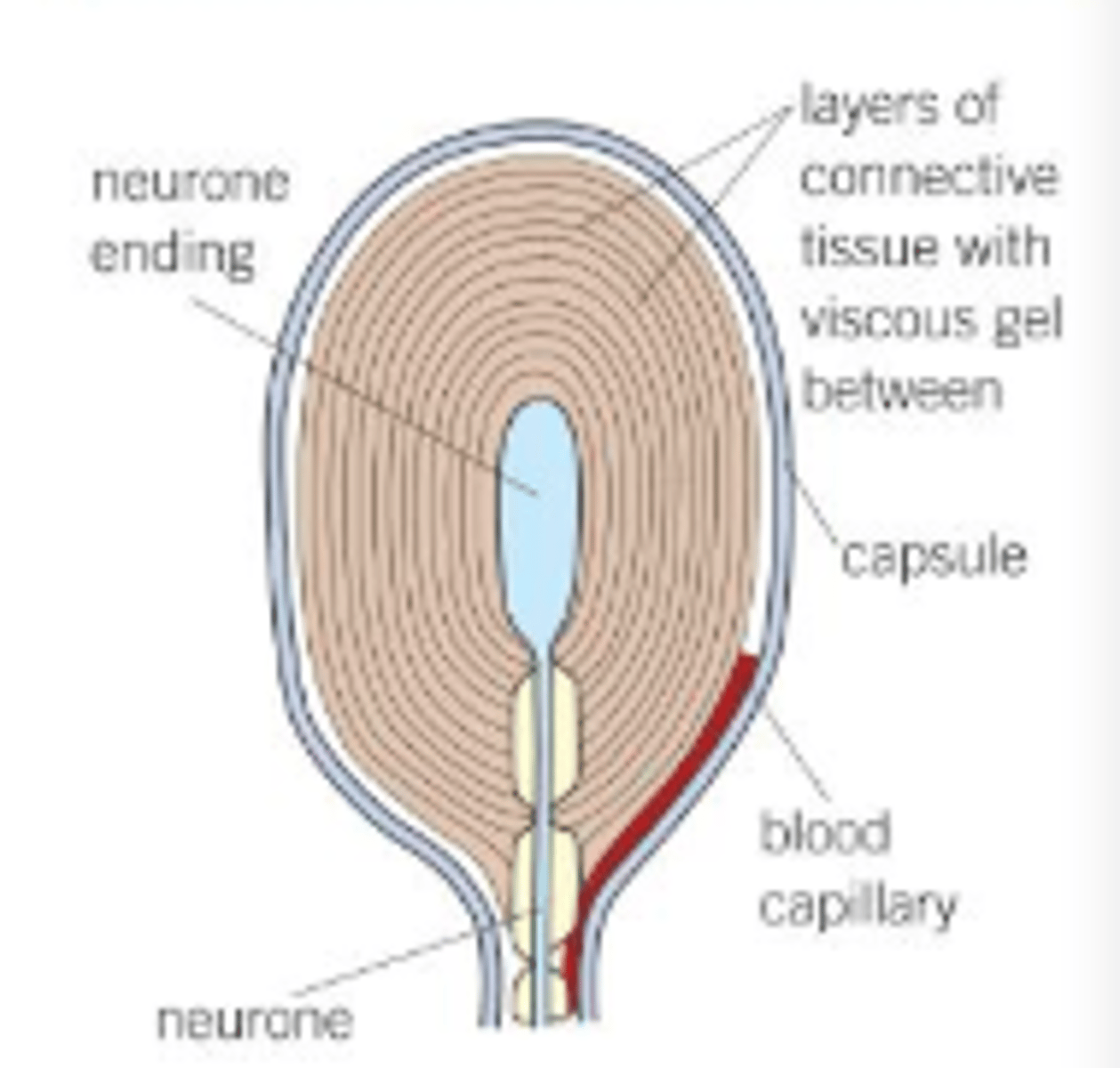
Pancinian corpuscle response to stimuli
mechanical stimulus deforms the capsule and nerve ending
this stretches the nerve ending and opens ion channels
Na+ influx - local depolarisation - receptor potential
action potentials generated and fires when myelination begins
does the Pancinian corpuscle show rapid adaptation
yes
rapid adaptation of Pancinian corpuscle
mechanical stimulus causes deformation of capsule
nerve ending stretches
opening of ion channels
open ion channels causes local depolarisation causing a generator potential
action potentials fired - brain detects
fluid rapidly redistributes within capsule lamellae which spreads the stimulus impact out laterally minimising downward deformation
downward force causing mechanical stretch to nerve endings stops so action potentials stop firing
stimulus withdrawn
Pancinian corpuscle response normally
rapidly adapting, ON/OFF response
what happens if capsule is removed from Pancinian capsule
bare nerve endings, loss of adaptation, continues to produce receptor potential
what is the receptive field
area or range of sensory input that can trigger a response in a particular neuron
What is 2 point discrimination?
Ability to discriminate between two closely spaced points touching the skin
What does the 2 point discrimination test depend on?
receptive field size
neuronal convergence
what causes low acuity
high convergence and a large secondary receptive field
lateral inhibition
allows us to locate stimulus precisely
 Note
Note  Flashcards (43)