Organic Evolution Exam 1
 Studied by 0 people
 Call Kai
 Learn
Learn Practice Test
 Spaced Repetition
 Match
Match Flashcards
 Knowt Play
1/77

There's no tags or description
Looks like no tags are added yet.
Name | Mastery | Learn | Test | Matching | Spaced | Call with Kai |
|---|
No analytics yet
Send a link to your students to track their progress
78 Terms
Charles Darwin
Natural Selection - differences in phenotypes in certain individuals can improve survivability and reproductive success.
HMS Beagle - gathered fossils of extinct animals, trapped birds and collected barnacles,
Homology
structural characters that are shared because they are inherited from a common ancestor
Types of Living Cetacean Mouth Anatomy
Mysticetes - use baleen to filter small animals from water (blue whale)
Odontocetes - toothed whales (sperm whales, dolphins, orca)
Philip Gingerich
discovered Pakicetus -
Fossil was 50 million years old - oldest cetacean fossil at that point
Pakicetus lived in shallow streams and appeared to have spent some time on land
Morphology
form and structure of organisms
Genera
taxonomic group that includes species
Genetic Drift
evolution arising from random changes in the genetic composition from one generation to the next
Evolutionary Change
can modify morphological, behavioral, and physiological features
Evolution
explains the diversity of life
Biological Evolution
any change in the inherited traits of a population that occurs from one generation to the next
Shared Traits of Whales to Mammals
Live birth
Mammary glands
Three middle ear bones
Dorudon
Transitional fossil that reveals whales’ link to land mammals
Baleen whales (mysticetes)
Ancestors of all modern whales had teeth
Baleen completely replaced teeth in mysticetes (genes for teeth building disabled)
Evolution of Large Brains
Caused by sociality
formation of lasting alliances
competition for mates
complex communication
Evidence for Understanding Evolution
Fossils
Comparative Anatomy - studying homologous structures, vestigial structures, etc.
Genetic Evidence - DNA, RNA, protein sequence comparison
The Great Chain of Being
Christians’ view of the cosmos - divine plan established by God at creation
Became known as “Natural Theology”.
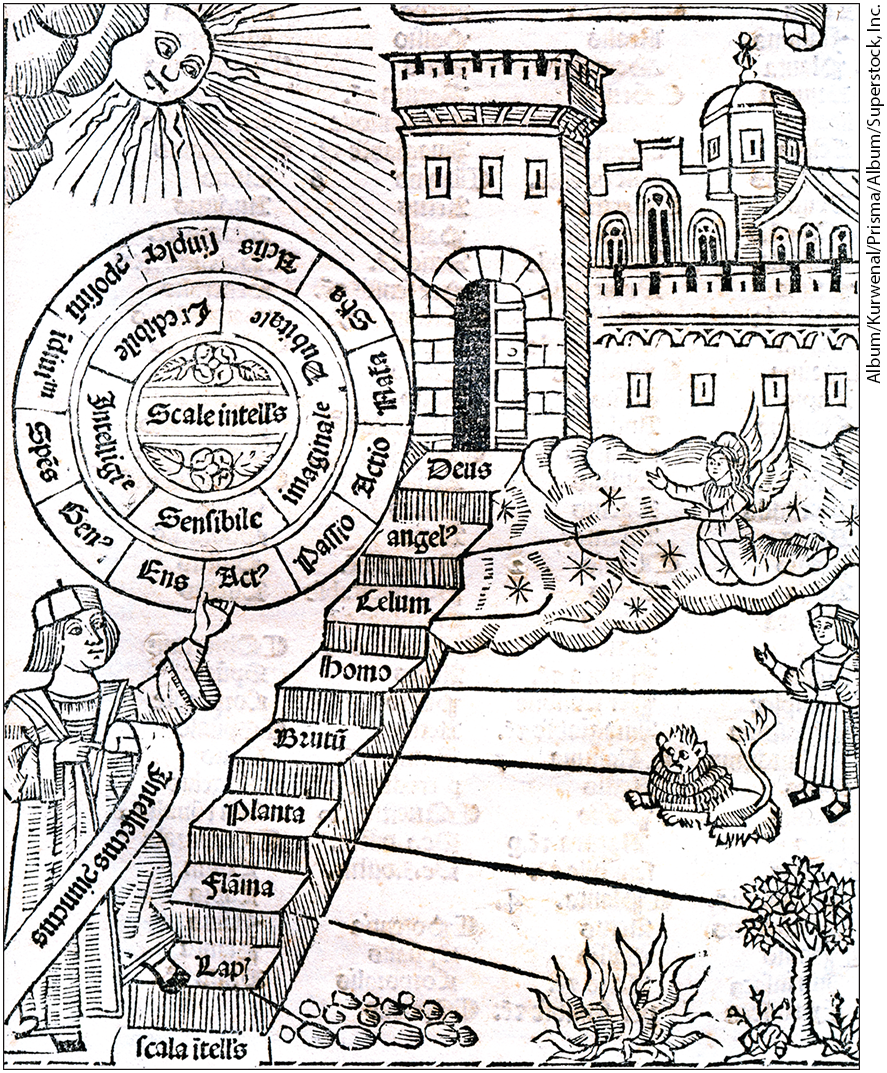
Carolus Linnaeus
Linnaean Classification
organized all living things into hierarchy groups = TAXA
Taxonomy - science of describing, naming, and classifying species of living or fossil organisms
Nicolaus Steno
Studied shark teeth - found that after death, teeth became stone
Idea: life and the planet that supported it had a history filled with change, and Earth itself kept a record of that history.
William Paley
wrote Natural Theology, or Evidences of the Existence and Attributes of the Deity Collected from the Appearances of Nature
proposed intricate design of life is evidence of a Divine Creator
cataloged examples of organs and their similarities to man-made machines
“If you see a rock, it’s natural. If you see a clock, there is a creator.”
Buffon
earth formed according to laws of physics & chemistry
Earth was older than previously thought
Life emerged @ distinct types; transformed when environment changed
Proposed varieties of species arise in response to new habitats
Mary Anning
Paleontologist - found fossils of reptiles (sharklike species & winged flying forms)
Helped provide evidence for concept of extinction
Lamarck
Believed animals and plants could adapt to their environment
believed physical changes acquired by organism can be passed down to offspring
Example: amputated limb can be passed to offspring
Complex species descended from microbes
Microbes are continually generated
Opposed “Great Chain of Being”
Georges Cuvier
compared elephant fossils to living elephant from Africa and India
discovered distinctions (mammoths)
concept of extinction
anti-evolutionist
Uniformitarianism
Natural laws observable now are responsible for events in the past
Popularized by Hutton & Lyell
Earth’s landscapes had been created not by gigantic catastrophes but by a series of many small changes
Ingredients for Natural Selection
All species have great potential fertility that population would increase exponentially if all were born successfully
Except for minor fluctuations, population will display stability in size
Natural resources are limited.
Inference 1: Because more individuals are produced than can be supported by the limited resources, resulting in only a small part of population to survive
No two individuals are the same. Every population displays variability.
Much of the variability is heritable.
Inference 2: Survival in the struggle is not random but depends on inherited traits. Unequal survival = natural selection
Inference 3: Process of natural selection will lead to continuing gradual change in populations = evolution and new species production
Lyell
Believed Earth’s geological features were caused by gradual changes
Influenced Darwin
Heredity
Transmission of characteristics from parent to offspring
Hutton
small changes can dramatically change landscapes
earth must be very old
Linnaean Taxonomy
Kingdon
Phylum
Class
Order
Family
Genus
Species
William Smith
Discovered different rock layers contain distinct groups of fossils
Created first geological map
The “Modern Evolutionary Synthesis”
Made evolutionary theory more powerful, blending genetics and other fields with natural selection
Most evolutionary biologists agree that natural selection is the most important driving force in evolutionary change. However, there are other mechanisms, such as sexual selection and genetic drift. In all mechanisms, the most important common denominator of evolutionary change is:
Reproductive success
Which statement is NOT a central tenet in Darwin/Wallace theory of natural selection
variations in populations emerge through mutations
Abigail Allwood
found fossils of microbes
dating back 3.43 billion years
built a rover to look for signs of life on Mars
Kelvin
argued w/ Darwin that Earth is only hundreds of thousands of years
used temperature of rocks in mine shafts
wrong because earth is not a rigid sphere - it is dynamic
Half-Life
N = Noe^(-λt)
N = # of unstable atoms that remain from original supply
λ = probability of atom decaying in a given time
Half-Lives
Carbon-14 → Nitrogen-14: 5730 years
All atoms of half lives found are more than 80 million years
Radiometric Dating
allows researchers to estimate precise ages at which one geological formation ends and another begins
unstable isotopes have fixed probabilities of decaying into a more stable form
unstable → stable
stability depends on neutron
14C (unstable) → 14N (stable)
isotopes with higher probability of decaying do so more quickly
can be used as “clocks” to provide absolute age
Rubidium87 → Strontium87 = 48.8 billion years (half-life)
Geological Periods (youngest → oldest)
Cenozoic (66mya - present)
Mesozoic (251.9 - 66 mya)
Paleozoic (541 - 251.9 mya)
Protezoic (neo-,meso-, paleo-) - (2500 - 541 mya)
Archaean (4000 - 2500 mya)
Hadean (4600 - 4000 mya)
Hominin
member of the clade that includes humans as well
also, all species closer to humans than chimpanzees
Only humans are still alive
Lagerstätte
site with an abundant supply of unusually well-preserved fossils - often including soft tissues - from the same period of time
Transition to multicellular life
began at least 2.1 billion years ago
evolved independently across multiple lineages
Example: slime mold can aggregate and form stalks for reproduction
Mobility
Elizabeth Turner - found sponge fossils
Ediacaran fauna - animal species found in Ediacaran period (before Cambrian)
Chordates
diverse phylum of animals that includes the vertebrates, lancelets, and tunicates
ALL HAVE:
notochord
pharyngeal gill slits
post-anal tail
Tetrapod
vertebrate with four limbs
Living tetrapods include:
mammals
reptiles
birds
amphibians
Teleosts
Bony fishes that comprises most of today’s living aquatic vertebrate
Distinguished by:
upper jawbone mobility = premaxilla
Synapsids
Lineage of tetrapods that gave rise to mammals
320 million years ago
distinguished by a pair of openings behind eyes = temporal fenestrae
nostril opening
Earliest Detections
Oldest chemical traces: 4.1 billion years old
Stromatolites & other microbes: 3.4 billion years
Multicellular organisms: 1.6 billion years
Biomarkers of animals: 650 million years
Plant fossils: 475 million years
Oldest known animals that looked similar to living animals: 200 million years
Our own species: 300,000 years
Tracks of terrestrial animals: 480 years
Cambrian Period
lasted 540 millions years
CT Scan
determined function of hadrosaur crest
crest connected to nasal cavity (sound generated by blowing air)
found ears were tuned to specific frequency
Burgess Shale
Occasionally soft tissues fossilize
Landslide will cover previous layes
example of lagerstätte
505 mya
more than 65,000 specimens
Dawn of Animals
Animals = hetetroph, Plant = autotroph
Early animal life resemble sponge
oldest fossils dated @ 890 mya
biomarkers of sponges dating to 635 mya
Earliest animal tracks
585mya
tells us animal gain mobility, instead of being sedentary
Ediacaran fauna
fauna = animals
dominated oceans from 570-540 mya
many went extinct at the end of Ediacaran period
Cambrian fauna
Animals diversified → some grazed on microbial mats, others predator-prey
541 mya - 485 mya
Chordates
515 mya
predecessors of vertebrates (NOT ALL HAVE VERTEBRAL COLUMN)
All had: notochord, pharyngeal gill slit, post-anal tail
Terrestrial Plant and Fungal Life
Oldest terrestrial plant fossils → ~470 mya
Large forest ecosystems within 100 million years
First Terrestrial Animal Life
Invertebrate trackways → 480 mya
Probably relatives of insects and spiders
not clear whether they lived on land permanently
Oldest fossil: 428 mya
Many were millipedes
First Terrestrial Vertebrates
Oldest trackways → 390 mya
Oldest fossils of tetrapods → 370 mya
showed how they walked
Present Forms of Life Emerged:
Teleost fish → 240 mya
Mammals → 200 mya
Birds → 136 mya
Flowering Plants → 136 mya
Insects → 400 mya
Dinosaurs → 240 mya
The lineage of vertebrates that gave rise to mammals were
Synapsids
Phylogeny
The evolutionary history of a lineage or lineages (populations, genes, or species)
Phylogenetic Tree
visual representation of a phylogeny
shows evolution over time
Reading a Phylogenetic Tree
Nodes: represent common ancestors for all descendent lineages
Clades: a common ancestor and all of its descendants
Taxa: named groups of organisms
Taxonomic Units
Monophyly: same clade
Polyphyly: multiple organisms from different clades
Paraphyly: multiple organisms (some from same clade, others from different clade)
Synamorphy
derived character state shared by an ancestor and its descendantsO
Outgroup
used to infer approximate ancestral character states
when making tree, make sure all matrices are 0
Homoplasy
Character state similarity NOT due to common descent
Arose multiple times
Convergent evolution: independent evolution of similar traits in separate lineages
EX: streamlined body of dolphins and fish
Evolutionary Reversal: reversion back to ancestral character state
EX: fish that lost their eyes because they live somewhere w/o light and eyes weren’t beneficial
Fins to Limbs: Homology Through Time
Coelacanths are one of the closest living relatives of tetrapods
have fins homologous with tetrapod forelimbs → lobe-fin
derives ulna, tibia, etc.
Neil Shubin
Predicted where transitional fossils would be found
Mid-Devonian rocks in Northern Canada
Tiktaalik
Transitional fossil
Between fish and tetrapods
forelimbs share more homologies with tetrapods than Eusthenopteron
Mammalian Ear Bones
Homologous to bones of reptilian jaw
bones shrunk and detached → adapted to detect airborne sound
Feathers Evolved Before Flight
Nest protection
Mating
Species Recognition
Exaptation: natural selection co-opts a trait for a new function
trait was already there & gained a function
Feathers = protection → flight
What do phylogenetic trees represent?
evolution over time
Which statement about a node of a phylogenetic tree is correct?
A node represents the point at which a lineage splits
What is the main difference between a paraphyletic group and a polyphyletic group?
Paraphyletic Group: does NOT include all the descendants of a common ancestor
Polyphyletic Group: do not share an immediate common ancestor
What are characters in relation to phylogenetic trees?
Heritable aspects of organisms that can be compared across taxa
Polytomy occurs when:
an internal node of a phylogeny has more than two branches
therefore, the order in which the branchings occurred is NOT resolved
we don’t know which branch is more closely related
Tiktaalik is a transitional fossil. What does that mean?
Tiktaalik shares some characters states with tetrapods and some with lungfishes and coelacanths.
Synapomorphy
shared traits or characteristics that two or more species inherit from a recent common ancestor
Thomas Maltus
Human population size is limited by resources
 Note
Note  Flashcards (31)