MBIO L1 - intro to microbiology
 Call Kai
 Learn
Learn Practice Test
 Spaced Repetition
 Match
Match Flashcards
 Knowt Play
1/67

Earn XP
Description and Tags
Lecture 1
Name | Mastery | Learn | Test | Matching | Spaced | Call with Kai |
|---|
No analytics yet
Send a link to your students to track their progress
68 Terms
what are microorganisms?
organisms that are too small to be seen with the naked eye
what are the three major groups of microorganisms?
prokaryotes
eukaryotes
viruses (acellular microbes)
what are the three domains living organisms are classified by?
what are they based on?
bacteria, archaea & eukarya
they are based on their cellular composition and genetic relationships
what are prokaryotes?
unicellular organisms that lack a membrane-bound nucleus
they also have a single circular chromosome
provide examples of prokaryotes
bacteria & archaea
describe archaea
unicellular organisms that are able to live in adverse environmental conditions
ex: high salt concentrations, high temperatures and acidic environments
what are eukaryotes?
multicellular or unicellular organisms with a membrane-bound nucleus and organelles
provide examples of eukaryotes
protozoa & fungi
define:
acellular, unicellular, multicellular
acellular: not made of any cells
unicellular: made of one cell
multicellular: made of many cells
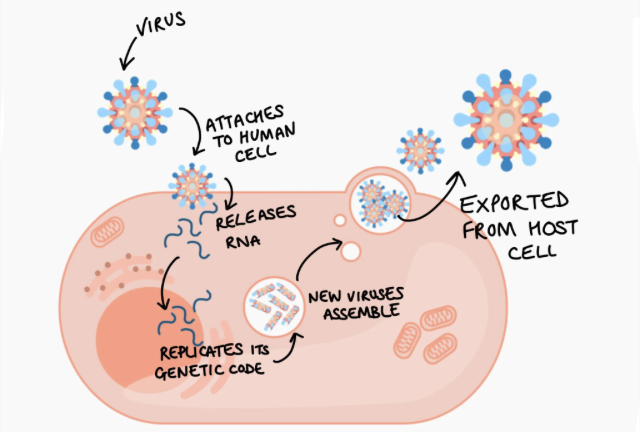
what are viruses?
acellular entities that require a living host cell to reproduce
how do viruses reproduce if they are acellular?
they do not grow or divide; they replicate by assembling new viral particles inside a living host cell
what system is used for naming microorganisms?
the binomial system of nomenclature which assigns each species a two-part Latin name
in the binomial system, which comes first: genus or species?
genus comes first followed by the species name
ex: Staphylococcus aureus or Staphylococcus aureus
the first letter of the genus is capitalized while the species name is in lowercase while both are italicized or underlined
can a genus contain multiple species?
give an example
yes
ex: the Bacteroides genus contains over 100 species
how can you abbreviate a microorganism’s scientific name?
use the first letter of the genus (capitalized) & the species name (not capitalized)
ex: S. aureus
why is microbiology important for humans, animals and plant life?
they play essential roles in many areas of life including health, agriculture and the environment
how did microorganisms contribute to the development of higher life forms (complex, multicellular organisms)?
primitive photosynthetic microbes likely produced atmospheric oxygen, allowing higher life forms to develop
what role do microorganisms play in soil and plants?
they help degrade organic materials and perform atmospheric nitrogen fixation in plants
what impacts do microorganisms have on medicine?
they produce antibiotics that are used in clinical practice
how do normal bacteria in the human body help us?
normal bacteria within the body prevents the growth of harmful bacteria
how are microorganism used in the food industry?
they are used in fermentation for beer, wine and yogurt
who was the first to see and describe cells in 1665?
Robert Hooke
what invention allowed Robert Hooke to see cells?
the microscope
what scientific idea did Hooke’s observation of cells lead to?
the start of the cell theory (in which all living things are composed of cells and that cells are the basic unit of life)
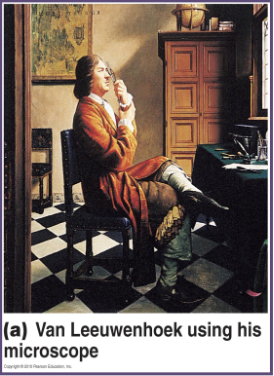
who used the microscope to view live microbes in 1684?
Anthoni van Leeuwenhoek
what did Leeuwenhoek call the microbes he observed?
animalcules
what is spontaneous generation?
the theory that bacteria can arise spontaneously from non-living matter
what will happen to food left out for long periods of time according to spontaneous generation?
they will eventually spoil and may become contaminated with bacteria
what do microscopic examination reveal about spoiled food?
that spoiled food is crawling with bacteria
who rejected the theory of spontaneous generation?
Louis Pasteur rejected the theory of spontaneous generation
he demonstrated that microorganisms come from other microorganisms
what is biogenesis?
the hypothesis that living matter arrises only from pre-existing living matter
according to biogenesis, can living matter come from non-living matter?
no, living matter arises only from pre-existing living matter
which theory (spontaneous generation or biogenesis) is currently accepted?
biogenesis
this is because experiments demonstrates that bacteria only appears when pre-existing living organisms are present
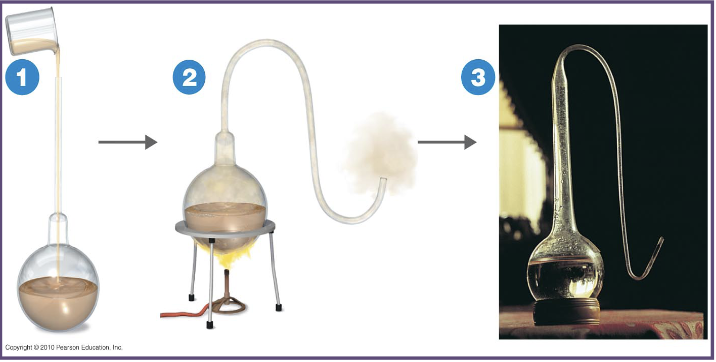
what did Louis Pasteur demonstrate using a swan neck flask?
what did he show about micro-organisms responsible for food spoilage?
he demonstrated aseptic technique and showed that microorganisms responsible for food spoilage came from the air and not from spontaneous generation
what was the main conclusion of Louis Pasteur’s swan neck flask experiment?
that spontaneous generation could not occur and that microorganisms came from the air
what are aseptic techniques?
practices used to prevent microorganisms from the air from contaminating materials, showing that microorganisms come from pre-existing living sources rather than spontaneous generation
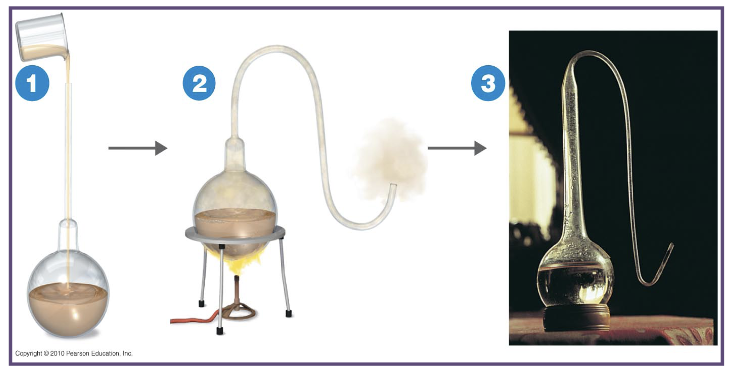
describe this image by stages
stage 1:
broth is placed in a flask
broth is heated
stage 2:
the flask has a swan-neck shape
air can enter the flask
dust and microorganisms from their air gets trapped in the curve of the neck
microorganisms cannot reach the broth
stage 3:
the broth remains clear and uncontaminated
no microbial growth occurs, supporting the idea that microorganisms come from pre-existing living sources
what was first thought to convert sugar into alcohol?
it was first thought thought that air converted sugar into alcohol
what did Louis Pasteur show convert sugar to alcohol?
he showed that it is yeast that converts sugar into alcohol in the absence of air
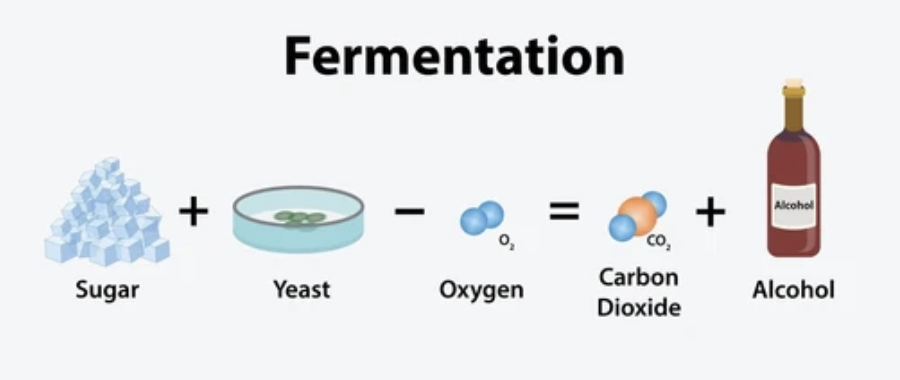
what is the process called when yeast converts sugar to alcohol in the absence of air?
fermentation
what causes the souring of milk and beer/wine?
the souring occurs when the bacteria present coverts sugar into vinegar
how can you prevent the souring of milk and beer/wine?
you could heat the milk/beer/wine which would kill all of the bacteria present and prevent spoilage
what procedure involves heating milk, beer or wine to kill bacteria and prevent spoilage?
is this procedure still used today?
pasteurization
yes, it is still used today
how did Pasteur determine spoilage can be prevented?
by heating milk, beer or wine to kill bacteria (pasteurization)
differentiate fertilization and pasteurization
fermentation is the process where yeast converts sugar into alcohol in the absence of air
pasteurization involves heating milk, beer or wine to kill bacteria and prevent spoilage
what is the germ theory of disease?
the belief that micro-organisms are responsible for the cause of infectious diseases.
who developed the germ theory of disease, and on what basis?
Robert Koch on the basis that microbes alter the chemical and physical nature of organic material
what did the development of the germ theory lead to?
it lead to the development of Koch’s Postulates
what is Koch’s Postulates?
a set of criteria established to prove that a specific microbe is responsible for a specific disease
what are Koch’s Postulates used for today?
they are used in order to prove that a specific microbe is responsible for a specific disease.
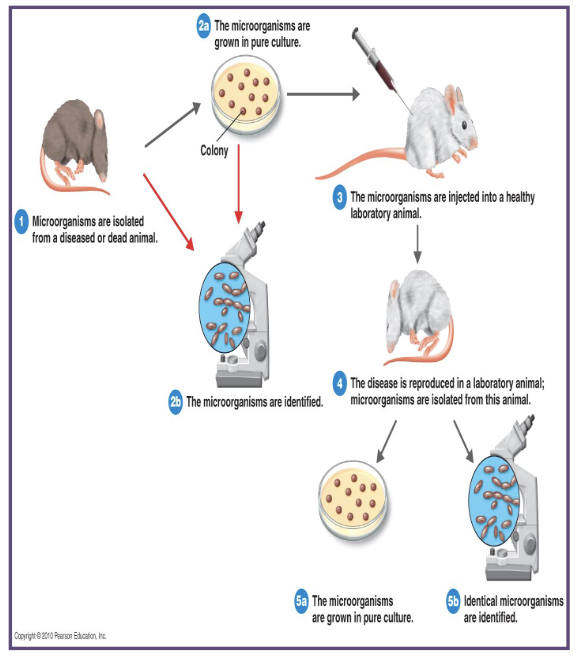
based on this image demonstrating Koch’s Postulates, answer the following questions:
what is the first step shown in Koch’s Postulates?
what happens to the microorganisms after isolation?
what is done after the microorganisms are grown in pure culture?
what occurs in the laboratory animal after injection?
what happens after the disease is isolated?
what is shown at the final step of Koch;s Postulates?
microorganisms are isolated from a diseased or dead animal
the microorganisms re grown in pure culture
the microorganisms are injected into a healthy laboratory animal
the disease is reproduced in the laboratory animal
microorganisms are isolated from this animal
identical microorganisms are identified and grown in pure culture
what is pure culture?
a culture containing only one type of microorganism
who developed the small pox vaccine?
Edward Jenner
what observation was the small pox vaccine based on?
it was based on the observation that people previously infected with cow pox were immune to small pox
what did Edward Jenner do to test his observation? what happened after?
he injected a young boy with cow pox but the boy became mildly ill
what was later discovered that about the boy injected with cow pox?
it was later discovered that this boy was immune to small pox
what is the relevance of the discovery that the boy was immune to small pox?
it showed that infection with cow pox provided immunity to small pox and laid the groundwork for the development of vaccines
who developed the idea of selective toxicity?
Paul Ehrlich
what is selective toxicity?
the ability to either kill or inhibit the growth of pathogenic organisms while leaving the host unharmed
what did Paul Ehrlich discover that demonstrated selective toxicity?
the first effective anti-microbial Salvarsan which was used cure syphilis without damaging host cells
what are syphilis?
a sexually transmitted infection (STI) that can cause a serious disease if untreated
what are host cells?
the cells of the host organisms that can be infected by microorganisms
who made an important discovery in 1929 related to antimicrobials?
Alexander Fleming who discovered Penicillin
what did Alexander Fleming discover about the mold Penicillium chrysogeum?
he discovered that a product of the mold Penicillium chrysogeum was able to inhibit the growth of bacteria on plates contaminated with the mold
what was the product discovered from the Penicillium chrysogeum?
what is it?
penicillin
it is an antimicrobial agent (antibiotic) that inhibits bacterial growth.
what effect did penicillin have on bacteria?
It inhibited the growth of bacteria
how was the discovery of penicillin made?
this discovery was made by an accident
why was the discovery of penicillin important?
it revolutionized modern medicine

