RMM 8: Repeated Measures t-Test
 Studied by 2 people
 Call Kai
 Learn
Learn Practice Test
 Spaced Repetition
 Match
Match Flashcards
 Knowt Play
1/6

There's no tags or description
Looks like no tags are added yet.
Name | Mastery | Learn | Test | Matching | Spaced | Call with Kai |
|---|
No analytics yet
Send a link to your students to track their progress
7 Terms
What does a repeated measures t-test determine?
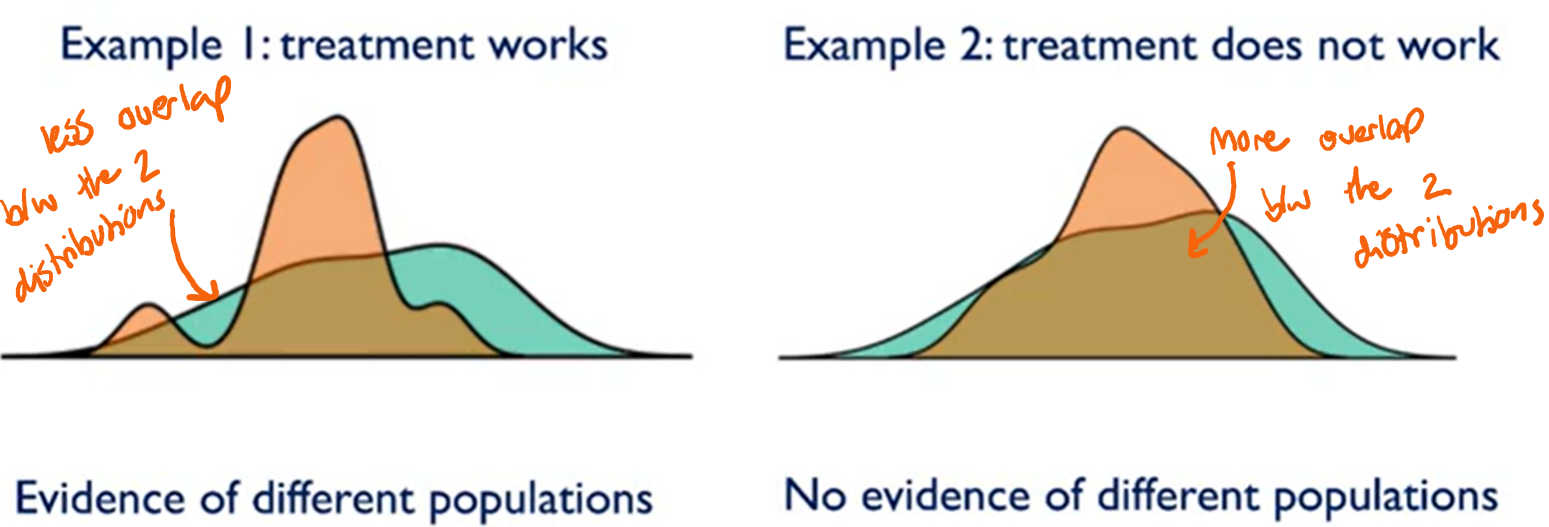
If the means of two distributions are the same of if they are extremely different to each other, involving the same sample assessed over two different points in time
What is the study design of a repeated measures t-test?
Use a repeated-measures research design
Each participant is measured on >/= 2 different occasions
Research question: "Is there a change across time?"
Pre-treatment --> treatment --> post-treatment
Use difference scores to measure the change from pre-treatment to post-treatment
XD = XT2 - XT1
What is matched pairs data?
testing to see if people who are matched or paired in some way agree on a specific topic, where the data obtained doesn't indicate a direction or change but rather a level of agreement
JASP Output - Classical t-test (just an example0
What are the critical values (t*) based on in a repeated-measures t-test?
Level of significance (~a = .05)
Directionality of the test (1-tailed or 2-tailed)
Degrees of freedom (df = n - 1
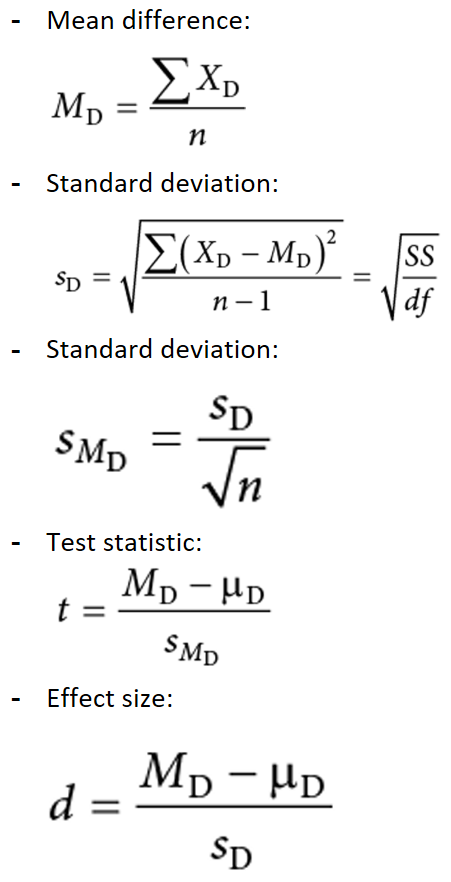
What notation is used for the statistical values involved in a repeated-measures t-test?
(Not sure if this is examinable, but I thought I would put this here just in case)
Statistical value followed by D (e.g. MD, SD, SMD). The D indicates the difference in time for the different values (i.e. MD = difference in sample means, SD = difference in standard deviation)
How can we determine if a difference in the sample means if significant?
Compare test statistic to critical value (t*): if test statistic > t*, reject null hypothesis
 Note
Note  Flashcards (154)