Unit 5.4 Exploring the Nervous System
 Call Kai
 Learn
Learn Practice Test
 Spaced Repetition
 Match
Match Flashcards
 Knowt Play
1/47

There's no tags or description
Looks like no tags are added yet.
Name | Mastery | Learn | Test | Matching | Spaced | Call with Kai |
|---|
No analytics yet
Send a link to your students to track their progress
48 Terms
How is the nervous system related to both internal and eternal?
The nervous system senses the external environment then acts to restore optimal internal conditions
What is the “definition” of the nervous system?
“Specialized organ system that connects the external environment to the internal environment and helps maintain homeostasis
What kinds of things does the nervous system sense?
Depth of breathing, pressure on skin, temperature, light, odour
What two types of movements does the nervous system control?
Unconscious and conscious
Give an example of unconscious movements
Blinking, breathing
Give an example of a conscious movement
Scratching an itch
Besides breathing, scratching, what are more complicated functions the nervous system controls?
Memory, thought, language
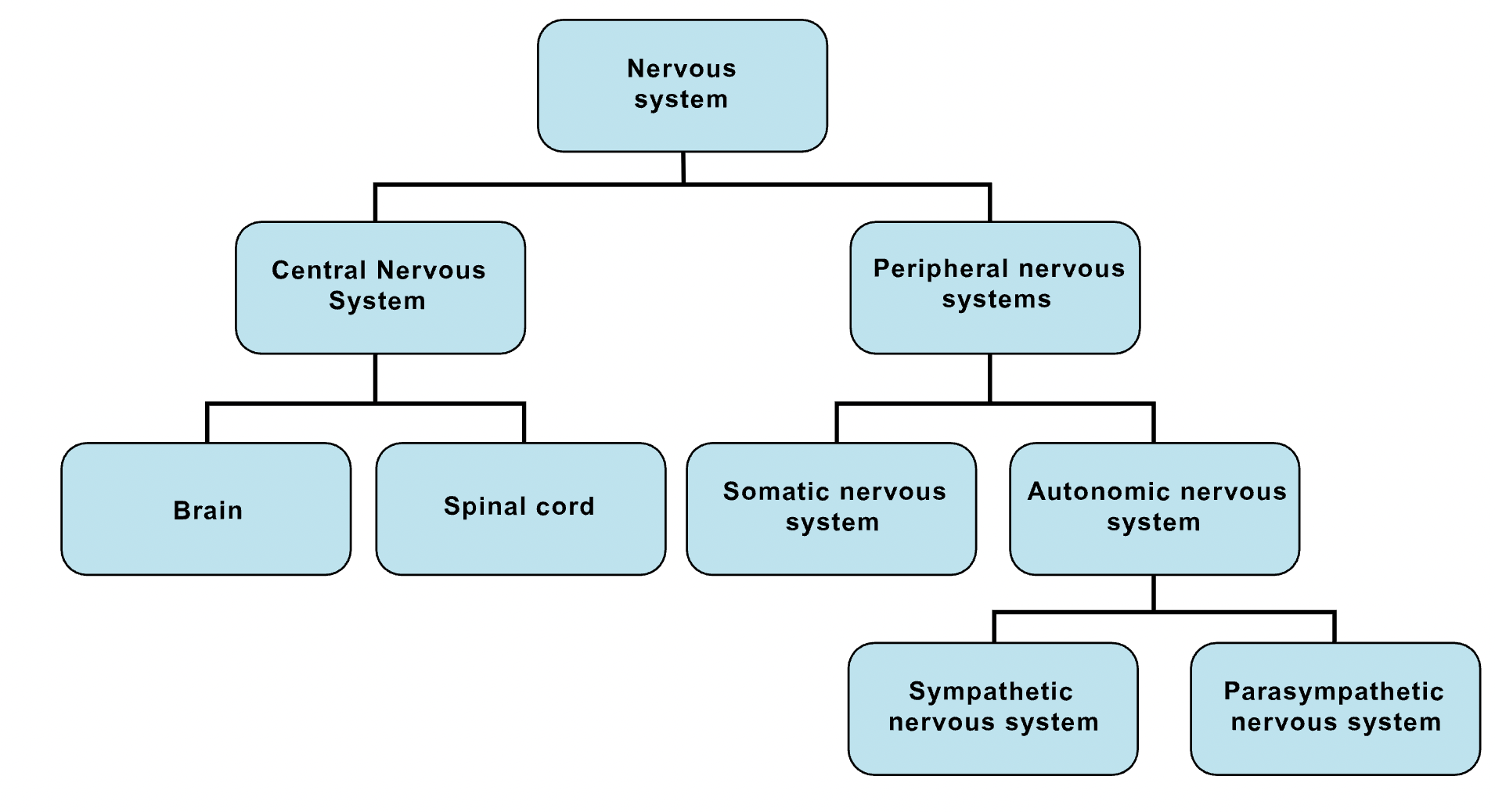
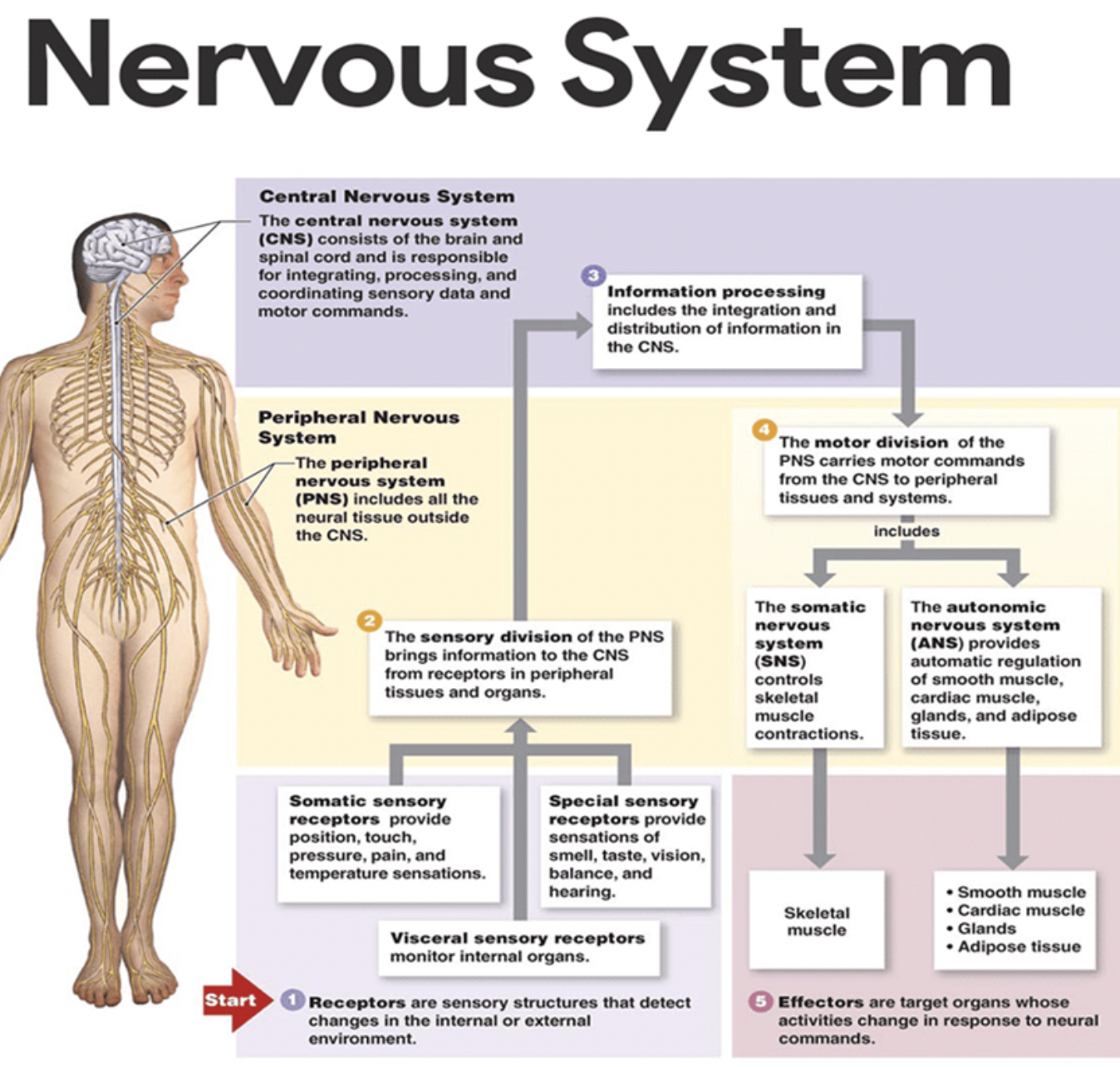
Name the 2 main divisions of the nervous system
Central nervous system
Peripheral nervous system
What parts of the body make up the central nervous system? What is the function of the CNS?
Brain and spinal cord; it is the coordinating centre for incoming and outgoing information
What parts of the body make up the peripheral nervous system? What is the function of the PNS?
Nerves; carries information between the CNS and the organs
The peripheral nervous system is further subdivided into what 2 divisions?
Somatic nervous system
Autonomic nervous system
The somatic nervous system of the PNS consists of what parts of the body?
Skeletal muscles, bones, skin, sensory nerves, motor nerves
The autonomic nervous system of the PNS controls what parts of the body?
The internal organs
The autonomic nervous system of the PNS is further subdivided into 2 divisions. Name them
Sympathetic nervous system (“fight or flight”)
Parasympathetic nervous system (“rest and digest”)
Name the 2 types of nerve cells
Glial cells
Neurons
Are glial cells conducting or non-conducting?
Non-conducting
What is the function of glial cells?
To provide structural support
What is an example of a glial cells and how does it function?
Myelin sheath surrounds nerves like insulation, ensures efficient transmission of electric charge
Neurons are the _____ of the nervous system
Functional units
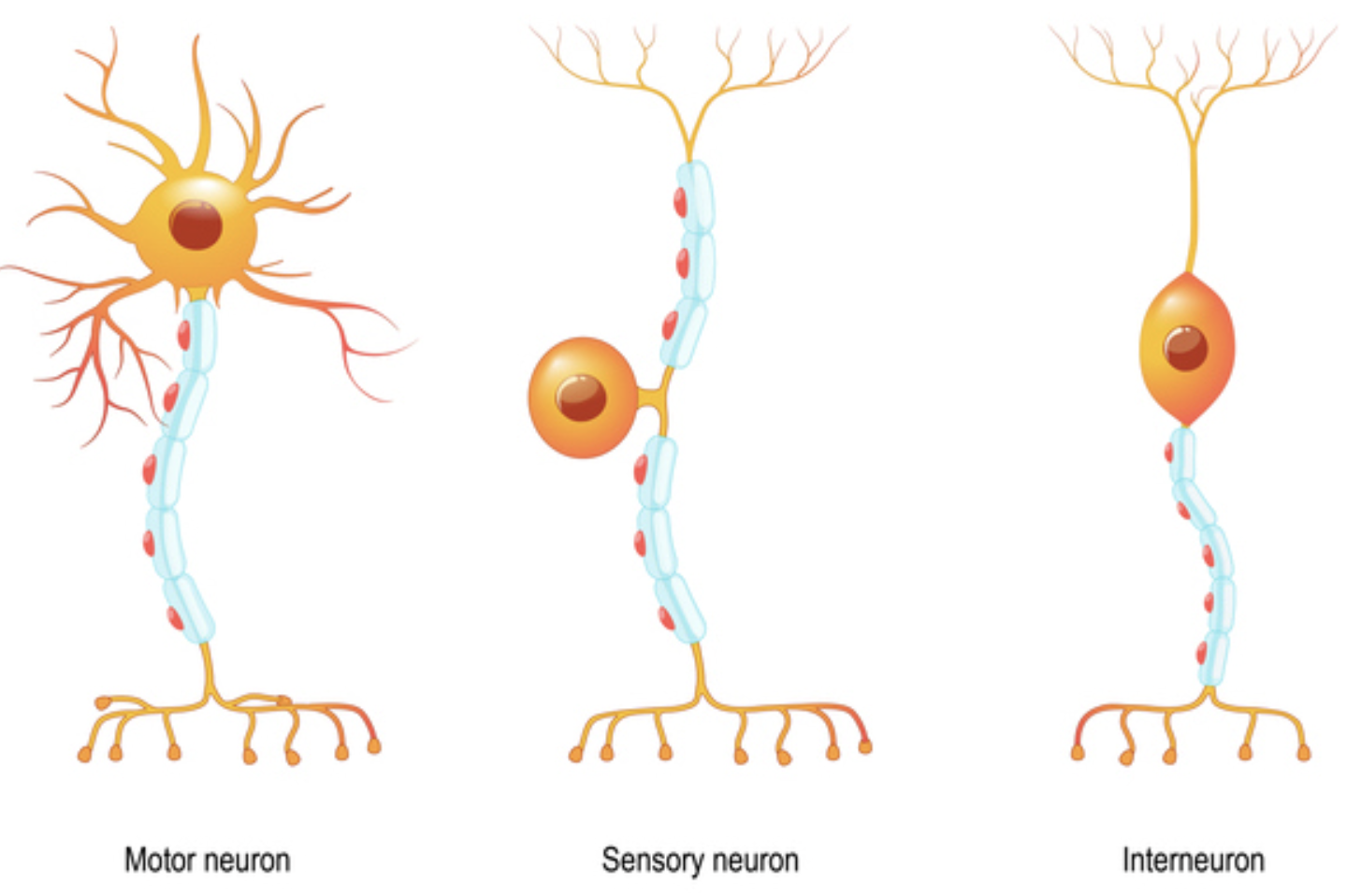
Name the 3 types of neurons
Sensory neurons
Interneurons
Motor neurons
Define sensory neurons. Describe them physically
Sense and relay information from the environment to the CNS for processing; located in clusters and ganglia
Define interneurons. Where are they mostly found?
Neurons that link neurons. Integrate and interpret the sensory information and connect neurons to outgoing motor neurons; found in the brain and spinal cord
What is another name for motor neurons?
Efferent neurons
Define motor neurons
Neurons that send information to the “effectors” meaning the muscles/organs/glands
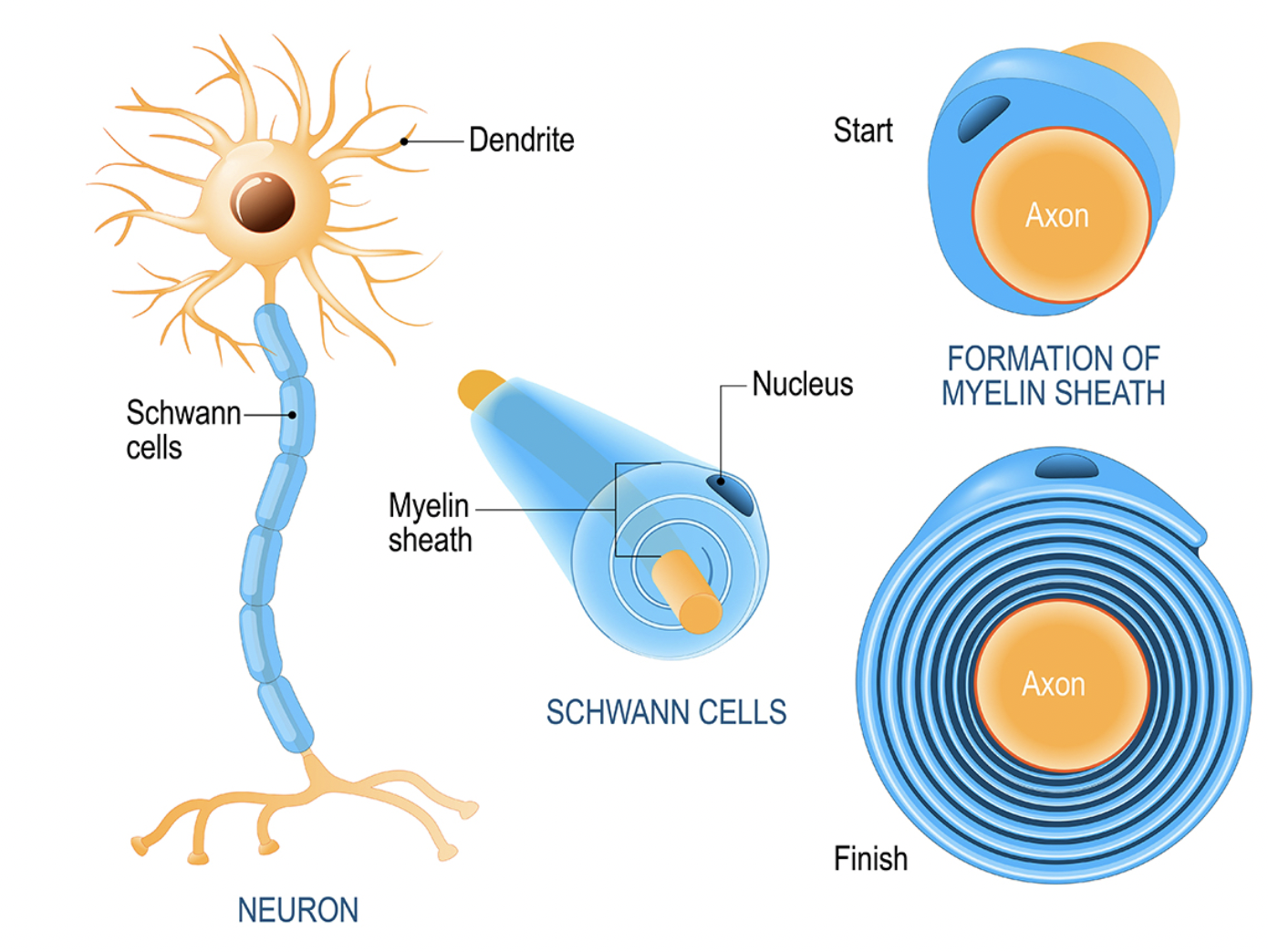
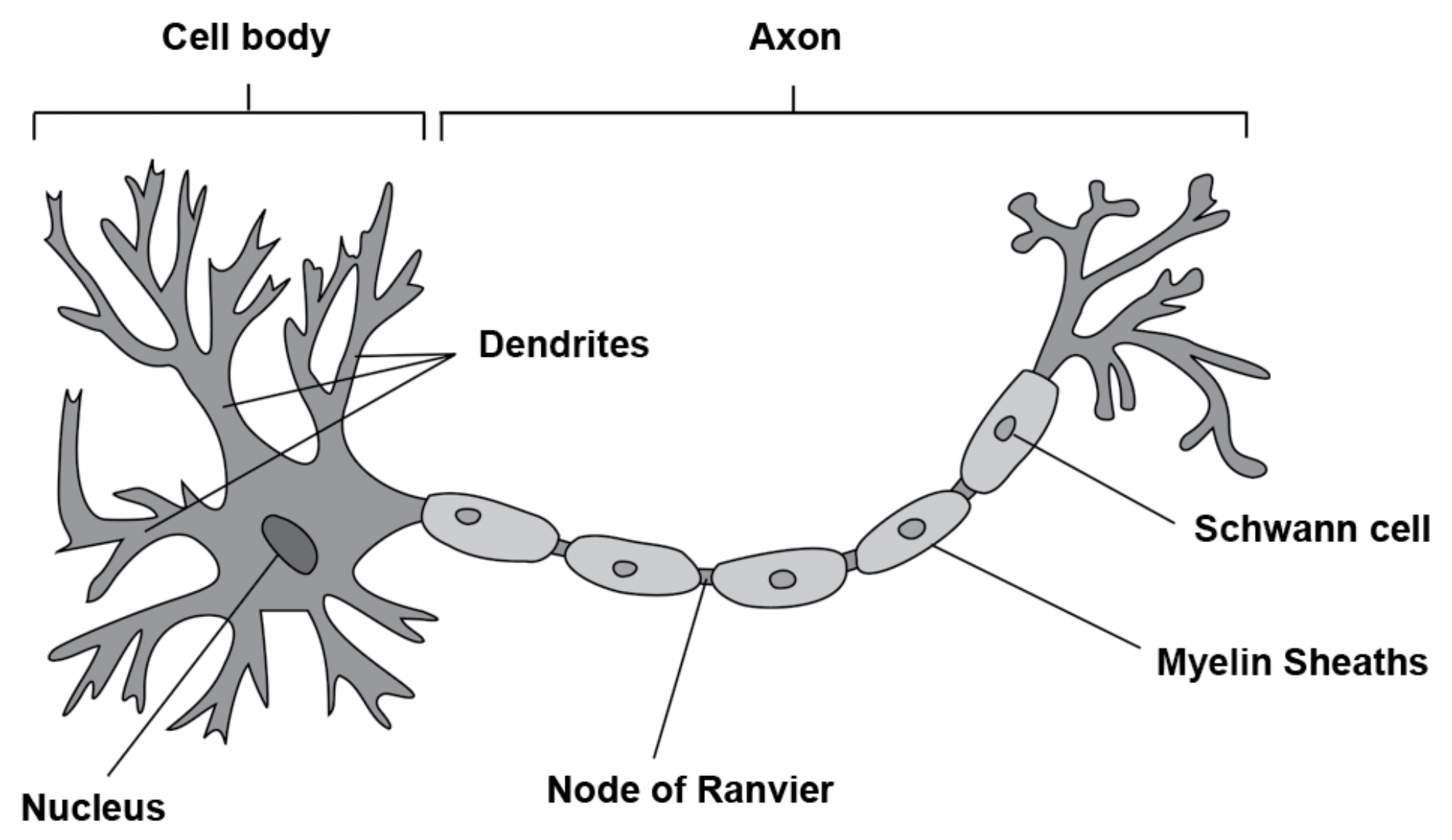
Name the 3 main parts of a neuron
Dendrites
Cell body
Axon
Define dendrites
Part of the neuron that receives information from sensory receptors or other nerve cells. Conducts nerve impulses toward the cell body
Define cell body
Part of the neuron that contains the nucleus and the majority of the cytoplasm
Define axon
Extension of the neuron that carries nerve impulses away from the cells body towards other neurons or effectors.
The axon is thin and is covered in what? Why?
Myelin sheath; for insulation to prevent the loss of charges ions from the nerve cell
The axon is formed by glial cells called ______
Schwann cells
The areas between the sections of myelin sheath are called _____
The nodes of Ranvier
What happens with these nodes?
Nerve impulses jump from node to node which speeds up the conduction process
Which is faster for conduction- myelinated or non-myelinated?
Myelinated
How are neural circuits made?
Created when nerves communicate
Are neural circuits simple or complex?
Both!
What is a reflex? Give an example
When an action must be immediate without thinking. Occurs even before the brain gets the message; touching a hot stove
What is a reflex arc?
A neural circuit that runs through the spinal cord and provides a way for a reflex action to occur
What are the 5 steps (with arrows) of a reflex arc?
Stimulus → Sensory neuron → Interneuron → Motor neuron → Response
After the stimulus of burning your hand, describe the 4 steps in more detail
Heat triggers sensory receptors in the skin. Sends to the spinal cord
Interneurons in the spinal cord receive the information and immediately send a signal to the motor neurons
Motor neurons activate an effector organ (i.e. muscles)
Effector organ causes an immediate response (i.e. pulling your hand away)
Are reflex arcs voluntary or involuntary?
Involuntary
What is the “definition” of nerve impulses?
“Nerve impulses are electrochemical messages created by the movement of ions through the nerve cell membrane”
What is a more basic definition of nerve impulse?
An electrical current, generated in the nerves and muscles, that is carried through the body in nerve impulses that travel along neurons
When a nerve gets stimulated, what changes?
A rapid change occurs in the electrical potential difference across the nerve membrane

