Lecture 31-34 (gastrointestinal system)

0.0(0)
studied byStudied by 0 people
0.0(0)
full-widthCall Kai
learnLearn
examPractice Test
spaced repetitionSpaced Repetition
heart puzzleMatch
flashcardsFlashcards
GameKnowt Play
Card Sorting

1/104

encourage image

There's no tags or description

Looks like no tags are added yet.

Study Analytics
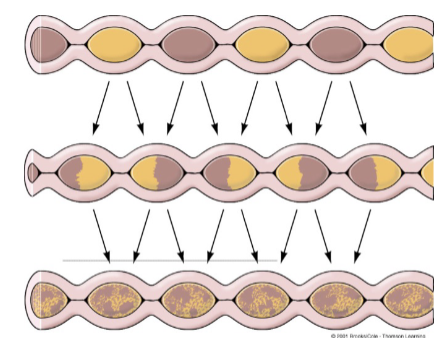
Name
Mastery
Learn
Test
Matching
Spaced

No study sessions yet.

105 Terms

1
New cards

What is the major function of the digestive system?


to transfer nutrients from the food we eat into our body to be used as fuel and building blocks
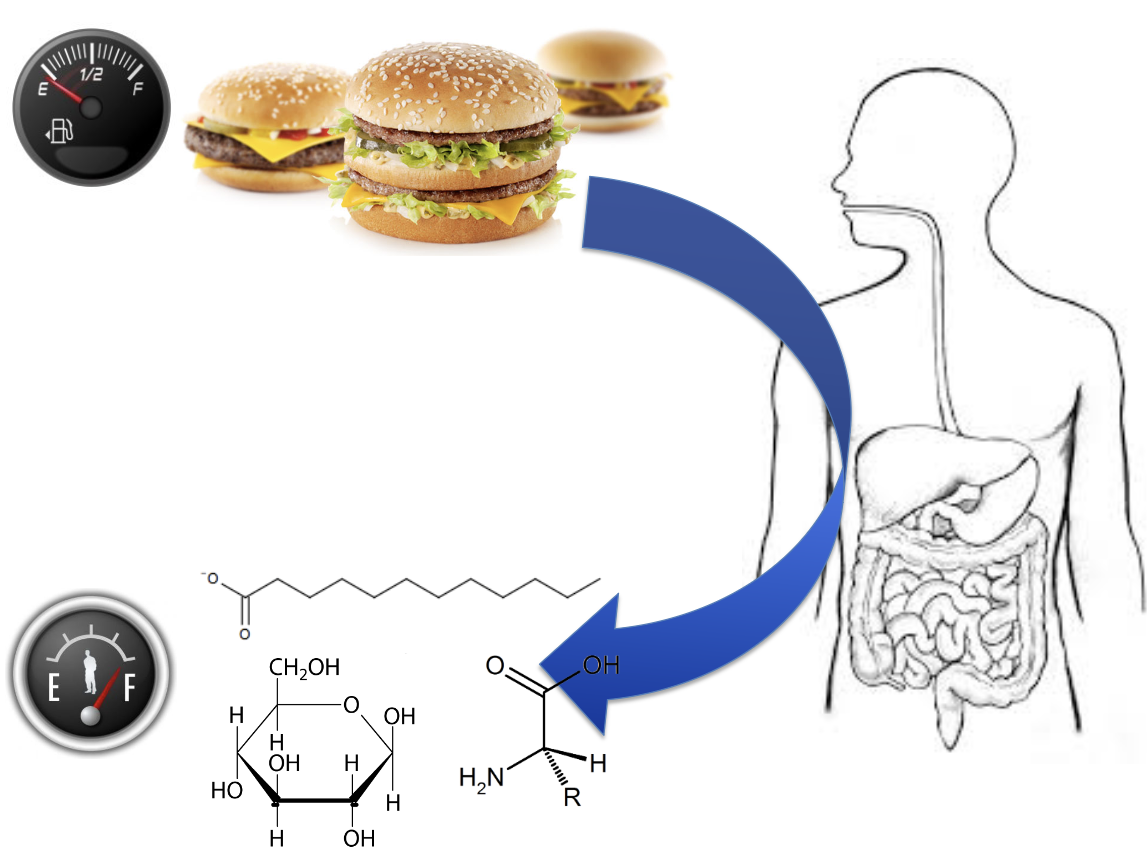
<p><span style="color: rgb(255, 255, 255);"><span><br>to transfer nutrients from the food we eat into our body to be used as fuel and building blocks</span></span></p>
2
New cards

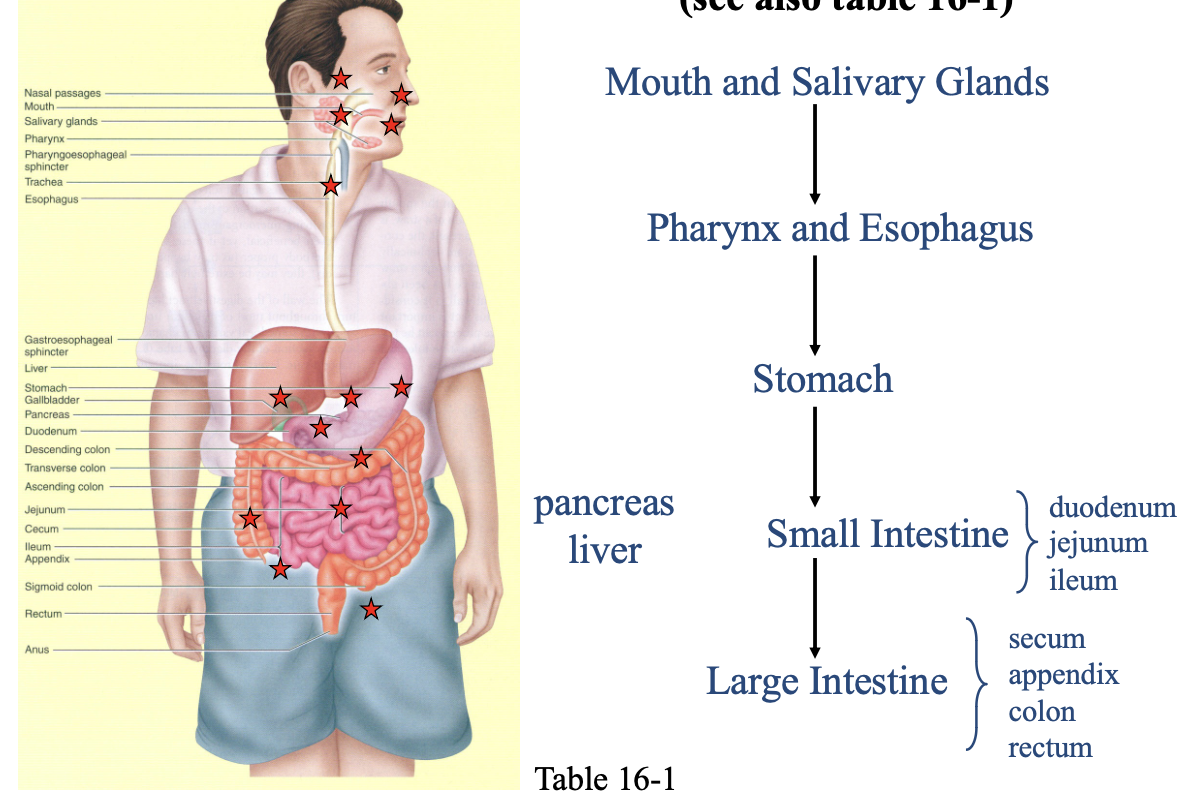
Overview of the Digestive Organs:

  1. mouth and salivary glands

  2. pharynx and esophagus

  3. stomach

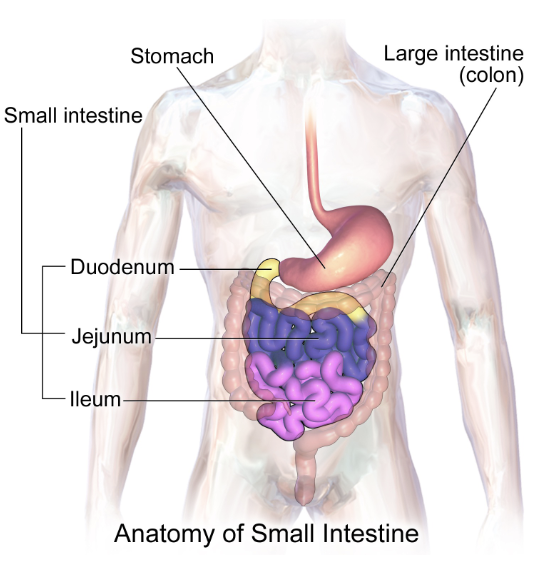
  4. small intestine

  5. large intestine

<ol><li><p>mouth and salivary glands</p></li><li><p>pharynx and esophagus</p></li><li><p>stomach</p></li><li><p>small intestine</p></li><li><p>large intestine</p></li></ol><p></p>
3
New cards

What is the general structure of the digestive tract wall?

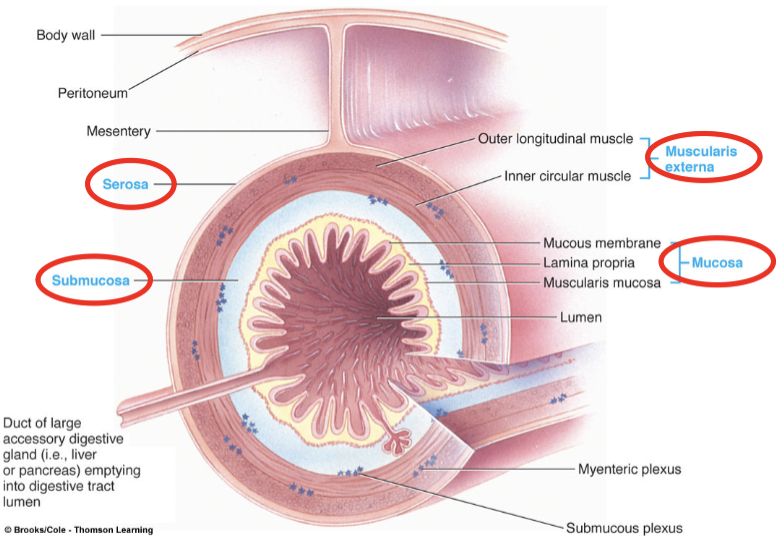
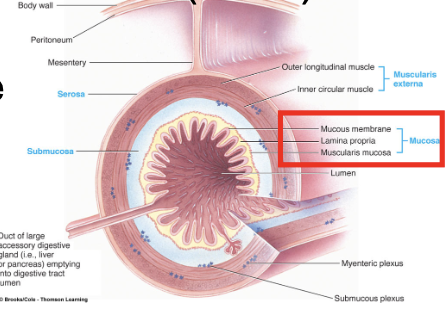
made up of four major tissue layer

  • serosa

  • muscularis externa

  • submucosa

  • mucosa

<p>made up of four major tissue layer</p><ul><li><p>serosa</p></li><li><p>muscularis externa</p></li><li><p>submucosa</p></li><li><p>mucosa</p></li></ul><p></p>
4
New cards

Serosa:

provide a protective outer layer and to secrete serous fluid (lubricates), which reduces friction between digestive organs and surrounding structures

  • allows freedom for mixing and propulsive movements

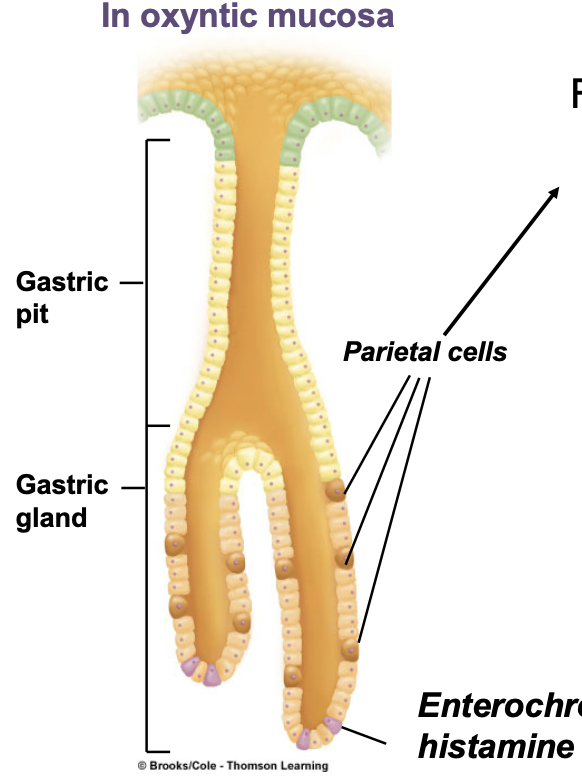
  • continuous with mesentery throughout much of the tract
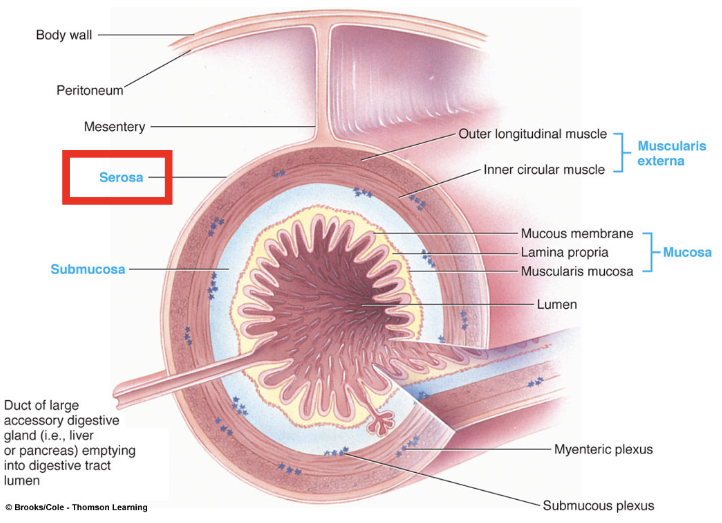
<p><span><span>provide a protective outer layer and to secrete serous fluid (lubricates), which reduces friction between digestive organs and surrounding structures</span></span></p><ul><li><p><span>allows freedom for mixing and propulsive movements</span></p></li></ul><ul><li><p><span style="color: rgb(255, 255, 255);"><span>continuous with mesentery throughout much of the tract</span></span></p></li></ul><p></p>
5
New cards

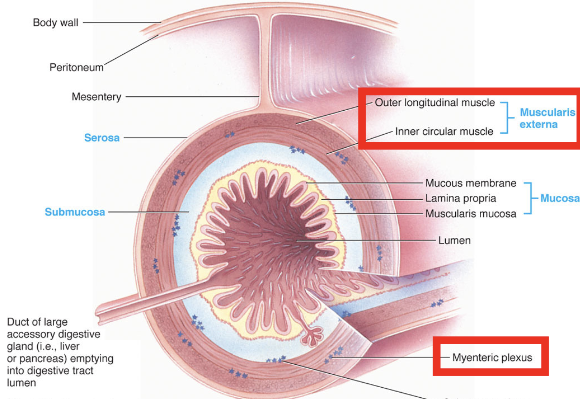
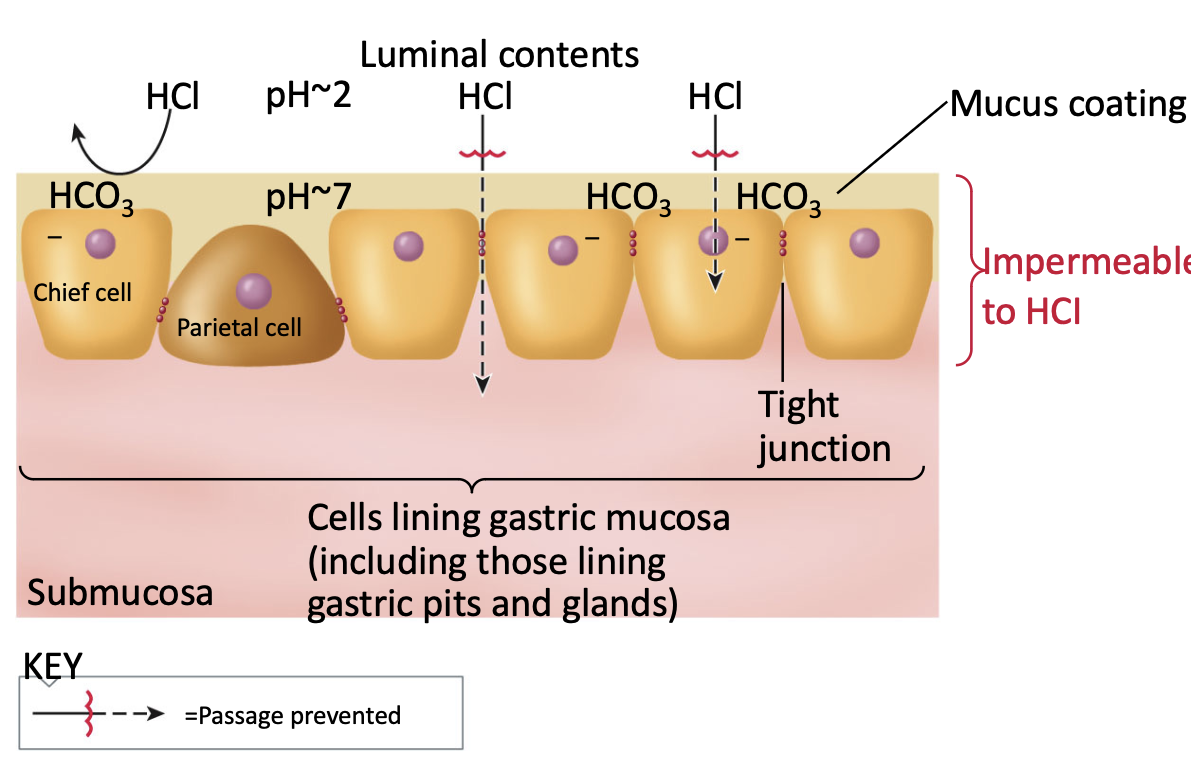
Muscularis Externa:

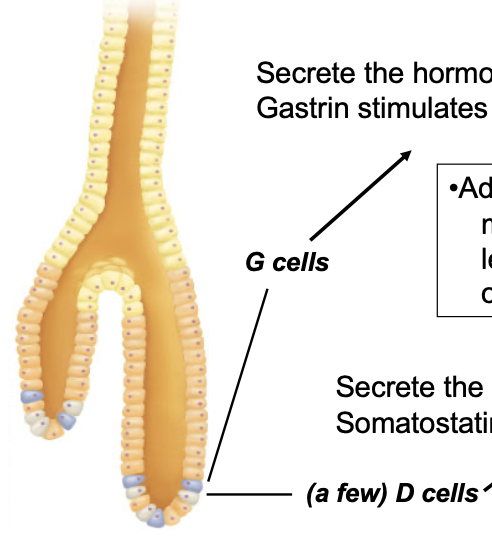
major smooth muscle coat of digestive tube where contractile activity produces propulsive and mixing movements

  • Usually two layers

    • Inner circular layer → Contraction decreases diameter of lumen

    • Outer longitudinal layer → Contraction shortens the tube

  • myenteric plexus

<p><span style="color: rgb(255, 255, 255);"><span>major smooth muscle coat of digestive tube where </span></span><span>contractile activity produces propulsive and mixing movements</span></p><ul><li><p><span style="color: rgb(255, 255, 255);"><span>Usually two layers</span></span></p><ul><li><p><span style="color: rgb(255, 255, 255);"><span>Inner circular layer → Contraction decreases diameter of lumen</span></span></p></li><li><p><span style="color: rgb(255, 255, 255);"><span>Outer longitudinal layer → Contraction shortens the tube</span></span></p></li></ul></li></ul><ul><li><p>myenteric plexus</p></li></ul><p></p>
6
New cards

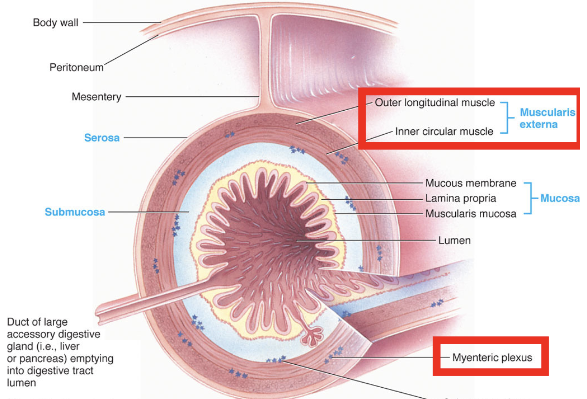
Myenteric plexus:

is part of the enteric nervous system that controls and coordinates muscle contractions (peristalsis) to propel food through the digestive tract

  • increases overall gut tone and the strength/speed of contractions

  • provides motor innervation to the muscular layers of the digestive tract

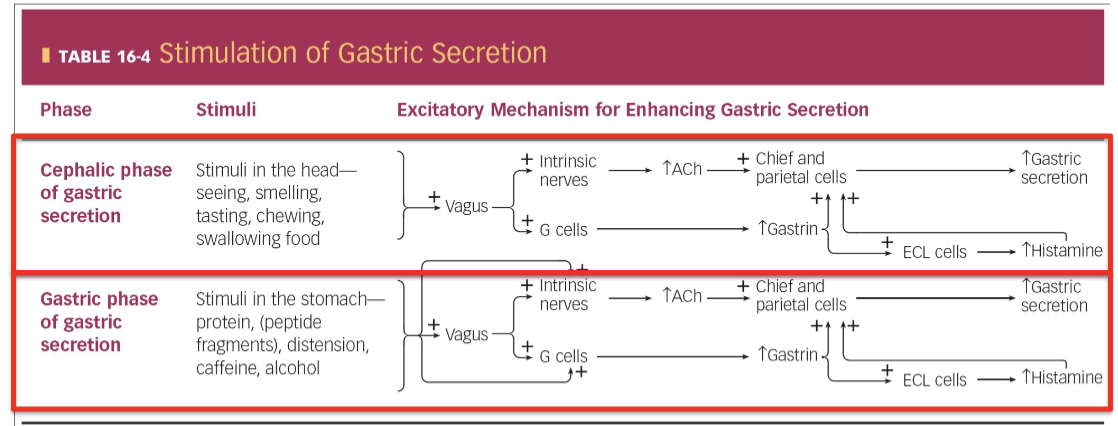
    • in-between muscle layers

<p><span><span>is </span></span>part of the enteric nervous system that <span><span>controls and coordinates muscle contractions (peristalsis) to propel food through the digestive tract</span></span></p><ul><li><p><span><span>increases overall gut tone and the strength/speed of contractions</span></span></p></li><li><p><span><span>provides motor innervation to the muscular layers of the digestive tract</span></span></p><ul><li><p>in-between muscle layers</p></li></ul></li></ul><p></p>
7
New cards

Submucosa:

providing support, elasticity, and nourishment via its blood vessels, lymphatics, and nerves, facilitating nutrient absorption, glandular secretion (mucus, enzymes, electrolytes), and regulating muscle activity (peristalsis) through its nerve network

  • acts as a structural scaffold, joining the mucosa to the muscle, and plays a key role in sensing stretch and initiating pain signals

  • contains submucosal plexus nerve network part of the enteric nervous system
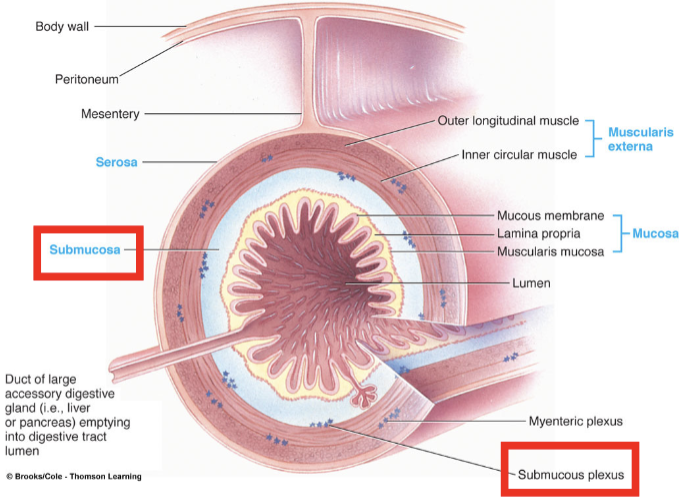
<p><span><mark data-color="unset" style="background-color: unset; color: inherit;"><span>providing support, elasticity, and nourishment via its blood vessels, lymphatics, and nerves, facilitating nutrient absorption, glandular secretion (mucus, enzymes, electrolytes), and regulating muscle activity (peristalsis) through its nerve network </span></mark></span></p><ul><li><p><span><span>acts as a structural scaffold, joining the mucosa to the muscle, and plays a key role in sensing stretch and initiating pain signals</span></span></p></li></ul><ul><li><p><span style="color: rgb(255, 255, 255);"><span>contains submucosal plexus nerve network part of the enteric nervous system</span></span></p></li></ul><p></p>
8
New cards

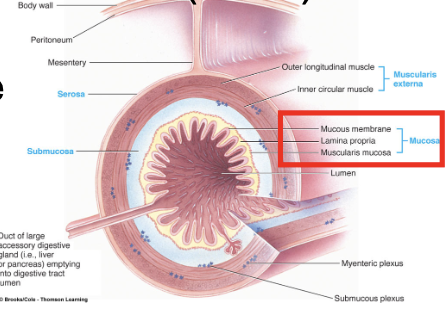
Mucosa:

inner lining responsible for protection, secretion, and absorption, acting as a critical barrier against pathogens and toxins while secreting mucus, enzymes, and hormones, and facilitating nutrient uptake through its folded structure that vastly increases surface area

  1. epithelial layer

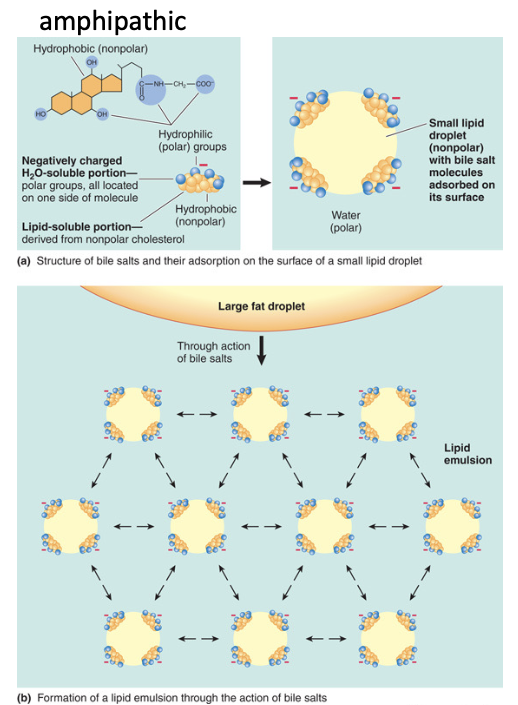
  2. lamina propia

  3. muscularis mucosa

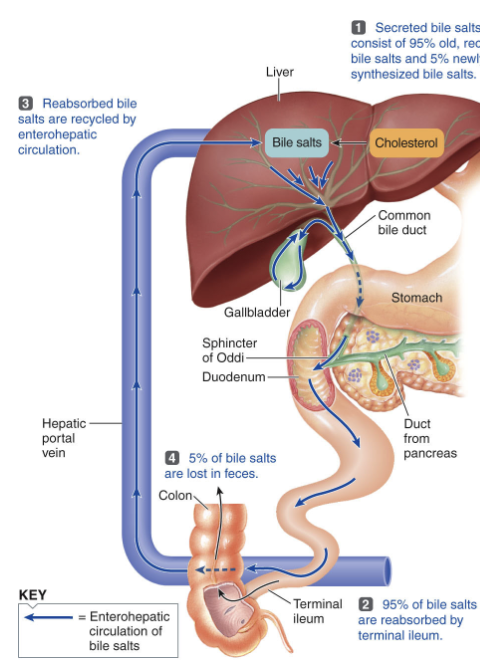
<p><span>inner lining responsible for </span>protection, secretion, and absorption, acting as a critical barrier against pathogens and toxins while secreting mucus, enzymes, and hormones, and facilitating nutrient uptake through its folded structure that vastly increases surface area</p><ol><li><p>epithelial layer</p></li><li><p>lamina propia</p></li><li><p>muscularis mucosa</p></li></ol><p></p>
9
New cards

Epithelial layer:

cells modified for secretion and absorption

  • contains exocrine gland cells → secrete digestive juices, mucus, enzymes into lumen

  • contains endocrine gland cells → secrete gastrointestinal hormones into capillaries
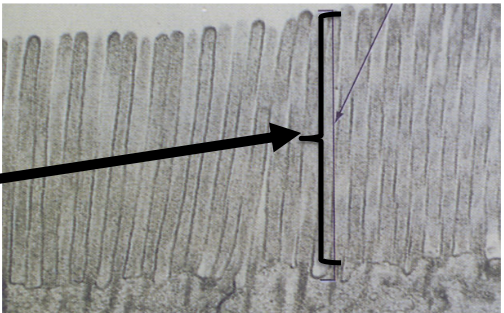
<p><span style="color: rgb(255, 255, 255);"><span>cells modified for secretion and absorption</span></span></p><ul><li><p><span style="color: rgb(255, 255, 255);"><span>contains exocrine gland cells → secrete digestive juices, mucus, enzymes into lumen</span></span></p></li><li><p><span style="color: rgb(255, 255, 255);"><span>contains endocrine gland cells → secrete gastrointestinal hormones into capillaries</span></span></p></li></ul><p></p>
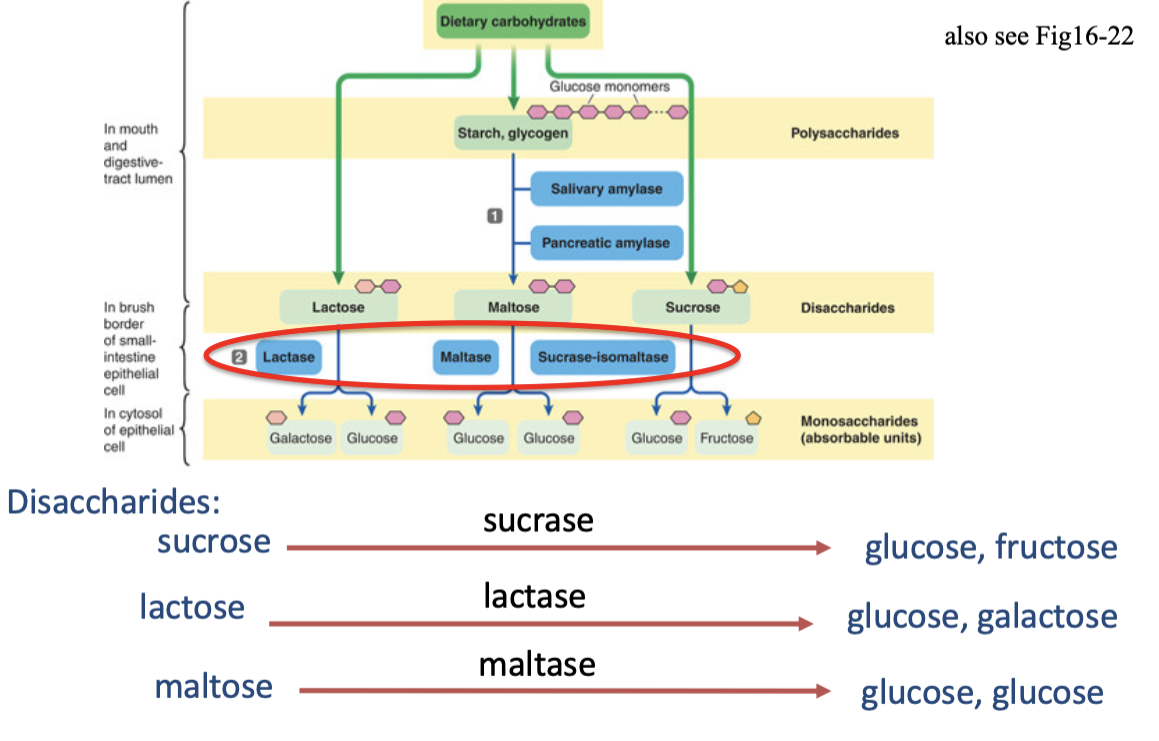
10
New cards

Lamina propia:

loose connective tissue

  • small blood vessels, lymphatics, and enteric neurons

  • contains gut-associated lymphoid tissue (GALT)
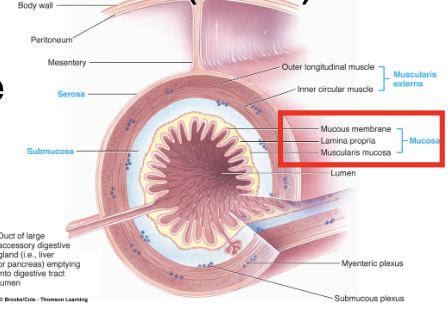
<p>loose connective tissue</p><ul><li><p><span style="color: rgb(255, 255, 255);"><span>small blood vessels, lymphatics, and enteric neurons</span></span></p></li><li><p><span style="color: rgb(255, 255, 255);"><span>contains gut-associated lymphoid tissue (GALT)</span></span></p></li></ul><p></p>
11
New cards

True or False: The lumen of the gastrointestinal tract is continuous with the external environment.

True

12
New cards

Why is the lumen being continuous with the external environment important?

  • pH in the stomach can fall as low as 2 where inside the body the range of pH that is compatible with life = 6.8 - 8.0 (homeostatic range is 7.35 - 7.45)

  • Harsh Enzymes that hydrolyze food could destroy the body’s own tissues

    • therefore enzymes are synthesized in an inactive form and are activated when they reach the lumen

  • Millions of microorganisms inhabit the GI-tract, and these could be lethal if they entered the body proper

13
New cards

What is the process of the digestive system?

  1. ingestion, chewing, swallowing, defecation

  2. secretion

  3. digestion

  4. absorption

14
New cards

What is the purpose of ingestion, chewing, swallowing, defecation?

transfers food into the digestive tract via the mouth

  • skeletal muscle → voluntary

15
New cards

Digestive motility:

muscular contractions that mix and move forward the contents within the tract, facilitating later steps in the digestive process

  • smooth muscle → involuntary

  • propulsive movements

  • mixing movements

16
New cards

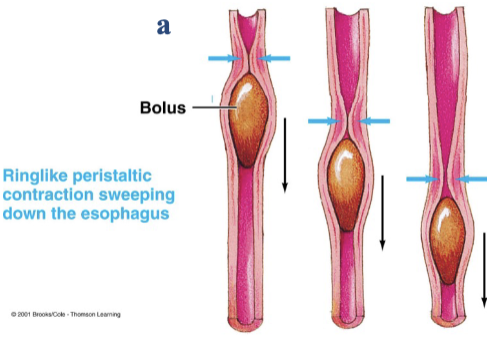
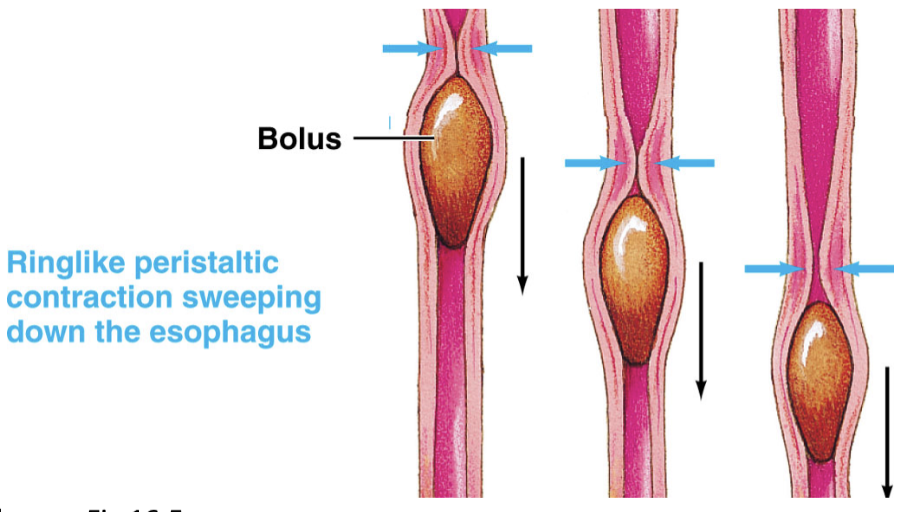
Propulsive movements (peristalsis):

move the contents forward through the digestive tract

  • happens in the esophagus and when you defecate (large intestine)
<p>move the contents forward through the digestive tract</p><ul><li><p>happens in the esophagus and when you defecate (large intestine)</p></li></ul><p></p>
17
New cards

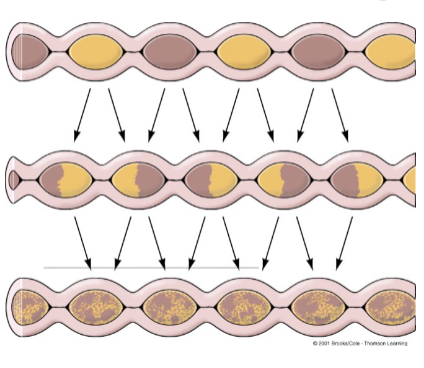
Mixing movements (segmentation):

happens mainly in the stomach + small intestine and serves 3 purposes

  • aid digestion by mixing food with digestive juices

  • facilitate absorption by exposing food to absorbing surfaces

  • forward movement (slow and non-linear)
<p>happens mainly in the stomach + small intestine and serves 3 purposes</p><ul><li><p><span style="color: rgb(255, 255, 255);"><span>aid digestion by mixing food with digestive juices</span></span></p></li><li><p><span style="color: rgb(255, 255, 255);"><span>facilitate absorption by exposing food to absorbing surfaces</span></span></p></li><li><p><span style="color: rgb(255, 255, 255);"><span>forward movement (slow and non-linear)</span></span></p></li></ul><p></p>
18
New cards

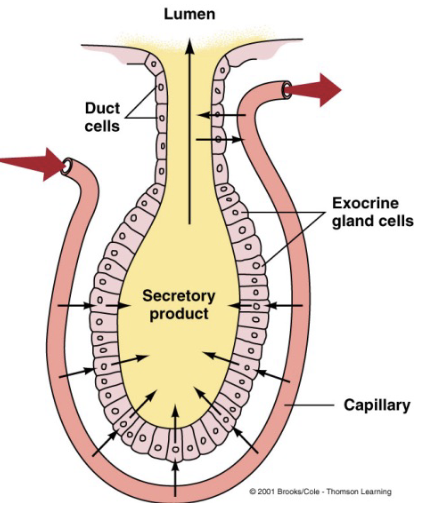
Exocrine secretion:

digestive juices are secreted into the lumen by exocrine glands upon appropriate neuronal or hormonal stimulation

  • secretions contain enzymes, acids, buffers, electrolytes, and water that

    • promote digestion

    • adjust tonicity

    • provide lubrication for better movement throughout the tract
<p>digestive juices are secreted into the lumen by exocrine glands upon appropriate neuronal or hormonal stimulation</p><ul><li><p><span style="color: rgb(255, 255, 255);"><span>secretions contain enzymes, acids, buffers, electrolytes, and water that </span></span></p><ul><li><p><span style="color: rgb(255, 255, 255);"><span>promote digestion </span></span></p></li><li><p><span style="color: rgb(255, 255, 255);"><span>adjust tonicity</span></span></p></li><li><p><span style="color: rgb(255, 255, 255);"><span>provide lubrication for better movement throughout the tract</span></span></p></li></ul></li></ul><p></p>
19
New cards

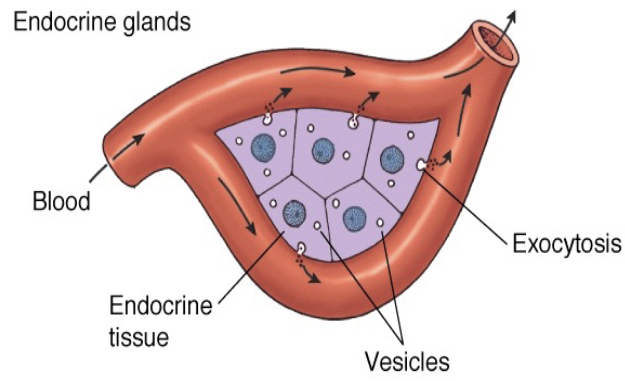
Endocrine secretion:

gut hormones are secreted into the blood by endocrine glands upon appropriate neuronal or nutritional stimulation

  • gut hormones are chemical messengers released into circulation and act on receptors in distal locations to regulate motility, pancreatic secretions, and other digestive tract (and non-digestive tract) functions
<p>gut hormones are secreted into the blood by endocrine glands upon appropriate neuronal or nutritional stimulation</p><ul><li><p><span style="color: rgb(255, 255, 255);"><span>gut hormones are chemical messengers released into circulation and act on receptors in distal locations to regulate motility, pancreatic secretions, and other digestive tract (and non-digestive tract) functions</span></span></p></li></ul><p></p>
20
New cards

Digestion:

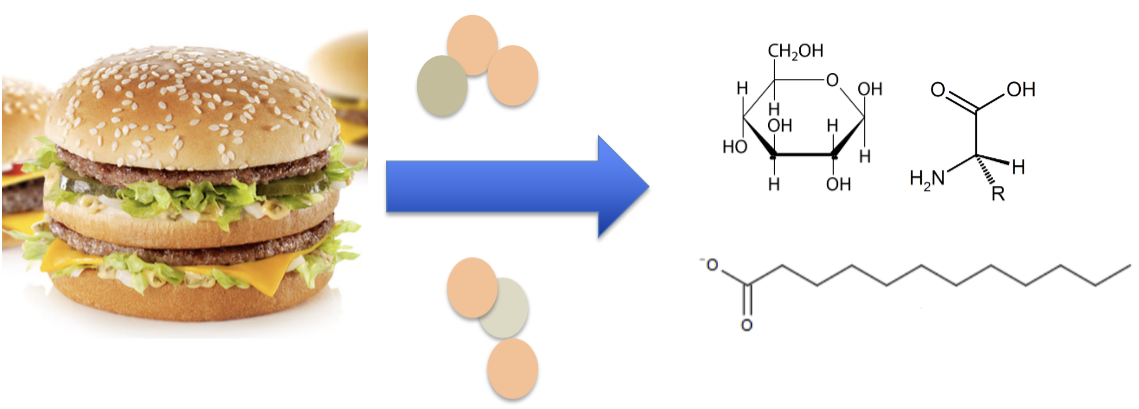
accomplishes the breakdown of structurally complex foodstuffs into smaller, and eventually absorbable units

  • chemical

<p><span style="color: rgb(255, 255, 255);"><span>accomplishes the breakdown of structurally complex foodstuffs into smaller, and eventually absorbable units</span></span></p><ul><li><p>chemical</p></li></ul><p></p>
21
New cards

Chemical digestion:

enzymatic hydrolysis of carbohydrates, proteins, and fats into absorbable units

22
New cards

Chemical digestion of carbohydrates:

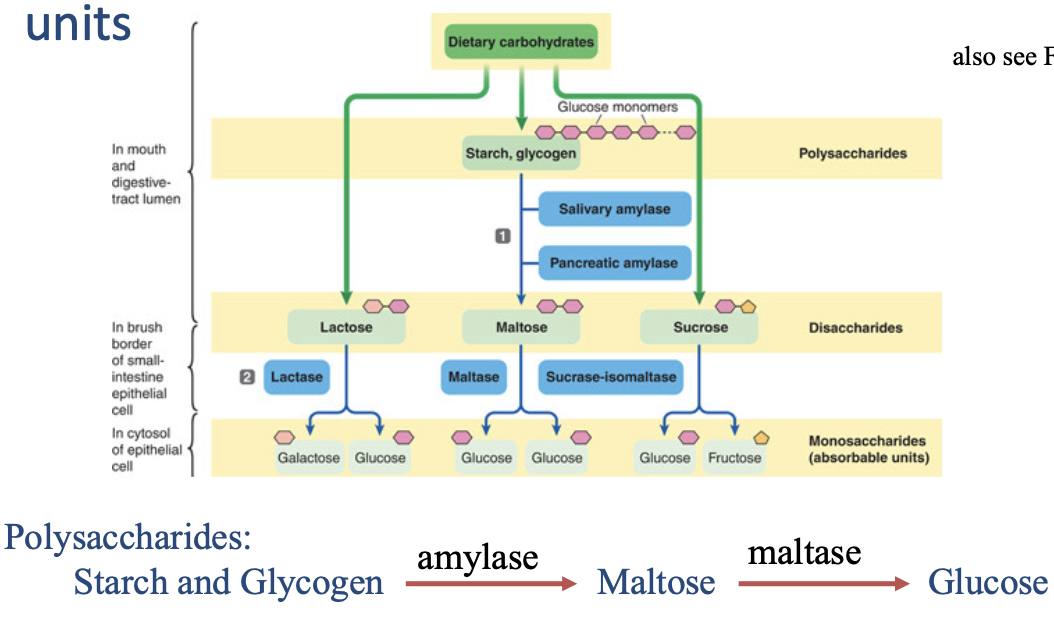
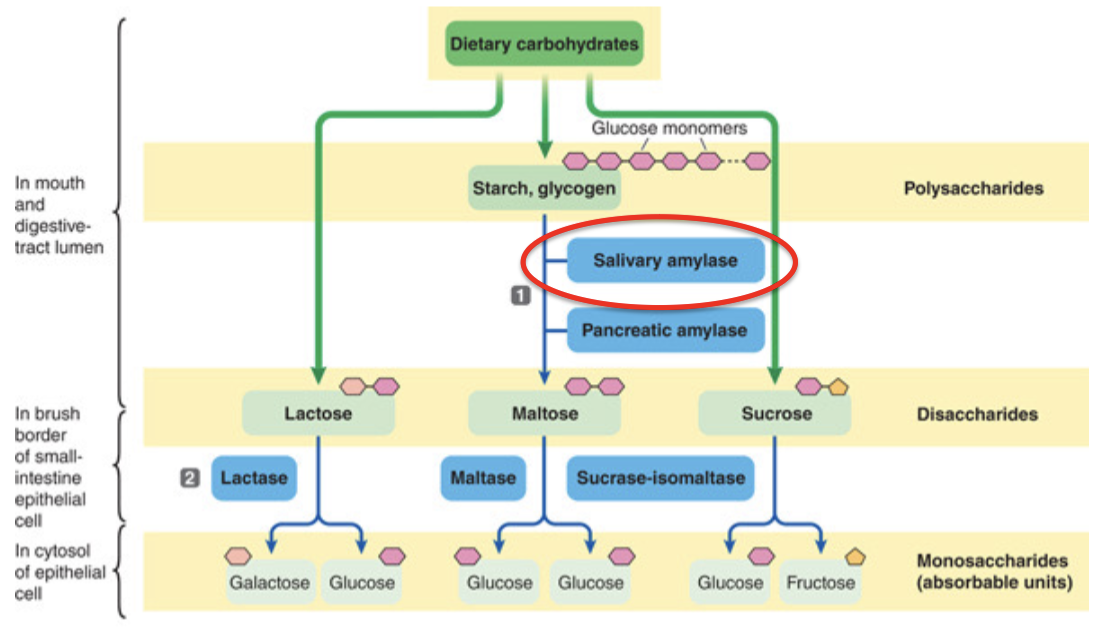
complex carbohydrates broken down by 1) amylase into disaccharides and then 2) set of enzymes into monosaccharides

  • only absorb glucose

<p>complex carbohydrates broken down by 1) amylase into disaccharides and then 2) set of enzymes into monosaccharides</p><ul><li><p>only absorb glucose</p></li></ul><p></p>
23
New cards

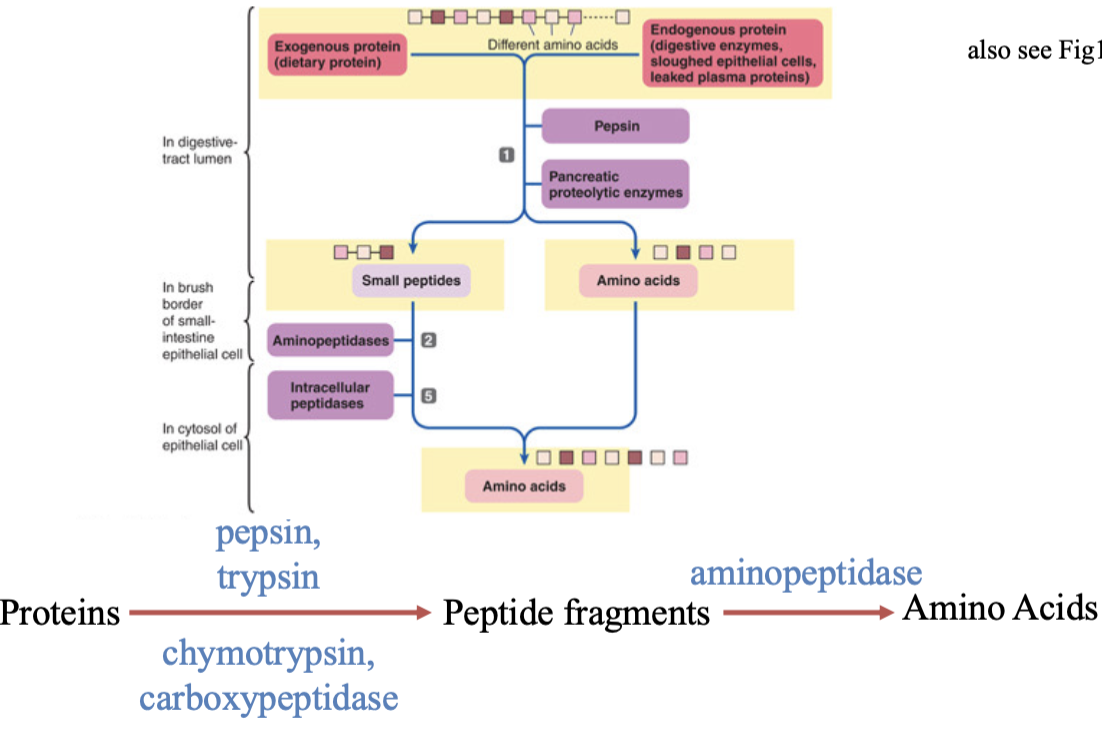
Chemical digestion of proteins:

each enzymes chops bonds between proteins to make smaller fragments of amino acids
<p>each enzymes chops bonds between proteins to make smaller fragments of amino acids</p>
24
New cards

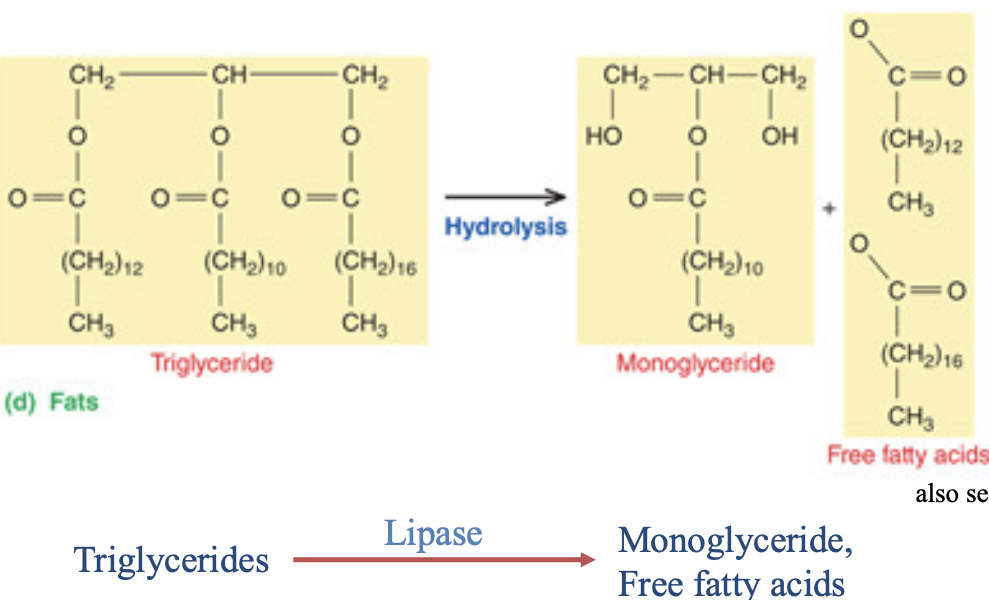
Chemical digestion of fats:

chopping fatty acid tails to form three free fatty acids
<p>chopping fatty acid tails to form three free fatty acids</p>
25
New cards

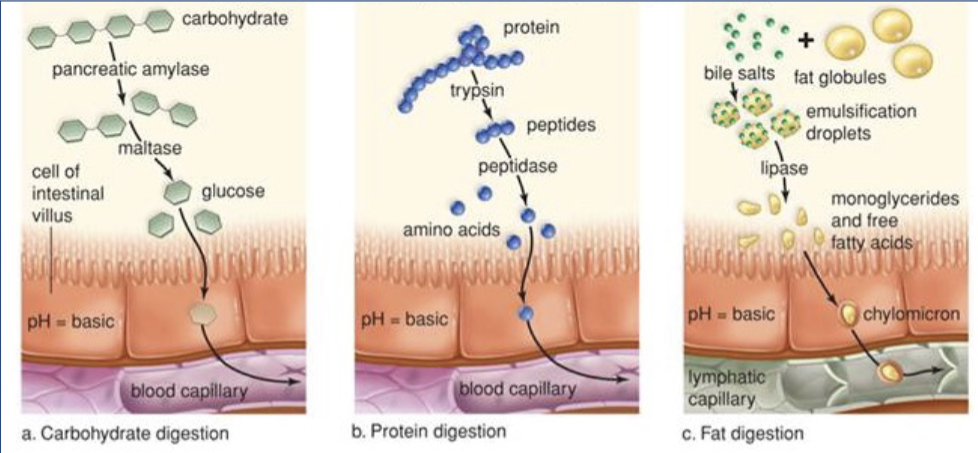
Absorption:

the transfer of small absorbable units along with water, vitamins, and electrolytes from the lumen into the blood or lymph

  • why our blood sugar goes up after a meal
<p><span style="color: rgb(255, 255, 255);"><span>the transfer of small absorbable units along with water, vitamins, and electrolytes from the lumen into the blood or lymph</span></span></p><ul><li><p>why our blood sugar goes up after a meal</p></li></ul><p></p>
26
New cards

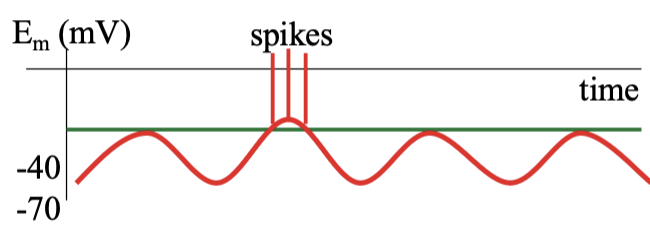
Basic electrical rhythm (BER):

creates a fluctuating potential that allows stronger "spike potentials" to trigger actual muscle spasms, coordinating movements like peristalsis and segmentation, with frequencies varying along the gut

  • sets the rhythm and frequency for gut contractions, but usually doesn't cause them directly

  • membrane potential of pacemaker cells in the stomach → interstitial cells of Cajal

27
New cards

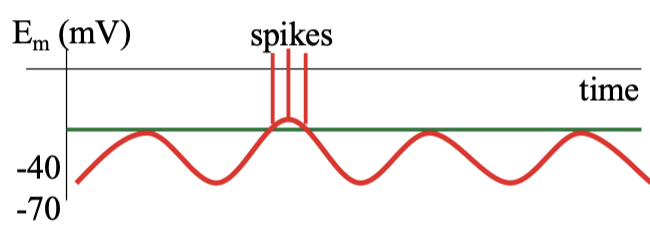
What happens when no food is in the lumen of digestive tract?

  1. the membrane potential of pacemaker cells (ICC) oscillate at 3-5 times per sec (3-5 Hz)

  2. ICCs in the small intestine depolarize more frequently (8-11 Hz) → the BER in the small intestine

  3. these depolarizations spread thru gap junctions to smooth muscle cells, then signal propagated through the tract by the enteric nervous system

  4. however, these depolarizations exceed spike threshold only 10-15 times per day → the migrating motility complex
<ol><li><p><span style="color: rgb(255, 255, 255);"><span>the membrane potential of pacemaker cells (ICC) oscillate at 3-5 times per sec (3-5 Hz)</span></span></p></li><li><p><span style="color: rgb(255, 255, 255);"><span>ICCs in the small intestine depolarize more frequently (8-11 Hz) → the BER in the small intestine</span></span></p></li><li><p><span style="color: rgb(255, 255, 255);"><span>these depolarizations spread thru gap junctions to smooth muscle cells, then signal propagated through the tract by the enteric nervous system</span></span></p></li><li><p><span style="color: rgb(255, 255, 255);"><span>however, these depolarizations exceed spike threshold only 10-15 times per day → the migrating motility complex</span></span></p></li></ol><p></p>
28
New cards

Migrating motility complex:

triggers contractions that are frequent enough to “sweep” residual contents from the stomach & small intestine to the large intestine

  • triggered by hormone motilin → extrinsic regulation
<p><span>triggers contractions that are frequent enough to “sweep” residual contents from the stomach &amp; small intestine to the large intestine</span></p><ul><li><p><span>triggered by hormone motilin → extrinsic regulation</span></p></li></ul><p></p>
29
New cards

What happens with food in the lumen?

  1. stretch and gastrin (hormone induced by protein in the stomach) activate neural circuits that increase the amplitude & frequency of the basic electrical rhythm (BER) depolarizations

  2. when these depolarizations exceed spike threshold (approx -35 mV), the smooth muscles spike & therefore contract

  3. stretch & gastrin thereby increase digestive tract motility

<ol><li><p><span style="color: rgb(255, 255, 255);"><span>stretch and gastrin (hormone induced by protein in the stomach) activate neural circuits that increase the amplitude &amp; frequency of the basic electrical rhythm (BER) depolarizations</span></span></p></li><li><p><span style="color: rgb(255, 255, 255);"><span>when these depolarizations exceed spike threshold (approx -35 mV), the smooth muscles spike &amp; therefore contract</span></span></p></li><li><p><span style="color: rgb(255, 255, 255);"><span>stretch &amp; gastrin thereby increase digestive tract motility</span></span></p></li></ol><p></p>
30
New cards

What else can move the ICCs below threshold, inhibit motility signal, or act directly on muscle cells?

certain hormones, intrinsic nerve reflexes, or sympathetic output move ICCs below threshold and inhibit motility signal, or act directly on muscle cells themselves

<p><span style="color: rgb(255, 255, 255);"><span>certain hormones, intrinsic nerve reflexes, or sympathetic output move ICCs below threshold and inhibit motility signal, or act directly on muscle cells themselves</span></span></p>
31
New cards

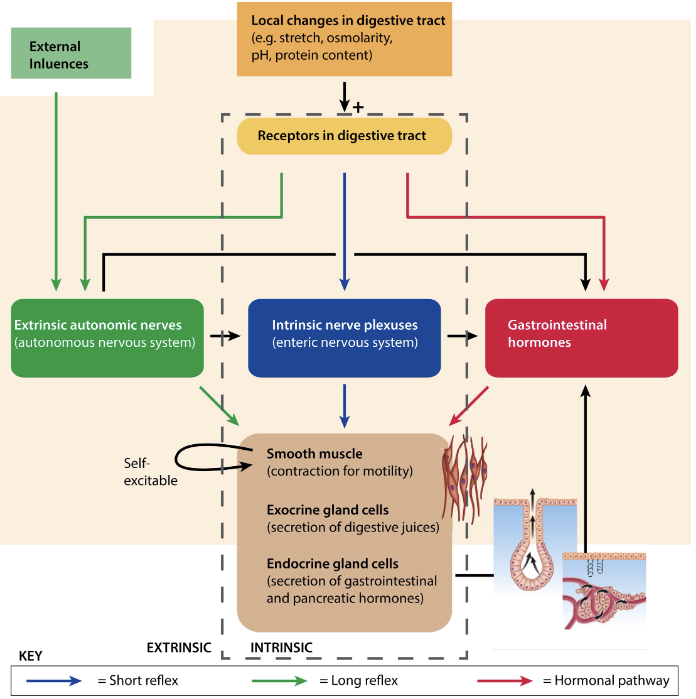
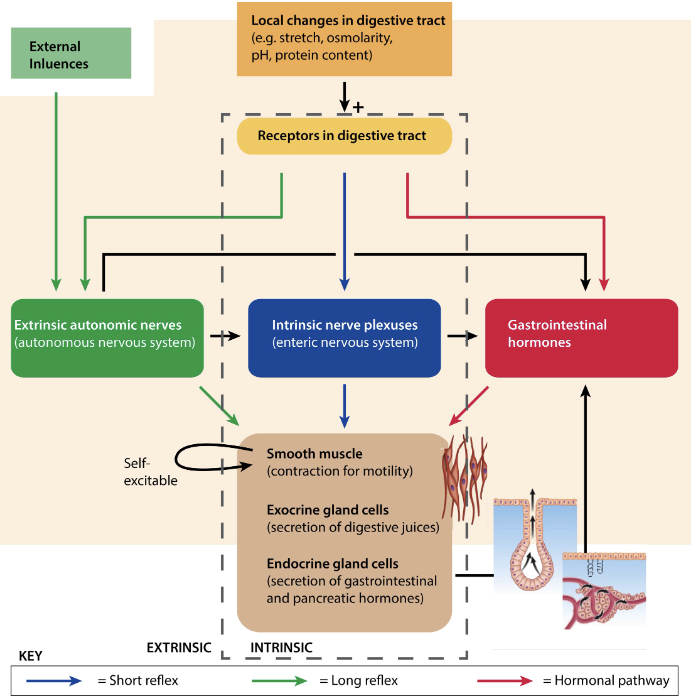
What are intrinsic factors controlling digestive system functions?

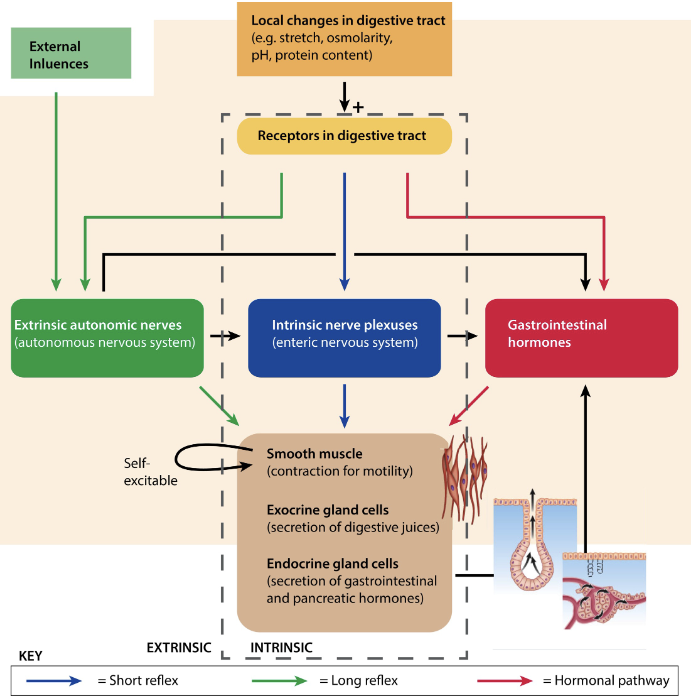
  • autonomous smooth muscle cells

  • interstitial cells of Cajal (ICC)

  • enteric nervous system

<ul><li><p>autonomous smooth muscle cells</p></li><li><p>interstitial cells of Cajal (ICC)</p></li><li><p>enteric nervous system</p></li></ul><p></p>
32
New cards

Autonomous smooth muscle cells:

connected by gap junctions, thereby forming a functional syncytium

  • single-unit smooth muscle

33
New cards

Interstitial cells of Cajal (ICC):

act as pacesetter cells and generate slow-wave potentials (Basic Electrical Rhythm; BER)

  • If threshold is reached and action potentials are triggered, then the whole muscle sheet contracts as a unit

34
New cards

Enteric nervous system:

vast network of neurons in the gut wall controlling digestion (motility, secretion, blood flow) autonomously, yet communicating bidirectionally with the central nervous system (CNS) via the gut-brain axis

  • coordinates local activity within the digestive tract

  • myenteric + submucosal nerve plexuses

<p><span><span>vast network of neurons in the gut wall controlling digestion (motility, secretion, blood flow) autonomously, yet communicating bidirectionally with the central nervous system (CNS) via the gut-brain axis</span></span></p><ul><li><p><span style="color: rgb(255, 255, 255);"><span>coordinates local activity within the digestive tract</span></span></p></li></ul><ul><li><p><span style="color: rgb(255, 255, 255);"><span>myenteric + submucosal nerve plexuses</span></span></p></li></ul><p></p>
35
New cards

What are the functions of intrinsic factors controlling digestive system?

refers to extrinsic nerves and gastrointestinal hormones
<p>refers to extrinsic nerves and gastrointestinal hormones</p>
36
New cards

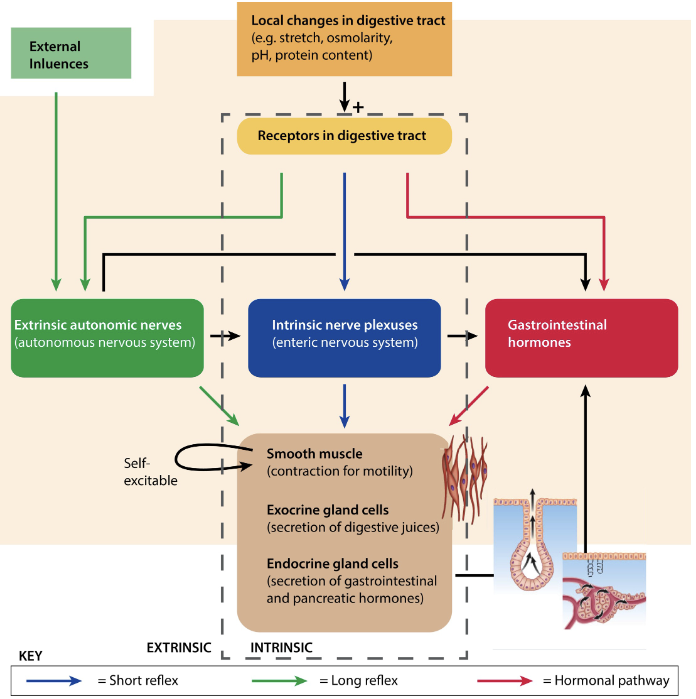
Extrinsic nerves:

originate from outside the digestive system from both the sympathetic and parasympathetic branch where they influence motility and secretion by:

  • Modifying activity of the enteric nervous system

  • altering gastric hormone secretion

  • acting directly on smooth muscle and glands
<p><span style="color: rgb(255, 255, 255);"><span>originate from outside the digestive system from both the sympathetic and parasympathetic branch where they influence motility and secretion by:</span></span></p><ul><li><p><span style="color: rgb(255, 255, 255);"><span>Modifying activity of the enteric nervous system</span></span></p></li><li><p><span style="color: rgb(255, 255, 255);"><span>altering gastric hormone secretion</span></span></p></li><li><p><span style="color: rgb(255, 255, 255);"><span>acting directly on smooth muscle and glands</span></span></p></li></ul><p></p>
37
New cards

Gastrointestinal hormones:

long-range chemical messengers secreted into blood and act on receptors in distal locations to regulate digestive tract (and non-digestive tract) functions
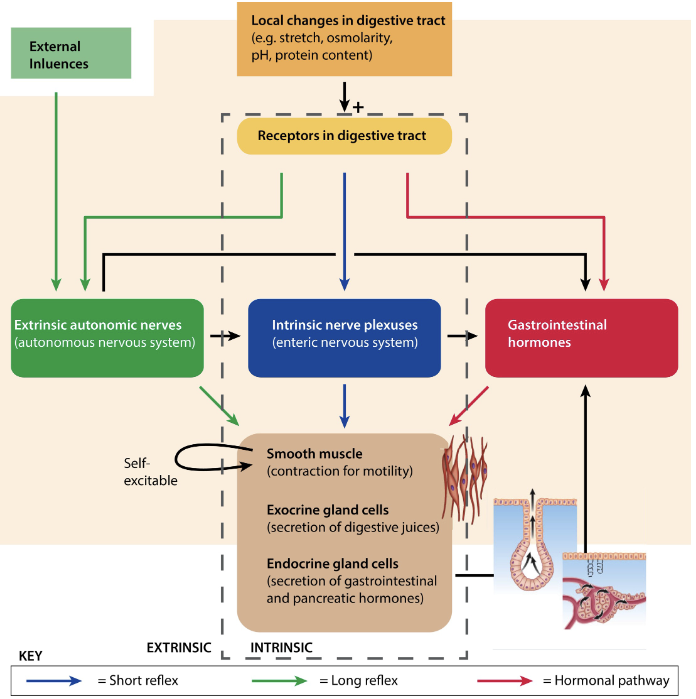
<p><span style="color: rgb(255, 255, 255);"><span>long-range chemical messengers secreted into blood and act on receptors in distal locations to regulate digestive tract (and non-digestive tract) functions</span></span></p>
38
New cards

Lips and Tongue:

contain food in mouth and guide food during chewing and swallowing

39
New cards

Teeth:

begin mechanical breakdown by chewing of food

40
New cards

Palate:

roof of oral cavity from nasal passage

  • allows chewing and breathing to occur simultaneously
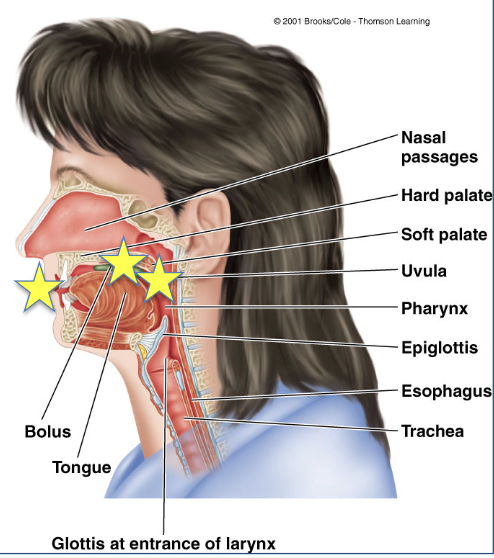
<p>roof of oral cavity from nasal passage</p><ul><li><p>allows chewing and breathing to occur simultaneously</p></li></ul><p></p>
41
New cards

Uvula:

soft tissue that hangs from the rear of the mouth and seals off nasal passage during swallowing
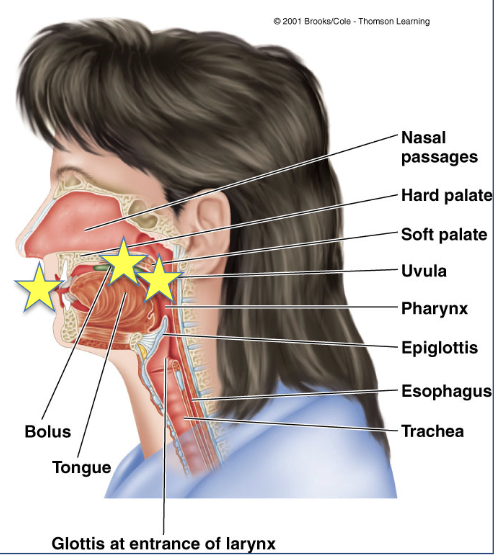
<p>soft tissue that hangs from the rear of the mouth and seals off nasal passage during swallowing</p>
42
New cards

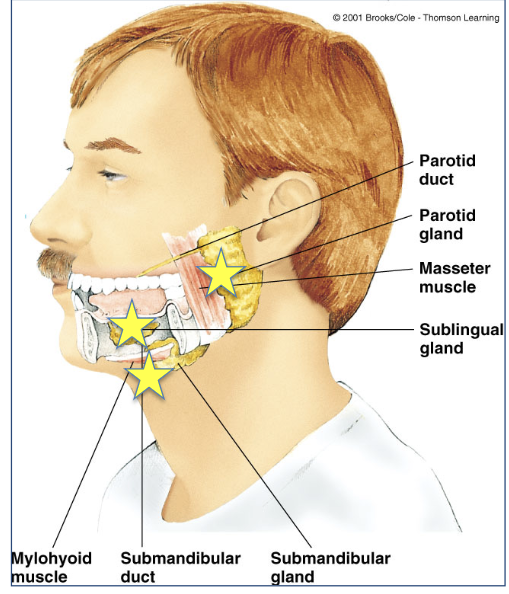
Salivary glands:

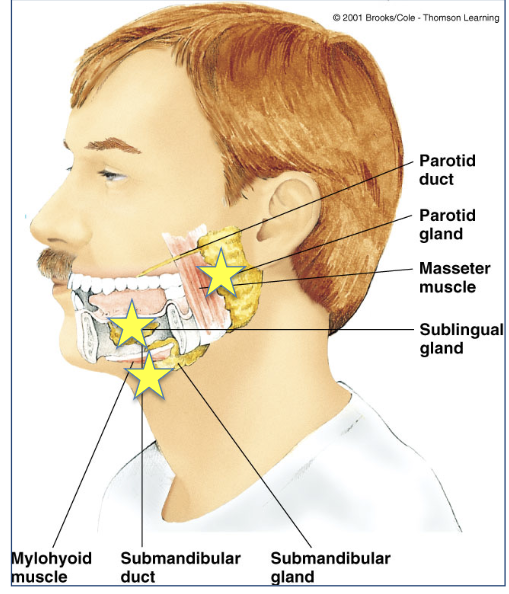
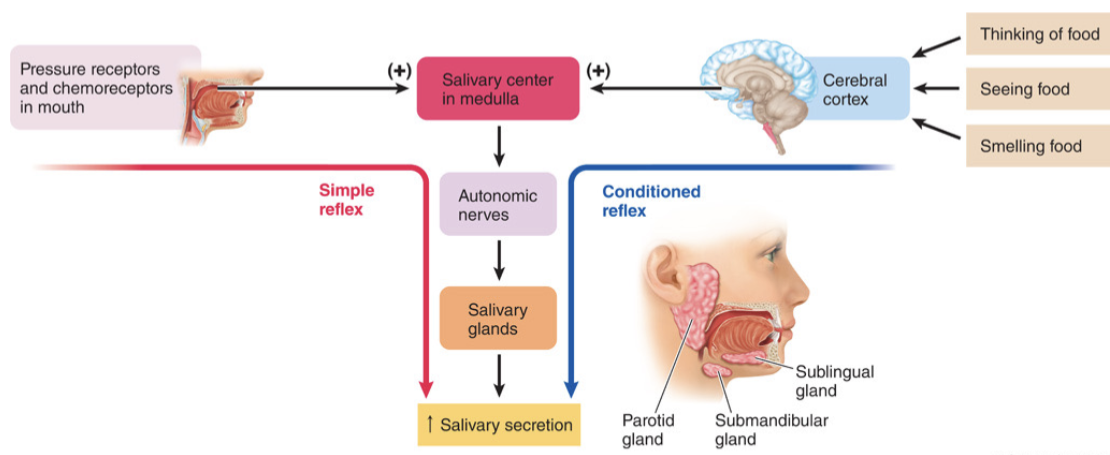
made up of 3 gland and secrete saliva in response to autonomic stimulation 

  • sublingual

  • submandibular

  • parotid

<p>made up of 3 gland and secrete saliva in response to autonomic stimulation&nbsp;</p><ul><li><p>sublingual</p></li><li><p>submandibular</p></li><li><p>parotid</p></li></ul><p></p>
43
New cards

What does saliva contain?

  • mucus to moisten food and lubricate

  • lysozyme to lyse bacteria

  • Bicarbonate buffers which neutralize acids

  • amylase, which begins chemical digestion of carbohydrates by cleaving polysaccharides into maltose
<ul><li><p><span style="color: rgb(255, 255, 255);"><span>mucus to moisten food and lubricate</span></span></p></li><li><p><span style="color: rgb(255, 255, 255);"><span>lysozyme to lyse bacteria</span></span></p></li><li><p><span style="color: rgb(255, 255, 255);"><span>Bicarbonate buffers which neutralize acids</span></span></p></li><li><p><span style="color: rgb(255, 255, 255);"><span>amylase, which begins chemical digestion of carbohydrates by cleaving polysaccharides into maltose</span></span></p></li></ul><p></p>
44
New cards

Mouth and Salivary Glands:

describes how salivation works

  • simple or conditioned reflexes

<p>describes how salivation works</p><ul><li><p>simple or conditioned reflexes</p></li></ul><p></p>
45
New cards

Where does the digestion of carbohydrates (polysaccharides) start?

starts in the mouth
<p>starts in the mouth</p>
46
New cards

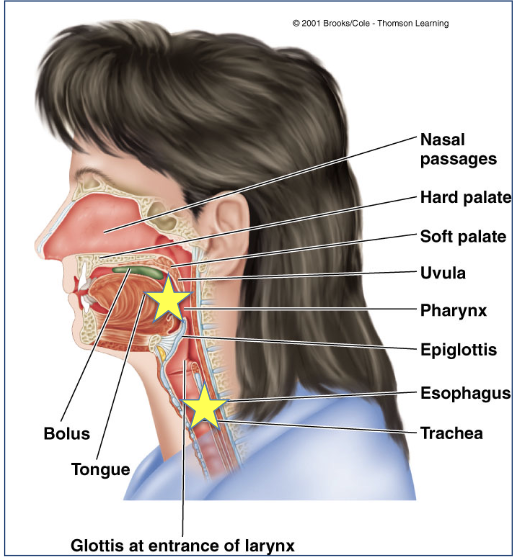
Swallowing:

refers to the entire process of moving food from the mouth, through pharynx
and esophagus, to the stomach in two stages

  • is a sequentially programmed all-or-none reflex, initiated when bolus is voluntarily forced by tongue to rear of mouth into pharynx

    • can be initiated voluntarily but cannot be stopped once it has begun
<p><span style="color: rgb(255, 255, 255);"><span>refers to the entire process of moving food from the mouth, through pharynx<br>and esophagus, to the stomach in two stages</span></span></p><ul><li><p><span style="color: rgb(255, 255, 255);"><span>is a sequentially programmed all-or-none reflex, initiated when bolus is voluntarily forced by tongue to rear of mouth into pharynx</span></span></p><ul><li><p><span style="color: rgb(255, 255, 255);"><span>can be initiated voluntarily but cannot be stopped once it has begun</span></span></p></li></ul></li></ul><p></p>
47
New cards

What are the two stages of swallowing?

  • oropharyngial stage → when the food is still in your mouth entering the pharynx

  • esophageal stage → when food is in the esophagus

48
New cards

True or False: In the esophageal stage, peristaltic (propulsive) waves move bolus (food) into the stomach.

True, at the end of the oropharyngeal stage, the pharyngoesophageal sphincter closes & breathing resumes
<p><span style="color: rgb(255, 255, 255);">True, </span><span style="color: rgb(255, 255, 255);"><span>at the end of the oropharyngeal stage, the pharyngoesophageal sphincter closes &amp; breathing resumes</span></span></p>
49
New cards

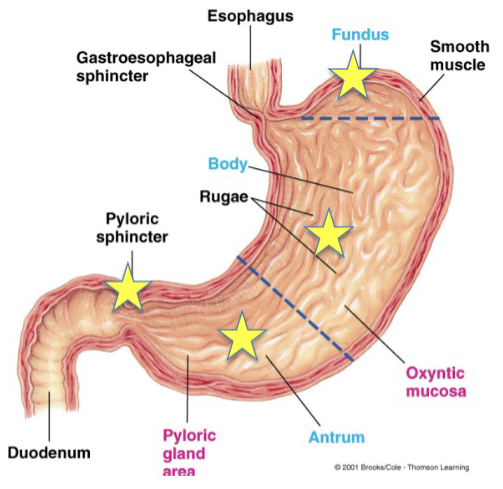
Stomach:

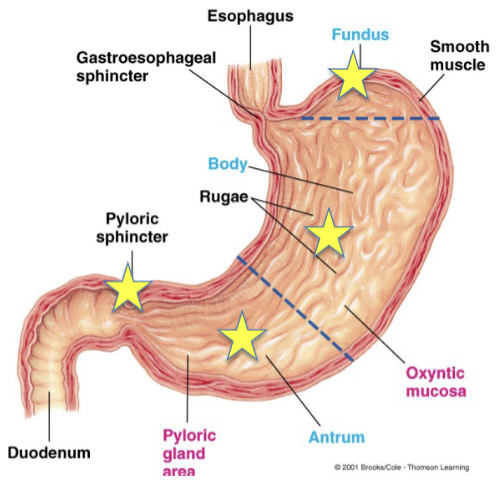
J-shaped chamber located between the esophagus and the small intestine

  • thick layer of smooth muscle connected to small intestine by pyloric sphincter and is a key regulator of gastric emptying

    • fundus → located above the gastroesophageal sphincter

    • body → middle

    • antrum → bottom

<p>J-shaped chamber located between the esophagus and the small intestine</p><ul><li><p>thick layer of smooth muscle connected to small intestine by pyloric sphincter and is a key regulator of gastric emptying</p><ul><li><p>fundus →&nbsp;located above the gastroesophageal sphincter</p></li><li><p>body → middle</p></li><li><p>antrum → bottom</p></li></ul></li></ul><p></p>
50
New cards

Main functions of the stomach:

  • store ingested food until it can be emptied into small intestine

    • occurs in the body of the stomach

  • create gastric secretions → including HCl and enzymes that begin chemical digestion of protein

  • gastric motility converts pulverized food to chyme → a thick liquid mixture of pulverized food and gastric secretions
<ul><li><p><span style="color: rgb(255, 255, 255);"><span>store ingested food until it can be emptied into small intestine</span></span></p><ul><li><p><span style="color: rgb(255, 255, 255);"><span>occurs in the body of the stomach</span></span></p></li></ul></li><li><p><span style="color: rgb(255, 255, 255);"><span>create gastric secretions → including HCl and enzymes that begin chemical digestion of protein</span></span></p></li><li><p><span style="color: rgb(255, 255, 255);"><span>gastric motility converts pulverized food to chyme → a thick liquid mixture of pulverized food and gastric secretions</span></span></p></li></ul><p></p>
51
New cards

Gastric filling:

gastric volume can expand ~20-fold during a meal, by expansion/ flattening of deep folds

  • expansion of gastric volume is a vagally-mediated process called receptive relaxation

52
New cards

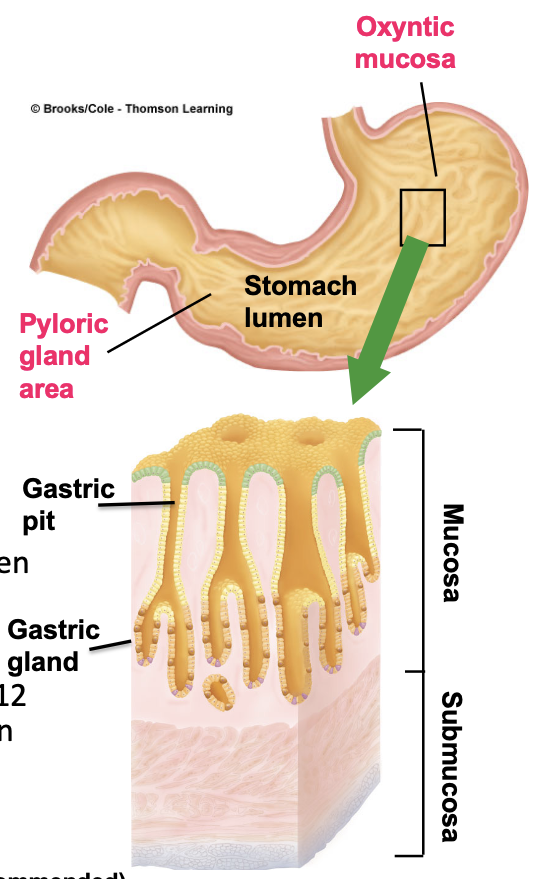
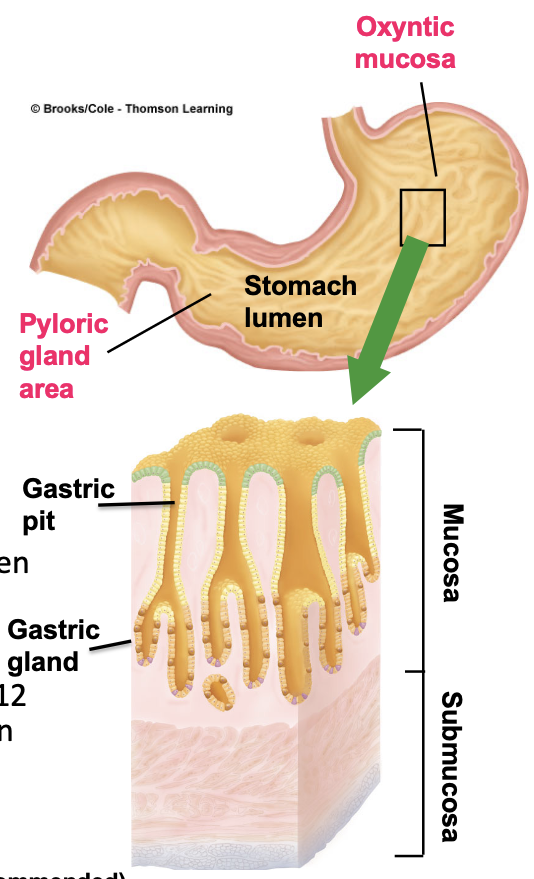
What are the two distinct areas of secretory gastric mucosa?

oxyntic mucosa (body and fundus) and pyloric gland area (antrum)
<p>oxyntic mucosa (body and fundus) and pyloric gland area (antrum)</p>
53
New cards

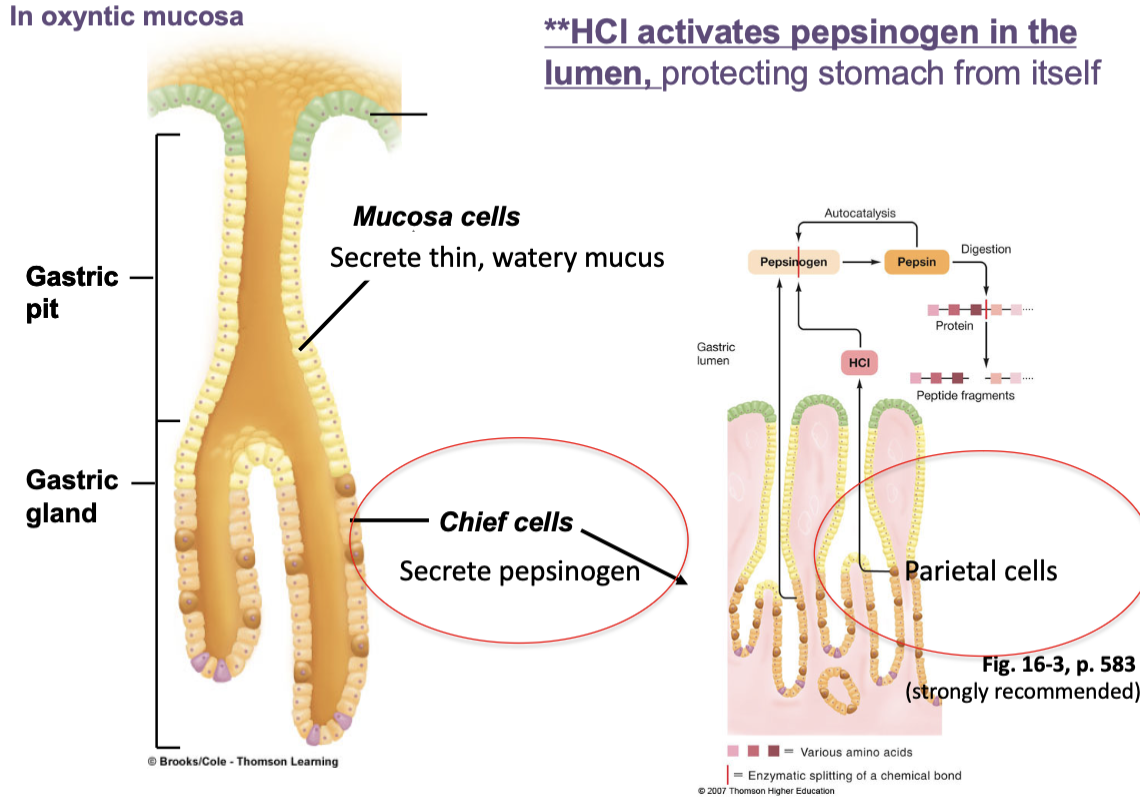
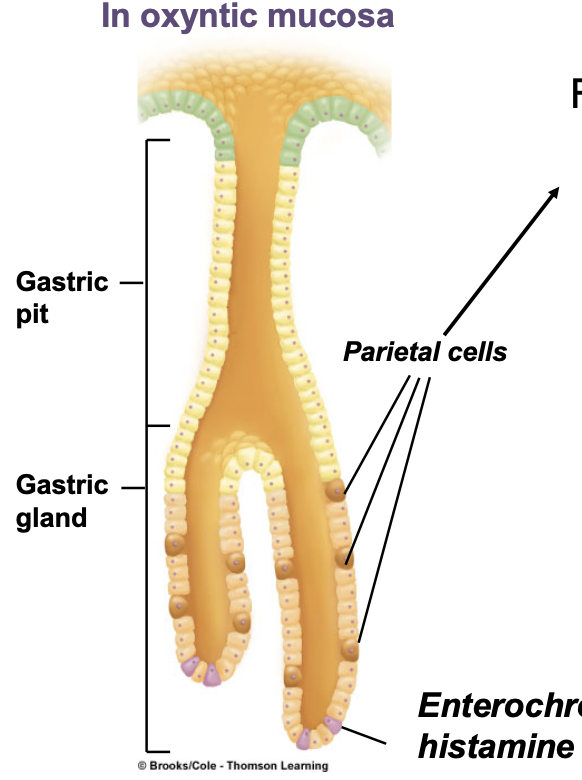
In oxyntic mucosa, what are the 3 types of gastric EXOCRINE secretory cells, associated with gastric pits?

  1. Mucous cells → secrete thin, watery mucus

  2. Chief cells → secrete enzyme precursor, pepsinogen

  3. Parietal (oxyntic) cells secrete HCl and intrinsic factor (essential for normal function of red blood cells)
<ol><li><p><span style="color: rgb(255, 255, 255);"><span>Mucous cells → secrete thin, watery mucus</span></span></p></li><li><p><span style="color: rgb(255, 255, 255);"><span>Chief cells → secrete enzyme precursor, pepsinogen</span></span></p></li><li><p><span style="color: rgb(255, 255, 255);"><span>Parietal (oxyntic) cells secrete HCl and intrinsic factor (essential for normal function of red blood cells)</span></span></p></li></ol><p></p>
54
New cards

HCl activates what in the stomach?

activates pepsinogen in the lumen, protecting stomach from itself
<p>activates pepsinogen in the lumen, protecting stomach from itself</p>
55
New cards

Functions of HCl in the stomach?

activates pepsinogen to active enzyme pepsin and provides acid medium for optimal pepsin activity

  • denatures protein

  • along with salivary lysozyme, kills most of the microorganisms ingested with food
<p><span style="color: rgb(255, 255, 255);"><span>activates pepsinogen to active enzyme pepsin and provides acid medium for optimal pepsin activity</span></span></p><ul><li><p><span style="color: rgb(255, 255, 255);"><span>denatures protein</span></span></p></li><li><p><span style="color: rgb(255, 255, 255);"><span>along with salivary lysozyme, kills most of the microorganisms ingested with food</span></span></p></li></ul><p></p>
56
New cards

Enterochromaffin- like (ECL) cells:

secrete histamine (activates parietal cells) and is usually a local intermediate in a signaling loop

  • in this case, activates parietal cells which are the HCl- producing cells

  • purple spots

<p><span style="color: rgb(255, 255, 255);"><span>secrete histamine (activates parietal cells) and is usually a local intermediate in a signaling loop</span></span></p><ul><li><p>in this case, activates parietal cells which are the HCl- producing cells</p></li><li><p>purple spots</p></li></ul><p></p>
57
New cards

How do stomach cells survive despite the acid?

in between gastric pits, the actual lining of the stomach has mucus producing cells that make a very thick layer of mucus that release bicarbonate

  • prevents outside of stomach from directly damaging mucosal cells

  • cells are not meant to last long

<p>in between gastric pits, the actual lining of the stomach has mucus producing cells that make a very thick layer of mucus that release bicarbonate</p><ul><li><p>prevents outside of stomach from directly damaging mucosal cells</p></li><li><p>cells are not meant to last long</p></li></ul><p></p>
58
New cards

Endocrine secretory cells in the pyloric gland area secrete what?

  • secrete hormone gastrin into bloodstream which stimulates parietal, chief, and ECL cells

    • G cells

  • secretes hormone somatostatin into the bloodstream which inhibits parietal and ECL cells

    • D cells

<ul><li><p>secrete hormone gastrin into bloodstream which <strong>stimulates</strong> parietal, chief, and ECL cells</p><ul><li><p>G cells</p></li></ul></li><li><p>secretes hormone somatostatin into the bloodstream which <strong>inhibits</strong> parietal and ECL cells</p><ul><li><p>D cells</p></li></ul></li></ul><p></p>
59
New cards

Gastrin increases what?

increases gastric motility and promotes movement of leftover, undigested/unabsorbed material out of ileum into large intestine

60
New cards

Gastric mixing and emptying:

strong peristaltic contractions occur in the antrum that

  • mix food with gastric secretions to produce chyme

  • propel chyme towards pyloric sphincter, where a small amount is pushed into the duodenum

  • in response to chyme, sphincter closes and remaining chyme is tumbled back into the antrum.
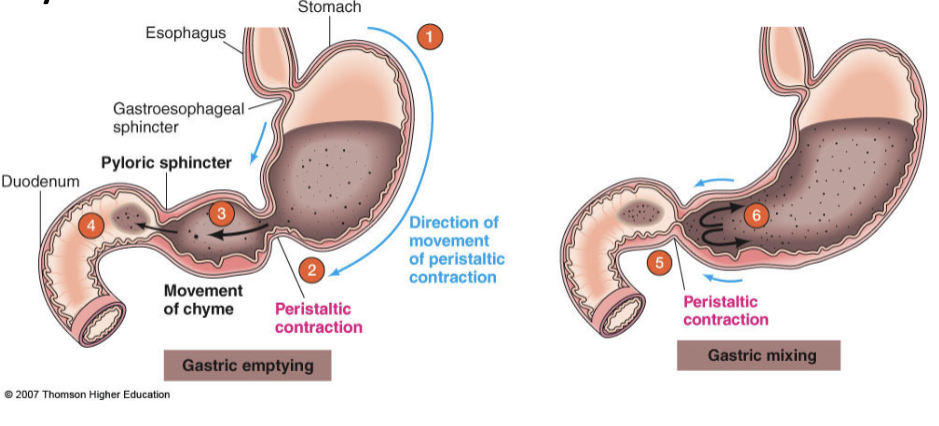
<p><span style="color: rgb(255, 255, 255);">s</span><span style="color: rgb(255, 255, 255);"><span>trong peristaltic contractions occur in the antrum that</span></span></p><ul><li><p><span style="color: rgb(255, 255, 255);"><span>mix food with gastric secretions to produce chyme</span></span></p></li><li><p><span style="color: rgb(255, 255, 255);"><span>propel chyme towards pyloric sphincter, where a small amount is pushed into the duodenum</span></span></p></li><li><p><span style="color: rgb(255, 255, 255);"><span>in response to chyme, sphincter closes and remaining chyme is tumbled back into the antrum.</span></span></p></li></ul><p></p>
61
New cards

How does the volume of the chyme control gastric mixing and emptying (pyloric function)?

distention directly stimulates stretch receptors on the smooth muscle, stimulates enteric and parasympathetic nervous system as well as the stomach hormone gastrin to increase motility

  • more volume, more contractions (to an extent)

62
New cards

How does the fluidity of the chyme control gastric mixing and emptying (pyloric function)?

liquids do not require extensive mixing and churning; contents must be rendered fluid before they are evacuated

63
New cards

How does fat control gastric emptying (via neural and hormonal factors)?

fat is only digested and absorbed within the small intestine, so when fat is present in the small intestine further emptying is inhibited

  • more fat, less movement for absorption

64
New cards

How does acid control gastric emptying (via neural and hormonal factors)?

highly acidic chyme from the stomach is neutralized by sodium bicarbonate (secreted from pancreas) in the duodenum

  • Un-neutralized acid in the duodenum inhibits gastric emptying

  • acidic = less emptying

65
New cards

How does hypertonicity control gastric emptying (via neural and hormonal factors)?

increased osmolarity in the duodenum indicates a back-up of nutrients and delays gastric emptying

  • lots of nutrients = preventing gastric emptying for more absorption

66
New cards

How does distension control gastric emptying (via neural and hormonal factors)?

stomach initiates gastric emptying promoting motility while simultaneous duodenal distension triggers inhibitory hormones

  • Stomach → has brakes to prevent overfilling of duodenum

  • Small intestine → too much chyme in the duodenum inhibits gastric emptying

    • if stretched too much = can’t process efficiently

67
New cards

Factors that regulate gastric motility by triggering neural responses:

neural responses are mediated through both intrinsic nerves (short reflex) and autonomic nerves (long reflex)

  • collectively this is called the enterogastric reflex

68
New cards

Factors that regulate gastric motility by triggering hormonal responses:

hormonal response involves release of hormones from duodenal mucosa collectively known as “enterogastrones”

  • cholecystokinin (CCK) → stimulated by fat in the duodenum

    • inhibits antral contractions and induces contraction of the pyloric sphincter

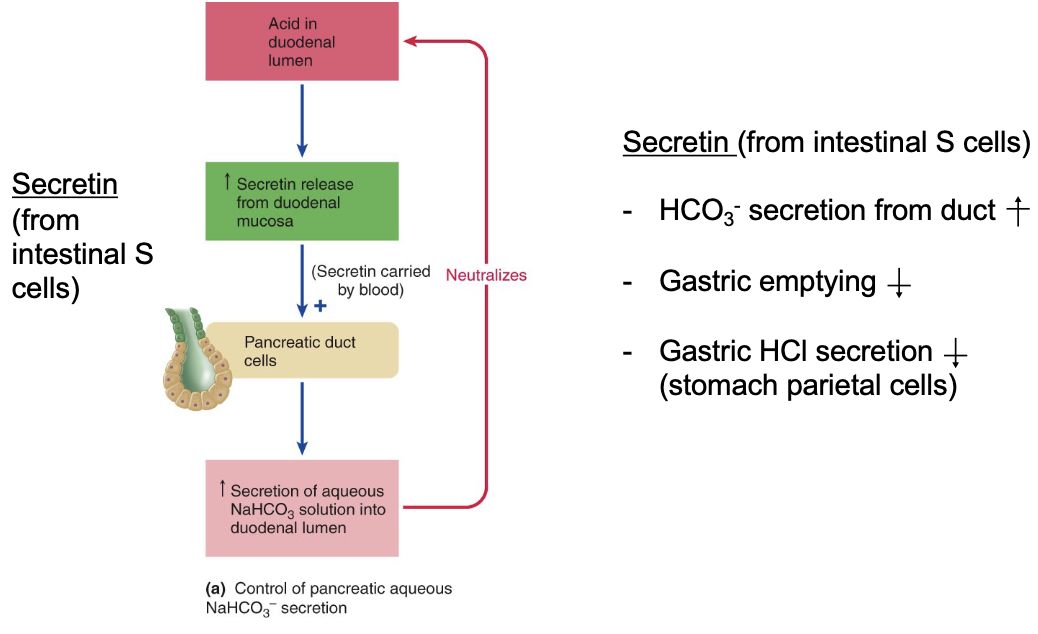
  • secretin → stimulated by unneutralized acid in the duodenum

    • released by S cells and slows gastric emptying

69
New cards

What are the 3 phases in gastric secretion?

  • cephalic

  • gastric

  • intestinal

70
New cards

Cephalic phase:

pre-activation of your stomach by signals that have not yet reached the stomach, that are entirely in the head → seeing, smelling, tasting, chewing, swallowing of food

  • excitatory → activates the stomach

  • nervous and endocrine response involved

    • ACh → Parasympathetic + enteric NS neurotransmitter

    • intrinsic nerves + G cells activating gastric secretion and motility
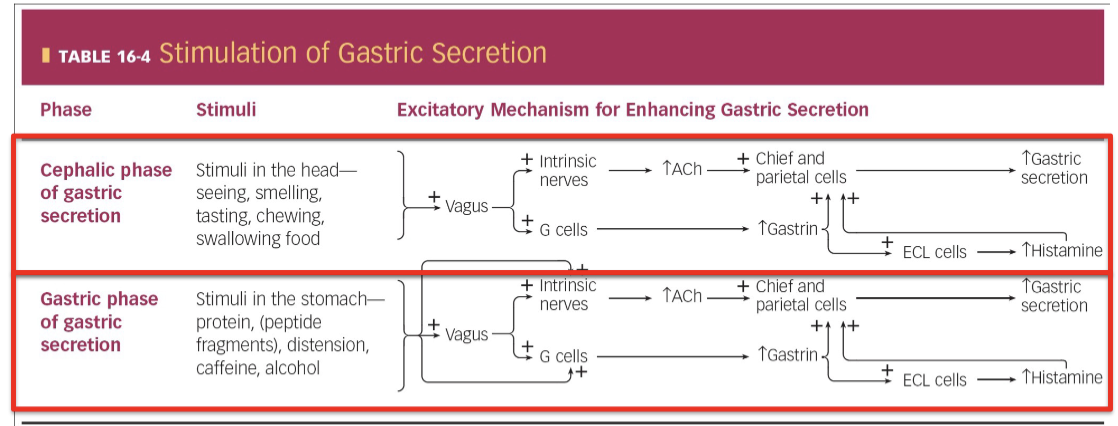
<p>pre-activation of your stomach by signals that have not yet reached the stomach, that are entirely in the head → seeing, smelling, tasting, chewing, swallowing of food</p><ul><li><p>excitatory → activates the stomach</p></li><li><p>nervous and endocrine response involved</p><ul><li><p>ACh → Parasympathetic + enteric NS neurotransmitter</p></li><li><p>intrinsic nerves + G cells activating gastric secretion and motility</p></li></ul></li></ul><p></p>
71
New cards

Gastric phase:

once food hits the stomach, gastric emptying will become activated

  • same as cephalic phase but more potent due to direct signals from within the stomach

  • excitatory

<p>once food hits the stomach, gastric emptying will become activated</p><ul><li><p>same as cephalic phase but more potent due to direct signals from within the stomach</p></li><li><p>excitatory</p></li></ul><p></p>
72
New cards

Intestinal phase:

will activate both nerves and hormones (CCK + secretin) that collectively inhibit H+ secretion, pepsinogen, smooth muscle contraction, and overall reduce gastric secretion and motility

  • inhibitory → slow down stomach

    • not a lot of acid content

  • removing protein and extension as stomach empties gradually removes signal that activated stomach
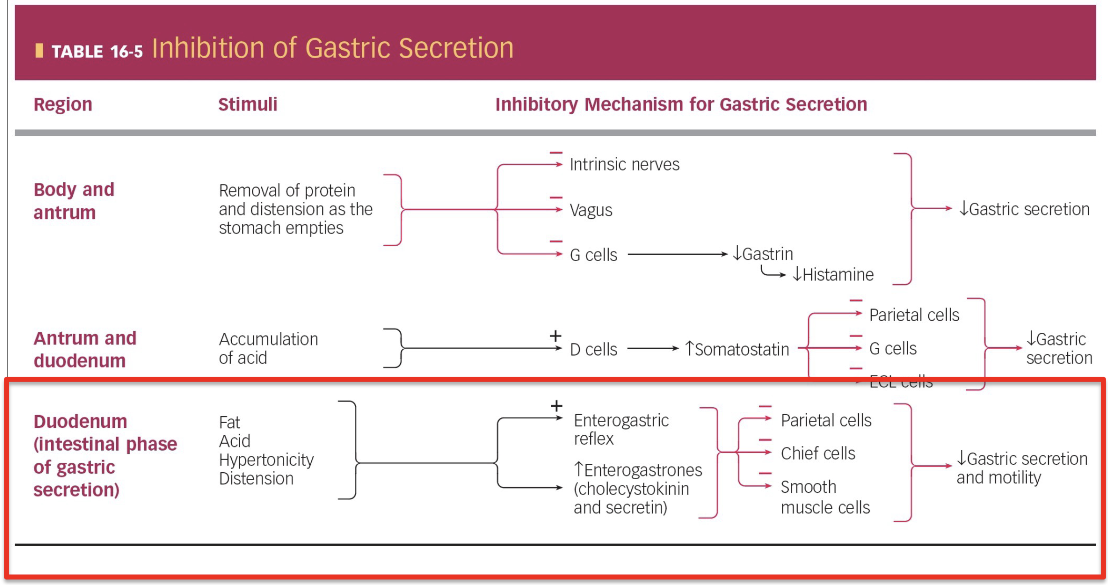
<p>will activate both nerves and hormones (CCK + secretin) that collectively inhibit H<sup>+</sup> secretion, pepsinogen, smooth muscle contraction, and overall reduce gastric secretion and motility</p><ul><li><p>inhibitory → slow down stomach</p><ul><li><p>not a lot of acid content</p></li></ul></li><li><p>removing protein and extension as stomach empties gradually removes signal that activated stomach</p></li></ul><p></p>
73
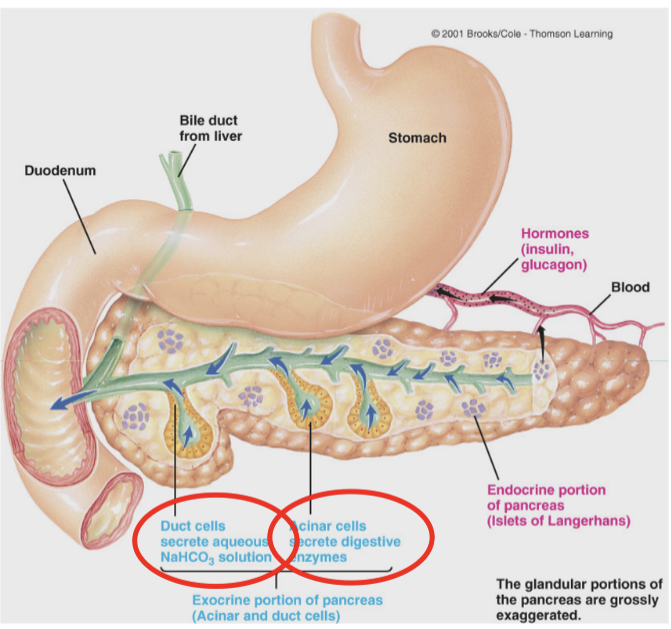
New cards

Pancreas:

located dorsal and caudal to the stomach and is a mixed gland that contains both endocrine and exocrine tissue
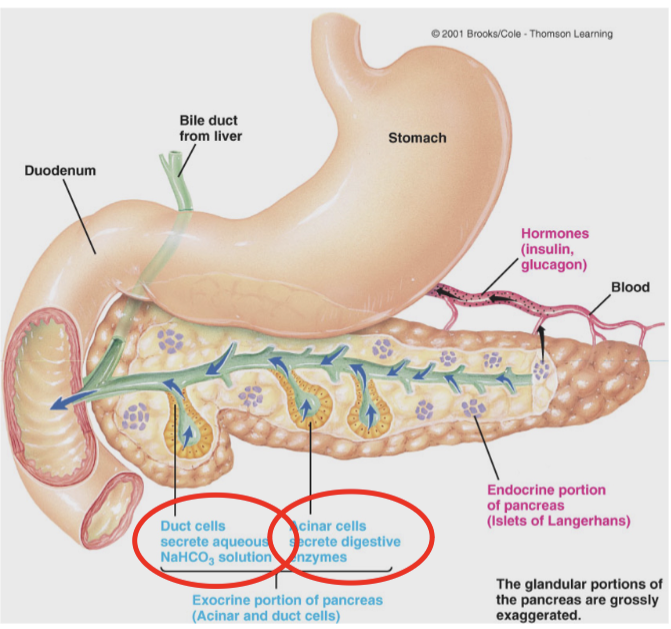
<p><span style="color: rgb(255, 255, 255);"><span>located dorsal and caudal to the stomach and is a mixed gland that contains both endocrine and exocrine tissue</span></span></p>
74
New cards

Exocrine pancreas includes what?

  • duct cells → release sodium bicarbonate (NaHCO3) into duodenum to neutralize acidic chyme

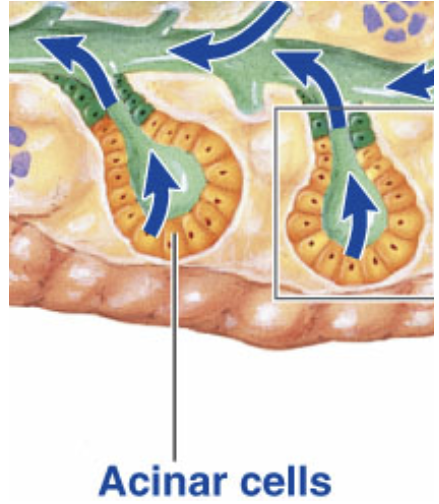
  • acinar cells

<ul><li><p><span style="color: rgb(250, 250, 250);"><span>duct cells → release sodium bicarbonate (NaHCO3) into duodenum to neutralize acidic chyme</span></span></p></li><li><p><span style="color: rgb(250, 250, 250);"><span>acinar cells</span></span></p></li></ul><p></p>
75
New cards

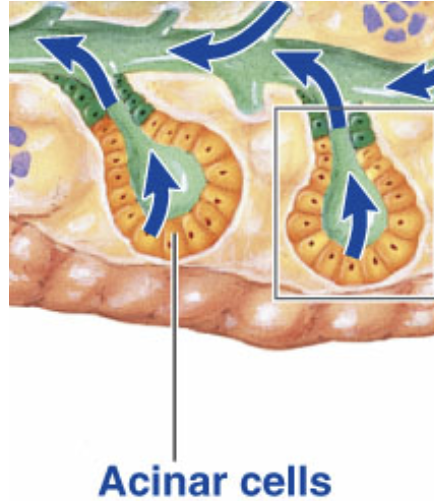
Pancreatic acinar cells:

release digestive enzymes into duodenum and work better at a neutral or alkaline pH

  • pancreatic amylase → carbohydrate digestion

  • pancreatic lipase → only enzyme secreted throughout human digestive system that can significantly digest fat

  • proteolytic enzymes

<p><span><span>release digestive enzymes into duodenum and work better at a neutral or alkaline pH</span></span></p><ul><li><p>pancreatic amylase → carbohydrate digestion</p></li><li><p>pancreatic lipase → only enzyme secreted throughout human digestive system that can significantly digest fat</p></li><li><p>proteolytic enzymes</p></li></ul><p></p>
76
New cards

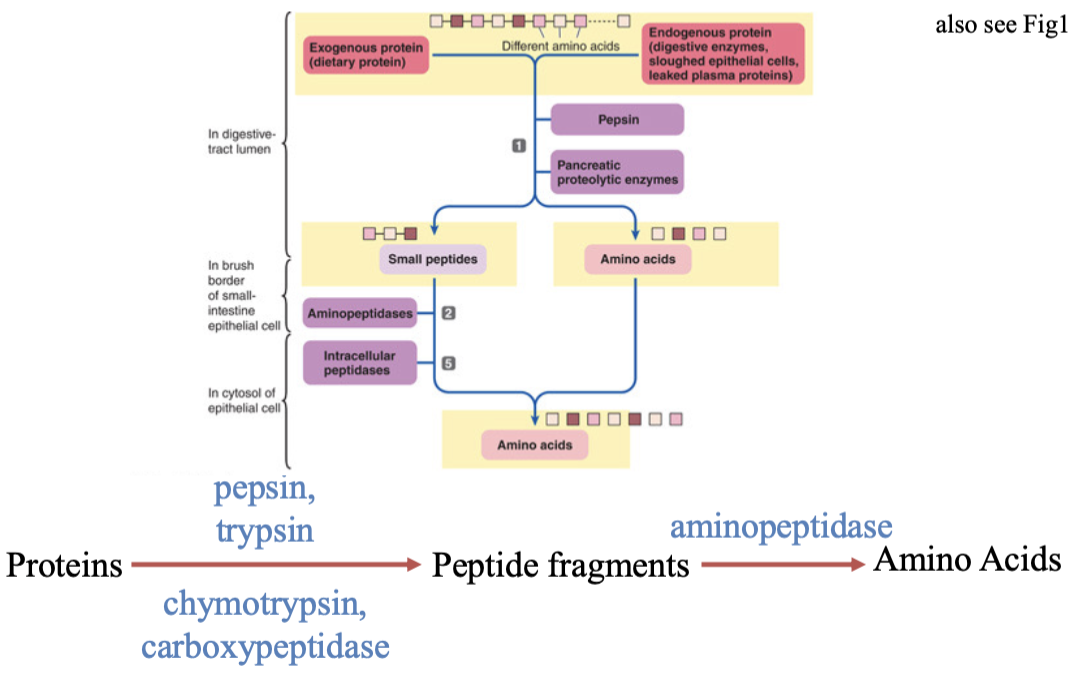
Proteolytic enzymes:

secreted as inactive forms and cleave bonds between amino acids

  • Trypsinogen → converted to the active form trypsin by enteropeptidase in the luminal (brush border) membrane of small intestine

  • Chymotrypsinogen → converted to active form chymotrypsin by trypsin

  • Procarboxypeptidase → converted to active form carboxypeptidase by trypsin
<p>secreted as inactive forms and cleave bonds between amino acids</p><ul><li><p><span style="color: rgb(255, 255, 255);"><span>Trypsinogen → converted to the active form trypsin by enteropeptidase in the luminal (brush border) membrane of small intestine</span></span></p></li><li><p><span style="color: rgb(255, 255, 255);"><span>Chymotrypsinogen → converted to active form chymotrypsin by trypsin</span></span></p></li><li><p><span style="color: rgb(255, 255, 255);"><span>Procarboxypeptidase → converted to active form carboxypeptidase by trypsin</span></span></p></li></ul><p></p>
77
New cards

Why are protein-degrading (proteolytic) enzymes (pepsin, trypsin, chymotrypsin and carboxypeptidase) secreted as inactive precursors, while lipid- and carbohydrate-degrading enzymes (amylase, lipase) are secreted as active precursors?

proteins are part of your own body’s structure, so proteases must be tightly controlled; fats and carbs aren’t, so their enzymes can be active right away

  • ensures they are only activated in the right place and at the right time
<p>proteins are part of your own body’s structure, so proteases must be tightly controlled; fats and carbs aren’t, so their enzymes can be active right away</p><ul><li><p><span><span>ensures they are only activated in the right place and at the right time</span></span></p></li></ul><p></p>
78
New cards

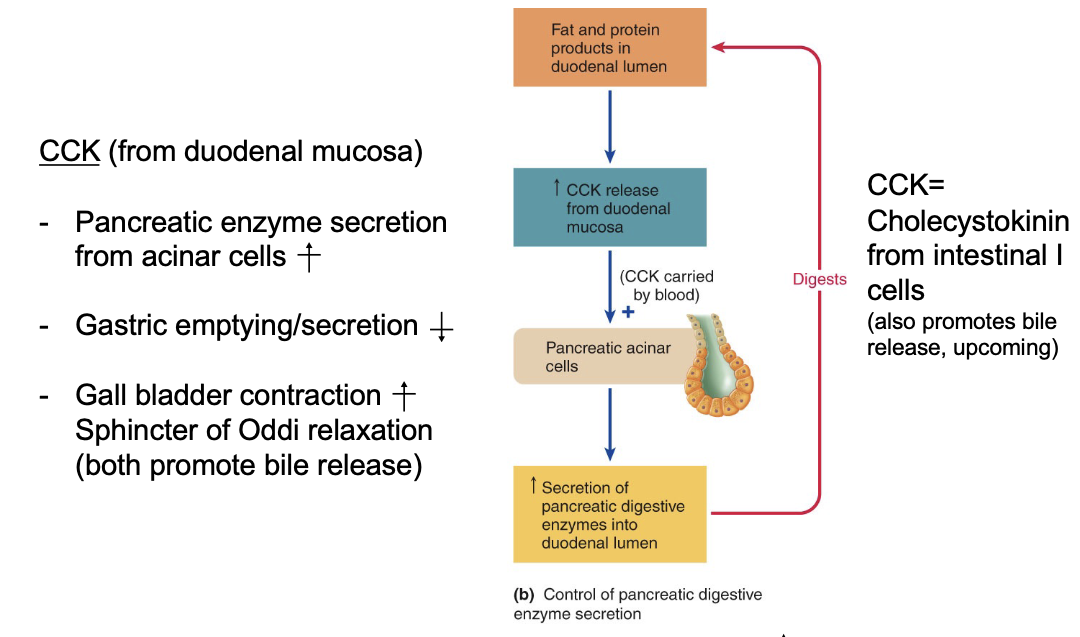
How does the pancreas know when to secrete (CCK)?

same CCK that told pancreas to slow down in response to fat is telling to release more lipase and other enzymes (3 proteolytic and amylase) from acinous cells

  • chyme in the duodenum stimulates pancreatic secretions via intestinal hormones, aka enterogastrones

  • vagovagal reflex in response to increased volume in duodenum secretin and CCK

    • weak direct stimulation of duct and acinar cells by vagus (cephalic phase)

  • CCK feedback loop

<p>same CCK that told pancreas to slow down in response to fat is telling to release more lipase and other enzymes (3 proteolytic and amylase) from acinous cells</p><ul><li><p>c<span style="color: rgb(255, 255, 255);"><span>hyme in the duodenum stimulates pancreatic secretions via intestinal hormones, aka enterogastrones</span></span></p></li><li><p><span style="color: rgb(255, 255, 255);"><span>vagovagal reflex in response to increased volume in duodenum secretin and CCK </span></span></p><ul><li><p><span style="color: rgb(255, 255, 255);"><span>weak direct stimulation of duct and acinar cells by vagus (cephalic phase)</span></span></p></li></ul></li><li><p>CCK feedback loop</p></li></ul><p></p>
79
New cards

How does the pancreas know when to secrete (secretin)?

secretin released in response to acid in duodenum separates endocrine cells called S cells which trigger the release of secretin

  • goes around in the duct cells which release bicarbonate and neutralize acid → a feedback loop
<p>secretin released in response to acid in duodenum separates endocrine cells called S cells which trigger the release of secretin</p><ul><li><p>goes around in the duct cells which release bicarbonate and neutralize acid → a feedback loop</p></li></ul><p></p>
80
New cards

Both the secretin and CCK loops work in parallel as they stimulate and inhibit what?

stimulate the pancreas and inhibit the stomach so as to carefully dose the pace with which we empty our stomach

81
New cards

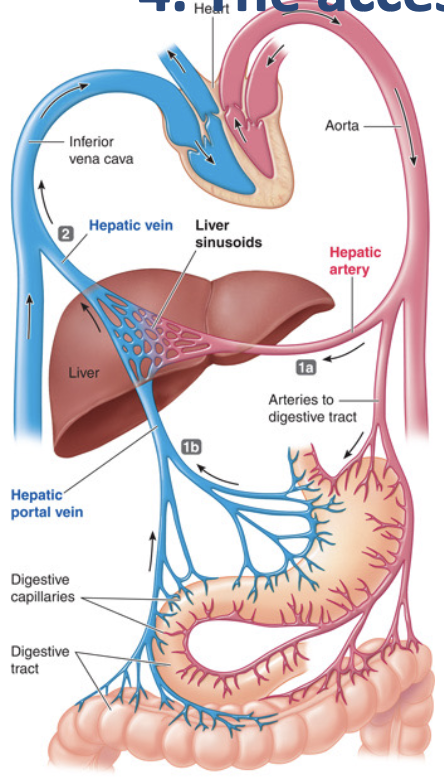
The liver receives its blood from what two sources?

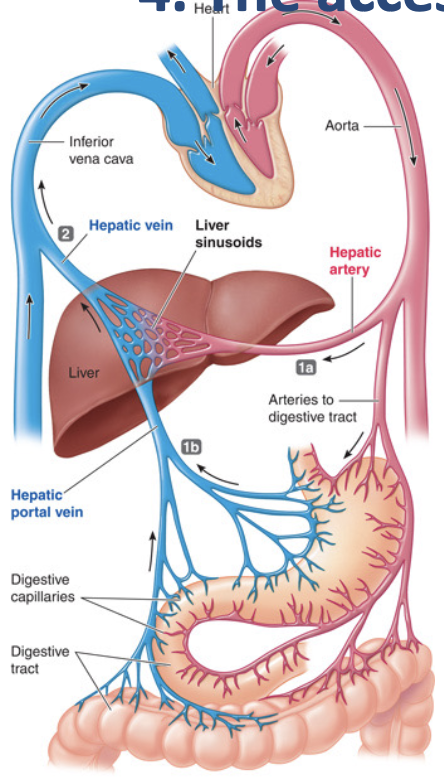
the hepatic artery which provides oxygenated blood and the hepatic portal vein that ensures venous blood from digestive tract is first carried to the liver

  • blood leaves liver through hepatic vein
<p>the hepatic artery which provides oxygenated blood and the hepatic portal vein that ensures venous blood from digestive tract is first carried to the liver</p><ul><li><p>blood leaves liver through hepatic vein</p></li></ul><p></p>
82
New cards

Liver functions:

allows for detoxification of absorbed foreign compounds by the liver first, before they access the general circulation

  • ensures that all absorbed monosaccharides and amino acids are routed to the liver first for processing
<p><span style="color: rgb(255, 255, 255);"><span>allows for detoxification of absorbed foreign compounds by the liver first, before they access the general circulation</span></span></p><ul><li><p><span style="color: rgb(255, 255, 255);"><span>ensures that all absorbed monosaccharides and amino acids are routed to the liver first for processing</span></span></p></li></ul><p></p>
83
New cards

The major contribution of the liver to the digestive system is what?

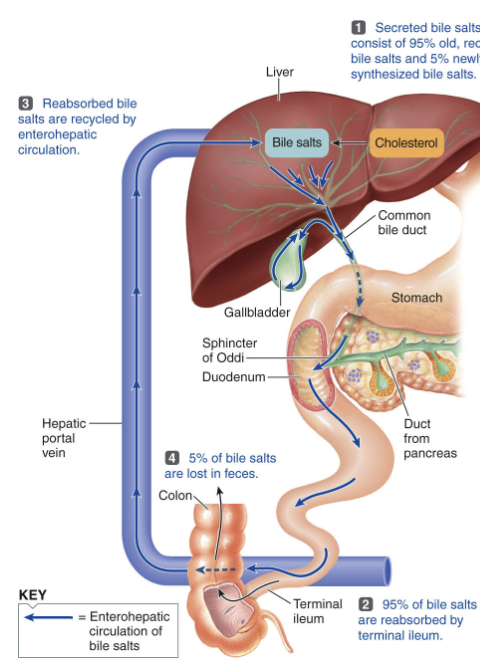
the secretion of bile that is stored in the gall bladder due to CCK

  • during, between, and after meals

<p>the secretion of bile that is stored in the gall bladder due to CCK</p><ul><li><p>during, between, and after meals</p></li></ul><p></p>
84
New cards

During meals, what happens to bile?

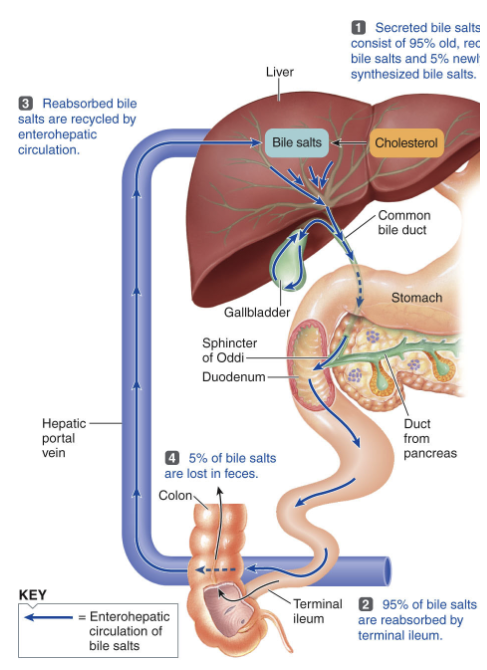
it is secreted from the liver (and/or released from gall bladder) and enters the duodenum

  • help digest fats by breaking large globules into smaller droplets
<p>it is secreted from the liver (and/or released from gall bladder) and enters the duodenum</p><ul><li><p><span><span>help digest fats by breaking large globules into smaller droplets</span></span></p></li></ul><p></p>
85
New cards

Between meals, what happens to bile?

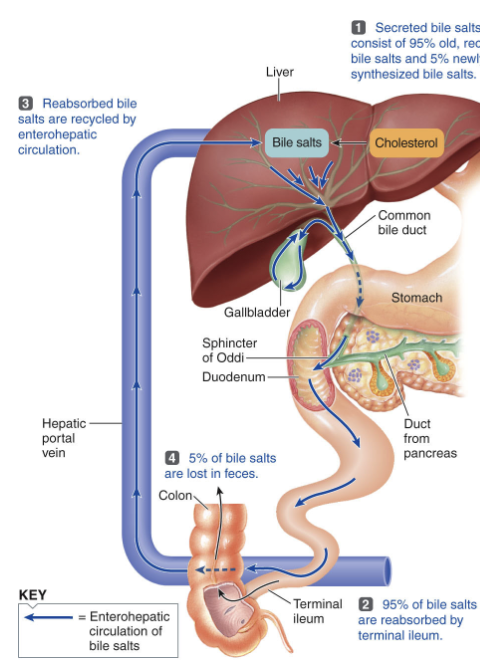
the sphincter of Oddi closes and bile flows to the gallbladder for storage and concentration, becoming 5-10 times stronger as water is removed

  • ready to help digest fats when you eat again
<p><span style="color: rgb(255, 255, 255);"><span>the sphincter of Oddi closes and bile </span></span><mark data-color="unset" style="background-color: unset; color: inherit;">flows to the gallbladder for storage and concentration</mark><span>, becoming 5-10 times stronger as water is removed</span></p><ul><li><p><span>ready to help digest fats when you eat again</span></p></li></ul><p></p>
86
New cards

After meals, what happens to bile?

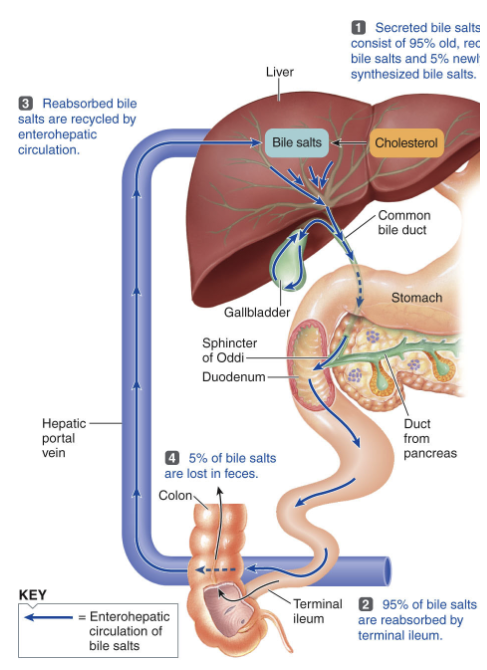
used bile salts get reabsorbed and recycled back to the liver with some ending up in the large intestine and being excreted

  • ~95% of bile salts are reabsorbed in the distal small intestine and carried to the liver
<p><span><span>used bile salts get reabsorbed and recycled back to the liver with some ending up in the large intestine and being excreted</span></span></p><ul><li><p><span style="color: rgb(255, 255, 255);"><span>~95% of bile salts are reabsorbed in the distal small intestine and carried to the liver</span></span></p></li></ul><p></p>
87
New cards

Bile consists of what?

  • Bile acids/salts

  • Cholesterol

  • Phospholipid (Lecithin)

  • Bilirubin (RBC breakdown product)

  • Aqueous mixture or bicarbonate, ions, water
<ul><li><p><span style="color: rgb(255, 255, 255);"><span>Bile acids/salts</span></span></p></li></ul><ul><li><p><span style="color: rgb(255, 255, 255);"><span>Cholesterol</span></span></p></li><li><p><span style="color: rgb(255, 255, 255);"><span>Phospholipid (Lecithin)</span></span></p></li><li><p><span style="color: rgb(255, 255, 255);"><span>Bilirubin (RBC breakdown product)</span></span></p></li><li><p><span style="color: rgb(255, 255, 255);"><span>Aqueous mixture or bicarbonate, ions, water</span></span></p></li></ul><p></p>
88
New cards

Bile plays a role in what?

aids in fat digestion by emulsification → increases surface area for lipase

  • helps neutralize stomach acid

  • cholesterol balance

*CCK causes bile to be secreted!
<p><span style="color: rgb(255, 255, 255);"><span>aids in fat digestion by emulsification → increases surface area for lipase</span></span></p><ul><li><p><span style="color: rgb(255, 255, 255);"><span>helps neutralize stomach acid</span></span></p></li><li><p><span style="color: rgb(255, 255, 255);"><span>cholesterol balance</span></span></p></li></ul><p>*CCK causes bile to be secreted!</p>
89
New cards

Which of these is NOT a role for cholecystokinin (CCK)?

A) CCK promotes the release of pancreatic digestive enzymes from acinar cells

B) CCK slows down gastric emptying and gastric motility

C) CCK stimulates the release of bile by promoting smooth muscle contractions of the gall bladder and relaxing the sphincter of Oddi

D) CCK promotes the release of gastrin from G cells in the mucosae of the pyloric gland area

D) CCK promotes the release of gastrin from G cells in the mucosae of the pyloric gland area

90
New cards

Small intestine:

primary site of digestion and absorption

  • duodenum → 5%

  • jejunum → 35-40%

  • ileum → 55-60%

<p>primary site of digestion and absorption</p><ul><li><p>duodenum → 5%</p></li><li><p>jejunum → 35-40%</p></li><li><p>ileum → 55-60%</p></li></ul><p></p>
91
New cards

Motility in the small intestine occurs via what?

occurs via segmentation which both mixes and propels chyme

  • propulsion occurs because the frequency of local contractions gradually decreases along length of small intestine

  • mixing food with digestive juices

  • facilitate absorption

  • forward movement

<p>occurs via segmentation which both mixes and propels chyme</p><ul><li><p><span style="color: rgb(255, 255, 255);"><span>propulsion occurs because the frequency of local contractions gradually decreases along length of small intestine</span></span></p></li><li><p><span style="color: rgb(255, 255, 255);"><span>mixing food with digestive juices</span></span></p></li><li><p><span style="color: rgb(255, 255, 255);"><span>facilitate absorption</span></span></p></li><li><p><span style="color: rgb(255, 255, 255);"><span>forward movement</span></span></p></li></ul><p></p>
92
New cards

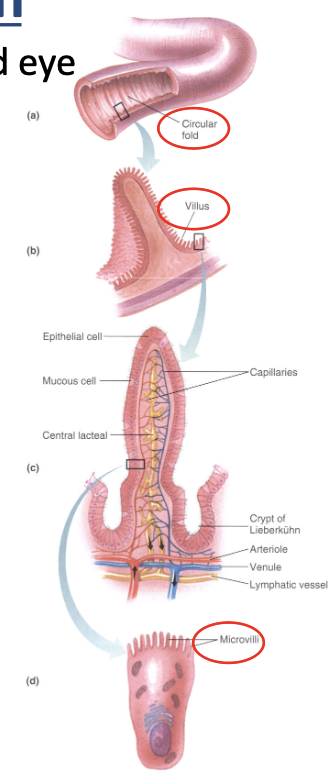
How does the small intestine facilitate absorption?

facilitates absorption by having a large surface area to allow nutrients to be absorbed by diffusion over the mucosal lining

  • contributes to increase of surface area

    • circular folds → visible

    • villi → inside circular folds

    • microvilli → inside villi

<p>facilitates absorption by having a large surface area to allow nutrients to be absorbed by diffusion over the mucosal lining</p><ul><li><p>contributes to increase of surface area</p><ul><li><p>circular folds → visible</p></li><li><p>villi → inside circular folds</p></li><li><p>microvilli → inside villi</p></li></ul></li></ul><p></p>
93
New cards

Small intestine digestion:

carbohydrate and protein digestion accomplished by pancreatic enzymes, with fat digestion enhanced by bile secretions all occurring in the intestinal lumen

  • small intestine produces digestive enzymes but act on surface if cells lining brush border
94
New cards
<p>Brush border:</p>

Brush border:

vastly increases surface area for absorption and secretion packed with digestive enzymes for final nutrient breakdown and plays a crucial role in nutrient transport and forming a protective barrier

  • enteropeptidase

  • disaccharidases →which complete the digestion of carbohydrates

    • maltase, sucrase, and lactase

  • aminopeptidases →which complete the digestion of proteins
<p><mark data-color="unset" style="background-color: unset; color: inherit;"><span>vastly increases surface area for absorption and secretion</span></mark><span> packed with digestive enzymes for final nutrient breakdown and plays a crucial role in nutrient transport and forming a protective barrier</span></p><ul><li><p><span style="color: rgb(255, 255, 255);"><span>enteropeptidase</span></span></p></li><li><p><span style="color: rgb(255, 255, 255);"><span>disaccharidases →which complete the digestion of carbohydrates</span></span></p><ul><li><p><span>maltase, sucrase, and lactase</span></p></li></ul></li><li><p><span style="color: rgb(255, 255, 255);"><span>aminopeptidases →which complete the digestion of proteins</span></span></p></li></ul><p></p>
95
New cards

Carbohydrate digestion:

  1. polysaccharides starch and glycogen are converted to the disaccharide maltose by amylase in the mouth and digestive tract lumen

  2. maltose, lactose, and sucrose are converted to monosaccharides (glucose, galactose, and fructose) on the brush border of intestinal epithelial cells by the enzymes lactase, maltase, and sucrase

  3. glucose and galactose are absorbed into the epithelial cells by active transport

  4. fructose enters the epithelial cells by passive facilitated diffusion

  5. glucose, galactose and fructose exit the cell into the blood by passive facilitated diffusion
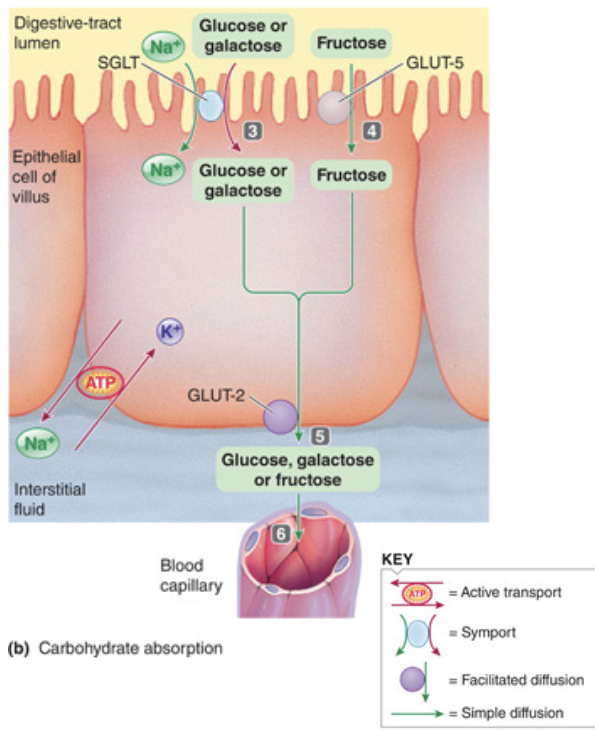
<ol><li><p><span style="color: rgb(255, 255, 255);"><span>polysaccharides starch and glycogen are converted to the disaccharide maltose by amylase in the mouth and digestive tract lumen</span></span></p></li><li><p><span style="color: rgb(255, 255, 255);"><span>maltose, lactose, and sucrose are converted to monosaccharides (glucose, galactose, and fructose) on the brush border of intestinal epithelial cells by the enzymes lactase, maltase, and sucrase</span></span></p></li><li><p><span style="color: rgb(255, 255, 255);"><span>glucose and galactose are absorbed into the epithelial cells by active transport</span></span></p></li><li><p><span style="color: rgb(255, 255, 255);"><span>fructose enters the epithelial cells by passive facilitated diffusion </span></span></p></li><li><p><span style="color: rgb(255, 255, 255);"><span>glucose, galactose and fructose exit the cell into the blood by passive facilitated diffusion</span></span></p></li></ol><p></p>
96
New cards

Protein digestion:

  1. proteins hydrolyzed into small peptide fragments and individual amino acids by pepsin and pancreatic proteolytic enzymes

  2. small peptides are broken down into amino acids on the brush
    border by peptidases and aminopeptidases

  3. amino acids absorbed into cell via Na+ and energy-dependent active transport and enter blood down their concentration gradients (6/7)
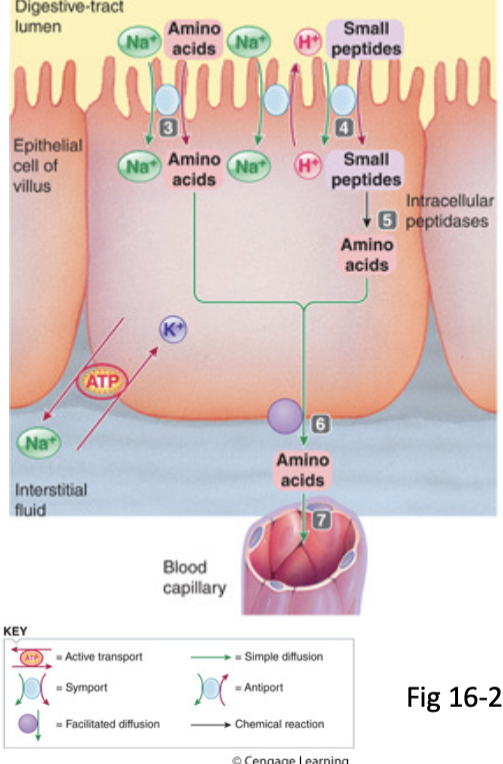
<ol><li><p><span style="color: rgb(255, 255, 255);"><span>proteins hydrolyzed into small peptide fragments and individual amino acids by pepsin and pancreatic proteolytic enzymes</span></span></p></li><li><p><span style="color: rgb(255, 255, 255);"><span>small peptides are broken down into amino acids on the brush</span></span><span style="color: rgb(255, 255, 255);"><br></span><span style="color: rgb(255, 255, 255);"><span>border by peptidases and aminopeptidases</span></span></p></li><li><p><span style="color: rgb(255, 255, 255);"><span>amino acids absorbed into cell via Na</span><sup><span>+</span></sup><span> and energy-dependent active transport and enter blood down their concentration gradients (6/7)</span></span></p></li></ol><p></p>
97
New cards

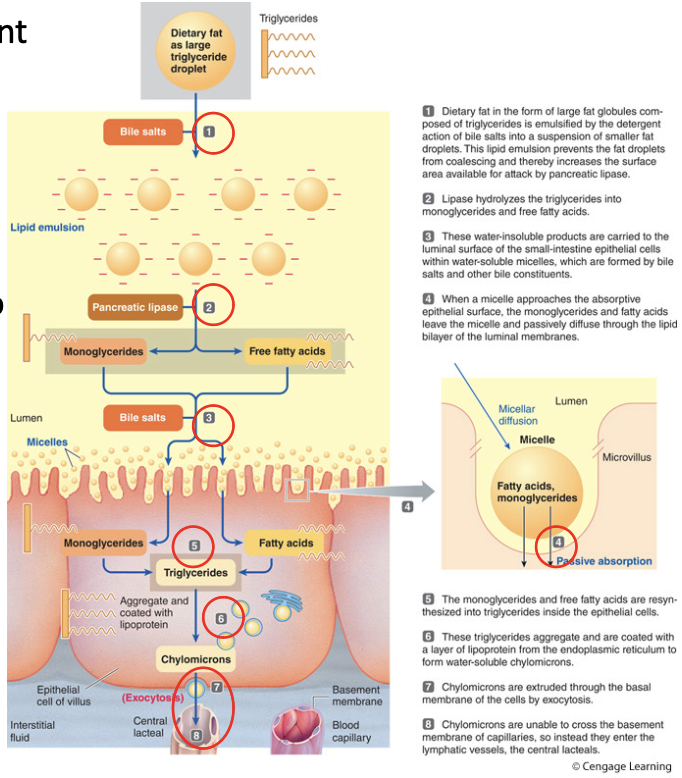
Fat digestion:

  1. fat is emulsified by the detergent action of bile salts

  2. lipases hydrolyze triglycerides into monoglycerides and free fatty acids

  3. water insoluble products move within the interior of micelles to the epithelial cell surface

  4. monoglycerides and free fatty acids diffuse into cell

  5. monoglycerides and free fatty acids resynthesize into triglycerides

  6. triglycerides coated with lipo- protein and form chylomicrons that are exocytosed from cell

  7. chylomicrons enter lymphatic vessels

<ol><li><p><span style="color: rgb(255, 255, 255);"><span>fat is emulsified by the detergent action of bile salts</span></span></p></li><li><p><span style="color: rgb(255, 255, 255);"><span>lipases hydrolyze triglycerides into monoglycerides and free fatty acids</span></span></p></li><li><p><span style="color: rgb(255, 255, 255);"><span>water insoluble products move within the interior of micelles to the epithelial cell surface</span></span></p></li><li><p><span style="color: rgb(255, 255, 255);"><span>monoglycerides and free fatty acids diffuse into cell</span></span></p></li><li><p><span style="color: rgb(255, 255, 255);"><span>monoglycerides and free fatty acids resynthesize into triglycerides</span></span></p></li><li><p><span style="color: rgb(255, 255, 255);"><span>triglycerides coated with lipo- protein and form chylomicrons that are exocytosed from cell</span></span></p></li><li><p><span style="color: rgb(255, 255, 255);"><span>chylomicrons enter lymphatic vessels</span></span></p></li></ol><p></p>
98
New cards

Small and Large intestine:

separated by the ileocecal valve and sphincter which is a one-way flow 

  • contents from the ileum into cecum (first part of the large intestine)

  • necessary to keep colonic bacteria from entering the ileum
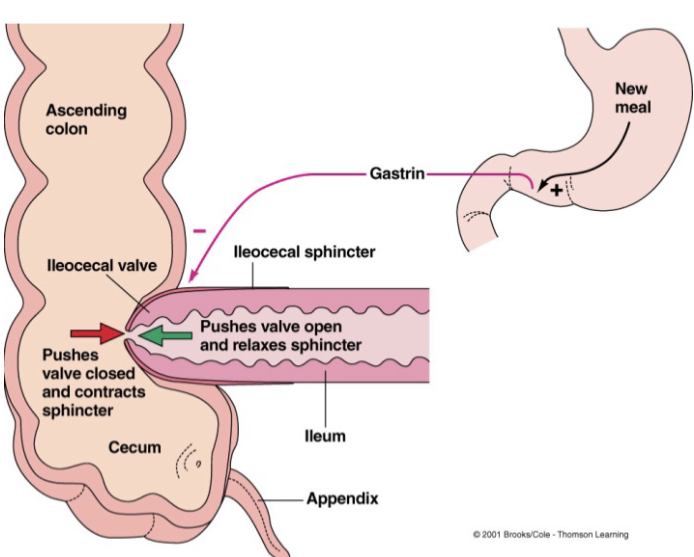
<p>separated by the ileocecal valve and sphincter which is a one-way flow&nbsp;</p><ul><li><p>contents from the ileum into cecum (first part of the large intestine)</p></li><li><p>necessary to keep colonic bacteria from entering the ileum</p></li></ul><p></p>
99
New cards

Large intestine:

primarily for drying and storage, includes

  • Cecum → blind-ended pouch below ileocecal valve

  • Appendix → finger-like projection of lymphoid tissue

  • Colon → ascending, transverse, descending, & sigmoid

  • Rectum → “straight”, connected to anal canal
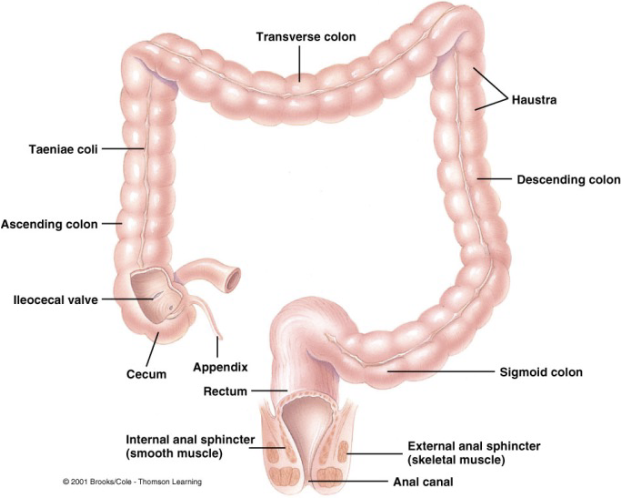
<p><span style="color: rgb(255, 255, 255);"><span>primarily for drying and storage, includes</span></span></p><ul><li><p><span style="color: rgb(255, 255, 255);"><span>Cecum → blind-ended pouch below ileocecal valve</span></span></p></li><li><p><span style="color: rgb(255, 255, 255);"><span>Appendix → finger-like projection of lymphoid tissue</span></span></p></li><li><p><span style="color: rgb(255, 255, 255);"><span>Colon → ascending, transverse, descending, &amp; sigmoid</span></span></p></li><li><p><span style="color: rgb(255, 255, 255);"><span>Rectum → “straight”, connected to anal canal</span></span></p></li></ul><p></p>
100
New cards

Large intestine motility is influenced through what?

through Haustral contractions, mass movement, and defecation reflex