ch8 capacitance L11
 Studied by 0 people
 Call Kai
 Learn
Learn Practice Test
 Spaced Repetition
 Match
Match Flashcards
 Knowt Play
1/16

There's no tags or description
Looks like no tags are added yet.
Name | Mastery | Learn | Test | Matching | Spaced | Call with Kai |
|---|
No analytics yet
Send a link to your students to track their progress
17 Terms
surface of a conductor must be equipotential because
positive and negative charges move to cancel out any differences in potential until they are equal
E-field visualized with field lines, so electric potential visualized with
equipotential surface
equipotential surface formed by
the locus of points all of which have the same potential i.e. moving test charge from A to infinity or B to infinity involves the same amount of work
equipotential lines are drawn by
making them perpendicular to E-field lines
if we know V, we can get equipotential surface by
equating V to k q/r, flipping around and solving for r
moving charge from any point on an equipotential surface to another point on same surface involves
zero work
surface of conductors must be equipotential because
any voltage difference would disappear, with + charges moving to lower voltage and - charges moving to higher voltage
if two conducting spheres connected by wire, they are at
equipotential
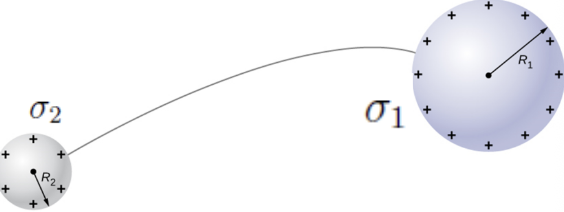
since the two spheres are at equipotential,
σ1R1 = σ2R2
if radius is smaller, the surface charge density is
greater

as more charge is added to conductor, it is
more difficult to keep adding
capacitance
proportional coefficient that relates Q and C
capacitance equation
Q = CV
value of C depends on
shape, size, and medium around the conductor; intrinsic property
unit of C
coulomb/volt = farads (F)
capacitor
device for storing charge, consisting of two conductors separated by some small distance
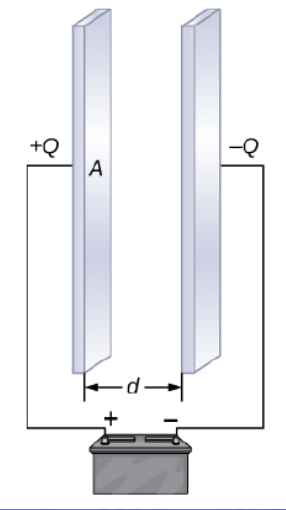
parallel plate capacitance
C = ε0A/d
 Note
Note  Flashcards (39)