Behavioural Neuroscience PSY 3109 Music and the Brain
 Studied by 0 people
 Call Kai
 Learn
Learn Practice Test
 Spaced Repetition
 Match
Match Flashcards
 Knowt Play
1/92

There's no tags or description
Looks like no tags are added yet.
Name | Mastery | Learn | Test | Matching | Spaced | Call with Kai |
|---|
No analytics yet
Send a link to your students to track their progress
93 Terms
Review anatomy of ear
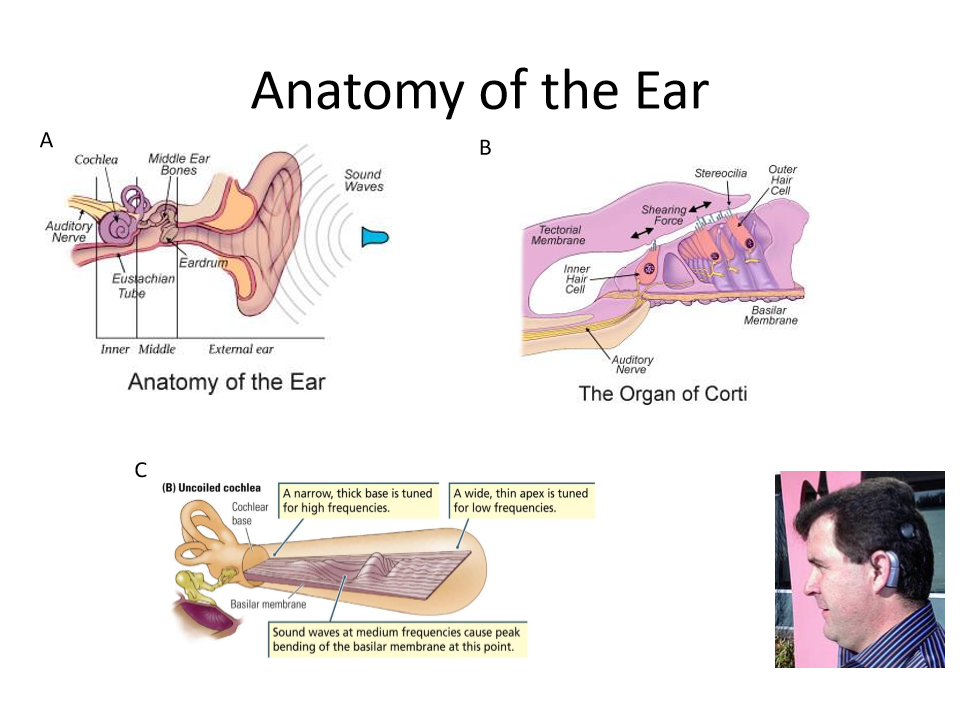
What is the main theme of the lecture “Music and the Brain”?
The lecture explores how music is processed in the brain, how it engages multiple neural systems, and why music is deeply connected to perception, emotion, memory, and identity.
Why is music considered a brain-wide activity rather than localized to one area?
Because listening to and creating music activates auditory, motor, emotional, memory, visual, and reward systems simultaneously.
What question does the lecture implicitly raise about music perception?
Whether music exists only as sound waves or whether it truly “exists” once the brain interprets and experiences it.
What philosophical question does this slide introduce about if a tree falls in the forest?
Whether sound exists independently in the environment or only when it is perceived by a brain.
How does this question relate to hearing and music?
It highlights that sound becomes meaningful only when the auditory system and brain process it.
What is the role of the brain in hearing according to this idea?
The brain actively constructs the experience of sound rather than passively receiving it.
What are the three main parts of the ear?
The outer ear, middle ear, and inner ear.
What is the function of the outer ear?
To collect sound waves and funnel them toward the eardrum.
What is the role of the middle ear bones?
They amplify sound vibrations from the eardrum.
What structure in the inner ear is critical for hearing?
The cochlea.
What is the organ of Corti responsible for?
Transducing mechanical sound vibrations into neural signals via hair cells.
What is a cochlear implant?
A medical device that bypasses damaged parts of the ear and directly stimulates the auditory nerve.
Who benefits from cochlear implants?
Individuals with severe to profound hearing loss.
How do cochlear implants differ from hearing aids?
Hearing aids amplify sound, while cochlear implants convert sound into electrical signals sent directly to the auditory nerve.
What does the electrode array do in a cochlear implant?
It stimulates different regions of the cochlea corresponding to different sound frequencies.
Where does auditory processing begin in the brain?
In the cochlear nuclei of the hindbrain.
What is the superior olivary complex responsible for?
Processing sound localization and differences between ears.
What is the role of the inferior colliculus?
Integrating auditory information in the midbrain.
What is the medial geniculate nucleus (MGN)?
The auditory relay nucleus in the thalamus.
Where is the primary auditory cortex located?
In Heschl’s gyrus in the temporal lobe.
What is the general flow of the auditory pathway?
Cochlea → brainstem nuclei → midbrain → thalamus → auditory cortex.
Is auditory information processed bilaterally?
Yes, information from each ear is sent to both hemispheres of the brain.
Why is bilateral processing important?
It allows precise sound localization and redundancy in hearing.
What does “tonotopic organization” mean?
Different sound frequencies are represented in specific spatial locations in the cochlea and auditory cortex.
How is tonotopy preserved in the brain?
The frequency mapping from the cochlea is maintained all the way to the primary auditory cortex.
What frequencies are processed at the base vs. apex of the cochlea?
High frequencies at the base, low frequencies at the apex.
Is music processed in a single brain region?
No, different components of music are processed in different brain regions.
Which brain region is central to pitch processing?
Heschl’s gyrus and surrounding auditory areas.
Heschl’s gyrus and surrounding auditory areas.
What brain system is involved in emotional responses to music?
The limbic circuit.
What musical elements are processed separately in the brain?
Pitch, rhythm, tempo, timbre, harmony, loudness, meter, and key.
What did fMRI studies of Sting reveal about imagining music?
Imagining music activates many of the same brain areas as listening to music.
What happened when Sting listened to “musak”?
There was less brain activity because the music was predictable and bland.
What happens in the brain when composing music?
Many regions are activated, including areas involved in creativity, motor planning, and emotion.
Does imagining music activate the auditory cortex?
Yes, though typically less strongly than actual listening.
Are melody and rhythm processed in the same brain areas?
No, they engage overlapping but distinct neural networks.
Which brain region processes the basic features of sound?
The auditory cortex, which extracts pitch, loudness, and timbre.
What role does the motor cortex play in music?
It is involved in movement, tapping, dancing, and playing instruments—even during passive listening.
Why is the cerebellum active during music listening?
It helps with timing, rhythm, coordination, and emotional responses.
How is the hippocampus involved in music?
It supports memory for music and links music to past experiences.
What does the amygdala contribute to musical experience?
Emotional reactions to music, including pleasure and intensity.
Is music culturally universal?
Yes, music is found in all societies and across all historical eras.
What evidence suggests music predates written history?
Ancient instruments made from animal bones dating back tens of thousands of years.
Why is early musical evidence important?
t suggests music played a role in early human survival and social organization.
What is Darwin’s sexual selection hypothesis for music?
Music evolved as a way to attract mates by signaling fitness and creativity.
How does music promote social bonding?
Through shared emotional experiences and oxytocin release.
How might music protect from predators?
By coordinating group behavior and increasing vigilance.
Why is music important for oral tradition?
It helps preserve and transmit information across generations before literacy.
How does Daniel Levitin define the role of music in humans?
As a core element of human identity, not merely entertainment.
According to Levitin, what behaviors did music help enable?
Language, cooperation, and transmission of knowledge.
What are the six types of songs Levitin proposes?
Songs of friendship, joy, comfort, knowledge, religion, and love.
Were music and language once thought to use the same brain areas?
Yes, early theories suggested overlap.
What did later research show about hemispheric specialization?
Language is primarily left-lateralized, while music is more right-lateralized—but with overlap.
What is aphasia?
A disorder involving impaired language production or comprehension.
What is amusia?
A loss of musical ability, such as difficulty detecting pitch or melody.
What is the difference between apperceptive and associative musical agnosia?
Apperceptive: cannot discriminate melodies but can recognize familiar ones.
Associative: can discriminate melodies but cannot recognize familiar ones.
Can babies remember music heard in utero?
Evidence suggests they may remember it later in life.
What did Laurel Trainor’s EEG studies show?
Babies’ brains detect missing notes and remember melodies by 8 months.
When is the auditory cortex developed?
By approximately 20 weeks of gestation.
Does music increase intelligence in children?
Playing instruments is associated with increased IQ and broader brain activation.
How does music act as an emotional “tag”?
It links memories to strong emotional and neurochemical responses.
What did Osuch et al. find in depressed patients?
Reduced activation in reward areas during music listening.
Why is music effective for knowledge encoding?
It preserves and transmits information, especially before literacy (e.g., ABCs).
Why is musical memory unusually accurate?
People can recognize songs from very short clips and reproduce tempo and key precisely.
Which brain regions are most involved in emotional responses to music?
Amygdala, insula, orbitofrontal cortex, and auditory cortex.
Can the brain distinguish pleasant from unpleasant music?
Yes, different emotional valences activate distinct neural patterns.
What was Oliver Sacks’ musical preference?
He loved Bach and felt lukewarm about Beethoven.
What did fMRI studies reveal about Bach vs. Beethoven?
Bach elicited stronger emotional responses and amygdala activation.
Could the brain distinguish composers even when Sacks couldn’t?
Yes, neural patterns differentiated Bach from Beethoven.
Why do Alzheimer’s patients often remember music?
Music is strongly linked to emotional memory formed during identity development.
Why is adolescence a critical period for musical memory?
Hormonal changes, pruning, and identity formation enhance emotional salience.
Who conducted key research on music and autobiographical memory?
Petr Janata at UC Davis.
Why was music from teenage years used in studies?
Because it is most strongly linked to identity and memory.
How might music help maintain a sense of self?
By linking memories, emotion, and identity as we age.
What does green brain activation indicate?
Response to familiar versus unfamiliar music.
What does red activation indicate?
Strong autobiographical memory evocation.
What role does the DMPFC play?
It integrates familiarity and autobiographical significance.
How can music aid brain recovery after injury?
It activates alternative neural pathways and supports plasticity.
What conditions are highlighted?
Parkinson’s disease and stroke affecting auditory and speech areas.
What surprising ability do Alzheimer’s patients retain?
Detecting missed notes in music.
Why is the prefrontal cortex important here?
It deteriorates last and supports autobiographical memory retrieval.
How does music affect Parkinson’s patients?
It enables movement, dancing, and coordination even without medication.
What historical condition supports this observation?
Encephalitis lethargica patients responding to music (Oliver Sacks).
What does the ballerina example demonstrate?
Music can unlock motor memory even in advanced Alzheimer’s disease.
Why does Matt stop ticcing while drumming?
Music may establish neural synchrony that suppresses tics.
What defines a musical savant?
Exceptional musical ability despite cognitive or sensory limitations.
What happened to Tony after being struck by lightning?
He developed an obsessive drive to compose and perform music.
How does Jerry Garcia describe music’s role?
As a source of magic, meaning, and transcendence.
Why is music paradoxical according to Janata?
It’s not necessary for survival, yet humans deeply crave it.
What characterizes Williams syndrome?
Genetic disorder with cognitive deficits but strong musical and social abilities.
Which brain regions are larger or more active in williams syndrome?
Cerebellum and amygdala.
What does this tell us about music?
Musical ability can be preserved or enhanced despite other impairments.
 Note
Note  Flashcards (54)