Environmental Energy Quiz
 Call Kai
 Learn
Learn Practice Test
 Spaced Repetition
 Match
Match Flashcards
 Knowt Play
1/31

There's no tags or description
Looks like no tags are added yet.
Name | Mastery | Learn | Test | Matching | Spaced | Call with Kai |
|---|
No analytics yet
Send a link to your students to track their progress
32 Terms
Electricity Grid
system that distributes power facilitated at various locations to end users over far distances. four components are: individual generators, transmission, distribution, and consumer use
Issues the need to be addressed with the Grid
Hardware and software needs to be modernized to withstand weather conditions
High voltage transmission lines need to be added as well as long duration batteries to ensure stability and reliability
modernized to be able to handle energy demand, increase reliability, make it more stable, and integrate clean energy like solar and wind
current grid was designed for fossil fuel plants, not for renewable energy, which limits society’s efforts to reach clean energy targets.
Net Energy Yield
the amount of energy obtained from a resource minus the amount of energy needed to produce it.
Renewable
replenished by natural processes either directly or indirectly from the sun
Non-renewable
exist in a fixe quantity in the earth and can not be replenished in our lifetime
Inexhaustible Resource
natural resources that are available in unlimited quantities and cannot be completely used up by human activities. EX- solar and wind energy
How are fossil fuels created
HEAT + PRESSURE
coal: dead plants buried under water and dirt became coal due to heat and pressure
oil & natural gas: dead plants and animals buried under silt and sand in the ocean. over millions of years, heat and pressure turned them to oil and gas
Pros and Cons (Oil)
Pros: ample supply for several decades, net energy is decreasing, low land disruption, efficient distribution system
Cons: water pollution, oil spills, environmental costs not included in market cost, releases coo2 when burned,
Pros and Cons (Coal)
Pros: medium-high net energy yield, low cost, plentiful
Cons: pollution, toxic emissions threaten human health, emits large amounts of co2 when burned
Pros and Cons (Natural Gas)
Pros: versatile, medium net energy yield, emits less co2 when burned
Cons: fracking uses and pollutes lots of water, potential ground water pollution
Oil - Location, extraction, use
found under earths surface within the cracks and pores of rock
crude oil and nat gas often found tg under the sea floor
wells are drilled which draw out the oil using gravity, pumping it to the earths surface
The high pressure underground keeps the oil flowing
crude oil or petroleum is collected then refined
Refining is the process by which oil is heated in order to separate it into different fuels and products based on their boiling points.
Nat gas - Location, extraction, use
mixture of gases (50%–90% methane)
Hydraulic fracturing used to extract natural gas from deep underground rock formations
injecting high-pressure fluid into the rock to create fractures and release the gas
Coal - Location, extraction, use
coal is a solid fossil fuel that is the dirtiest FF for air and water pollution
extracted through mining
used for generating electricity and producing steel
How do fossil fuel power plants work to generate electricity
Fossil fuel power plants generate electricity by burning fossil fuels like coal, oil, or natural gas to produce heat
Heat creates steam that drives turbines connected to generators
Converts mechanical energy into electrical energy
Clean Coal
a set of technologies designed to reduce harmful pollutant emissions from coal-burning power plants.
primarily involves carbon capture and storage where CO2 is trapped after combustion and stored underground
Clean coal is a myth
Coal Ash
Some coal burning plants use scrubbers to try and remove pollutants. produces coal ash
Some ash is buried, some gets into the water systems, and some is sold for construction
pollution control devices installed in coal-fired power plants to remove sulfur dioxide (SO2) and other harmful pollutants from exhaust gases before they leave the smokestack
Types of Coal
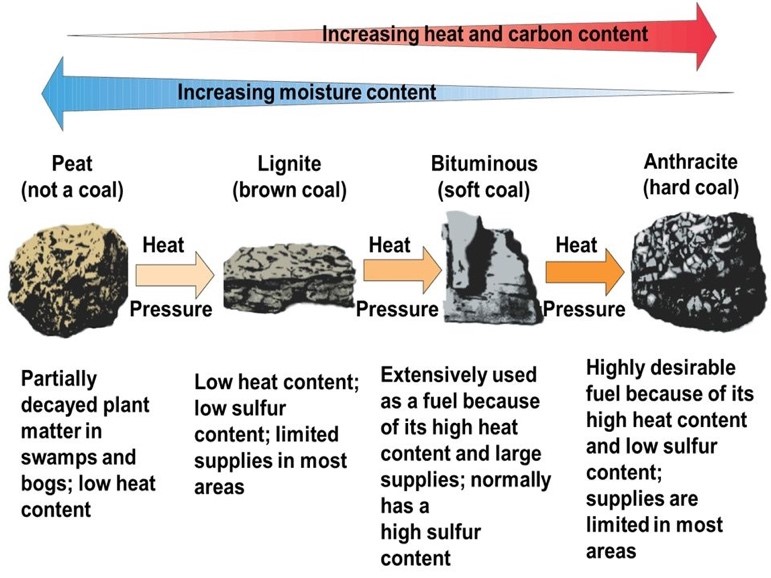
Hydraulic Fracturing
method used to extract natural gas from deep underground rock formations by injecting high-pressure fluid into the rock to create fractures and release the gas
Liquified Natural Gas (LNG)
can be liquefied into liquified petroleum gas (LPG) or Liquified Natural Gas (LNG)
LPG and LNG are easier to transport than natural gas in its regular form
primarily used for generating electricity, heating, and as a fuel for vehicles
Crude Oil and Oil Refinement
crude oil (petroleum) is the raw oil formed beneath the earths surface that we gather, refine, and combust
Refining = process by which oil is heated in order to separate it into different fuels and products based on their boiling points
It takes energy which effects the net energy yield of the fuels
Can create additional pollution by creating petcock (left over black power that accumulates) which blows in the wind
Are we running out of oil?
amount of oil stored underground is unknown but it is NOT believed the world will run out of oil shortly
Many oil stores that havnt’t been used
Proven Oil reserves
the deposit from which oil can currently be extracted
Petrochemicals
After refinement, byproducts called petrochemicals can then be used to create other products such as pesticides, plastics, paints, and cosmetics!
Shale Oil
oil found within layers of rock. Shale oil has a low net energy yield due to the energy needed to extract it. It is not considered an economically practical option
Tar Sands
oil mixed with clay, sand, water and bitumen – also has a low net energy yield
Bitumen is a tick, sticky heavy oil with a higher sulfur content
Nuclear Energy- what is it
The goal of a nuclear power plant is to boil water to produce steam that will spin a turbine and create energy.
It is a simple goal, but the process is complex and expensive
Nuclear power uses nuclear fission reactions to provide the heat need for the process.
How does it work, the nuclear fuel cycle
Fuel for a reactor is made from uranium – a ore that is mined from the earths crust
The usable uranium is known as uranium-235
After being minded, the ore must be enriched to make it more concentrated
After being enriched, the uranium is processed into pellets of uranium dioxide
One pellet (the size of a pencil eraser) contains the same amount of energy as 1 ton of coal
Fuel Rods & Fuel Assembly
pellets are packed into sealed pipes called fuel rods and grouped together to create fuel assemblies which will go into the core of the reactor
Once the fuel assemblies have been placed in the reactor, operators use control rods to control the amount of power produced
A coolant (water) is present in the reactor which helps to slow the reaction rate and cool the fuel cells, to prevent melting
A containment shell made of thick metal and concrete surrounds the reactor to keep radioactive material from escaping
Nuclear Waste
The used uranium rods are highly radioactive and the waste must be handled very carefully to avoid radioactivity from entering the environment
Rods can remain radioactive for thousands of years
They are usually stored in underwater pools on the same site as the reactor
From there, they are often moved to dry storage called dry casks
Basics of Nuclear Fission
process where the nucleus of an atom splits into two or more smaller nuclei, releasing a large amount of energy, neutrons, and radiation
Future of Nuclear
There is much disagreement about the future of nuclear
Facilities are aging
Waste storage is problematic
Building new facilities is costly
Nuclear meltdowns are infrequent, but can be very damaging and have become a widespread societal fear
Fear of the spread of nuclear weapons
An increase in research could lead to newer, safer technology
Does produce low greenhouse emissions - low environmental impact
Mining of uranium ores have an impact
Nuclear Fusion
two light nuclei merge to form a single heavier nucleus. The process releases energy because the total mass of the resulting single nucleus is less than the mass of the two original nuclei. The leftover mass becomes energy
produces more energy than fission and only leaves a small amount of short lived radioactive waste
fusion reactions can be halted much more quickly and easily than fission, the risk of meltdown is almost zero- making fusion much safer than fission

