4.1 international economics
 Studied by 3 people
 Call Kai
 Learn
Learn Practice Test
 Spaced Repetition
 Match
Match Flashcards
 Knowt Play
1/96

There's no tags or description
Looks like no tags are added yet.
Name | Mastery | Learn | Test | Matching | Spaced | Call with Kai |
|---|
No analytics yet
Send a link to your students to track their progress
97 Terms
globalisation
the process where countries become increasingly interdependant on each other for trade
characteristics of globalisation
greater percentage of foreign trade
higher levels of migration
increasing capital flow between countries
emergance of global brands
greater use of outsourcing and offshoring
e.g. dyson moved manufacturing from wiltshire to malaysia
factors contributing to globalisation
improvements in transport
e.g. containerisation - technical economy of scale reduces unit cost of shipping
increased free trade - lower barriers becuase its mutually beneficial
closer political ties
abolition of capital (money) control - easier to move money + invest overseas
impact of globalisation on workers
more opportunities - easier to work overseas
manual/ low skilled jobs lost oversease (outsourcing)
impact of globalisation on consumers
cheaper price
wider choice + increase quality
impact of globalisation on producers
access to low cost resources overseas - labour, land
danger of export ineffecieny e.g. diseconomies
also need to maintain quality + ethics e,g, exploitation
impact of globalisation on environment
increase trade - increase pollution (extrenal costs)
shared knowledge e.g. green technology
increase efficiency may reduce waters
impact of globalisation on governments
increase econ activity - increase tax revenue
developing countries may attract investment
(MNC’s - increase hard currency)
developing countries may be exploited e.g. land, labour by MNC’s
impact of globalisation on individual countries
can specialise in their comparitive advantage
increase GDP - can increase living standards
danger of overspecialisation
why do countries specialise then trade
it can be mutually advantagous
e.g prices, choice, growth
how do countries gain
absolute advantage
comparative advantage
absolute advantage
the ability of one country being able to produce more of a good or service than another country with the same inputs, meaning its more efficient
comparitive advantage
occurs when one country can produce a good or service at a lower opportunity cost than another
how to calculate comparative advantage
work out the opportunity cost of producing one good over another in both parties/ countries
assumptions and limitations of comparative adavantage
factor immobility between countries i.e land, labour,capital
assumed perfect factor mobility within a country
no economies or diseconomies of scale i.e constant returns to scale
no transport costs
no artificial barriers e.g. tarriffs, health and safety checks etc
advantages of specialisation and trade
higher income and living standards
lower prices ( allocative efficiency, econ of scale)
increased choice
less dominance of national monopolies -benefit customers
disadvantages of specialisation and trade
overspecialisation - primary product dependency - over reliant on one commodity - volatile prices
infant industries struggle
risk of “dumping” - occurs when below cost products are dumped into the market - considered unfair, domestic firms suffer
global monopolies may emerge e.g. tech
increased local unemployment - some jobs outsourced or offshored
factors influencing the pattern of trade
comparitive advantage e.g recent growth of the exports in manufactured goods from developing countries to developed countries since they have an advantage in production - this has led to more industrialisation in china and india
emerging economies - growing countries will need to increase imports for products and increase exports to pay for this
trading blocs and bilateral agreements - increase the trade between countries
relative exchange rates
trading blocs
a group of contries that reduce or elimated trade barriers among themselves to increase integration and cooperationb
bilateral agreements
legally binding agreement which outline specific rights and obligation for the parties included
terms of trade
the rate of exchange of one product for another when 2 countries trade
improvement in terms of trade
when one country can buy more imports for the same amount of exports
deterioration in terms of trade
when one country has to buy less imports for the same amount of exports due to a ris in price of imports or fall in price of exports
how to calculate terms of trade
(average export price index/average import price index) x 100
why is terms of trade measured in the form of an index
because it is taken from a weighted average of thousandes of import and export prices
the change in price of oil has a bigger weightage than the change in price of a rolls royce
what happens if tot index rises
increase X price > increase M price
then coutnry will benefit from
improve current account
improve standard of living
reasons why terms of trade may improve
specialisation in higher value exports
world real income levels change in favour of this exchange rate appreciating
reasons why terms of trade may worsen
opposite of improvements
trading blocs
groups of countries that come together and form agreements to promote trade and economic cooperation among themselves, remove barriers to trade
examples of trading blocs
EU
ASEAN
african continental free trade agreement
types of trading blocs
free trade areas
custom unions
common markets
monetary unions
free trade areas
no barriers to trade in between members and members negotiate their own trade deals with non-members e.g. NAFTA
customs unions
free trade between members + a common external tariff on non-members
common markets
same characteristics as customs union but include free movement of factors of production between member countries
monetary unions
customs unions that adopt a common currency e.g. the eurozone in the EU
regional trade agreement
a treaty between 2 or more countries where they agree to reduce or elimate barriers between them i.e tariffs and quotas
bi-lateral trade agreement
a type of regional trade agrement where its only 2 countries
benefits of regional trade agreement
trade creation
increase in FDI
increase in economic power
trade creation
occurs when trade increases due to membership of a trading bloc
this happens because free trade and reduce tariffs means cosumers/firms cansource goods for cheaper
moving from a high cost source to a low cost source
trade creation graph
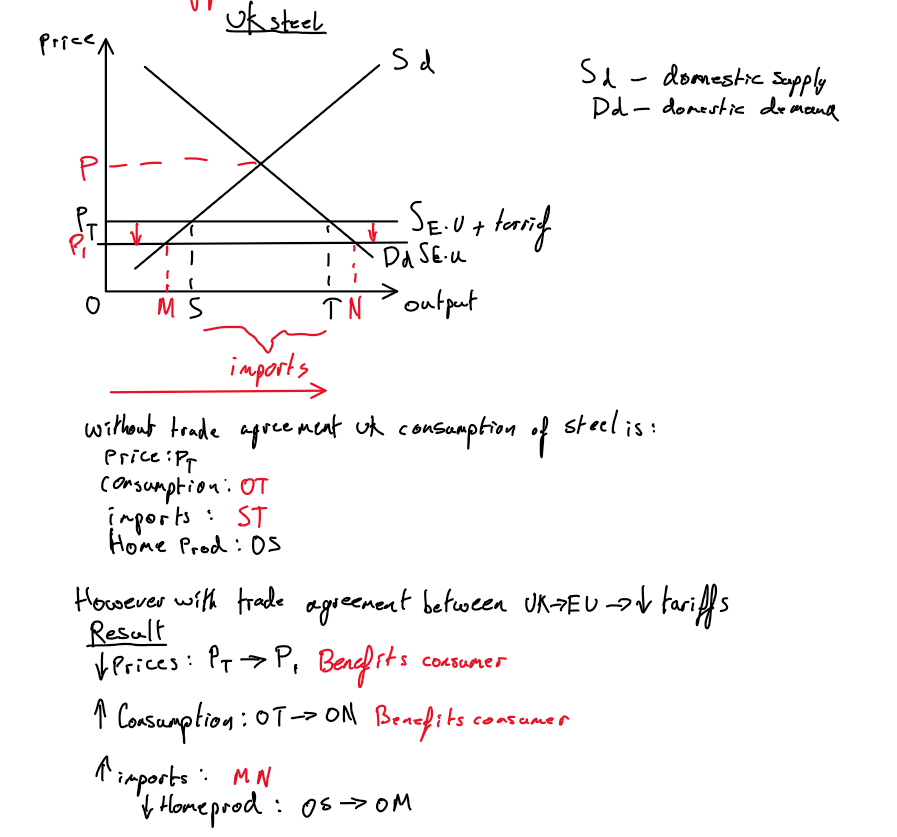
increase in FDI
foreign direct investment:
because they can avoid a commmon external tariff e.g. increase sale of cars → increase profit
this is also beneficial to a “hot” country → increase jobs → increase wages + tax revenue
e.g. nissan -→ sunderland(uk - EU 1980s) → 85% of the cars produced are exported → helps our balance of payments
increase in economic power
a large trading bloc may be in a better position to negotiate trade agreements with other countries and trading blocs
costs of regional trade agreements
trade diversion
lack of negotitation power
trade diversion
this occurs when trade is switched from a low cost source (outside bloc) to a high cost source (inside bloc)
low cost source is subject to C.E.T → increase tax → increase price e.g. when UK joined E.U in 1975. imports of butter switched from Anchor butter (NZ) to Lurpak (denmark) - to expensive after tariff imposed
lack of negotiation power
members are unable to negotitate seperate trade deals if members of customs union
roles of the W.T.O in trade liberalisation
W.T.O has 166 members
to promote free trade - this is acheived through trade rounds - disputes can be taken to the W.T.O to resolve
to settle trade dispute between countries
why was the W.T.O setup
after WW2 - many countries were bankrupt and global economy was weak, setup to discourage tariffs and increase free trade
possible conflicts between the RTAs and the W.T.O
trade discrimination - RTAs may discriminate against non-members, potentially violating W.T.O’s most favoured principle
trade diversion - if RTAs lead to trade diversion, they can be seen as contrary to the W.T.O’s goal to reduce trade
inconsistent rules - conflicting rules between RTAs and W.T.O can lead to legal and practical challenges
preferred treatment - W.T.O rules generally favour non-dicrimination whereas RTAs have preferred treatment to its members
dispute resolution - can arise when W.T.O and RTAs rules conflict, requiring resolution mechanics to reconcile differences
non-economic arguements for protectionism
independence in time of war e.g fppd, steel, energy
maintain national heritage USA - Disney, canada - lumber, UK - rolls royce
diverse economy, socially desirable , science, engineering, creative
political links - solidatiry/sanctions e.g. Africa 1980s
economic arguements for protectionism
dangers of overspecialisation e.g. Ghana → X cocoa beans 30%, Malawi → raw tobacco 47%, if global demand falls for cocoa or tobacco - problems for ghana or malawi - worsen terms of trade, commodity price are volatile
protection of infant industries - need breathing room before they can compete, GRAPH →
protect declining industries - allow gradual decline and allow workers to re-train and reduce structural unemployment, e.g. UK 80s/90s deindustrialisation, they may be cases where a coountry loses its comparitive advantage in this sector
protects from unfair competition - subsidies - distorts comparitive advantage, dumping of goods
correction of an adverse balance of payments - attempt to bring M’s in line with X’s
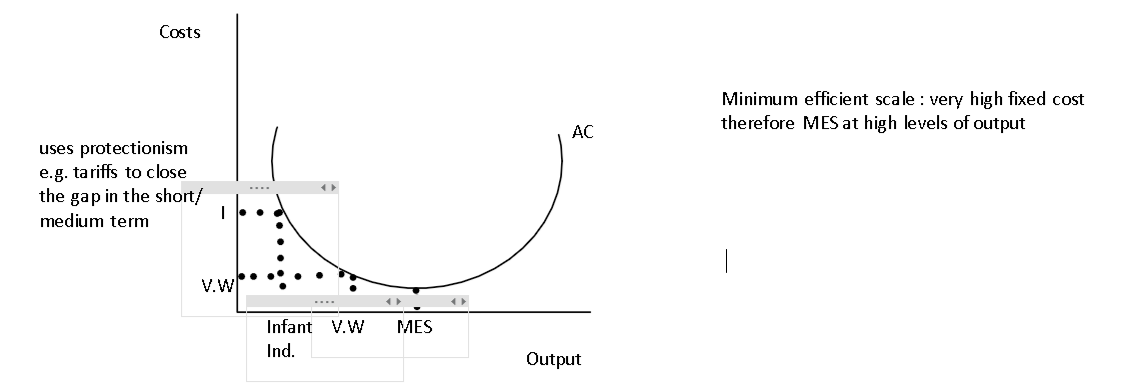
traditional means of protectionism
tariffs
quotas
tariffs
a tax on imports
reduces demand for imports
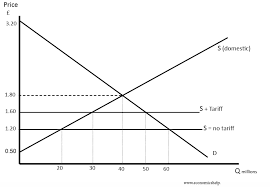
qoutas
a physical limit on the quantity of imports e.g. EU - 1980s - quota on japanese cars therefore encourages Japan to open car plants in EU
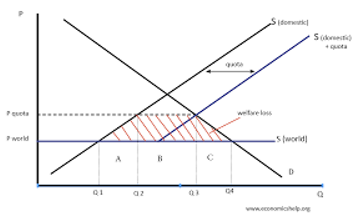
other measures of protectionism
export subsidies - govt subsidies domesti exports
red tape/ artificial barriers
impact of protectionist policies
home producers may increase market share
price - higher price for consumers
may improve current account however chance of retaliation
reduces Y due to higher prcie so may reduce living standards
increase tax revenue for Govt. however paid by consumers (Trump)
balance of payments
records all financial transactions between one country and the rest of the world
inflows of foreign currency - counted as positive entry
outflows of foreign currency - counted as negative entry
the current account of the balance of payments is the main measure of external trade peformance
the financial account emasure inflows and outflows of financial capital (money) across national boundaries
current account
balance of trade in goods
balance of trade in services
net primary income (interests, profits, dividends and migrant remittences)
net secondary income (contribution to EU, military aid, overseas aid)
capital account
sale/transfer of of patents,copyrights, franchises and other transferable contracts
financial account
net balance of foreign direct investment (FDI)
net balance of portfolio flows (e.g. shares)
balance of banking flows (e.g. hot money flowing in/out of banking system)
FDI
an ownership stake in a company, made by a foreign investor, company, or government from another country.
what makes a current account deficit/surplus
exchange rates
relative productivity
domestic economic growth
relative inflation
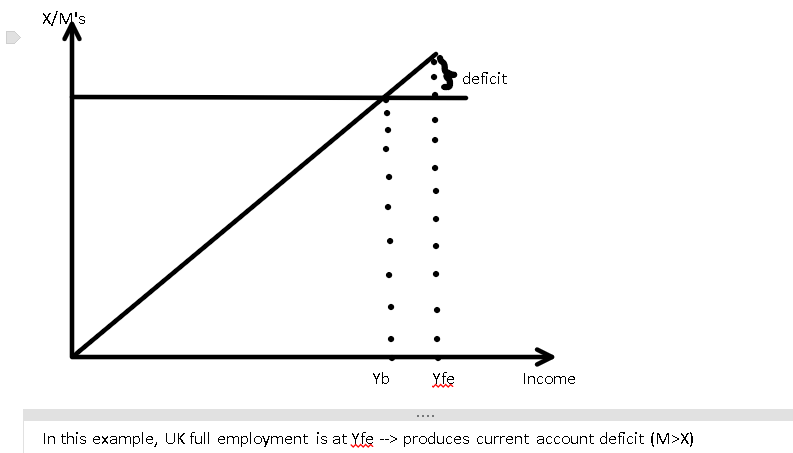
measure to deal with a crrent account deficit
improve infrastructure →decrease unit cost → increase international competiveness
subsidise exporters
tariffs
increase red tape
increase income tax
policies to deal with current account deficit
expenditure reducing
expenditure switching
supply side policies (longer term)
protectionism
expenditure reducing
deflation → reduce Y → to reduce M’s
UK has a high marginal propensity to import
expenditure switching
reduce UK demand for imports to domestic goods e,.g. devaluation, protectionism
how to deflate the economy
increase income tax
increase IR’s
Decrease govt.exp
devaluation - decrease ER value
protectionism
all these will have significant trade-offs e.g. econ growth, inflation
what does devaluation depend on
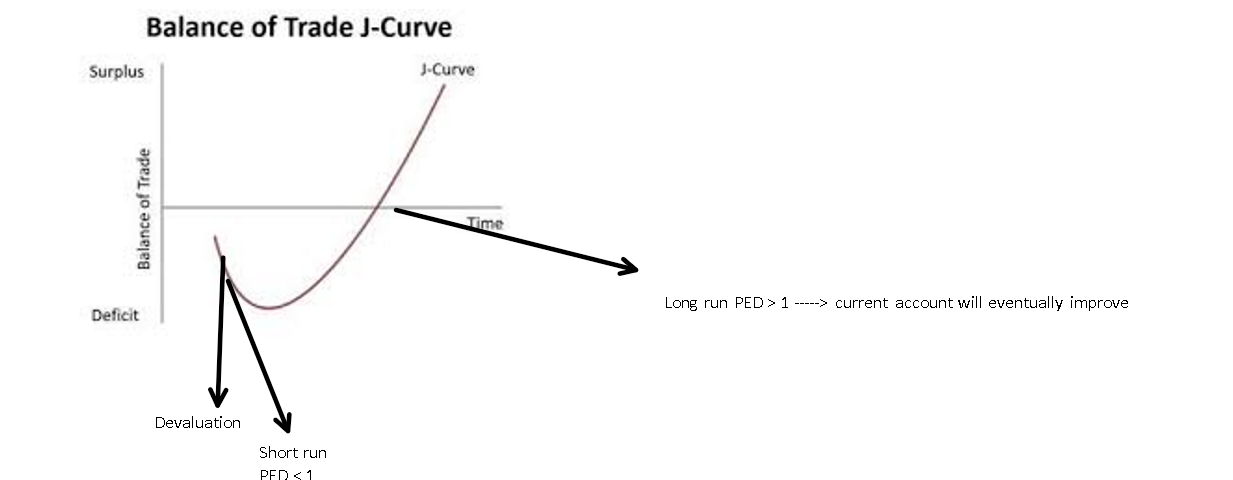
marshall lerner criterion
J-curve effect
marshall lerner criterion
states that devaluation of a currency will only only improve BOP if net price elasticity of X’s + M’s is price elastic i.e >1
J-curve effect
basically a devaluation will not improve bop immediately
in the short run theyll be little change to demand, buyers need time to switch i.e contracts already signed etc
how does protectionism deal with current account deficit
increase price of M reduces M’s therefore improve current account deficit
however:
may lead to retaliation
demand for imports may be inelastic i.e uk importing lithium
members of a custome union - not allowed to impose on others
trade imbalances
occur when some countries run persistant surpluses on their trade accounts, whereas others experience persistant and often large deficit
mercantalism
is the notion that the wealth of a nation is based on how much it could export in excess of its imports
surplus countries
Germany 300 billion dollars
Japan 200 billion dollars
China 165 billion dollars
deficit countries
USA 466 billion dollars
UK 106.7 billion dollars
India 51 billion dollars
exchange rates
the price of ones currency in terms of another currency
bought and solf on the forex market
how is ER determined
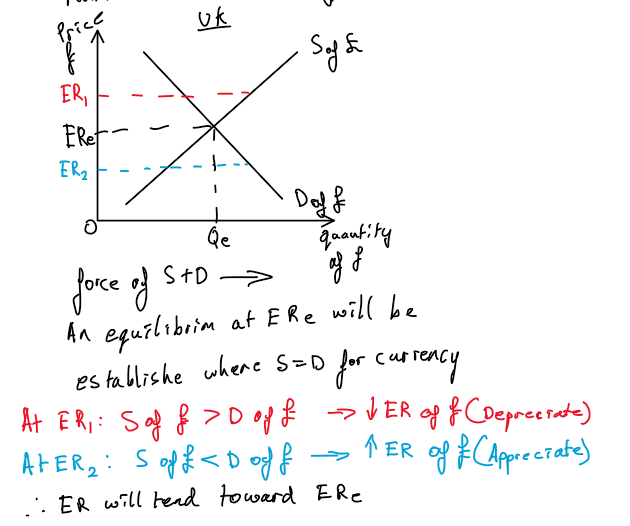
largely determined by S + D
however govt has a choice of ER systems
what are the ER systems
floating ER system
fixed ER system
mixed system - “dirty” float, adjustable peg
floating ER system
the market determines the ER i.e by force of S + D
uk policy since 1990
fixed ER system
ER is set by govt
“dirty” float
a managed float
here ER is allowed to float but govt will step in if its damaging to the economy
i.e appreciate too much → deflationary
depreciate too much → inflationary
adjustable peg
here the government fixes the ER, but will adjust ER value if the fixed ER is deemed to “high” or to “low” i.e damaging to the economy
how does the forex market look for a floating system in the UK, and how do the forces of S + D move ER
what determines demand and supply of £
BoP helps
current account
financial account
how does BoP affect D for £
to buy UK goods and services - i.,e current atc → this requires £ → implies D for £ therfore anything that affects D for UK goods and services
e.g. uk inflation rising faster than rivals → decrease Uk competitiveness → decrease exports → decrease D for £
level of econ growth overseas → boom → increases D for X
quality of UK goods and services
financial account: to put capital into UK requires £, reasons are
FDI - nissan - sunderland → increase D for £
speculation - if ER £ expected to rise→ increase D for £
portfolio investment e.g if canadian pensino fund invests in FTSE 100
what are the decisions to invest into UK made by overseas countries/firms affected by
interest rates e.g. increase IR → increase D for £
perceived peformance for UK econ
expected ERs
what determines supply of £
1) current account - UK demand for overseas goods + services so if £ sold there is more supply
financial account - UK demand for FDI, portfolio, speculation overseas
when do we use revaluation/devaluation vs appreciation/depreciation
revaluation/devaluation when its moved on purpose e.g. fixed ER system, but appreciation/depreciation is natural movement e.g. forces ofS + D
what does a rising and falling currency mean
ER is strenghthening or weakening
what would happend to market for £ when there is an increase in demand for UK military ships and planes overseas
shift right in demand
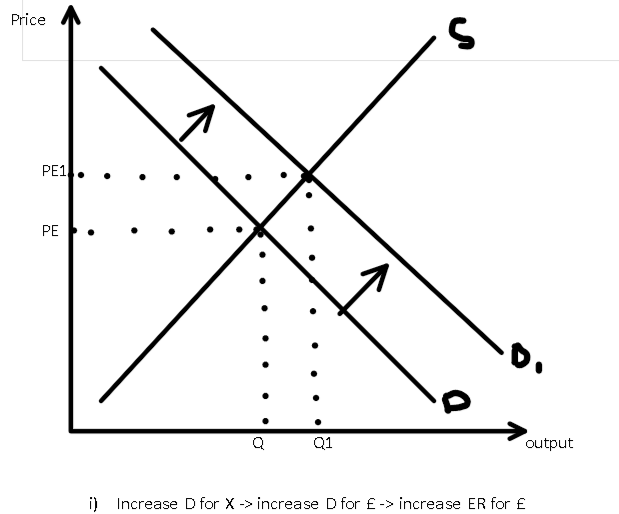
ways a government can intervene in currency markets
open market operations
interest rate changes
open market operations
using foreign currency reserves (central bank) to buy and sell currency
e.g. assume UK wanted to devalue the £ against the $, they would sell £ and buy $
interest rates changes
interest rates can be either used to attract (increase D for £) flows and “hot money” or the opposite
i.e
increase IR → makes £ more attractive → increase D for ER
decrease IR → decrease D for £
why would a country want to devalue its currency
to increase competitiveness of its X, to boost current account
to boost X → increase AD → growth
however whether it succeeds depends on PED (mlc) and inflationary therfeore long run bad (increase X → increase AD)
impact of changes of ER
devaluation - makes X relatviely cheaper, increase FDI
however these impacts depend on : marshal lerner criterion and J-curve
decrease ER of £ makes X cheaper (increase D.pull inflation), it also makes M more expensive → increase cost pull inflation therefore long term decreases UK competitiveness
decrease ER of £ may increase hostile mergers + takeovers
uk investment overseas becomes more expensive → long run reduces income
How is international competitiveness measured
1) Relative unit labour costs
2) relative export prices
Factors influencing international competitiveness
Productivity and workforce
Unit labour costs
Real exchange rates
Non-wage labour costs
Paternity rights
Level of technology and R+D
Government laws
Benefits of Int.Comp
Increase econ growth → increase living standards
Boost current atc
Increase D for ER → appreciates → deflationary
 Note
Note  Flashcards (20)