Muscle Physiology TEST 4
 Call Kai
 Learn
Learn Practice Test
 Spaced Repetition
 Match
Match Flashcards
 Knowt Play
1/84

There's no tags or description
Looks like no tags are added yet.
Name | Mastery | Learn | Test | Matching | Spaced | Call with Kai |
|---|
No analytics yet
Send a link to your students to track their progress
85 Terms
Interactions of skeletal muscles in the body
Muscles work together or in opposition to achieve a variety of movements
For every muscle, there is an opposing muscle doing the opposite
Muscles PULL not push
Origin
Immovable point of attachment
Insertion
Movable point of attachment
Deltoid Muscle
Origin - Clavicle & Acromion process and spine of scapula
Pectoralis Major Muscle
Origin - Sternal end of clavicle, sternum, ribs 1-6
Insertion - Intertubercular groove on humerus
Biceps Brachii Muscle
Origin - Coracoid process on scapula, Supraglenoid tubercle
Insertion- Radial tuberosity
4 Functional groups of muscles
Prime mover
Antagonist
Synergists
Fixator
Prime mover (agonist)
Leader, major muscle
Ex: Biceps
Antagonist
Opposing prime mover
Ex: Triceps
Synergists
Help prime mover
More force or stabilizes joint
Fixator
Stabilize bones like scapula, posture
We name the muscles based on their…
Location, shape, and size
Brevis
Short
Rectus
Straight
Transverse
90 degrees
Oblique
45 Degrees
Location of attachments
Origin first in name, insertion second
Ex: Sternocleidomastoid
Actions
Flex, extend, adbuct, adduct, etc
Muscle functions
Contractility
Posture
Stabilizing Joints
Heat
Excitability
Elasticity
Muscle cells are organized in…
Circles that get smaller and smaller
Muscle
Organ, 4 different tissues
Fascicles
Bundle of muscle cells
Muscle Cell
Equal to muscle fiber
Myofibril
Subunit of a muscle cell
Microfilaments
Myofilaments = Protein filaments - protein molecules
Tendon
Muscle to bone
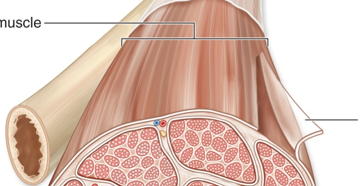
Connective Epimysium
Muscle covering
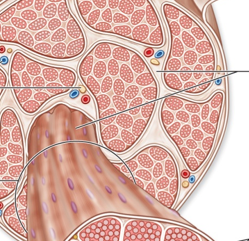
Connective Perimysium
Fascicle covering
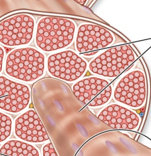
Connective Endomysium
Muscle cell covering
Myosin
Thick protein filament
Head attaches to actin
Pivots as muscle contracts
Actin
Thin protein filament
G action - Globular
Main part of the molecule
Tropomyosin
Blocks actins active site or attachment site
Troponin
Binding site for calcium
(Where the ice cream fits into)
Crossbridge
Place where actin (active site) and myosin (head) attach
Sarcomere
One contractile unit
One section of myofibril
Located from z line to z line
4 Regions (A band, I band, H zone, Z line)
A band
Length of myosin, dark band
Length stays the same when contracting
I band
Space between myosin, light band
Gets shorter when contracting
H zone
Space between actin, myosin only
Gets shorter when contracting
Z line
End of sarcomere, anchors actin
Sarcoplasm
Muscle cytoplasm
Sarcolemma
Muscle cell membrane
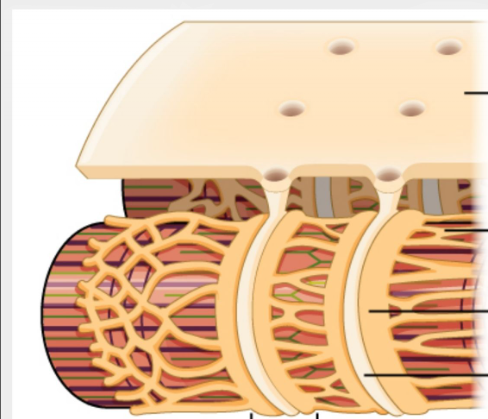
Sarcoplasmic reticulum (S.R.)
Stores calcium
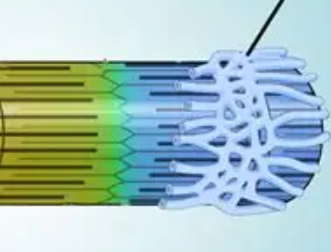
Terminal cisternae
Enlarged ends of S.R. , stores calcium (calcium closet)
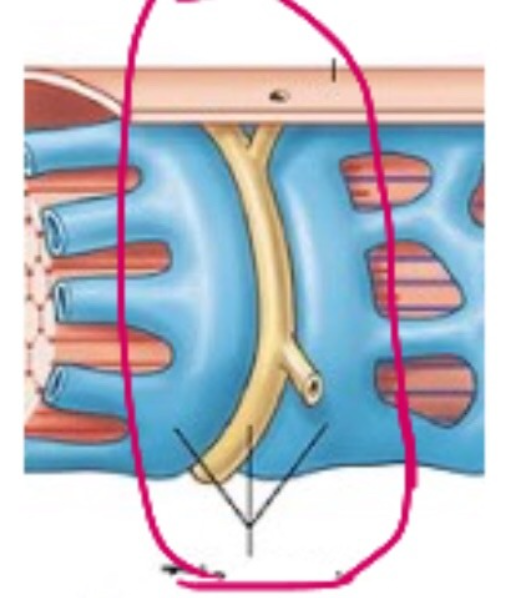
T-Tubules
Sarcolemma that extend deep into myofibril
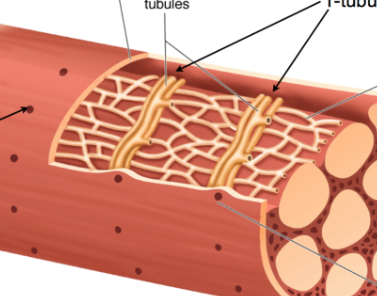
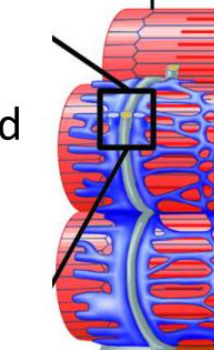
Triad
2 Terminal cisternae and T-Tubule
Mitochondria
Makes ATP
Nucleus
Cells large and many per cell
Nerve Cell
Electricity (action potentials) travel down the nerve cell (1)
Synaptic cleft
Space between the nerve and muscle cell where a chemical (neurotransmitter) is released by the nerve cell to tell the muscle cell to contract (2)
Sarcolemma
The AP travels along sarcolemma down into T-Tubules (3)
Terminal cisternae
AP causes terminal cisternae to release calcium to sarcoplasm (4)
Calcium
Binds to troponin on actin (ice cream cone) (5)
Troponin
Moves tropomyosin so it’s not blocking active site on actin (6)
Cross bridges formed
Myosin heads attach to actin (7)
Power stroke
Myosin head binds and pivots pulling Z-lines closer (8)
Detach
ATP needed to break head of myosin (relaxes)
crossbridge detachment (9)
Ratchet action
Resetting myosin head, ATP (energy) returns head to original position (10)
Repeat
Repeat steps 7-10 over and over again (cross bridge, reset, repeat) (11)
Z lines
Z lines get closes together
I and H disapear (12)
Action potential
Action potential from nerve cell stop, actin potential from muscle cells stops (13)
(Low to High)
Calcium pump
Active transport mechanism returns Calcium to the terminal cisternae (14)
Tropomyosin
Blocks active site on actin and no more cross bridges can occur (15)
ATP
Breaks cross bridge for the last time and the muscle relaxes (16)
Motor Unit
1 Nerve and all muscle fibers it attaches to
Muscle twitch
Single brief stimulus
Summation
combined twitches
Tetanus
Constant stimulus over a period of time
Whole
The ___ muscle cell contracts. Not a part of the cell
Recruitment
Summation of motor units
Threshold stimulus
Minimal stimulus needed to start muscle contraction
Myogram
Muscle length
Latent period
After stimulation, leading up to contraction
Period of contraction
Crossbridges activate
Period of relaxation
Initiated by calcium, uptake back into S.R
We never ____ muscle cells
Loose or gain
Hypertrophy
Enlargement of a muscle due to exercise/work
Atrophy
Withering f a muscle due to lack of exercise or work
Muscle fatigue
Inability to contract (energy, nerve, muscle)
Rigor mortis
Happens after death. Stiffening of the body due to lack of ATP to break bonds
Fast twitch muscle fibers
Smaller fibers used to high force, short duration activities
Make ATP anaerobically (like push up)
Slow twitch muscle fibers
Bigger fibers used for low force, long duration activities
They posses more endurance enzymes (marathon)
Isometric contraction
Increase tension, muscle length stays same
Isotonic contraction
Increase tension, muscle length chances
Concentric
Muscle shortens
Eccentric
Muscle lengthens (most exercises and all sports)
Explore top notes

Explore top flashcards
