Traumatic Brain Injury
 Call Kai
 Learn
Learn Practice Test
 Spaced Repetition
 Match
Match Flashcards
 Knowt Play
1/25

There's no tags or description
Looks like no tags are added yet.
Name | Mastery | Learn | Test | Matching | Spaced | Call with Kai |
|---|
No analytics yet
Send a link to your students to track their progress
26 Terms
Mild TBI
normal imaging
LOC 0-30 mins
AOC up to 24 hrs
PTA up to one day
GCS 13-15
Moderate TBI
normal or abnormal imaging
LOC greater than 30 mins, less than 24 hrs
AOC greater than 24 hrs
PTA 1-7 days
GCS 9-12
Severe TBI
normal or abnormal imaging
LOC greater than 24 hrs
PTA over 7 days
GCS 3-8
Penetrating Injuries
An object breaks through the skull and enters the brain
Damage is usually localized to the area of entry
Ex. Gunshot wound, Stab injury
Non-penetrating injuries
The skull is not broken
Brain is injured by movement inside the skull
Acceleration and non-acceleration injuries
Ex. Falls, Car accidents, Sports injuries
Secondary Injuries
Subsequent to initial insult. Effects evolve over time.
● Cerebral edema (swelling)
● Raised intracranial pressure
● Meningitis
● Biochemical changes (changes in levels of neurotransmitters,
sodium, potassium, etc.).
Attention (Selection)
attending to one aspect of a situation/stimulus and ignoring others
Attention (Capacity Limitation)
Only so much information can be consciously attended to, or held and manipulated in memory.
resource allocation theory
related to working memory (active manipulation of info)
Clinical Models of Attention
● Focused: basic ability to attend, even momentarily.
● Sustained: maintaining focus over time.
● Selective: maintaining focus in the presence of distraction.
● * Alternating: shifting focus back and forth between tasks.
● * Divided: “multi-tasking”.
alternating and divided considered the same
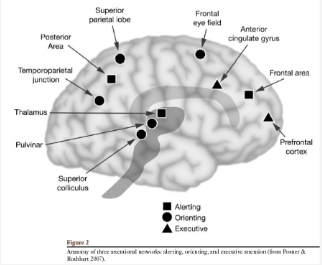
Attention and Neural Networks
Attention is a whole brain phenomenon, but certain areas are crucial. Some areas associated with attention:
● Alerting: achieving and maintaining a
high sensitivity to incoming stimuli.
● Orienting: selecting information from
sensory input.
● Executive attention: monitoring and
resolving conflict among thoughts,
feelings, and responses.
Attention and TBI
Diffuse and bilateral injury to: neocortex, limbic system, and brain stem areas.
Sensory selective attentional system (Parieto-temporo-occipital area).
Arousal, sustained attention and vigilance system (Midbrain reticular activating system and limbic structures).
Anterior system for selection and control of responses (Frontal lobes, anterior cingulate gyrus, basal ganglia, thalamus)
Frontal Lobe Syndrome/Dysexecutive Syndrome
cluster of behavioral, affective, and cognitive symptoms resulting from frontal lobe damage
executive function and pragmatic deficits
personality change
Concussion
mildest form of TBI
Short-Term Memory
● Maintaining information for a short time.
● Chunking is good for short-term memory.
● Limited capacity (e.g.,“magic number” of 7 ±2)
Sensory Memory
● Traces of sensory input that persist only briefly.
● Sensory memories typically only last a few seconds.
● It allows us to select what to pay attention to next.
Long-Term Memory
storage of information for an extended period
Retrospective Memory
Memory of people, words, events, etc. encountered or experienced in the past
Declarative/Explicit Memory
type of long term memory
type of retrospective memory
knowledge you can consciously access
Episodic Memory
type of long term memory
type of retrospective memory
type of declarative memory
for events involving contextual information (experiences)
Semantic Memory
type of long term memory
type of retrospective memory
type of declarative memory
word/lexical knowledge
memory independent of learning context
Non-Declarative Memory
type of long term memory
type of retrospective memory
knowledge you cannot consciously access
Procedural Memory
type of long term memory
type of retrospective memory
type of non-declarative memory
motor or automized cognitive skills
Conditioning Memory
type of long term memory
type of retrospective memory
type of non-declarative memory
neutral stimulus becomes linked with a meaningful stimulus, and this association is stored in memory.
Prospective Memory
type of long term memory
remembering to remember
Usually triggered by cues:
Certain time of day.
Certain event occurring or location.
Strength and salience of cues affect success.
proper (e.g., buying groceries en route home)
habitual (e.g., taking same medication every day)
vigilance (e.g., preventing a kettle from boiling over)
Supported by routines and external memory aids
Memory and TBI
In TBI, there is generally diffuse and bilateral injury to many regions, including
temporal and basal-frontal regions, hippocampus
Memory problems (Acute) ~69-80% of cases.
Memory problems (Chronic) ~35-75% of severe cases

