mamm. phys. exam 2!!
 Call Kai
 Learn
Learn Practice Test
 Spaced Repetition
 Match
Match Flashcards
 Knowt Play
1/42

There's no tags or description
Looks like no tags are added yet.
Name | Mastery | Learn | Test | Matching | Spaced | Call with Kai |
|---|
No analytics yet
Send a link to your students to track their progress
43 Terms
sensory cells: relationship between stimulus intensity and receptor response….
semi-logarithmic
threshold sensitivity
maximum cell receptor response
modality
= sensory quality! (type of receptor)
anatomically specific
connected to CNS!!
*NOT coded for by AP’s
range fractionation
different cells have overlapping sensitivities… which extends dynamic range!
tonic vs phasic receptors
tonic: slow adapting
constant firing rate as long as stimulus is applied
phasic: fast adapting
firing rate (# of AP’s) decreases w/ constant stimulus
5 basic tastes
salty, sour, sweet, bitter, umami
sensory transduction by taste receptor!
closes K channel… Na+ and Ca2+ enter the cell!
more depolarization… more APs!
more NT release
sweet & umami:
bitter:
salty:
sour:
sweet & umami: binds to membrane receptor, close K+ channel!!
bitter: binds to membrane receptor, Ca2+ released from ER!
salty: Na+ thru ion channel, opens Ca2+ channels!
sour: H+ thru ion channel, opens Ca2+ channels!
chemosensory coding: 2 types!
labeled-line coding = limited range of stimuli & direct neural line …. receptors are specialists!
across-fiber pattern = wider range of stimuli & contributes to perception …. receptors are generalists!
olfactory!!
receptor cells= bipolar neurons w/ cilia
bowman’s gland = odorant-binding proteins
project from nose directly to cortex!
25,000 receptor cell axons synapse on 25 mitral cells… large conversion of signals!
350 functional genes coding for different receptors… each gene for one receptor!
equilibrium pathways
directly to cerebellum ; indirectly to cortex (via thalamus)
all other pathways?
must pass thru thalamus before projecting to their relevant area
Somatotopic order…
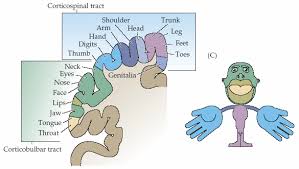
more brain area = more info processing = more important!
visible light range?
400 - 700 nm
fovea
eye! highest density of photoreceptor cells
rhodopsine=
rod cells:
cone cells:
opsin + retinal
rod cells: black/white, 1 type of opsin
cone cells: red/ blue/ green, 3 types of opsin
which retina form binds opsin
kinked (cis) retina form binds opsin … purple
straight (trans) retina form detaches from opsin …. clear
Which best describes lateral inhibition in the somatic sensory system?
The precision of locating a stimulus is increased by inhibiting signaling along nearby, parallel pathways
…. this sharpens the signal by inhibiting neighbors!
special vs somatic sense
Special senses are localized to specific organs (the ears, in the case of sound) and are mediated by specialized cranial nerves. Somatic sensations (also called "general senses") are processed by the somatosensory system and are distributed throughout the body rather than being confined to a single specialized organ
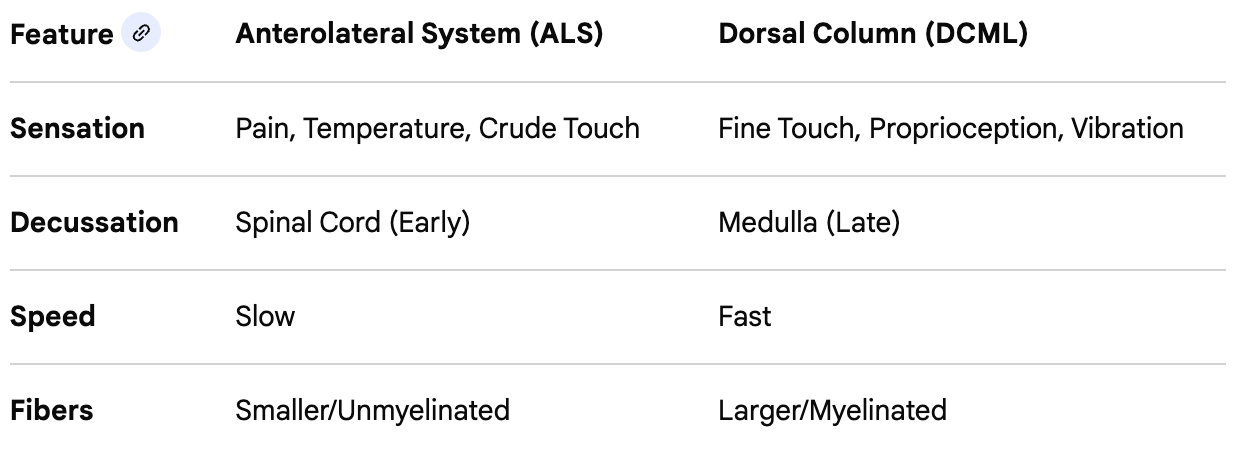
anterolateral vs dorsal column
Accommodation for near vision requires
Multiple Choice
flattening of the lens.
contraction of the ciliary muscles.
activation of the sympathetic nervous system.
increased rounding of the cornea.
dilation of the pupil.
contraction of the ciliary muscles.
rods vs cones location
cones = fovea
rods = spread around retina
combinational code for odor:
analogous to english alphabet
odorants are coded for by a combination of activated receptor cells!!
order that light passes thru
light → optic nerve fibers → neurons → photoreceptors (rods and cones)!
90% of retinal projections go to ____, the other target is ____
LGN - lateral geniculate nucleus
other target = superior colliculus
photoreceptors in vertebrae retina
outer segment= pigment in membrane disks
inner segment= organelles, ATP production (rods/ cones)
synaptic terminal= synapses w/ bipolar cells
light starts HERE!!!! ^
rod’s signal transduction pathway
Na+ channel opened by cGMP increase… depolarization! (which releases inhibitory NT glutamate) = NO graded potential of bipolar cell = NO ATP in ganglion cell!!
however….
if cGMP decreases …. Na+ channel closes (hyperpolarization!!) = NO inhibitory NT release, instead releases excitatory NT! which stimulates ATP in ganglion!
photoreceptor cell in light vs dark
light= no IPSP, bipolar cell depolarizes, AP!
dark = IPSP in bipolar cell, no AP!
IPSP vs EPSP
IPSP= hyperpolarization of a neuron's membrane potential caused by the flow of negatively charged ions into the postsynaptic cell. It decreases the likelihood of a neuron firing an action potential, acting as a "brake" on neural activity to regulate nervous system function.
EPSP= a temporary, graded depolarization of a postsynaptic neuron membrane caused by the inflow of positive ions (usually or ) when excitatory neurotransmitters, such as glutamate, bind to receptors. This shift makes the neuron more positive and likely to fire an action potential
direct (vertical) vs indirect (lateral) neural pathways!
direct (vertical): receptor, bipolar, ganglion cell
indirect (lateral): receptor, horizontal, bipolar, amacrine, ganglion cell
lateral inhibition?
lateral inhibition = inhibiting neighbors to create contrast enhancement of stimulus!
when is ganglion cell active vs inactive?
active = light shines on center
inactive = light shines also on surround area
size of cone/ magnitude of receptor response for red, blue, green… also which colors are s3x linked?
red= long
green= medium
blue= short
red and green = s3x linked
rods vs cones…. slow vs. fast, pigments, day vs. night vision
rods= fast! rhodopsin! night vision!
cones= slow! green/red/blue! daylight!
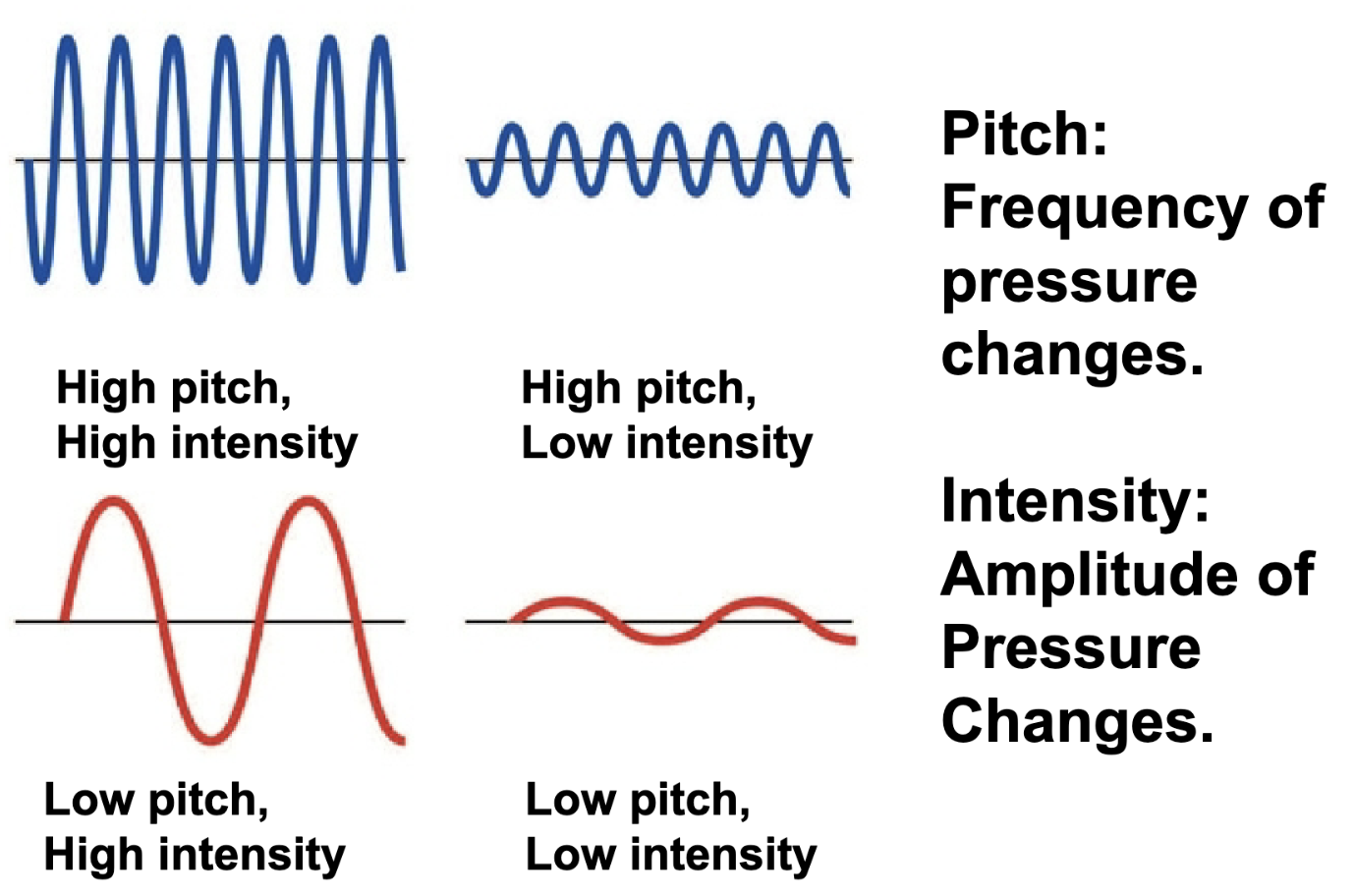
pitch vs intensity
pitch= frequency
intensity= amplitude
hair cell transduction (force away vs towards, shear, and tip links!)
force towards kinocilium → more NT release
force away from kinocilium → less NT release
*movement of basilar membrane relative to tectorial membrane = shear on the cilia of hair cells!
tip links= connects transduction channels (cation channels on hairs)
do you get hyperpolarization or depolarization when K+ flows thru the tip links?
depolarization! (role reversal of Na and K compared to AP; b/c endolymph outside cilium has higher K+ than inside cilium)
sound waves on basilar membrane (high vs low frequency)
high frequency/ pitch = move membrane closer to stapes (base; near round window) .. stiff
lower frequency/ pitch = sounds closer to distal end (apex) … flexible
what is sound loudness determined by??
degree of displacement
AP frequency
muscle types= (striated vs non-striated and voluntary vs involuntary)
skeletal
smooth
cardiaac
skeletal: striated and voluntary
smooth: non-striated and involuntary
cardiac: striated and involuntary
functions of muscle (5)
voluntary movement
control of body openings
maintain posture
communication
maintain body temperature
Sliding filament theory
myosin slides along actin; Z-lines move closer together and sarcomeres shorten
where is the actin-binding site on myosin?
on the heads / cross bridge!

