ADVCOMT REVIEWER Week 2 - Development of Multicore Computer System
 Call Kai
 Learn
Learn Practice Test
 Spaced Repetition
 Match
Match Flashcards
 Knowt Play
1/46

There's no tags or description
Looks like no tags are added yet.
Name | Mastery | Learn | Test | Matching | Spaced | Call with Kai |
|---|
No analytics yet
Send a link to your students to track their progress
47 Terms
Also Known as “CPU”
The Brain of the Computer
Central Processing Unit that performs arithmetic and logical operation (ALU).
The Processor
The Mother of all x86 CPUs
The 8086 processor from intel
Clocked at a Frequency of 4.77 MHz
Central Processing Unit
Acronym for CPU?
The CPU
Complex Silicon Chip Responsible for Interpreting and Executing most of the commands from your computer’s hardware and software
What are the Core Components in a Processor
Control Unit (CU)
Arithmetic Logic Unit (ALU)
Registers
Cache
The "conductor" of the processor. It directs the flow of data and tells the rest of the CPU how to respond to program instructions.
Control Unit (CU)
The "calculator." It performs all mathematical (addition, subtraction) and logical (AND, OR, NOT) operations.
Arithmetic Logic Unit (ALU)
Extremely fast, small storage locations used to hold data the CPU is currently working on.
Registers
A small pool of high-speed memory that stores frequently used data, so the processor doesn't have to wait for the slower RAM.
Cache
A processor performs its job by repeating a specific cycle billions of times per second.
Fetch-Decode-Execute Cycle
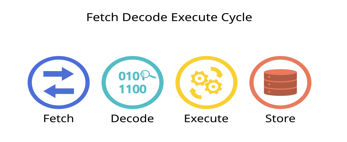
The CPU retrieves an instruction (in the form of binary code) from the system's RAM.
Fetch
The Control Unit breaks down the instruction to understand what needs to be done (e.g., "Add these two numbers").
Decode
The ALU or another functional unit carries out the command.
Execute
(Writeback): The result is saved back into a register or the main memory for later use.
Store
Measured in Gigahertz (GHz), this is the number of cycles a CPU performs per second, A 4,0 GHz CPU performs 4 billion cycles per second.
Clock Speed
Physical processing Units within a single chip. Multi - core processors can handle different tasks simultaneously (parallel processing)
Cores
Virtual cores that allow a single physical core to work on two tasks at once (Hyper-Threading or SMT).
Threads
The Design Philosophy of the chip, such as x86 (High Performance, used by Intel/AMD) or ARM (High efficiency, used in smartphones and Apple Silicon).
Architecture
Why is the computing industry (Apple, Qualcomm, AWS) shifting from x86 to ARM-based architectures in 2026?
Because ARM offers superior performance-per-watt.
ARM uses RISC (Reduced Instruction Set Computing).
x86 uses CISC (Complex Instruction Set Computing).
What is the specific function of a dedicated NPU in a modern processor?
It is designed to accelerate AI tasks, such as:
Large Language Models (LLMs)
Image generation
Other complex machine learning workloads.
Why ARM is Winning (2026 Trends)
Incredible Battery Life
System on a Chip (SoC) Design
Thermal Efficiency
Why can ARM-based laptops (e.g., MacBook M-series) achieve 20+ hours of battery life?
Because ARM instructions are simple, the processor does not have to work as hard or generate as much heat to perform tasks.
hat is the primary advantage of the System on a Chip (SoC) design used by ARM?
It places the CPU, GPU, RAM, and NPU on a single piece of silicon. This "all-in-one" layout allows data to move between components almost instantly.
How does ARM’s thermal efficiency change the physical design of modern laptops?
Because these chips require significantly less cooling, many laptops can be built without internal fans, making them completely silent.
Defined as being a system, which has more than two CPUs working together on the system same chip.
Multicore Computer System
• An Intel Core 2 Duo E6750 dual-core processor. (mid-2007)
• An AMD Athlon X2 6400+ dual-core processor. (released 2005-2007)
1st Generation Multi-core processors
This type of processor can function as efficiently as a single processor but can perform operations up to twice as quickly Because each core has its own cache, the operating system is able to handle most tasks in parallel
Dual Core Processor
This type of processors integrates two dual-core processors within a single processor. The two separate dual cores communicate with each other using processor cache.
Quad Core Processor
This type of processor is an advanced CPU with six different cores. These six distinct cores are utilized to execute and send all data. Hexa Core CPU performs tasks faster and with better efficiency than dual-core(2-core) and quad-core(4-core) processors.
Hexa-core Processor
This type of processor is a computer processor (CPU) with eight cores. Each core is its own processing unit, theoretically allowing the processor to multitask by splitting up computational tasks between the 8 processors.
Octa - Core Processor
What are the Components of a Computer System?
System Case
Power Supply Unit (PSU)
Motherboard
Central Processing Unit (CPU)
Memory
Video Card Adapter
Network Interface Card (NIC)
Sound Card
USB (Universal Serial Bus) Expansion Card
Serial ATA or SATA
Hard Disk
Optical Disc Drive (Optional Legacy Component)
Sometimes called the chassis or enclosure, is the metal and plastic box that houses the main components of the computer.
System Case
Is the component that supplies power to the other components in a computer.
Power Supply Unit (PSU)
Is the central printed circuit board (PCB)in computers and many modern holds many of the crucial components of the system, while providing connectors for other peripherals.
Motherboard (main system board)
Is the portion of a computer system that carries out the instructions of a computer program, and is the primary element carrying out the computer’s functions.
Central Processing Unit (CPU) or Processor
Refers to devices that are used to store data or programs (sequences of instructions) on a temporary or permanent basis for use in an electronic digital computer
Computer Memory
It’s an expansion card whose function is to generate and output images to a display
Video Card Adapter
It’s a computer hardware component designed to allow computers to communicate over a computer network
Network Interface Card (NIC)
Expansion card that facilitates the input and output of audio signals to and from a computer under control of computer programs.
Sound Card
Is a specification to establish communication between devices and a host controller (usually personal computers).
USB (Universal Serial Bus) Expansion Card
Is a storage-interface for connecting host bus adapters to mass storage devices such as hard disk drives and optical drives.
Serial ATA,or SATA
It’s a non-volatile storage device that stores digitally encoded data on rapidly rotating platters with magnetic surfaces.
Hard Disk Drive
Some discs, drives can but recent drives commonly both readers only read from are and recorders.
Recorders are sometimes called burners or writers. Compact discs, DVDs, HD DVD sand Blu ray discs are common types of optical media which can be read and recorded by such drives.
Optical Disc Drive (optional legacy component)
Chipsets found in a motherboard
Northbridge
Southbridge
Is an integrated circuit responsible for communications between the CPU (Central Processing Unit) interface, AGP (Accelerated Graphics Port), and the memory.
Northbridge
Is an IC (Integrated Circuit) on the motherboard responsible for the hard drive controller, I/O controller and integrated hardware.
South Bridge
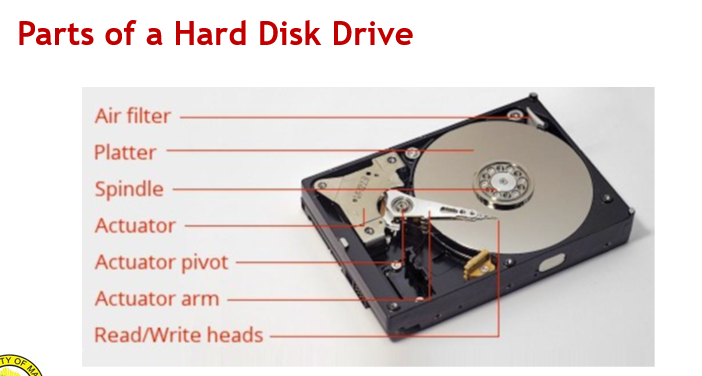
Parts of a Hard Disk Drive
Air Filter
Platter
Spindle
Actuator
Actuator pivot
Actuator arm
Read/Write Heads