Costa and McRae Part 1. Core and Periphery components
 Call Kai
 Learn
Learn Practice Test
 Spaced Repetition
 Match
Match Flashcards
 Knowt Play
1/41

There's no tags or description
Looks like no tags are added yet.
Name | Mastery | Learn | Test | Matching | Spaced | Call with Kai |
|---|
No analytics yet
Send a link to your students to track their progress
42 Terms
What are the basic tenets of trait theory?
That individuals can be characterised in terms of relatively enduring patterns
of thoughts, feelings, and actions
That traits can be quantitatively assessed
That traits show some degree of cross-situational consistency
What are the three central components of the five-factor theory
Basic tendencies
Characteristic adaptions
Self-concept
Basic tendencies of personality
Namely, the big five factors.
They are also inherited—they mainly come from a biological basis—so everyone will possess these basic tendencies because they are biological
What are the four key components of basic tendencies
Individuality
Origin
Development
Structure
Individuality
Origin
Suggests that genetics, hormones, and brain structures are causing these basic tendencies—the family plays no role—and they can only be altered via exogenous interventions that attack the biological basis
Development
How personality traits change—usually occurs during the first third of your life—and you often develop the most helpful traits to your situation
Structure
Traits are organized hierarchically, from broad to general, and the big five constitute the highest level of this hierarchy
Characteristic adaption broad definition
Things that adapt with life, such as our attitudes and relationships. We call them adaptations because they can be learned and changed
E.g. being able to speak French or being good in statistics. They are characteristic adaptations because they can change and be learned.
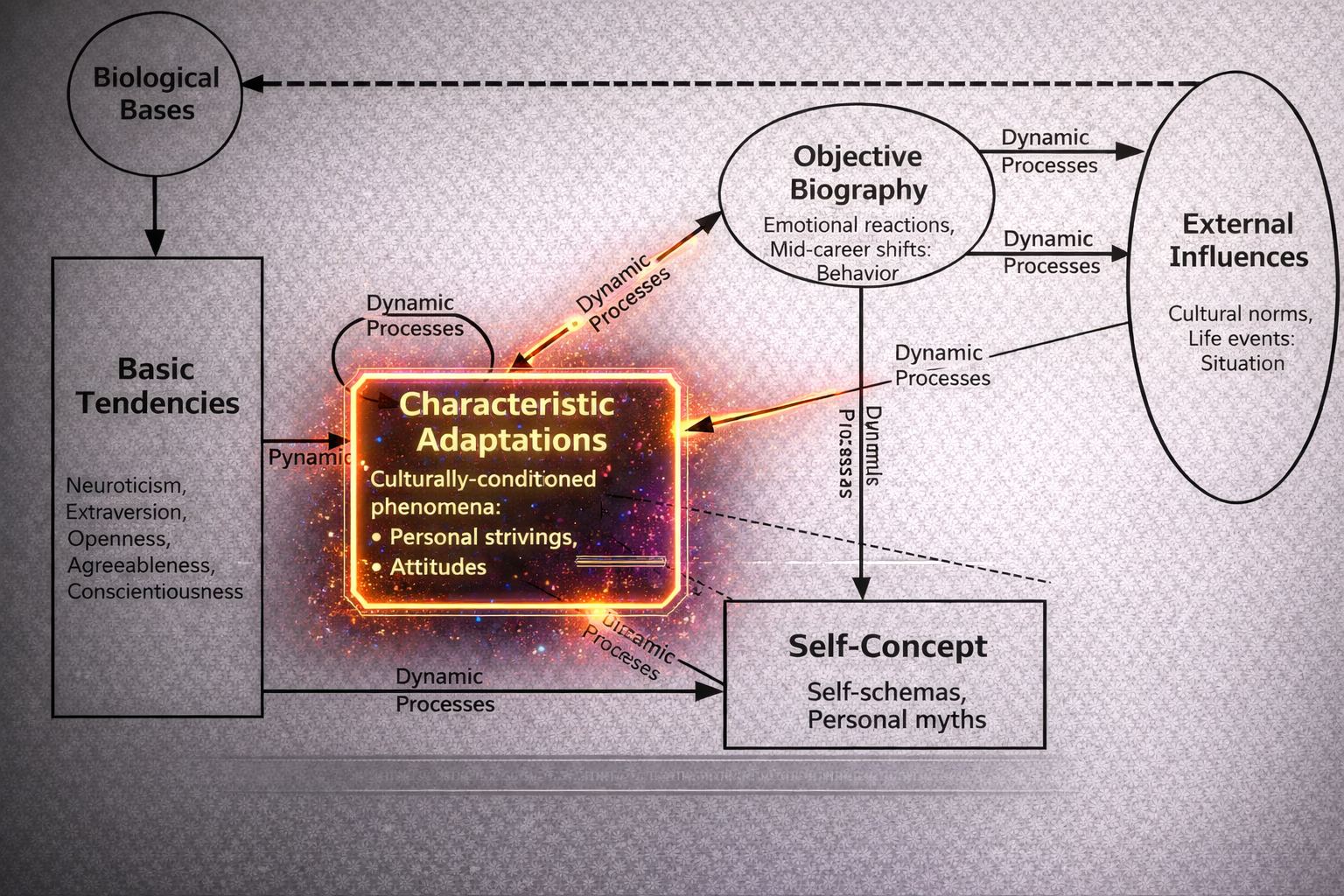
Three key components of characteristic adaptions
Adaptation
Maladjustment
Plasticity
Adaptation
The evolution of your thoughts, feelings, and behaviours driven by a basic tendency driving this action.
E.g. If you’re an extravert, you will probably join more groups and have more friends. This isn’t by chance, it results from your basic tendencies.
Maladjustment
When our responses are not consistent with our personal goals and/or cultural values—this usually results from some type of psychopathology
Ex. Extreme introversion resulting in pathological shyness, such as not ever leaving the house
Plasticity
Characteristic adaptations are highly malleable and are bound to change over time in response to biological maturation, social roles and/or expectations, changes in the environment or deliberate interventions
Ex. Going to therapy to correct your irrational fear of leaving the house
Self-concept
Is a sub facet of characteristic adaptations, and includes your knowledge, views, and evaluations of yourself.
How one thinks about themself will greatly influence their behaviour. E.g. if you’re intelligent, you will seek out scenarios where you can let your intelligence shine (Dr. Hamilton)
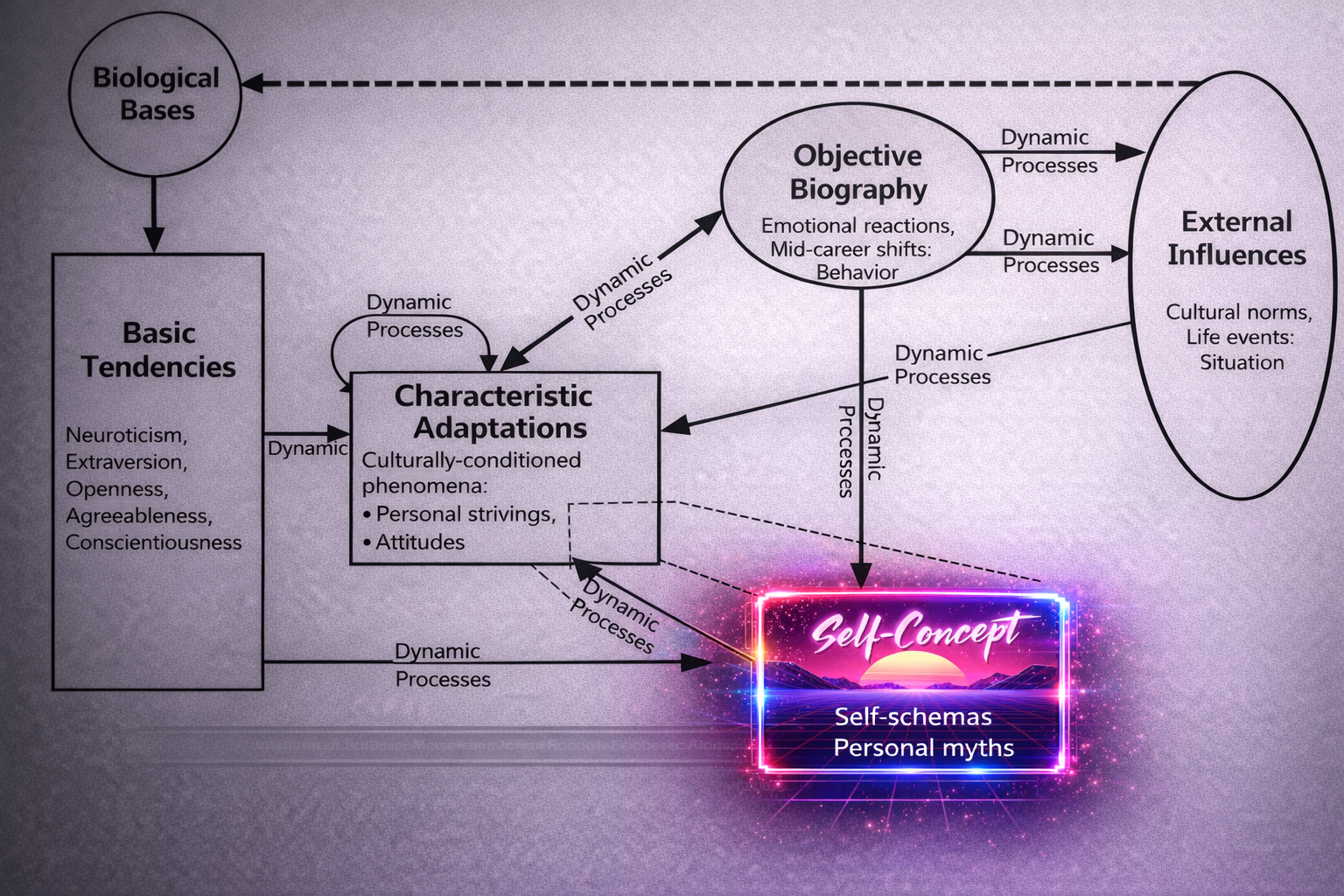
What are the two key components of the self-concept?
Self-schema
Selective perception
Self-schema
Who you think you are, and how you would describe yourself
Self-perception
We want to have a sense of coherence about who we are, so we selectively choose traits that are consistent with our self-perception
What are the three peripheral components of the five factor theory?
Biological bases
Objective biography
External influences
Biological bases
Biology has a significant influence on our basic tendencies, the five factor traits (although this is disputed)
Objective biography (definition)
The events that have actually happened in one’s life
Ex. Donald Trump is the 45th president
What are the two components of objective biography?
Multiple determination
Life course
Multiple determination
Anything in your objective biography can be predicted by a whole bunch of phenomena with multiple explanations.
E.g., someone may read a book because they are open to experience, conscientious about not spending too much time on their phone, or because they’re introverted
Life course
People have long-lasting goals, plans, and schedules that are all organized over a period of time consistent with personality traits
Ex. We’re all on the path of completing our undergraduate degree with the goal of becoming a registered psychologist
External influences definition
Characterized by things outside of your control, such as the culture we were born and raised in. It can also include inventions and phenomena such as COVID, natura disasters, or the invention of social media.
What are the three key types of external influences?
Interaction
Apperception
Reciprocity
Interaction
How the social world interacts with our personality
Apperception
We will perceive our environment in a way consistent with our personality
Reciprocity
Individuals influence their environment
Dynamic processes definition
Indicate how these components are interrelated the basic postulates of FFT
What are the two types of dynamic processes?
Universal dynamics
Differential dynamics
Universal dynamics
No notes?
Differential dynamics
Some people will be more affected by characteristic adaptations than others

