M8 Clegg- Divergence & Speciation I + II
 Studied by 0 people
 Call with Kai
 Learn
Learn Practice Test
 Spaced Repetition
 Match
Match Flashcards
 Knowt Play
1/9

There's no tags or description
Looks like no tags are added yet.
Name | Mastery | Learn | Test | Matching | Spaced | Call with Kai |
|---|
No study sessions yet.
10 Terms
what are the four species concepts?
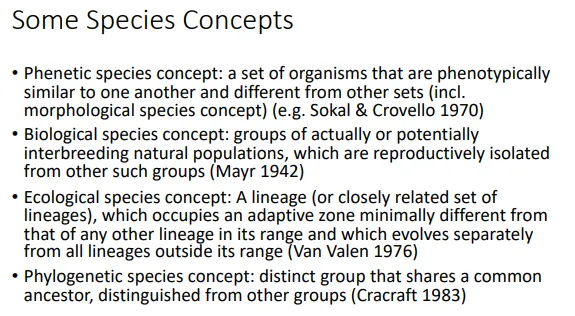
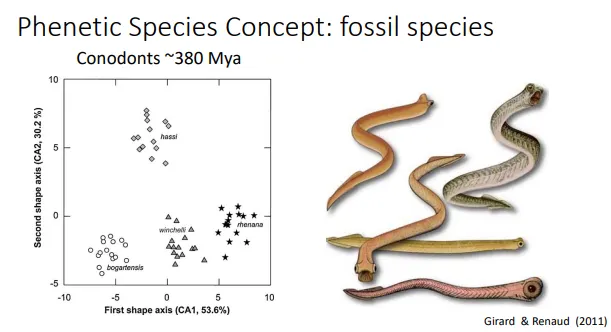
when/why is the phenetic species concept useful and what are its limitations?
defining species by phenotypic similarities is particularly useful for fossils eg. conodonts, as we can’t study the other species concepts properly
this is also used for some extant species eg. afrian gerbils- found in museum samples but hard to access in the wild
plotting measurements for two phenotypic traits (eg. length and width) against each other on a graph will show groupings for species- overlap may be present, but other traits can be applied to define the species
however:
this process may fail when you apply different traits or increase the sample, as they don’t cluster properly, and an be subjective beause it relies on human interpretation
this concept also doesn’t include an explanation for why the species are distinct
polymorphism- discontinuous variation can exist within species due to different forms- these polymorphs can have interbreeding and gene flow and can still be highly genetically similar eg. black bellied seedcracker bill size
plasticity- in some species, individuals may be able to change their phenotype (based on conditions at birth, not based of genetic differences) eg. deep sea vent tubeworms
cryptic species- multiple species can share one phenotype that aren’t immediately recognised as being distinct eg. neotropical skipper
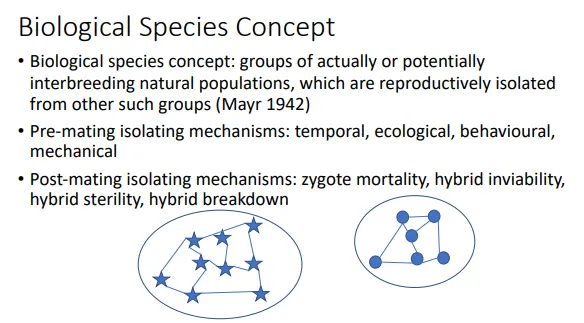
when/why is the biological species concept useful and what are its limitations?
defining species biologically is possible when two groups are reproductively isolated from each other, either by pre-mating (temporal, ecological, mechanical or behavioural eg. different mating calls) or post mating (hybrid mortality/sterility/inviability eg. mules) isolating mechanisms
this is helpful because it provides a mechanism for how/why the species are distinct
however:
it is difficult to know whether it would be possible for two species to mate, especially if their geographical ranges don’t overlap (allopatric), because we can’t necessarily force the two to mate- hybridisation could be possible even between what we thought were very distinct species
ring species- there is gene flow between adjacent populations around a geographical barrier (eg. a mountain range), but no gene flow between the species where the ring meets, which evolved in different directions around the barrier
this concept can’t be applied to fossils or to exclusively or alternately asexual species because reproduction must be observed
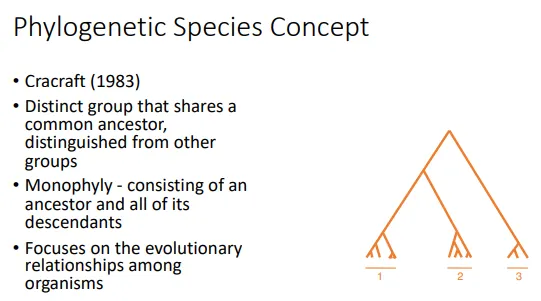
when/why is the phylogenetic species concept useful and what are its limitations?
this concept is useful because it focuses on the evolutionary relationships between distinct species
this can also be applied to fossils and asexual organisms
however:
a very high resolution of the phylogenetic tree is needed
taxonomic inflation- there is a tendency for the number of distinct species to continually increase with each new paper published, because it is hard to draw the lines, and each species could keep being divided up further and further (subjective)
when/why is the ecological species concept useful and what are its limitations?
this concept is very systematic, as adaptive zones (ecological niches) are defined apriori- before looking at the population itself
this can be applied to asexual organisms
it also allows for some gene flow/HGT between groups
however:
this assumes that ecologically discrete zones occur in nature with gaps in between, not as a continuous range
niche construction- certain species are able to change their environment to suit themselves, so they alter the adaptive zone they’re in
what are the different kinds of speciation?
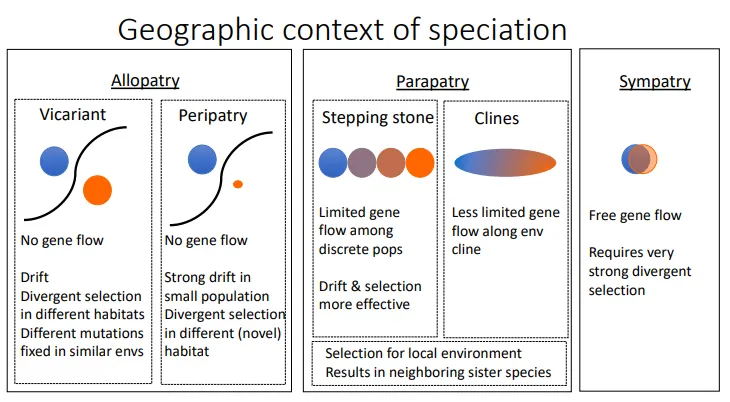
allopatry- speciation when organisms are in two different places (geographically isolated) so there is no gene flow at all, and the populations experience divergent selection (selection against the median phenotype) in their separate habitats
vicariant- the populations are of similar sizes, a few methods may affect it
peripatry- one of the populations is much smaller, and so is strongly affected by drift
parapatry- gene flow between adjacent populations along a long scale may occur, resulting in neighbouring sister species
stepping stone- more discrete populations with limited instances of gene flow
clines- more gene flow along a spectrum
sympatry- free gene flow within a population in same geographical area, relies on very strong divergent selection, against intermediate phenotypes and towards fitness peaks (more common than previously thought)
what evidence is there for vicariant speciation?
diptera mating experiments- separated fly populations that are combined after multiple generations under different degrees of selection/drift exhibit behavioural isolation and some incomplete reproductive isolation
snapping shrimp- strong reproductive isolation and genetic/morphological differences observed between sister species that became separated by the emergence of the isthmus of panama, which created different habitats

what evidence is there for parapatric speciation?
evidence for parapatric speciation is quite weak, because it is difficult to rule out allopatric divergence in the past
ring species- gene flow between adjacent populations, but not between the populations at either end
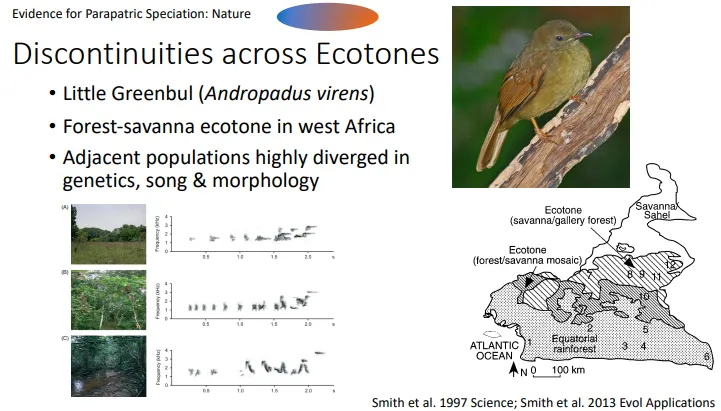
little greenbul- there is a forest-savanna ecotone (cline), across which speciation is starting to occur eg. birdsong frequencies shifting through the different habitats (selection- the sound travels differently in open vs sheltered habitats)
M. guttatus- copper waste from a mine created patchily contaminated soils and copper pollution resistance evolved only within these patches- there was some gene flow between patches but very strong selection, now hybrids don’t perfom well in either habitat
what evidence is there for sympatric speciation?
there are few good examples of sympatric speciation, but it is theoretically possible
lord howe island palms- defined by the analysis of molecular-based phylogenies and genetic data
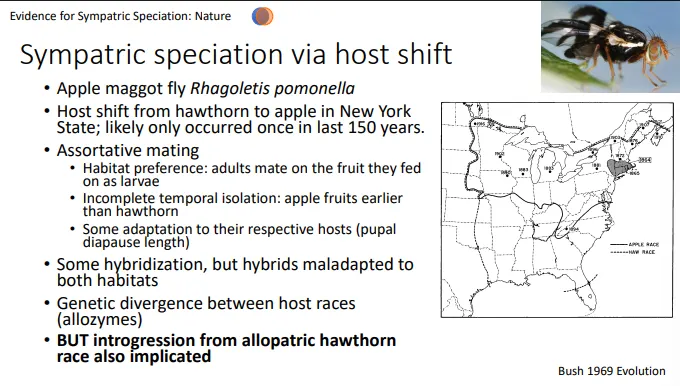
apple maggot fly- underwent a host shift from hawthorn to apple by assortative mating (adults tend to mate on the fruit they fed on as larvae) and incomplete temporal isolation (apples fruit earlier)
this may not be a good example due to recent evidence of a geographically separate southern species introgressing with one of the sympatric forms and causing genetic divergence
what are some other methods/examples of speciation?
speciation by hybridisation:
the ‘big bird’ lineage of G. fortis
an immigrant bred with a resident, resulting in offspring with an extreme bill phenotype that caused reproductive isolation within 3 generations, as the hybrid relatives only bred together (and inbreeding depression didn’t occur)
speciations due to polyploidy:
polyploidy individuals carry more than 2 sets of chromosomes
a change in the number of chromosome pairs that an individual carries can produce almost immediate reproductive isolation (common in plants)
 Note
Note  Flashcards (39)