ap euro final
 Studied by 0 people
 Call Kai
 Learn
Learn Practice Test
 Spaced Repetition
 Match
Match Flashcards
 Knowt Play
1/99

There's no tags or description
Looks like no tags are added yet.
Name | Mastery | Learn | Test | Matching | Spaced |
|---|
No study sessions yet.
100 Terms
Religious change in the seventeenth-century Netherlands led to?
a great vitality in intellectual and artistic life
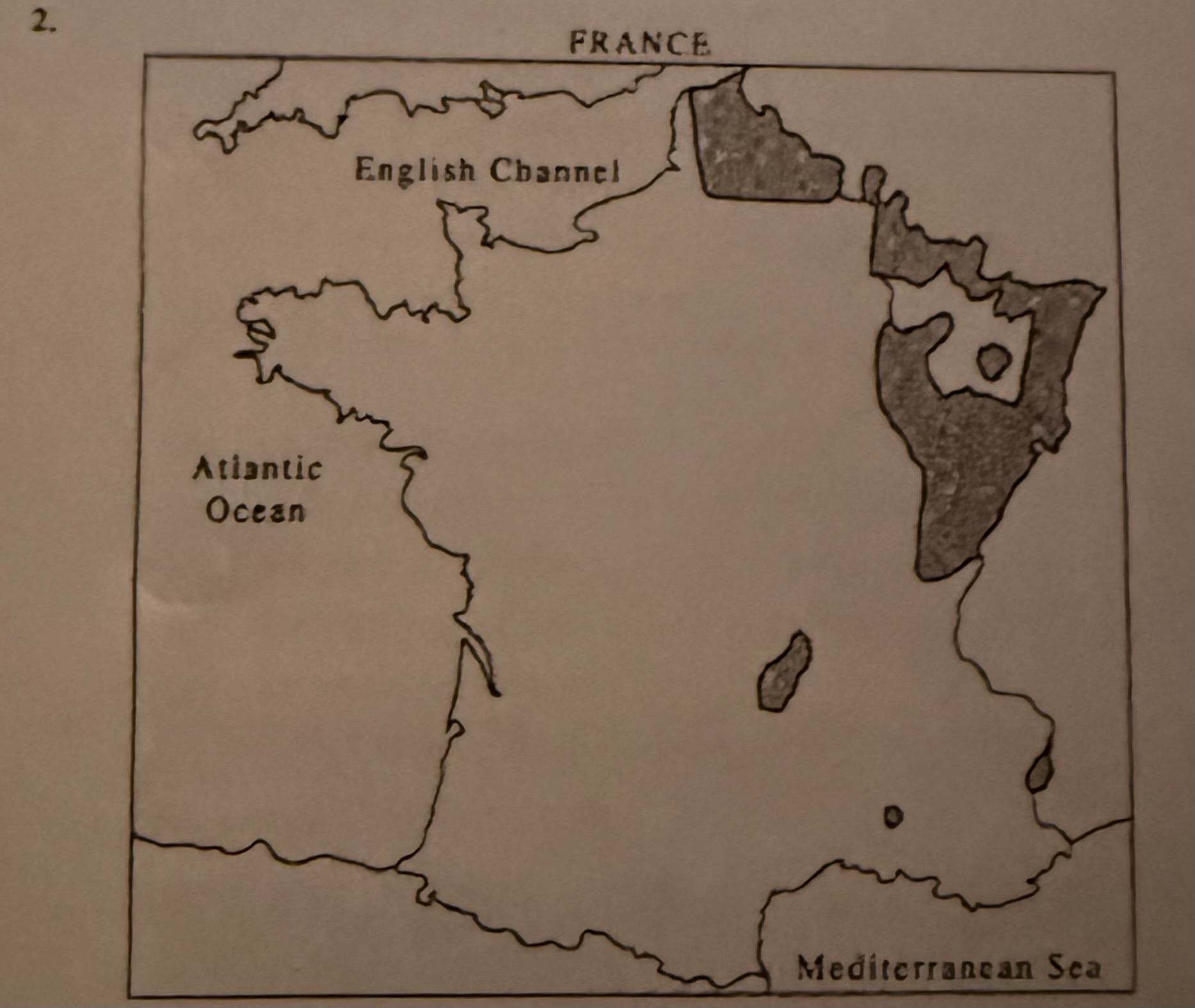
The shaded areas on the map of early eighteenth-century France shown above represent?
territorial acquisitions during the reign of Louis XIV
Which of the following cities dominated European trade and finance in the early seventeenth century?
Amsterdam
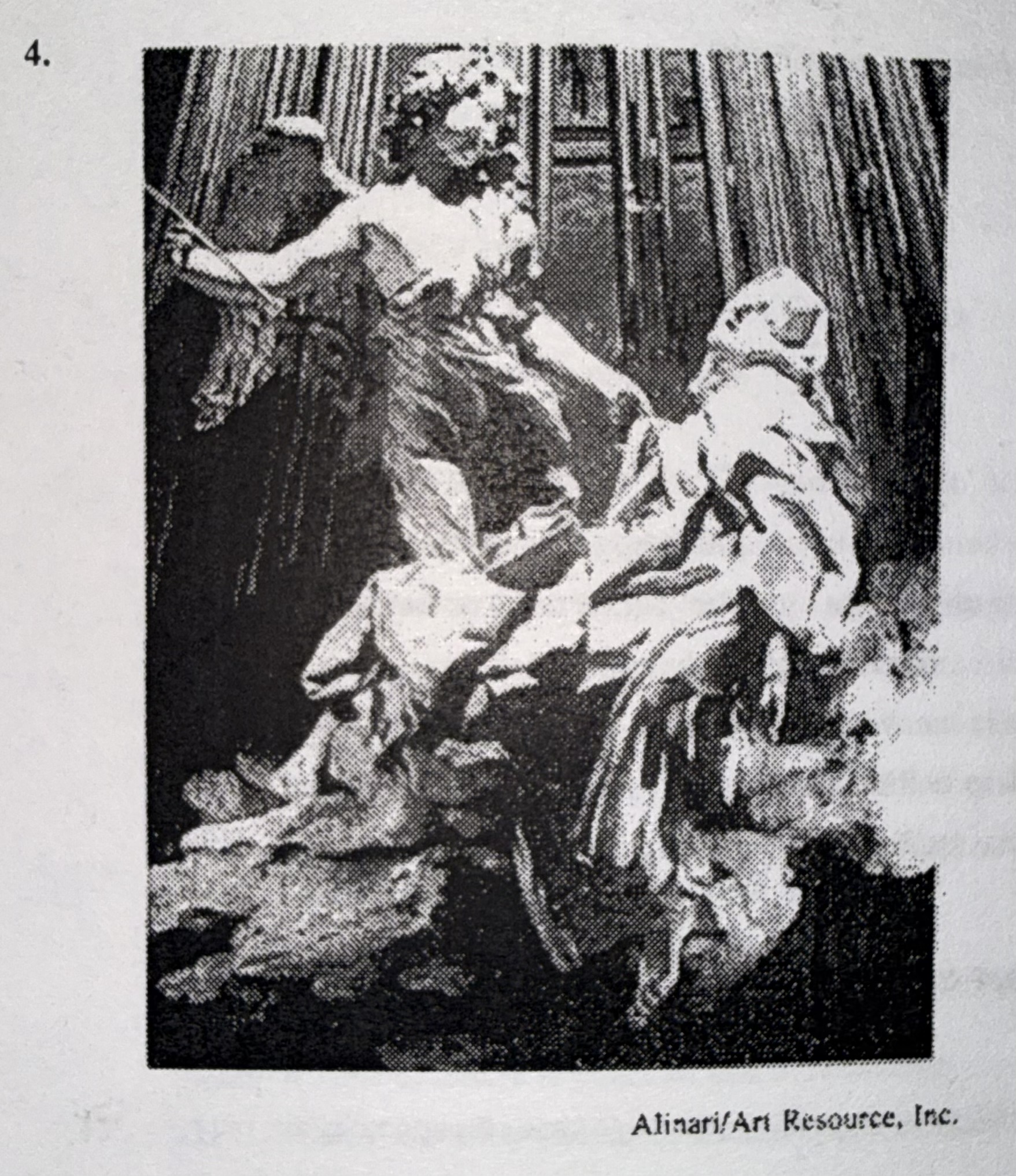
The sculpture by Bernini shown above celebrates?
Catholic Reformation mysticism
"No prudent master of a family ever attempts to make at home what it will cost him more to make than to buy. If a foreign country can supply us with a commodity cheaper than we ourselves can make it, better buy it from them with some part of the produce of our own industry." The quotation above was used to justify
free trade in early nineteenth-century Great Britain
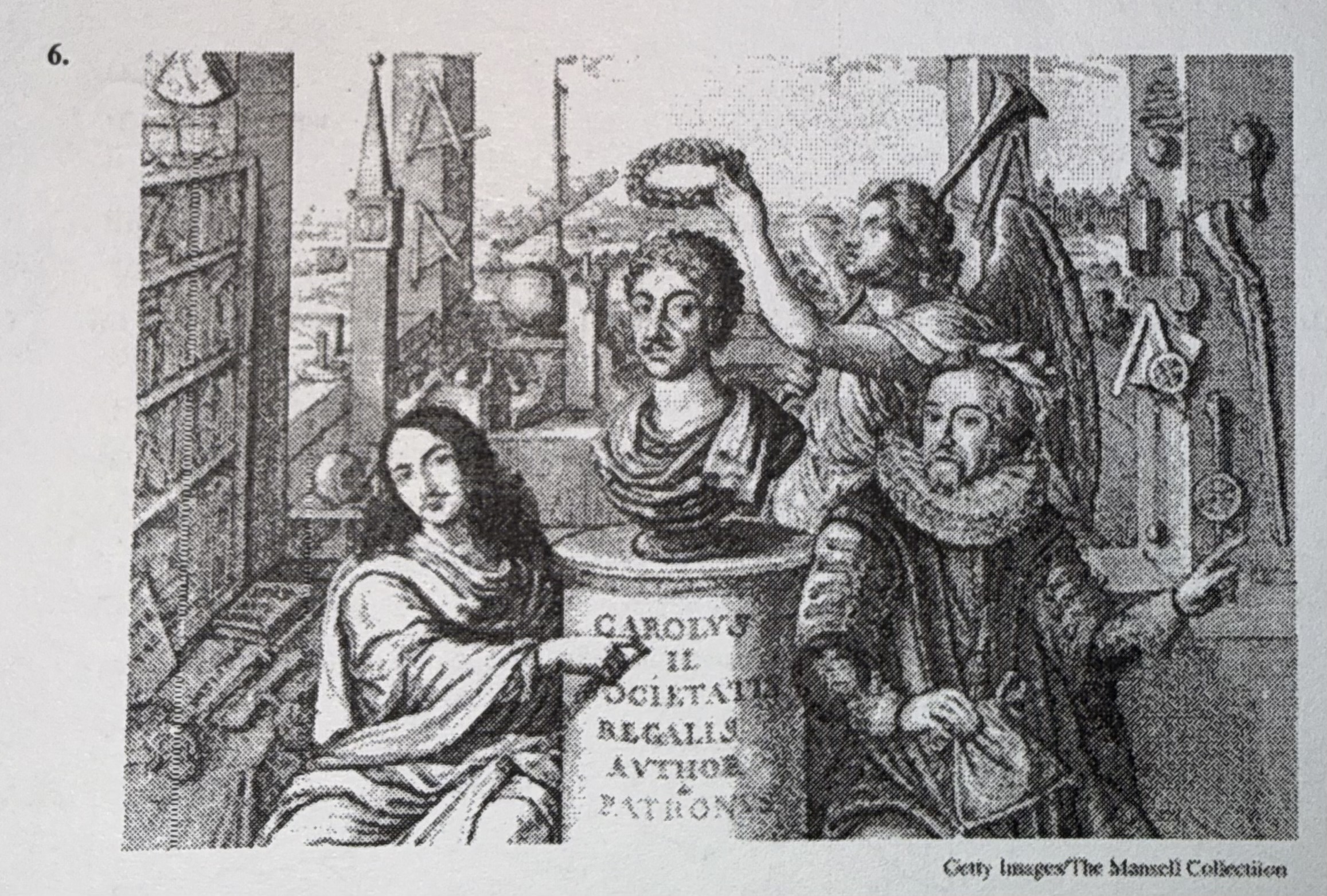
The engraving above illustrates the values of the?
Scientific Revolution
Prior to the expansion of the factory system during the Industrial Revolution, which of the following contributed to the increase in production of manufactured goods?
Expansion of cottage industries in the countryside
Which of the following diseases did NOT produce a major epidemic after the eighteenth century?
Bubonic plague
Which of the following most accurately describes the political system of the Dutch Republic of the seventeenth century?
Rule by wealthy merchants
The leadership of the Dutch revolts (1566–1648) sought all of the following EXCEPT?
an alliance with the English Catholics
A controversial aspect of the Agricultural Revolution in eighteenth-century England was the transformation of common land into private land through the process known as?
enclosure
"That the pretended powers of suspending of laws or the execution of laws by regal authority without consent of Parliament is illegal. That levying money for or to the use of the Crown by pretence of prerogative without grant of Parliament for longer time or in other manner than the same is illegal." The provisions above from the English Bill of Rights were enacted in response to
James II's attempts to dominate Parliament
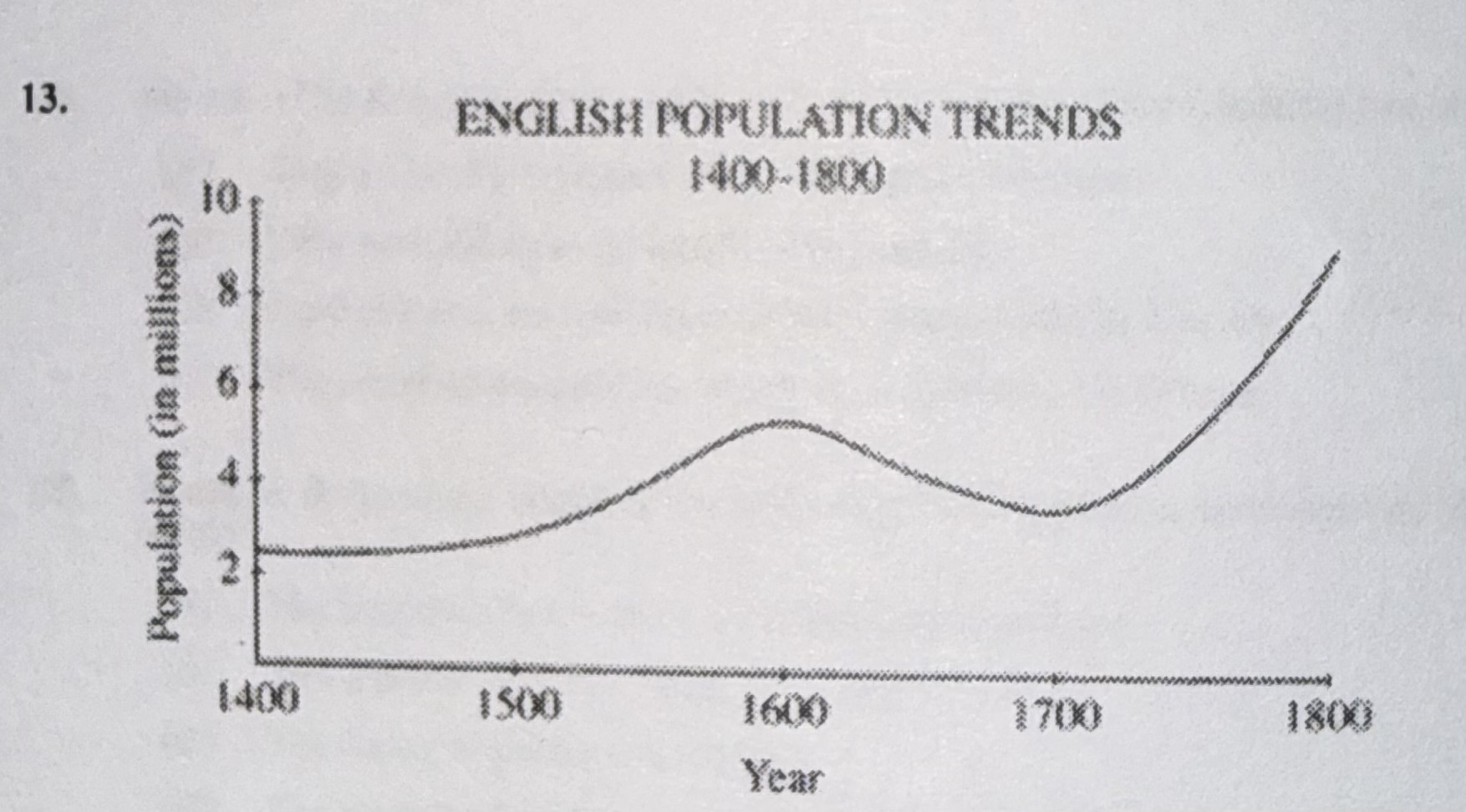
The graph above best supports which of the following statements?
During the late eighteenth century, the English population grew faster than it had from 1450 to 1600
"Since my accession to the throne, I have ever been anxious to conquer prejudices and to gain the confidence of my people. I granted toleration, and removed the yoke which had oppressed Protestants for centuries. Tolerance is a convincing proof of the improvement of the human mind." The author of the quotation was most likely a?
ruler influenced by Enlightenment precepts
Which of the following statements is true regarding western European family life in the period 1750–1850?
There was an increased importance placed on child-rearing among the upper classes
Italian women artists of the Renaissance and Baroque era were able to achieve recognition as artists primarily as a result of their?
commissions from wealthy patrons
Absolute monarchy declined in pre-1789 France primarily because of the?
growth of judicial and aristocratic opposition
Which of the following is true of the German Peasants' Revolt of 1524–1525?
The revolt resulted from a combination of new religious ideas and peasant demands
Hobbes and Rousseau would have agreed that?
the state is based on a social contract
The system of intendants was established in seventeenth-century France primarily to?
implement royal policies locally
In seventeenth- and eighteenth-century Prussia, the junkers supported the monarchy and served in the army in return for?
virtually absolute power over their serfs
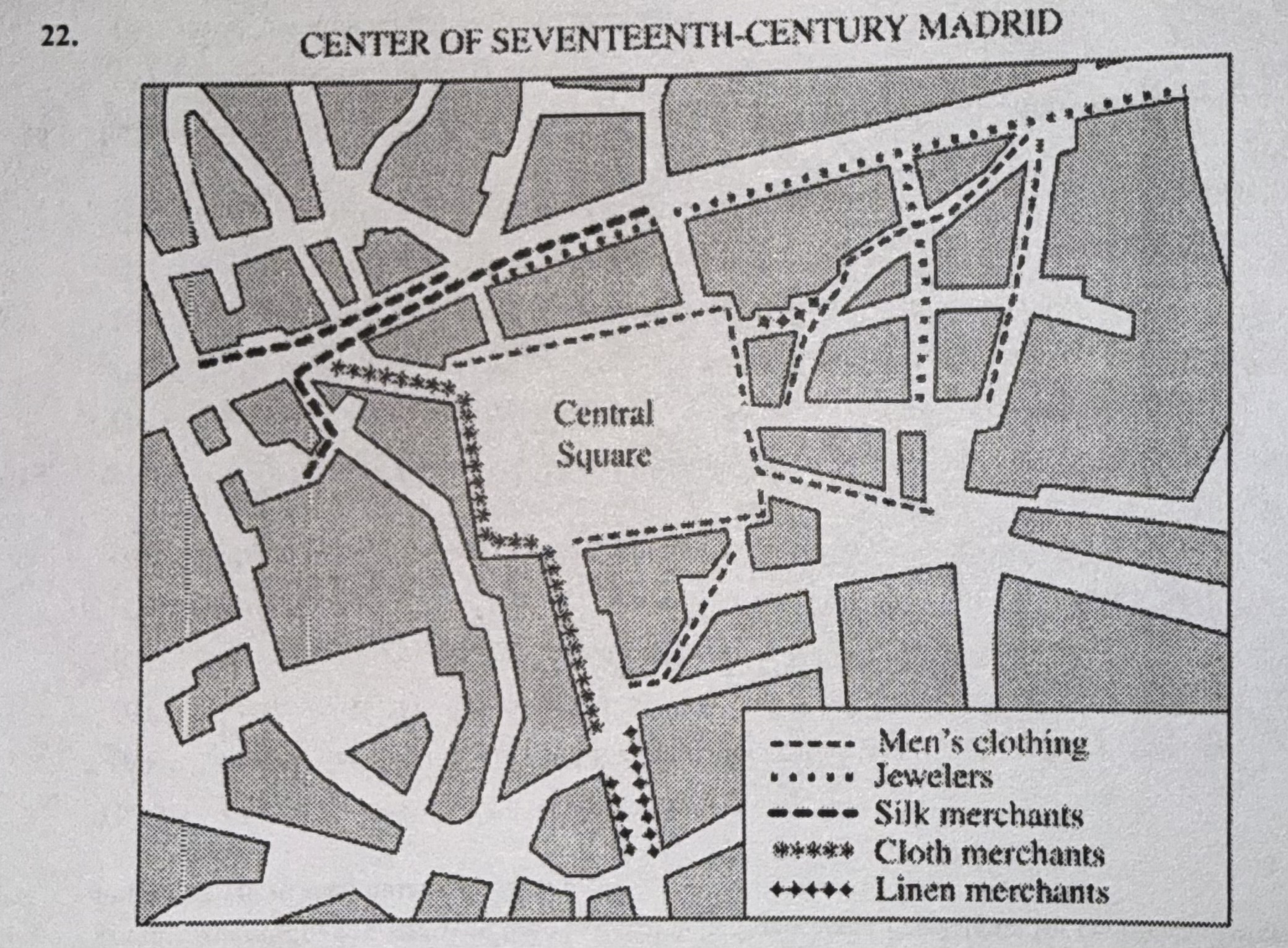
The map above shows which of the following about luxury shops in seventeenth-century Madrid?
Merchants selling similar goods grouped their shops next to one another
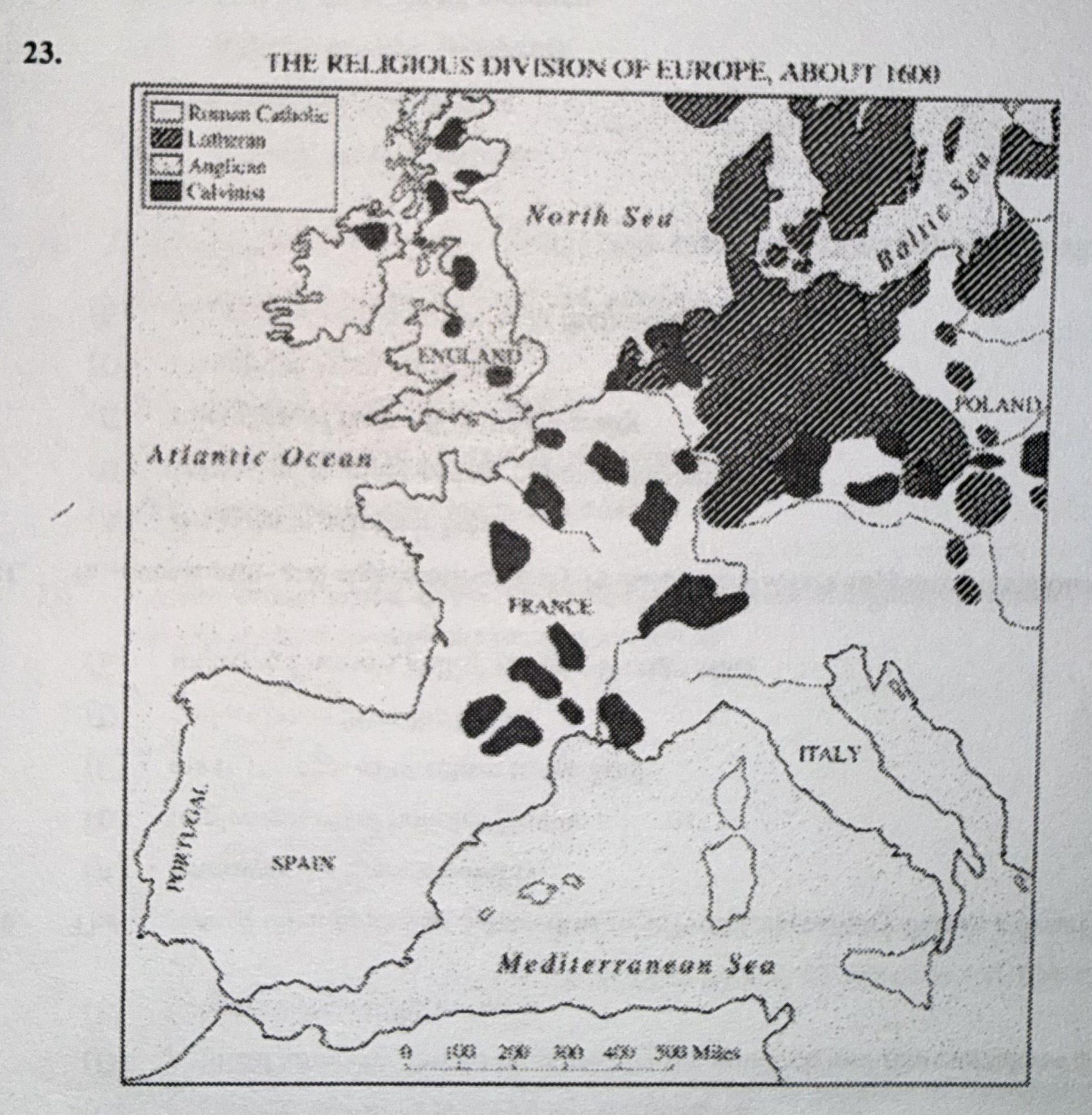
The map above, showing religious divisions in Europe around the 1600s, illustrates which of the following differences between Lutheranism and Calvinism?
Calvinists were more likely to be a minority within a state than were Lutheran areas
"People of France! . . . The French Revolution was nothing but a precursor of another revolution, one that will be bigger, more solemn, and which will be the last. . . ." Which of the following best explains Maréchal's view of the constitutions of 1791 and 1795?
They primarily reflected liberal bourgeois interests
Based on the passage, which of the following Jacobin policies best explains Maréchal's favorable view of the Constitution of 1793?
The fixing of prices and wages
Martin Luther believed that the most important role for a Christian woman was to?
become a wife and mother
Which of the following was a major characteristic of the English monarchy in the eighteenth century?
A steadily widening discrepancy between its theoretical and its real powers
The basic goal of Napoleon’s Continental System was to?
weaken England economically
Which of the following actions by Napoleon aided the cause of German unification?
The elimination of many small states and the political reorganization of territory
By the early seventeenth century, which of the following European nations was the greatest commercial power in Europe?
The Netherlands
Which of the following represents the final defeat of efforts by the Ottoman Empire to acquire large areas of central Europe?
The siege of Vienna (1683)
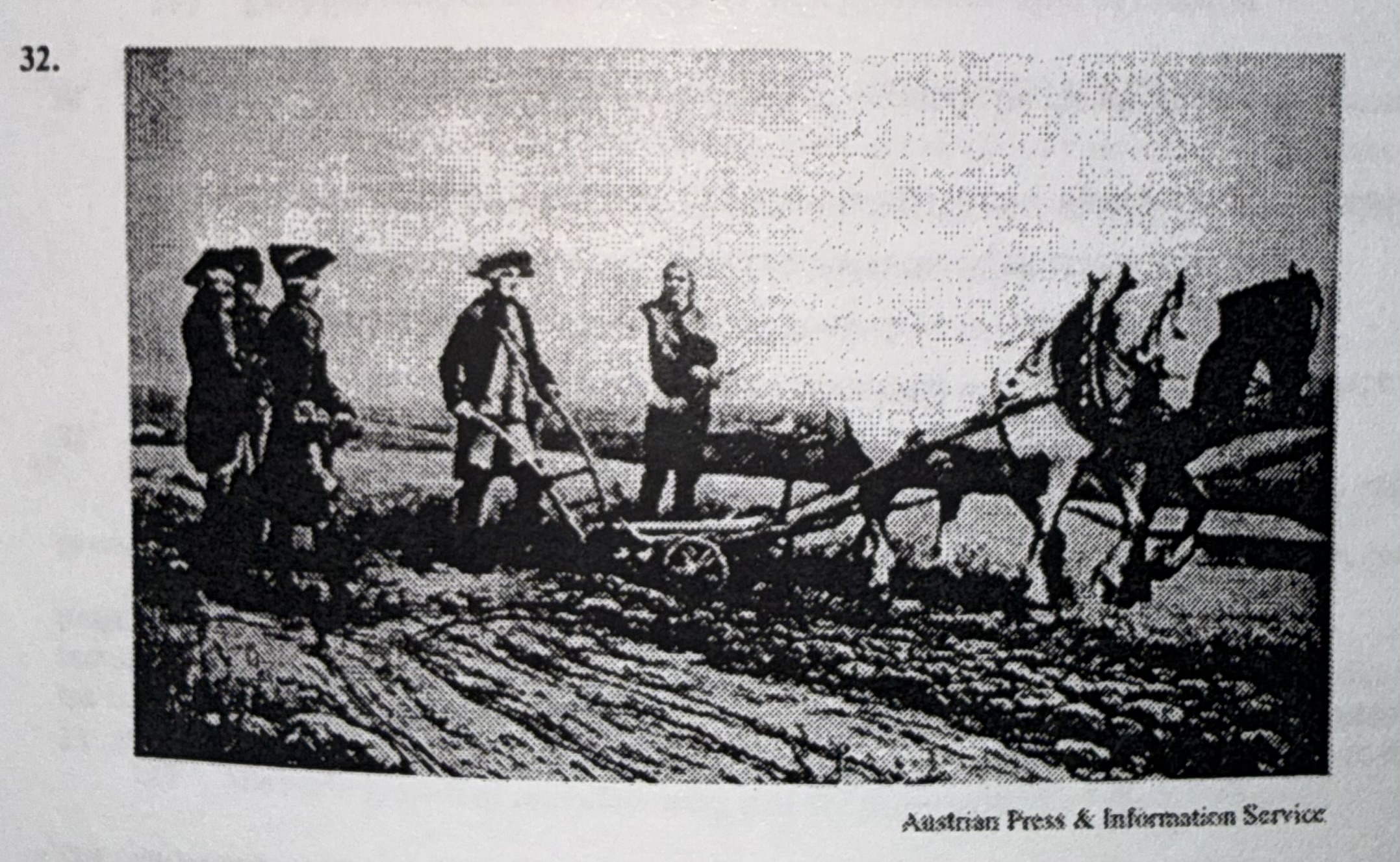
The painting above depicts the Austrian Emperor Joseph II (1780–1790) as?
an Enlightened monarch interested in methods of improving productivity

The Dutch church represented in the painting above can be identified as Protestant because of?
the plainness of the interior
Which of the following best describes the results of the Peace of Augsburg (1555)?
It provided a legal basis for the existence of Lutheranism
The primary purpose of the Peace of Augsburg (1555) was to?
end the civil war between Lutherans and Roman Catholics in the German states
Of the following, which was the most important result of the Peace of Utrecht (1713)?
It ended the efforts of Louis XIV to dominate continental European policies
"14. We are prevented, in violation of the old customs, from gathering wood in the county's forest. In the old days we were free to go to the forests…" The list of demands could best be used as evidence for which of the following?
The persistence of traditional social hierarchies in rural society
Conditions like the ones alluded to in the list of demands frequently encouraged peasants in the sixteenth century to do which of the following?
Mount armed revolts to gain relief from excessive taxes and restrictions
The list of demands is best understood as which of the following?
Landowners' attempts to maximize their income
The tensions between lords and peasants implied by the demands were in part the result of which of the following demographic trends?
The recovery of population after the mortality associated with the Black Death
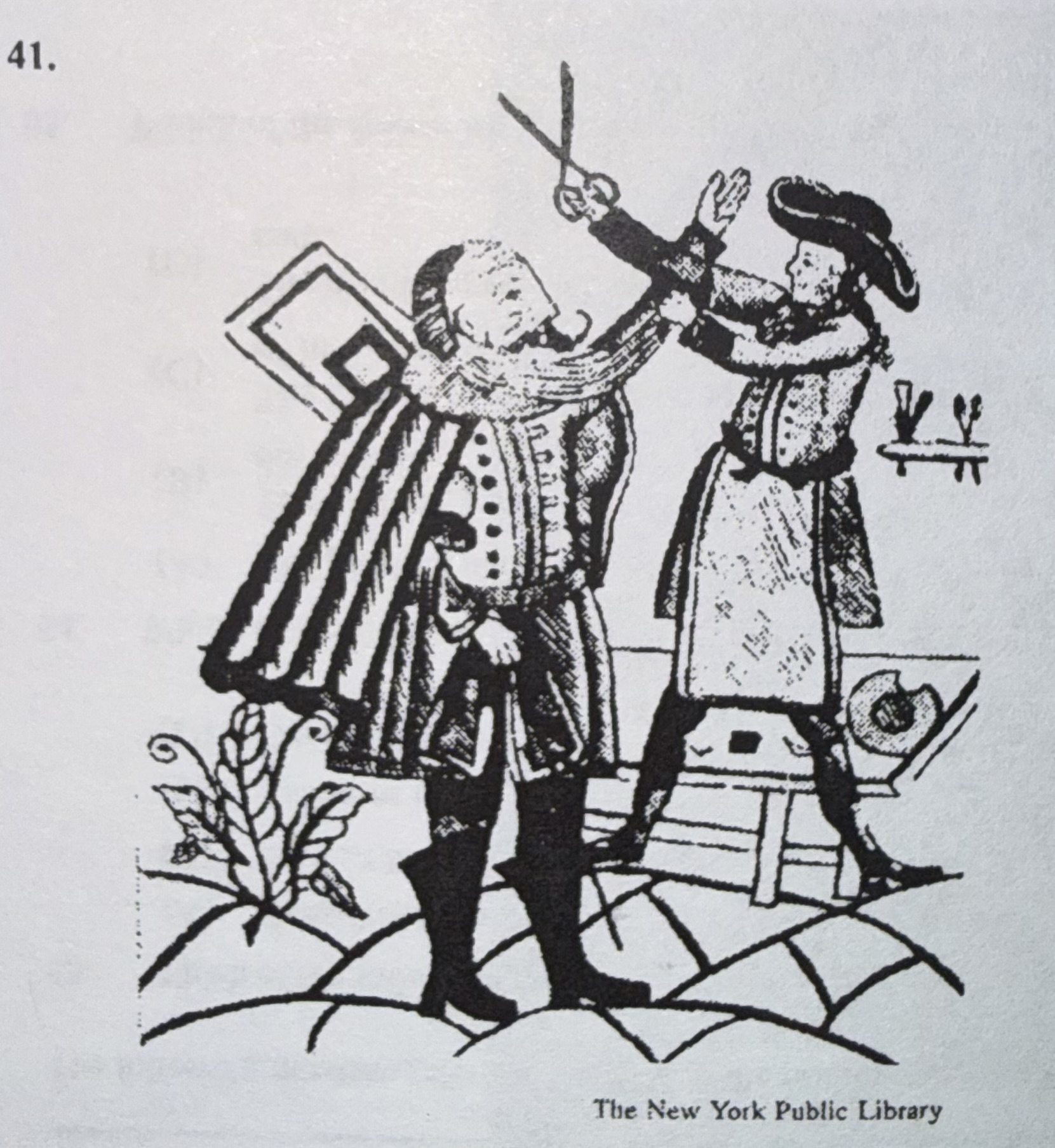
The Russian woodcut above (about 1698) symbolizes Peter the Great's?
imposition of Western values on the Russian nobility
The establishment and growth of St. Petersburg during the early eighteenth century was part of Peter the Great's attempt to do which of the following?
Remake Russian institutions to be as effective as those in western Europe
A primary goal of Philip II of Spain was to?
maintain Spanish control of the Netherlands
The eighteenth-century Enlightenment philosophes were primarily concerned with?
critical and inquiring approaches to knowledge
Which of the following pairs of European rulers is generally identified as "enlightened" monarchs?
Joseph II and Catherine the Great
Portuguese commercial expansion overseas in the sixteenth century resulted in?
seizure of Muslim coastal forts to serve as Portuguese trading posts and military bases
Which of the following was the most important factor behind the Price Revolution of the sixteenth century?
Steady population growth and rising food costs
In 1713 Emperor Charles VI sought approval of the Pragmatic Sanction in order to guarantee the?
indivisibility of the Habsburg lands
One of the main aims of the reforms in Russia under Peter the Great (1689–1725) was to make high social status dependent on?
service to the state
Demographic changes in late sixteenth- and early seventeenth-century Europe contributed to?
price inflation and a decrease in real wages
In seventeenth-century Poland, the most significant political influence was exercised by the?
nobility
The Habsburg Emperor Charles VI (1711–1740) issued his Pragmatic Sanction in order to?
guarantee the succession of his eldest daughter to the throne
Which of the following most facilitated the rapid adoption of the printing press in Europe in the last half of the 1400s?
increases in literacy and decreases in the cost of paper
Which of the following best explains why the spread of the printing press encouraged the spread of new religious ideas?
The printing press allowed people to bypass the Catholic Church’s traditional authority
Which of the following best explains how the printing press contributed to the development of national cultures in Europe?
The printing press encouraged the spread of vernacular literature
The acquisition of which of the following territories during the mid-eighteenth century helped to establish Prussia as a great power?
Silesia
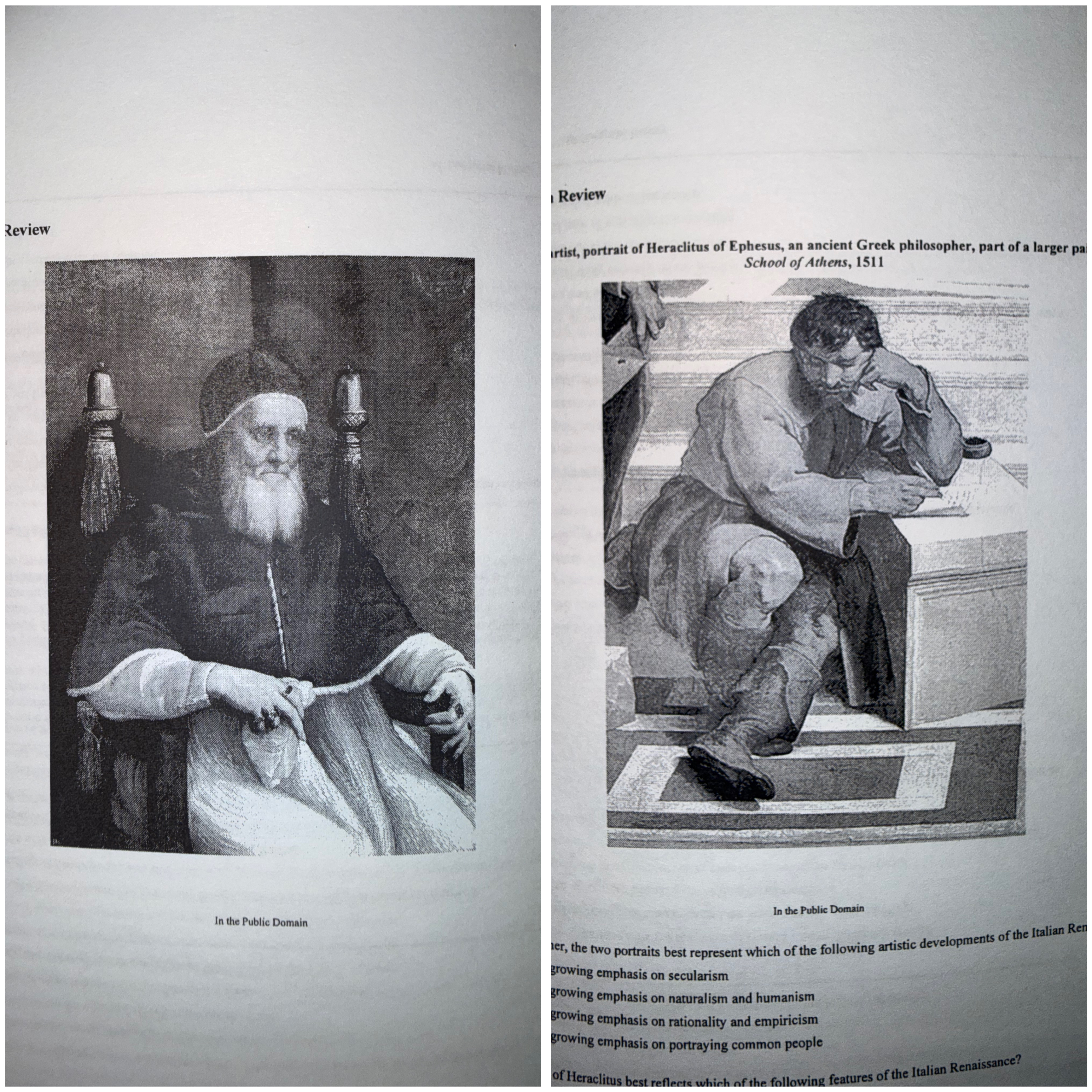
Taken together, the two portraits best represent which of the following artistic developments of the Italian Renaissance?
The growing emphasis on naturalism and humanism

The portrait of Heraclitus best reflects which of the following features of the Italian Renaissance?
The revival of interest in classical works
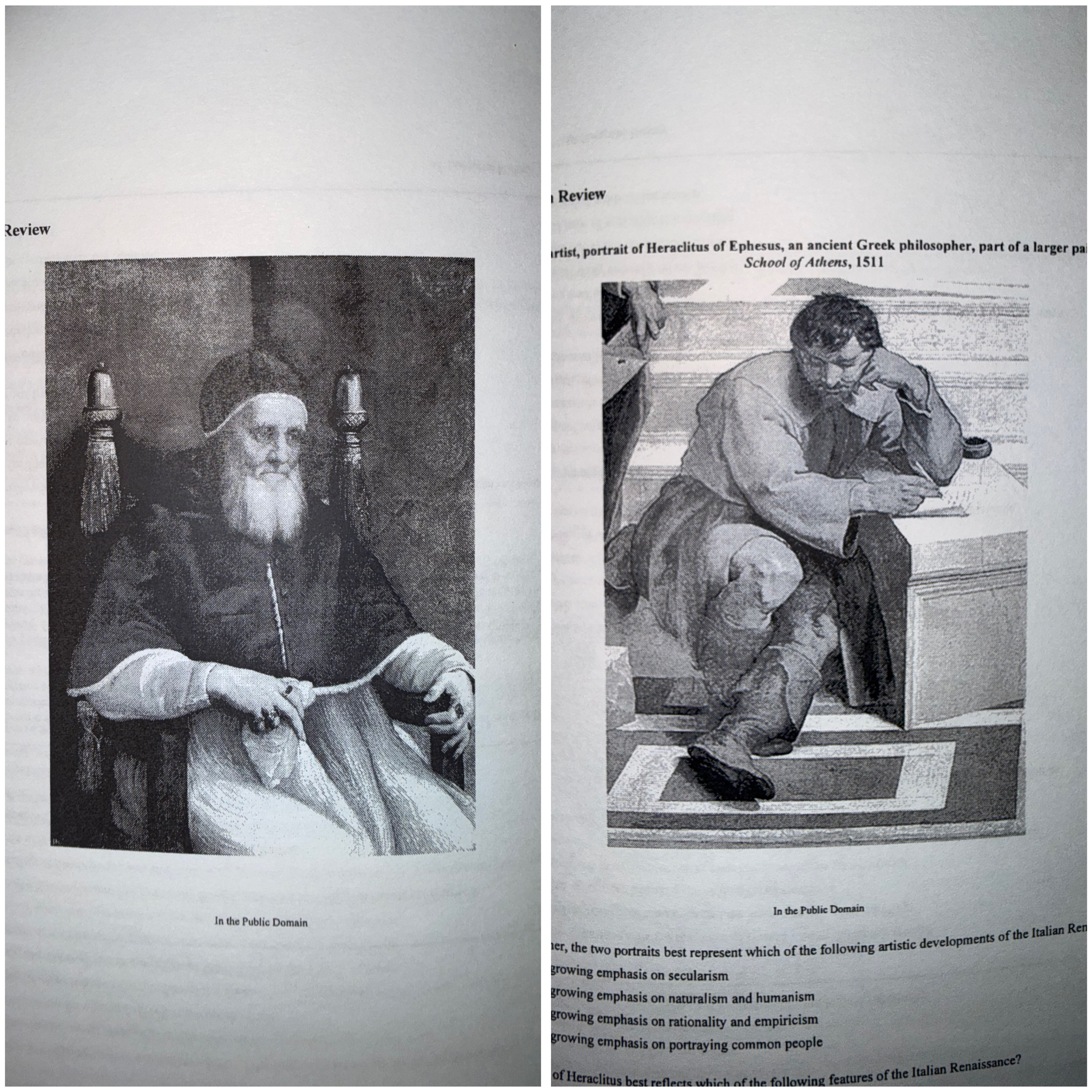
The commissioning of Image 1 best represents which of the following trends of the Italian Renaissance?
the use of art to enhance the prestige of the elites
The calling of the Estates-General in France by King Louis XVI in 1789 was the direct result of?
The failure of the Assembly of Notables to endorse the monarch’s program of tax reform
"The expansion of Europe was an intensely nationalistic phenomenon. It was an aspect of the trend, most evident in the late fifteenth and early sixteenth centuries…" Which of the following general claims does the author make regarding the background of European overseas expansion?
It emerged from the consolidation of central governments
Which of the following claims does the author make about the Portuguese ruling dynasty?
It consolidated power and overcame feudal divisions
Which of the following combined advantages does Reed claim that the Portuguese had in the Age of Discovery?
Stability in government and favorable geography
Which of the following affected the status of women during the Reformation?
The suppression of nunneries and the institution of a married clergy
Sixteenth- and seventeenth-century European political leaders generally viewed religious toleration as?
leading to dangerous civil disorder
Renaissance humanism is primarily defined as?
a curriculum based on the study of the classics, rhetoric, and history
Renaissance humanism drew its main inspiration from?
classical languages and literature
Italian society differed from the rest of Europe during the Renaissance in which of the following ways?
number of urban commercial centers
"They are ungrateful, changeable, simulators, dissimulators, runaways in danger, eager for gain; while you do well by them they are all yours; they offer you their blood…" The political assessment above of Renaissance citizens can be found in?
Machiavelli’s The Prince
"Assume, O men of the German lands, that ancient spirit of yours with which you so often confounded and terrified the Romans and turn your eyes to the frontiers of Germany…" Celtis’ discussion of Italian influence in the German lands is most similar to which of the following?
Martin Luther’s criticism of the Catholic Church in his Ninety-five Theses
The passage above most directly shows the influence of which of the following trends in fifteenth-century Europe?
The revival of classical learning and the development of northern humanism
Jean-Jacques Rousseau differed significantly from other Enlightenment philosophes in his?
emphasis on emotions and his admiration for the “noble savage”
"The law is the expression of the general will. All citizens have a right to concur either personally or by their representatives in its formation. The law should be the same for all, whether it protects or whether it punishes." The quotation above is a formulation of the idea of?
Jean-Jacques Rousseau

According to the map above, during the eighteenth century, Russia expanded in Europe primarily by gaining territory from?
Poland
In the eighteenth century, the effectiveness of the Russian monarchy was limited by?
the enormous land area of the country
The massacre of Saint Bartholomew’s Day (1572) was directed against?
Huguenots in France
In seventeenth-century western Europe, marriage patterns showed a tendency toward?
relatively late first marriage by non-noble women
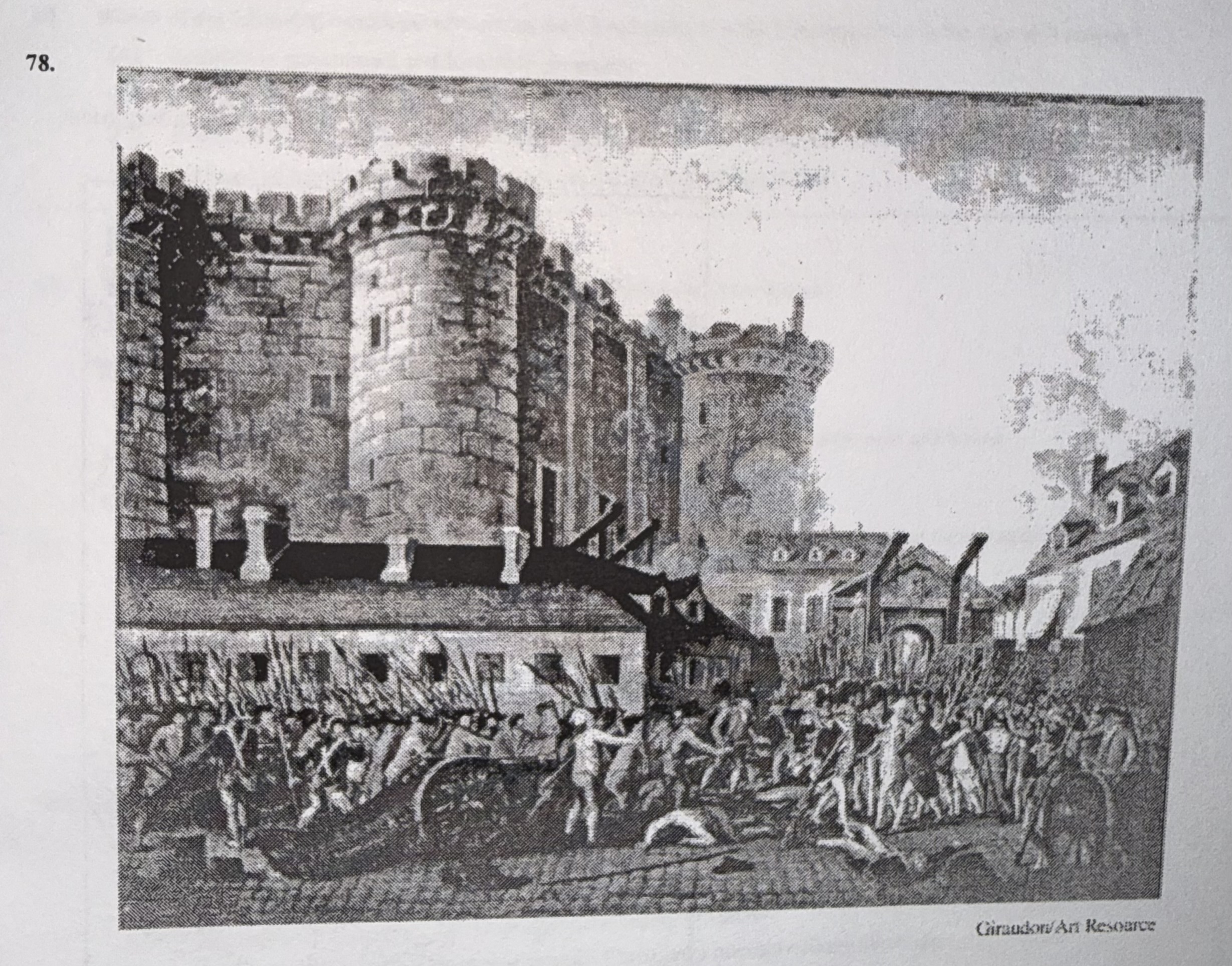
The contemporary drawing above of the storming of the Bastille was intended to portray?
popular participation in the revolutionary process
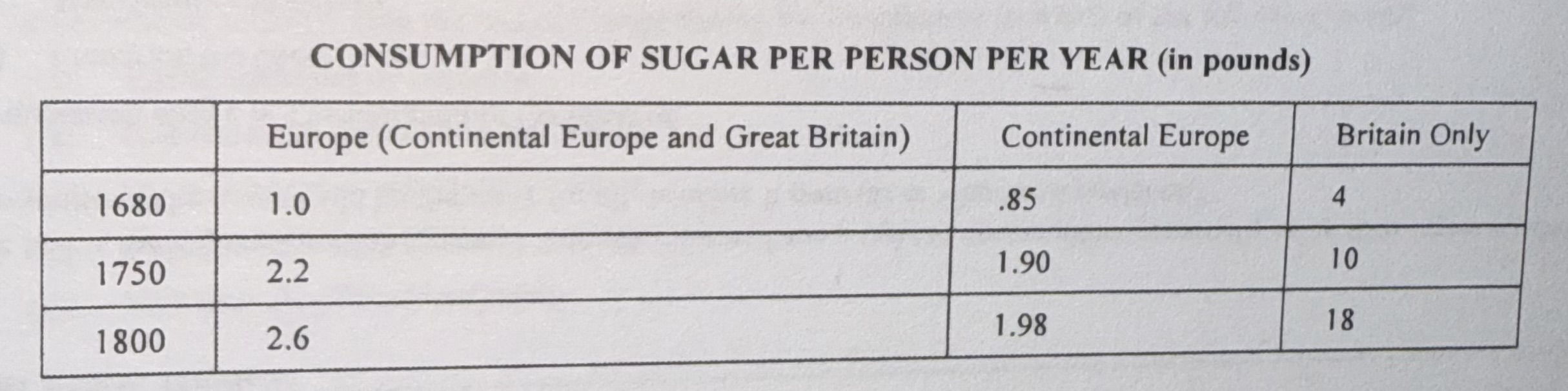
Which of the following best explains the overall trend in sugar consumption represented in the chart?
The development of plantation colonies in the Caribbean
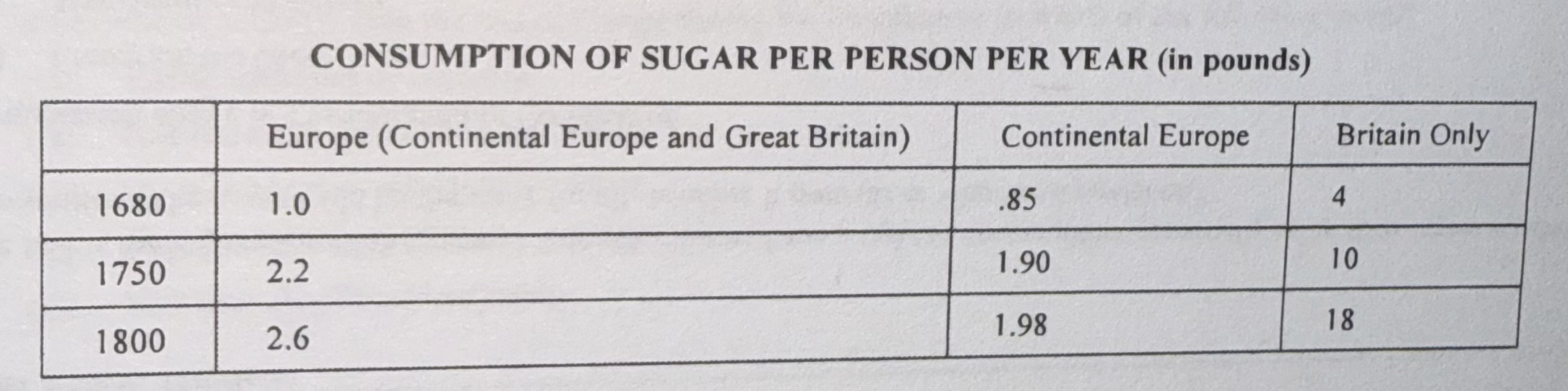
All of the following statements are factually accurate. Which describes the most serious limitation of the data showing only a small increase in sugar consumption by continental Europe from 1750 to 1800?
In 1800, the British navy was blockading French-controlled ports and interfering with overseas trade
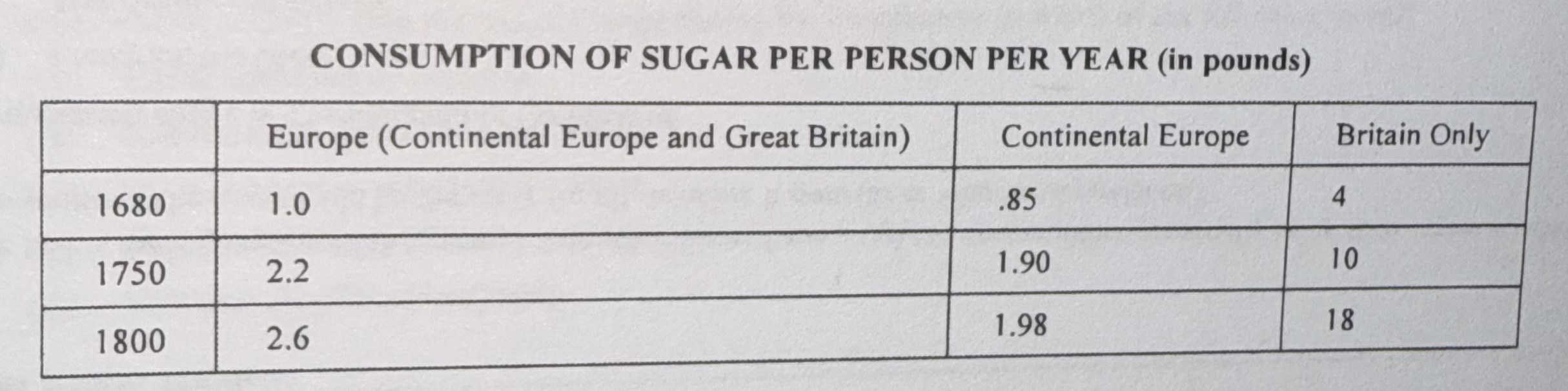
The overall trend in sugar consumption represented in the chart contributed LEAST to which of the following?
The outbreak of rebellion in the French colony of Saint-Domingue
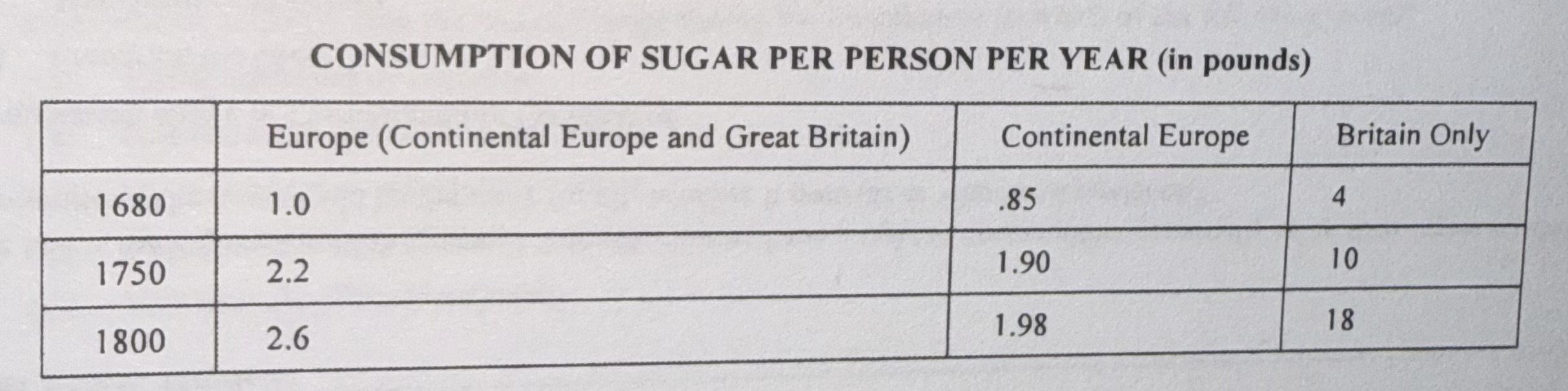
Which of the following most directly facilitated the trend in sugar consumption in Britain represented in the chart?
the wars of the eighteenth century left britain the dominant naval power in the atlantic
The American Revolution played a major role in European history because it?
precipitated the French fiscal crisis that led to the calling of the Estates-General
Napoleon’s primary aim in establishing the Continental System was to?
destroy Great Britain’s economy
The French Fronde is best described as the?
revolt over increasing centralization of royal power
The Peace of Westphalia (1648) resulted in which of the following?
the guaranteed independence of numerous small German states
The long-term effect of the Thirty Years’ War on the German states was to?
devastate the German states’ economies
The most important political and military result of the Thirty Years’ War and the Peace of Westphalia was the?
rise of France as a great power
The major drawback of the open-field (three-field) agricultural system was that?
every year a substantial portion of the land was not planted
Urban life in major European cities during the Industrial Revolution was characterized by?
overcrowded living conditions and unsafe working conditions
The group most severely criticized in the works of Voltaire was the?
Roman Catholic clergy
Which of the following is most characteristic of Voltaire’s ideas?
empiricism and religious toleration
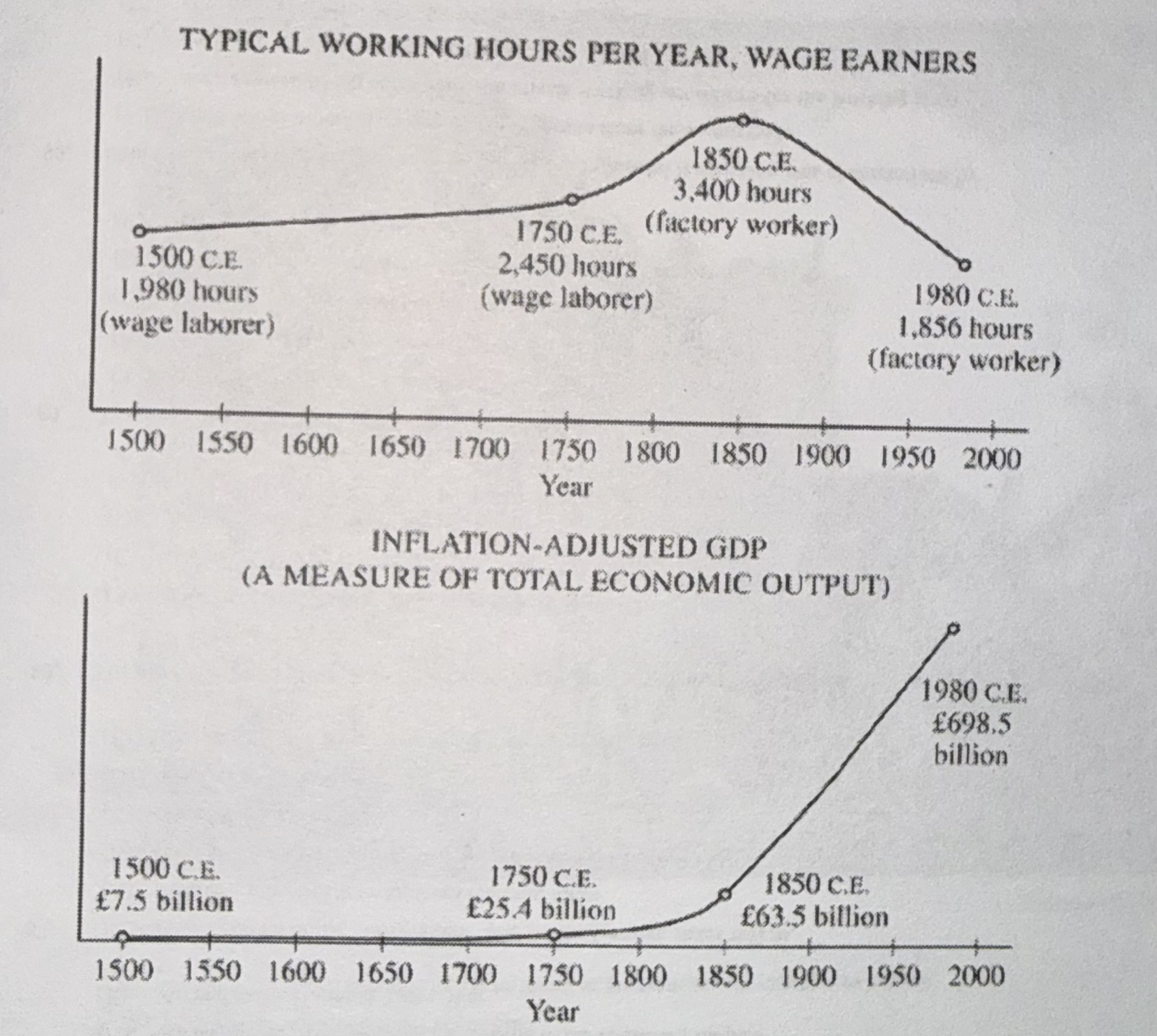
Which of the following was the most direct cause of the change in typical working hours between 1500 and 1750?
the lifting of traditional restrictions on economic activity
A major result of the War of the Spanish Succession and the Treaty of Utrecht was to?
prevent France from upsetting the balance of power
"Twentieth-century Fascism is a byproduct of disintegrating liberal democracy. Loss of hope in the possibilities of existing order and society, disgust with their corruption and ineffectiveness…" Which feature of the French Revolution best supports Weber’s argument comparing Fascism to Jacobinism?
the economic price and wage controls imposed during the Reign of Terror
"Lutherans who are subjects of Catholics, and Catholic subjects of Lutherans, and those who at some time following the peace’s publication shall profess and embrace a religion different from that of the lord…" The provisions of the treaty had which long-term effect on Europe?
a decline in the importance of religion as a cause of conflict
The Peace of Westphalia also had which of the following effects on European politics?
It weakened the Holy Roman Empire and encouraged eastward Habsburg expansion
"I was called to England to be the arbitrator and mediator between King James and his subjects…" William’s letter to Pope Innocent was intended to justify?
the outcome of the Glorious Revolution
William’s claim regarding James’s “design” is best explained by which of the following developments?
conflicts between the Catholic Stuart monarchy and Protestant Parliament
William’s development of his status within the English government is best explained by which of the following?
the assertion of parliamentary supremacy over the monarchy
 Note
Note  Flashcards (30)