2 motor development
 Studied by 0 people
 Call Kai
 Learn
Learn Practice Test
 Spaced Repetition
 Match
Match Flashcards
 Knowt Play
1/36

There's no tags or description
Looks like no tags are added yet.
Name | Mastery | Learn | Test | Matching | Spaced | Call with Kai |
|---|
No analytics yet
Send a link to your students to track their progress
37 Terms
major motor milestones
newborn - moro, positive support primitive reflexes, flexed posture
two months - head up 45o in prone
four moths - asymmetrical tonic neck primitive reflex, lifts chest in prone
six months - primitive reflexes gone, pulls to sit, sits tripod
nine months - postural reflexes present, rolls both ways, sits well
12 months - gets to sit, crawls, pulls to stand, walks with one hand help, catches rolling ball
18 months - gets to standing, walks alone, walks up and down stairs with railing
24 months - runs, jumps, kicks, throws ball overhand three feet forward, walks up stairs marking time no railing
36 months - pedals tricycle, walks down stairs marking time, no railing, walks up stairs alternating feet, no railing
48 months - hops, walks down stairs alternating feet, no railing, walks backwards in line
60 months - catches ball, balance on one foot; sit ups, skips
what are reflexes and why are they important incl. examples
involuntary, rapid movements in response to a stimulus
they help an organism to avoid danger eg: withdrawal reflex, blinking reflex and coughing reflex
name six infant reflexes and what they’re in response to
asymmetric tonic reflex - in response to head turn, ‘fencing’ reflex
grasping reflex - in response to palm stroke
stepping reflex - early kicking motion or precursor to walking?
moro response - ‘startle’ reflex to loud sound or sudden movement
rooting - in response to cheek stroke
babinski - in response to the sole of foot stroke
how long should primitive reflexes last
should disappear by 6-8 months, if not their persistence indicates neurological problems
where are primitive reflexes controlled by
the medulla and the midbrain
which two infant reflexes are primitive
moro and babinski
how long should adaptive reflexes last
they should disappear within the first year of life
what does a lack of adaptive reflexes indicate
weak or absent reflexes warn of possible neuronal development problems
what is the purpose of adaptive reflexes and which three infant reflexes are examples of this
sucking, swallowing and rooting all help survival
what are the average heights and weights at the newborn stage, end of year 1 and end of year 2
newborn - 20 inches long, 7 ½ pounds
end of year 1 - 32 inches long (50% greater than birth), triples to 22 pounds
end of year 2 - 36 inches long (75% greater than birth), quadruples to 30 pounds
Berk (2019)
when does a Childs body grow fastest
faster in the first two years than any other time in their life
what is cephalo-caudal measurement
from head to tail, at birth the head takes ip ¼ of total body length, lower body then catches up
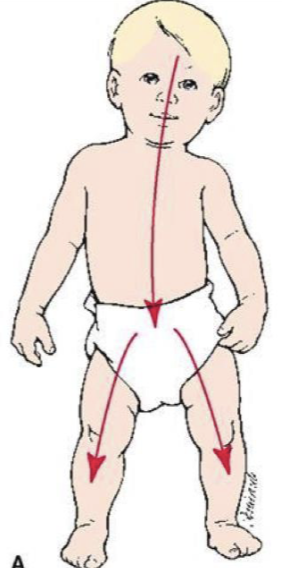
what is the proximo-distal measurement
from near to far, from one arm to opposite leg, prenatally, head, chest and trunk grow first then the arms and legs catch up
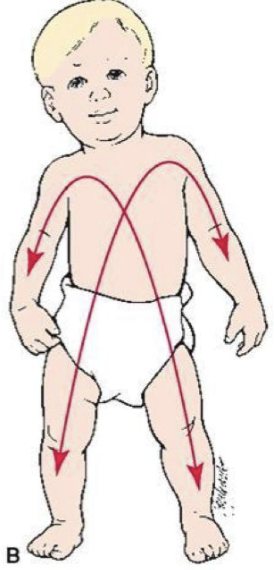
what type of pattern did Gesell and Ames (1940) suggest motor development follows
cephalon-caudal pattern, for head control, reaching, sitting and walking
what did Slater and Brenner (pp 47) say development is controlled by
“development is controlled by a maturational timetable… each animal species has its own sequence, and experience has little, if any, effect on motor development”
what are three gross motor milestones
posture - supine (pull up to sitting) and ventral suspension/prone
standing and walking
age of acquisition is variable; pattern is more meaningful
what are the developmental milestones in relation to sitting
newborn: complete head lag
3months: slight head lag
4-5 months: no head lag
5-6month: sits supporting self
6-7months: sits without support
10-11months: good support while sitting and able to perform movement
12+months: sits in a chair
what are the developmental milestones in relation to ventral suspension
newborn: lack of head control
6 weeks: momentarily holds head in same place as rest of body
8 weeks: maintains head in line with body
3months: maintains head above line of body, holds chin and shoulders off surface
5-6months: keeps the chest and shoulders off surface, maintains weight with hands and elbows
what are the developmental milestones in relation to the prone position (extension of ventral position)
at 3 months can roll from prone to supine
at 8-9 months crawls - required hip and leg muscle control, can lift trunk off floor
what are the developmental milestones in relation to standing and walking
2 months: hold head momentarily
6 months: can bear almost all weight, using legs
9 months: stands holding furniture, can pull self ip to standing
12 months: walks with broad case, steps unequal in length and direction
15 months: crawling up steps, standing position without help
2 years: picks up objects off the floor without falling, walks backwards
3 years: up and down steps one foot per step
what are the two sources of variability
intrinsic and extrinsic
what is meant by an intrinsic source of variability
genetically determined attributes eg. physical characteristics, temperament
what is meant by an extrinsic source of variability
environment, socioeconomic status, family, culture
is motor development sequence genetically determined
simply because of the general tendency for motor development does not mean it is genetically determined
major milestones in fine motor skills
newborn - root, suck primitive reflexes; orients to sound; smiles to voice; variable cries
two months - gurgles
four months - coos
six months - looks toward person talking; vocalises to answer; laughs
nine months - transfers; radial-digital grasp; touches cheerio with finger; raking pioneer grasp
12 months - pincer grasp; voluntary cube release into cup; holds bottle
18 months - inserts shapes, stacks two to three cubes; scribbles (fisted); self-feeds (fingers)
24 months - copies vertical line; stacks six cubes; uses spoon; helps dress
36 months - copies horizontal line; circle; stacks 10 cubes; uses spoon well and fork, drinks from open cub, removes socks and shoes, undresses
48 months - copies cross, draws two to four part person; cuts paper in half; dresses no buttons
60 months - copies square, draws 10 part person, colours between lines, tripod pencil grasp; washes and dries hands thoroughly
what are examples of fine motor skills
-precise movements of hands and fingers eg. pincer grasp
-eye hand coordination
-manipulating small objects
what are fine motor skills interlinked with (Gerber et al., 2010)
visuospatial skills which are both motor and cognitive skills
what are the developmental milestones in relation to grasping
newborn: grasping reflex
3-4 months: ulnar grasp (no thumb)
5 months: grasp objects voluntarily
4-6 months: adapt ulnar grasp for shape and size
1 year: pincer grasp
what did Rocha et al. (2013) find regarding reaching and grasping
infants tested longitudinal at 4,5,6 months
balls were large, small, soft or rigid
from 4 months infants adjusted their reach and grasp to suit the size and texture of the object
what are the developmental milestones in relation to grasping
newborn: pre reaching
3-4 months: purposeful reaching
4-5 months: transfer between object hands
5-6 months: continue to reach for an object in the dark
what did Witherington (2005) find regarding reaching and grasping
infants tested longitudinally at ages 5,6,7 months
object presented either horizontally or vertically
infants of all ages adjusted the orientation of their hand when reaching towards the object
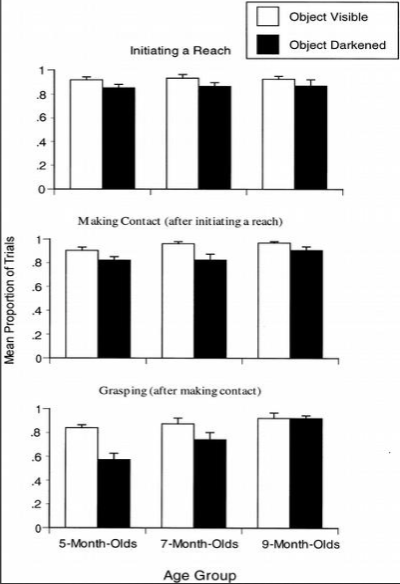
what did McCarty and Ashmead (1999) find regarding reaching and grasping
tested 5,7,9 month infants in a dark room
reaching for a rod that had lights inside
on half the trials the object remained visible, on the other half of the trials the light inside the object were turned off after the infant began reaching
infants still reached for the object even though it was no longer visible
what did galloway and thelen (2004) research into whether motor development follows a cephalo-caudal pattern
tested 8-15 week olds, weekly
held a toy at midline between shoulders and midline of hips
timing of reaching with hands and feet
-hands 15.7 weeks (extended contact 16 weeks)
-feet 11.7 weeks (extended contact 11.8 weeks)
how does teratogen exposure affect motor development
alcohol consumption damages the developing motor control system (Barr et al., 1990)
pregnant woman reported teratogen exposure, gross motor and fine motor control was examined later when their children were 4 years old and there was a significant negative effect of alcohol consumption on fine and gross motor skills
this risk seems to occur throughout pregnancy (Doney et al., 2014)
how are actions developed from skills
standing, walking, pincer grasp are building blocks of more complex sequences, actions
separate abilities blend together, become more complex, more effective
what is thelen and Spencer (1998) dynamic systems theory
motor developments result from ongoing and dynamic interaction between:
-developments of the nervous system
-capabilities of the body
-environmental constraints and support
critical idea is that these all interact to allow the development of the optimal movement for a particular situation
self organisation within the system
how did thelen (1999) investigate the dynamic systems theory
3 month olds tested
free condition - ribbon attached to one leg, made an overheard mobile move, infants quickly learned to kick legs independently to move the toy
yoked condition - both legs yoked together, infants learned to kick both legs together to move the toy
natural kicking pattern adapted to achieve their goal
 Note
Note  Flashcards (123)