NPB 101 UCD WQ26
 Studied by 0 people
 Call Kai
 Learn
Learn Practice Test
 Spaced Repetition
 Match
Match Flashcards
 Knowt Play
1/151

Earn XP
Description and Tags
Cumulative Review
Name | Mastery | Learn | Test | Matching | Spaced | Call with Kai |
|---|
No analytics yet
Send a link to your students to track their progress
152 Terms
Levels of Organism From Smallest to Largest
Atom → Molecule → Organelle → Cell → Tissue → Organ → System → Organism
What is the breakdown of Extracellular and Intracellular fluid?
33% Extracellular, 67% intracellular
What percent of the Extracellular fluid is interstitial fluid?
26%
What percent of the Extracellular Fluid is plasma?
7%
What is Interstitial fluid?
Fluid in between cells in the extracellular space
What are the four main tissue types?
MENC: Muscular, Epithelial, Nervous, Connective
What is the main function of Muscular Tissue?
Contractility
What is the primary function of Epithelial tissue?
Delimit, exchange, secretion
What is the main function of Connective Tissue?
Structural Support
What is connective Tissue made of?
Parenchyma & Stroma
What is Parenchyma?
Functional Cells
What is Stroma?
Supporting framework
What is the main function of Nervous Tissue?
Signal processing
What is homeostasis?
The maintenance of a dynamic steady state in an internal environment, where dynamic mechanisms detect and respond to deviations from a set point
What is required to achieve homeostasis?
A way to monitor a variable
A Set point
Ability to detect a change
Way to return the system to the set point
The combination of body components that work together to achieve homeostasis is called a:
Control System
What are the Three components of a control system
Sensors
Control Centers (a.k.a Integrator)
Effectors
What is the function of sensors
Monitor variable of interest and transform the info into a chemical/neural signal
What is the function of the Integrator (control center)
Compare registered value with set point
Create and send a signal to the appropriate body part (effectors)
What is the purpose of the Effectors
Undertake the change needed
What are the two ways that biological sensors act
They fall in a certain range of values
They fall out of range of values
In the Thermostat example, what is the control center?
thermostat
In the thermostat example, what is the heater?
Effector
In the thermostat example, what is the response?
Heat produced
In the Thermostat example, what is the room temperature monitor?
Sensor
In the thermostat example what signal is sent from the control center to the heater?
Efferent signal
In the thermostat example, what signal is sent from the room temperature sensor to the control center?
Afferent Signal
What is the Afferent Signal?
Sends information from the sensor to the control center/integrator
What is the Efferent Signal
Sends information from the control center (integrator) to the effectors that need to perform an action
In negative feedback, the controlled variable triggers a response that drives the variable in what direciton?
The opposite
In the room temperature regulation example, explain the role of the Thermometer, Thermostat, Furnace, Increasing Temperature
Thermometer: sensor
Thermostat: Integrator/Control Center
Furnace (heater): Effector
Increasing Temperature: Compensatory response
What are Intrinsic Control systems?
Control systems built into an organ or tissue (i.e vasodilation of tissues)
What are Extrinsic control systems?
Control systems that are outside an organ or system, permitting coordinated regulation of several organs (i.e blood pressure and blood glucose regulation)
Positive Feedback
you know this.
Feedforward Mechanism
Salivation, increased heart rate before working out,
What are the two methods of communicating signals?
Physical contact between cells (i.e gap junctions)
Secretion of chemicals/Substances(i.e neurotransmitters/hormones)
How do chemical signals reach their targets?
Passive Diffusion
Bulk Flow
What two organ systems are primarily responsible for maintaining homeostasis?
Nervous and Endocrine
What are the components of the central nervous system?
Brain
Spinal Cord
retina
What are the components of the Peripheral Nervous System?
Somatic
Autonomic
The autonomic peripheral nervous system is composed of which systems?
Sympathetic
Parasympathetic
Where do Somatic peripheral nerves come from?
Spinal cord
Spinal nerves are responsible for controlling
Motor and touch functions
Cranial nerves are responsible for
Motor and other sensory functions
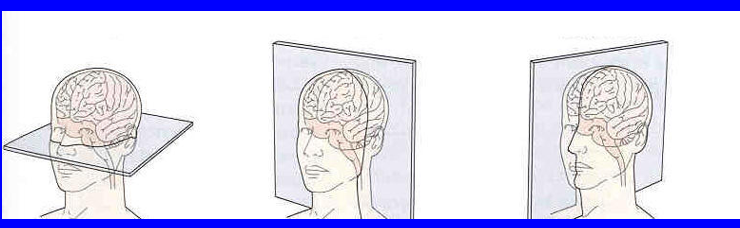
From left to right, identify the specific planes:
Horizontal, Frontal/Coronal, Saggital
What structures make up the brainstem?
Medulla
Pons
Midbrain
What is the purpose of the brainstem?
Controls bodily functions and basic processes (heartbeat, breathing, etc.)
Ventral
Towards stomach
Dorsal
Towards the back
Rostral/Superior
Toward the head
Caudal/Inferior
Toward the tailbone
Medial
Towards Midline
Lateral
Away from Midline
Ipsilateral
Same side of midline
Contralateral
Opposite side of midline
What tissues protect the brain?
Meninges
What cell types make up the nervous system?
Neurons
Glia
What are Neurons?
Larger than glia
Communicate with other neurons
Long processes
What are Glia?
support neuron shape
Maintain ionic environment
Make myelin
What is the Plasma Membrane?
A phospholipid bilayer membrane enclosing each cell
What purpose do membrane proteins serve in the membrane?
Channels, transport of molecules
Receptors
What is the purpose of carbohydrates in the plasma membrane?
Adhesions and junctions
Mitochondria.
atp. metabolism.
Purpose of the cytoskeleton
Protein network for structural support, transport, and cellular movement
What are the three components of the cytoskeleton?
Microtubules
Microfilaments
Intermediate FIlaments
What is the purpose of Microtubules
Maintain Cell shape and control axonal transport, movement of cilia, flagella, and chromosomes (long hollow tubes)
Axonal Transport
Bidirectional movement of large molecules and vesicles along the axon of neurons
Anterograde
Away from the cell body
Retrograde
Toward the cell body
A retrograde tracer will reveal:
cell bodies
An anterograde tracer will reveal
Axons
Speed of Fast Anterograde:
50-400 mm/day
Speed of Fast Retrograde:
200-400 mm/day
Measuring the current at a certain membrane potential is called:
Voltage clamp
Positive Current
Flowing from inside the cell to outside the cell
Negative current
Flowing from outside the cell to inside the cell
What forces act on the ion?
Chemical
Electrical
At equilibrium potential, what two forces cancel out? (NO NET MOVEMENT)
Electrical and Chemical

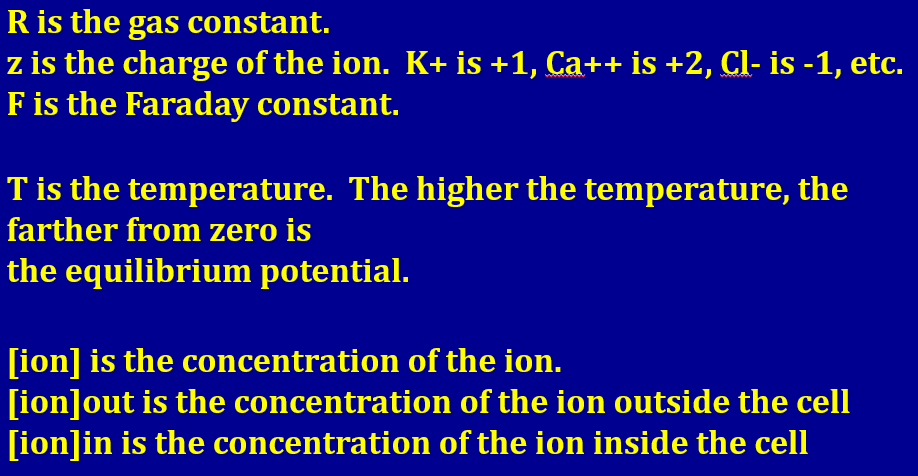
What do IV plots show?
Relationship between the current (y-axis) and membrane potential (x-axis)
At rest, only NA+ and K+ can cross the membrane; what makes it so that the resting membrane potential is closer to the equilibrium potential of K+ instead of Na+
Leak channels
Resting potential for Na+
~+65 mV
Resting Potential for K+
~-90 mV
To prevent too much Na+ from leaking into the cell, what must be used?
Na/K pumps to pump Na+ out of the cell (uses ATP)
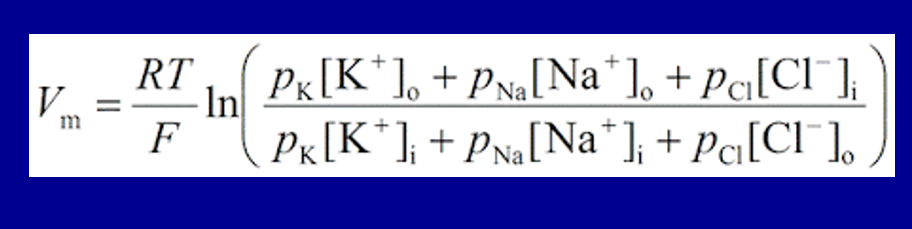
The Goldman-Hodgkin-Kats (GHK) equation takes into account what variables:
Permeability of ions
Concentration of Ions (Driving Force)
An activation potential only occurs once a _____ is reached
Activation threshold (~-55 mV)
Depolarization
Rise in membrane potential:
Voltage gated Na+ channels start to open after sequential synaptic potentials
Voltage-gated K+ channels open
Voltage-Gated Na+ channels begin to deactivate and close
Repolarization
Drop in membrane potential:
Voltage-gated K+ channels begin closing
Voltage-gated Na+ channels go from inactive to close
Hyperpolarization
Slight rise of membrane potential back to resting potential:
K+ pores open
Na+ leak channels
Action Potentials cannot carry a signal from just one single potential… so
it must propagate across the axon’s length
What can cause an action potential to move faster?
Depolarization of membrane:
Increase Axon diameter
Myelinate the axon (insulation)
Nodes of Ranvier
Places where voltage-gated channels are found n myelinated axons
What keeps an action potential from going inthe reverse direction?
Inactivation of voltage-gated Na+ channels
Absolute Refractory Period
The period that the voltage-gated Na+ channels are in the inactive state
Relative Refractory Period
The period that the voltage-gated Na+ channels are in the closed state and the voltage-gated K+ channels are still open
Why are Tetrodotoxins so dangerous?
Blocks voltage-gated sodium channels from opening, holding them closed
In normal conditions, what are the concentrations of Na+ and K+ in the cell?
K+ is more abundant in the cell
Na+ is more abundant OUTSIDE the cell
What do dendrotoxins do?
Block voltage-gated potassium channels of the motor neurons going to the muscles at the node of Ranvier
What is the path of an action potential release a neurotransmitter to another neuron?
Pre-synaptic neuron => AP => axon => axon terminal => release of Ca2+ => synaptic cleft => post-synaptic neuron
What prevents the neurotransmitter from acting on the receptor of the post-synaptic neuron again?
Enzymes in the synaptic cleft break down the neurotransmitter
Pre-synaptic neuron reuptakes unused receptor
 Note
Note  Flashcards (20)