sleep and circadian rhythms
 Call Kai
 Learn
Learn Practice Test
 Spaced Repetition
 Match
Match Flashcards
 Knowt Play
1/19

There's no tags or description
Looks like no tags are added yet.
Name | Mastery | Learn | Test | Matching | Spaced | Call with Kai |
|---|
No analytics yet
Send a link to your students to track their progress
20 Terms
What is sleep?
State of reduced physical activity and responsiveness
An altered form of consciousness
Homeostatic process associated with anabolism
Daily rhythm
Highly conserved across species
What is not sleep
Dreaming —> occurs during sleep in only a subset of animal species
Circadian rhythm —> they regulate processes such as sleep, but sleep itself is not a rhythm and not a clock
Recording sleep
Can be recorded with EEGs non-invasively
Records the brains electrical activity
The different electrodes placed on the scalp at standardised positions generate a pattern which represents the synchronous activity of many neurons
The more neurons that fire synchronously, the clearer and more defied the wave pattern will be
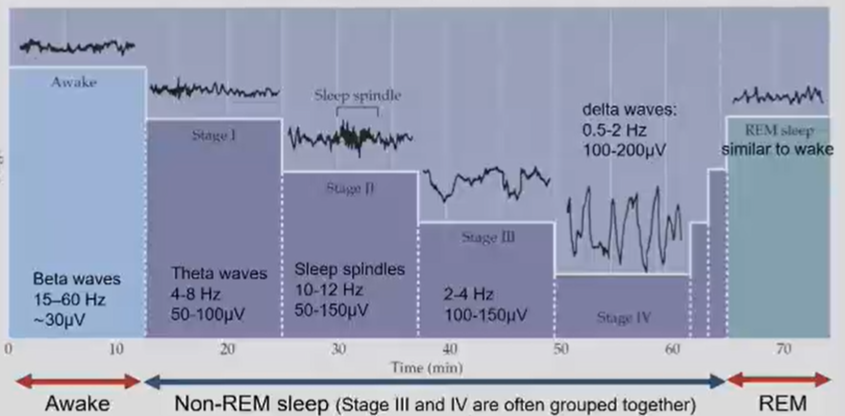
EEG and sleep phases
Sleep is made up of a cycle which is made of different phases
Lasts less than 2 hours so most people have several sleep cycles a night
Starts with awake phase, with beta waves, then progressing through several non REM phases progressing from theta to delta waves
REM sleep
Another sleep phase but is well studied and so has its own category
Eyes move rapidly under the eyelids during REM
Most of dreaming occurs, specifically lucid dreams
Minority of sleep phase and conserved through different ages
Known disturbances which are characterised by effects on the REM phase:
Muscular atonia – muscles not responding to thoughts
Sleep paralysis is when people wake up during the REM phase but muscular atonis is still engaged
People prone to have hallucinations during sleep paralysis
Why do we need sleep?
The fact that its conserved suggests that there must be a reason for sleeping
Sleep disruption has many consequences:
Inattention
Impaired cognition
Reduced learning capacity
What happens when we sleep – common hypotheses
Clearance of metabolites in the brain – specifically deposits of amyloid beta, linking insomnia as a risk factor for dementia
During sleep the brin prunes unnecessary synapses
Sleep homeostasis: argument that sleep restores the baseline that becomes elevated during wakefulness. Synaptic strengthening during wake leads to cellular costs and systemic consequences. Evidenced by several empirical observations: changes in brain wave patterns during NREM sleep and reduced evoked potentials. But this is not a universal mechanism that holds true for all species and does not account for the existence of REM sleep and so is limited.
Hypothesized to be a consequence of a complex nervous system
What time does our body want to go to sleep?
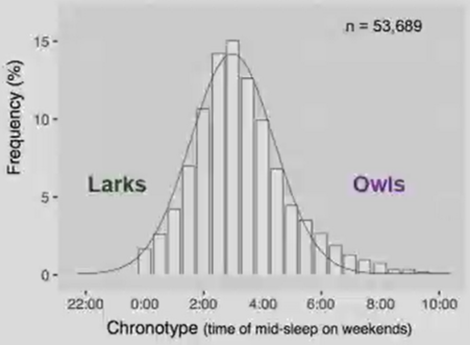
Variation between individuals, most people find that halfway through their sleep will fall between the hours of 2 and 4am.
During teenage years, tend to go to bed later and when you get older tend to go to bed earlier
Not only does sleep time, but also temperature fluctuates during sleep – starts dropping when our body anticipates to go to sleep
Do we have a clock inside our body?
Wanted to challenge the hypothesis that there is a circadian clock in the late 1930s
Believed that the sleep wake pattern was dependent on light input
thought that if they locked themselves inside a cave where sunlight could not reach, they could live a longer day
Even without light exposure, external time cues, their bodies showed a consistent 24 hour rhythm
What is a circadian rhythm?
Circadian refers to a rhythm that lasts approx. 24 horus
Other rhythms: Infradian rhythms last for longer than 24hours, ultradian rhthms means shorter than a day
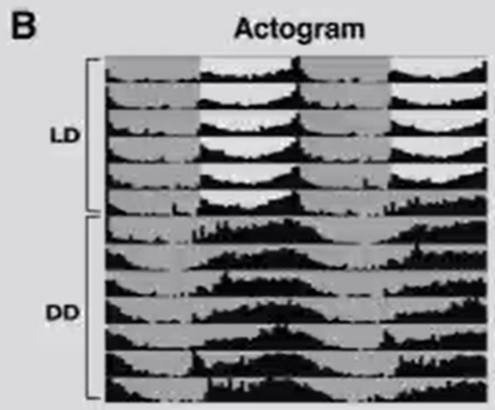
Circadian rhythms are autonomous and continue in the absence of external cues (planetary cycles)
Continue even in the presence of free running conditions (dark-dark)
However, they can be entrained by exogenous cues called zeitgebers and these include:
Light
Temperature
Humidity
Sound (in some conditions)
When external cues are present, we refer to zeitgeber time (ZT) and we describe their internal phase using circadian time (CT)
Independent evolution across all life forms
Most organisms have circadian rhythms, and can even be found in plants
Being able to anticipate predictable environmental changes provides a strong evolutionary advantage
Example: if bacteria undergoes mitosis during the dark phase, it reduces the chance of UV exposure mutations
Origins of rhythm different but are all a molecular clock – conserved between mammals and fruit flies but starts to vary in organisms like bacteria
How can we measure circadian rhythms?
In humans:
Trackers of sctivity with cameras
Temperature
In mice and flies:
Activity and rest cycles
Can be measured with running wheels in mice and tubes measuring activity with IR sesnors in flies
This information is compilated into an actogram and can be analysed precisely with statistics
Can also analyse the expression of proteins throughout the day with
GFP tagging
Westerm blot
qPCR
but the issues associated with this is that you ned to perform an extraction at each time point which can be difficult and expensive
Drosophila period
first component of molecular clock
when dawn has just passed it is the safest time for flies to hatch – provides a way to measure the circadian rhythms
Mutants which had a mutation in a gene called period, has no eclosion (hatching) rhythm à this mutation now known as per01
Other mutants identified such as pers which has a shorter subjective day of around 19 hours and is caused by the S589N substitution
The third mutant (perl) had longer subjective days with a circadian rhythm of roughly 28 hours, aused by a V243D mutation
Mammalian Pers
Flies have only one period, but we have 3
The endogenous period of a mouse is slightly shorter than 24 hours, but when per 1 or 2 is mutated, this becomes arrhythmic
However, for period 3, when mutated, can still be rhythmic
Period 1 and 2 important for the circadian clock, while period 3 contributes to the peripheral clocks
Period expression oscillates
Period cycles during the day confirmed with qPCR or mRNA extracts (protein rhythms follow the mRNA pattern)
Pattern related to the circadian time:
During the light, period accumulates
During the night period peaks and then drops
How can a protein like this oscillate? Due to the control of cryptochrome
Cryptochrome
Behaves exactly like period
Blue light sensitive protein in drosophila and plants, but CRY1 and CRY2 (mammalian cryptochrome) is insensitive to blue light
Nonetheless cycle with almost identical rhythms to period
Binds to period forming a heterodimer
CRYs required for rhythmicity
Partially overlapping role
Animals which lack CRY1 or 2 still have rhythms, although these may be shifted. For complete arrythmia, both CRY proteins must be lost.
This shows us that period can bind to both cryptochrome proteins and is likely that when one is lost, period will bind to the other
Specific neurons have specification of CRY1 or 2 and will determine the phenotype of the mutatnts —> different responsibility of the CRY proteins
Role of the complex
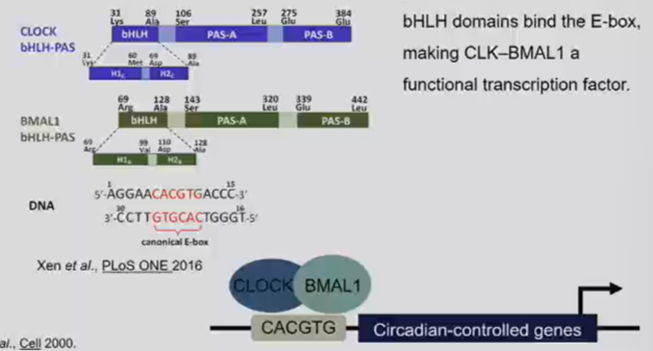
2 different mutants discovered: CLOCK and BMAL1 which resulted in arrhythmia in absence of external conditions
These two proteins found to have basic helix loop helix motif which allows them to bind to a vary specific E box DNA sequence
Proteins can also bind to each other
Clock and BMAL1 makes a dimer and recognises DNA sequences upstream of genes period, cryptochrome and other circadian controlled genes (up to 600)
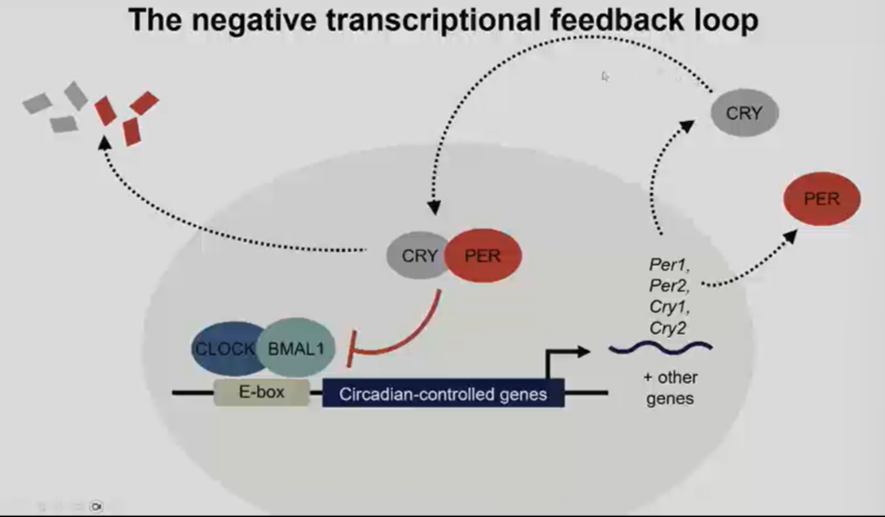
Forms the basis of molecular clock and I a negative feedback transcriptional loop
The molecular clock
Activity of cock bmal1 heterodimer controls period and cryptochrome expression
This heterodimer of period and cry inhibits clock and bmal1 heterodimer, which downregulates their expression
Cry/per is eventually degraded, allowing clock/bmal1 to bind and increase their expression
Other genes which are controlled by clock and bmal1 expression finetune components of the molecular clock by:
Finetuning the affinity of period and cry
Change the post-translational modification which makes them more/less prone to binding
Nuclear entry is an important gating system à circadian clocks can be induced in cells which don’t have one by inserting clock components into the nucleus of cells
Modifying cryptochrome and period stability
Per stability and degradation
Period and cryptochrome subjected to multiple phosphorylation events, some of which promote degratdation and others enchance stability
Kinases which have been discovered:
Casein kinase 2
DBT – known in humans as casein kinase 1 epsilon (promotes degradation of period)
Slimb
Casein kinase 1 epsilon
Mutated CK1e and have a much shorter lifetime of per proteins due to the tau mutation which makes the kinase more active
Explore top notes

Explore top flashcards
