Qualifying Exam: Signals and Systems
 Call Kai
 Learn
Learn Practice Test
 Spaced Repetition
 Match
Match Flashcards
 Knowt Play
1/36

There's no tags or description
Looks like no tags are added yet.
Name | Mastery | Learn | Test | Matching | Spaced | Call with Kai |
|---|
No analytics yet
Send a link to your students to track their progress
37 Terms
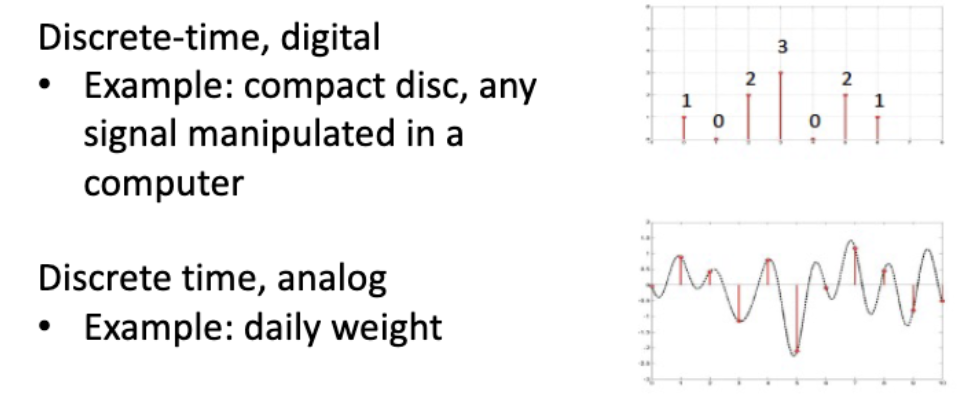
Analog signal
amplitude (y axis) can take on infinite number of values
Continuous time signal
independent variable (x axis) can take on an infinite number of values
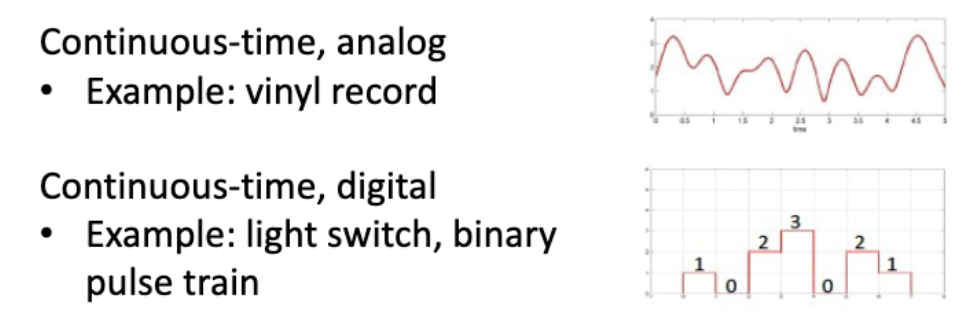
Digital signal
amplitude (y aics) can take on finite number of values
Discrete time signal
independent variable (x axis) can take on an finite number of values
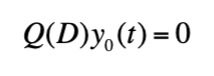
Zero input response
what the system does with no input at all (due to initial conditions like energy store in capacitors)
ytotal (t) = yzs (t) + yzi (t)
Zero state response
output of the system with all initial conditions at zero; found using the convolution integral
ytotal (t) = yzs (t) + yzi (t)
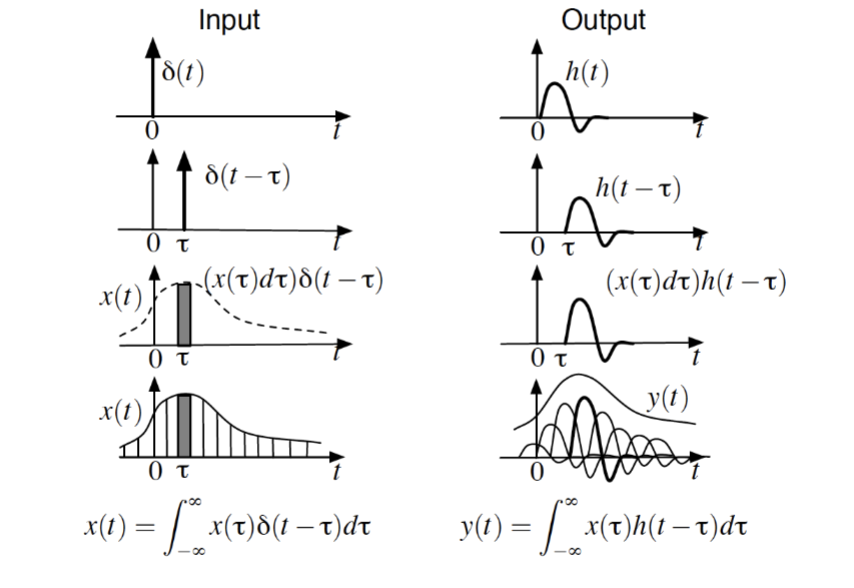
Impulse response
the output of the system at a time (t) to an impulse at time (𝜏)
h𝜏 = H(δ𝜏)
Unit impulse response
h(t)
Response of the system to a unit impulse input
Characteristic of the system, and used for finding the zero-state response
Convolution
Convolution combines an two signals: an input signal x(t) and the system’s impulse response h(t), to produce a third signal y(t)
y(t) = x(t) * h(t)
This can be used to find either the zero-state response x(t) or the unit impulse response h(t)
Zero-state stability: BIBO
BIBO Stable: application of a small input produces a response that eventually decays to zero
BIBO unstable: application of a small input produces an unbounded (ever increasing) response
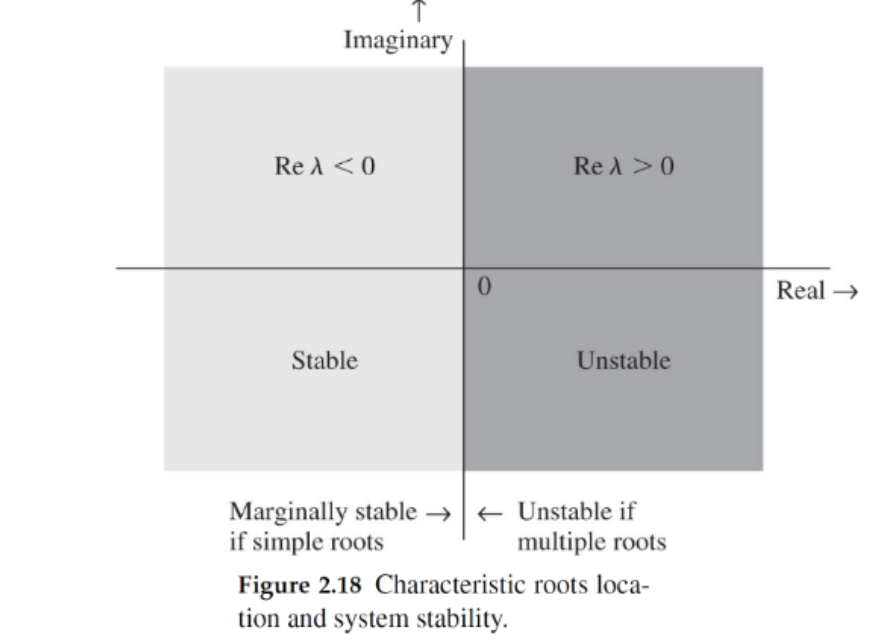
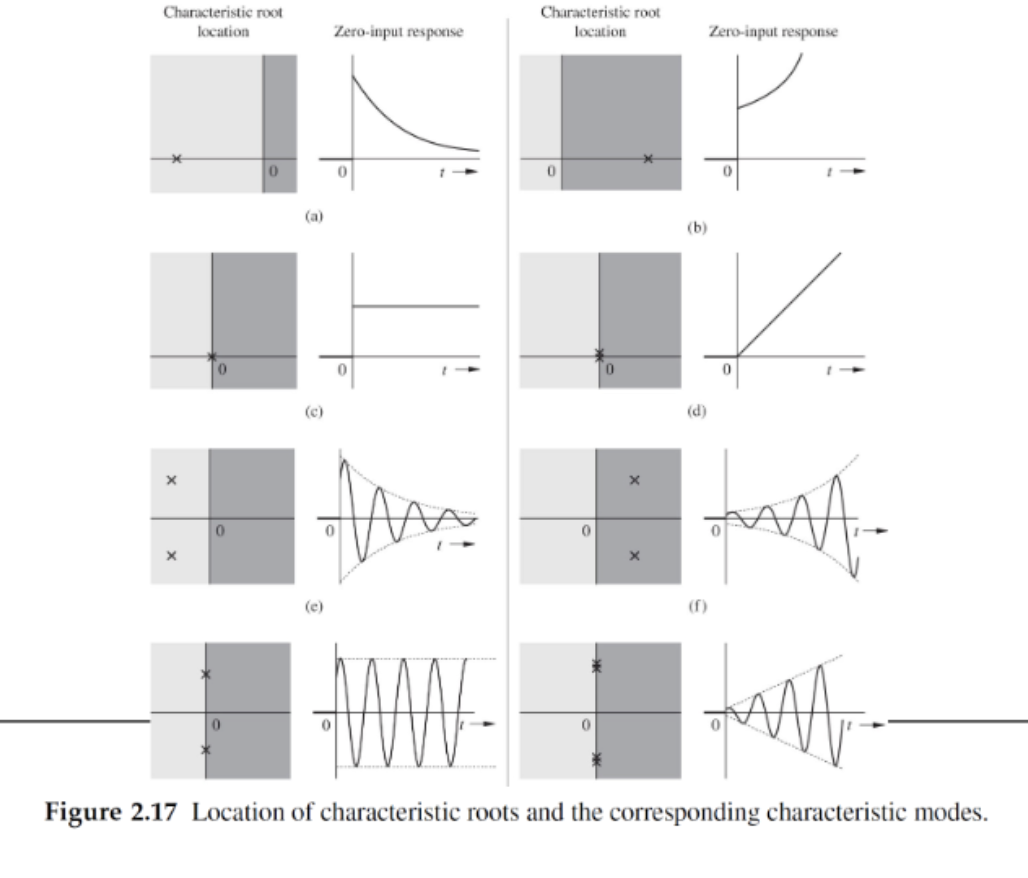
Zero-input stability: Internal (Asymptotic)
Internally stable: application of nonzero initial conditions produces a response that eventually decays to zero
Internally unstable: application of nonzero initial conditions produces a response that increases with time
Can be determined using characteristic modes
Fundamental frequency of sines and cosines (𝜔0)
Fundamental frequency is the greatest common factor of all the frequencies in the series
A signal composed of sines and cosines of frequency 𝜔0 and all of its harmonics is a periodic signal with the same period as that of the fundamental, regardless of the values of the amplitudes of each sine and cosine.
Trig series of a periodic signal
Finding the Fourier series for a periodic signal can be used to determine contributions of each of the periodic signals present in the signal
Helps determine frequency spectrum
Fourier series
a method of representing a periodic signal as a weighted sum of sinusoids, or everlasting exponentials whose frequencies lie along the j𝜔 axis in the s plane
Every periodic signal has a time domain and frequency domain representation
Fourier series: time vs frequency domain
time domain shows how a signal’s amplitude changes over time
frequency domain shows how much signal lies within frequency bands
Fourier transform translates between the two, decomposing signals into the sums of sinusoids
Bandwidth
the difference between the highest and lowest frequencies of the spectral components of a signal
Fourier transform
Transforms from time domain to fourier (frequency) domain
Amplitude and phases together make up the frequency spectra of x(t), constituting the frequency-domain description of x(t)
Fourier transform: constant
a constant signal in time corresponds to an impulse at zero frequency
Fourier transform: Sines
Fourier transform of sin/cos at a frequency f0 only has energy exactly at ± f0
One positive direction, one negative direction
Fourier transform: Cosines
Fourier transform of sin/cos at a frequency f0 only has energy exactly at ± f0
Both positive direction
Scaling property: Bandwidth effect
Doubling the signal duration halves its bandwidth, and vice versa
The bandwidth is inversely proportional to the signal duration or width
Convolution and Convolution Theorem
convolution in the time domain is multiplication in the frequency domain
Conv. Theorem: Given two signals x1(t) and x2(t) with Fourier transforms X1(f) and X2(f),
(x1*x2)(t)<=>X1(f)X2(f)
Modulation (Frequency Shifting Property)
Modulating a signal by an exponential shifts the spectrum in the frequency domain.
Modulation by a cosine causes replicas of X(f) to be placed at plus and minus the carrier frequency; replicas are called sidebands
Modulation vs Demodulation
Modulation varies a high-frequency carrier signal with low-frequeny information signal
Demodulation is the reverse process, and extracts the original information signal from the carrier at the receiver
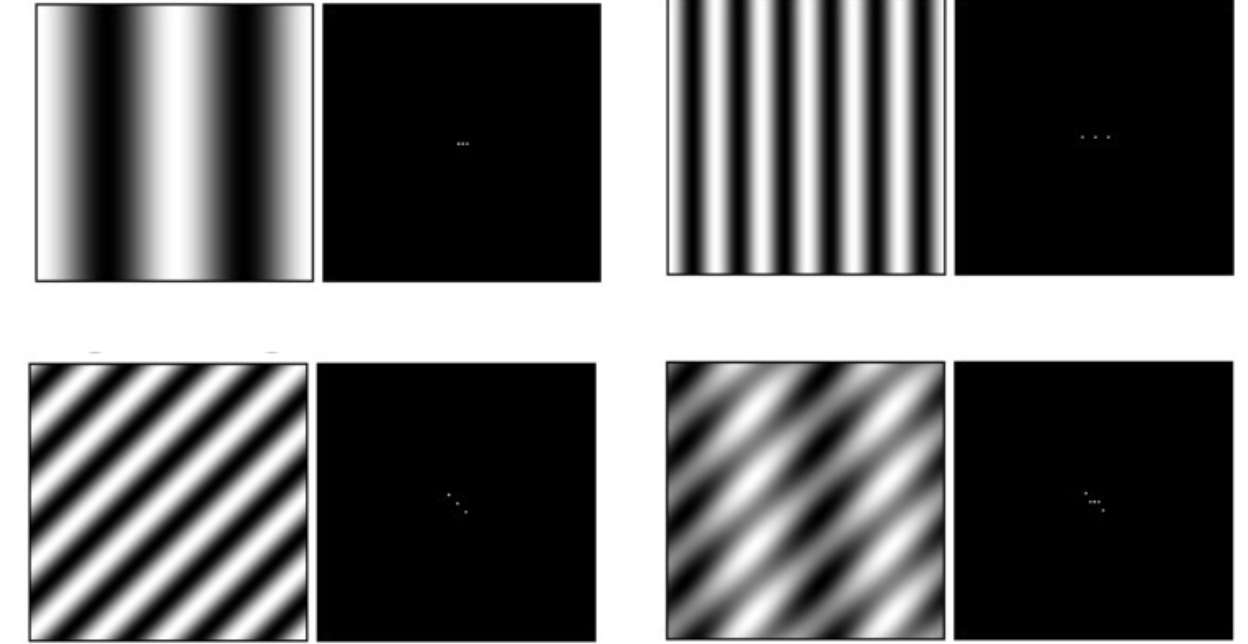
2D Fourier transform
The Fourier transform of a sinusoidal function presents as a Fourier series, with the central dot indicating the a0 or dc components and the dots on either side indicating the frequency component. For higher spatial frequency images, the dots are offset further away from the dc component
Natural (Homogeneous) and Forced (Particular) Responses
Homogeneous response: represents transient response of the system when the input is zero
Particular response: represents a forced steady-state response driven by a particular input
Fourier series vs Fourier transform
Fourier series: for discrete index, calculated using summation
Fourier transform: for continuous index, caculated using integral
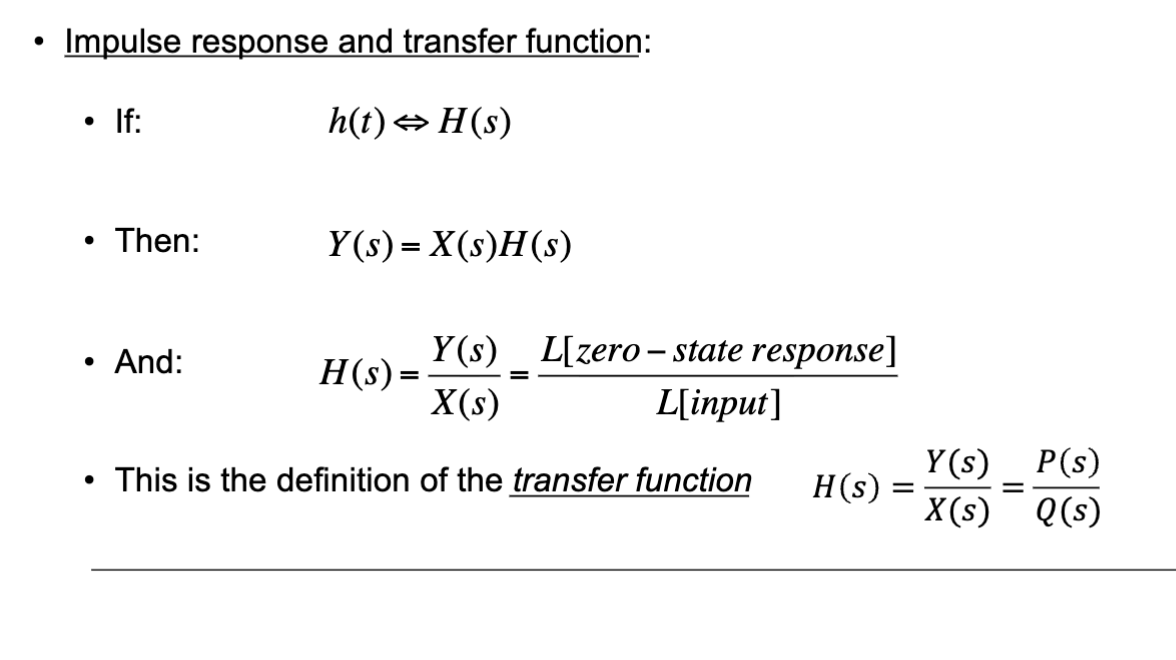
Impulse response and transfer function
Filtering
the process by which the essential and useful part of a signal is separated from the undesirable components (noise, for example)
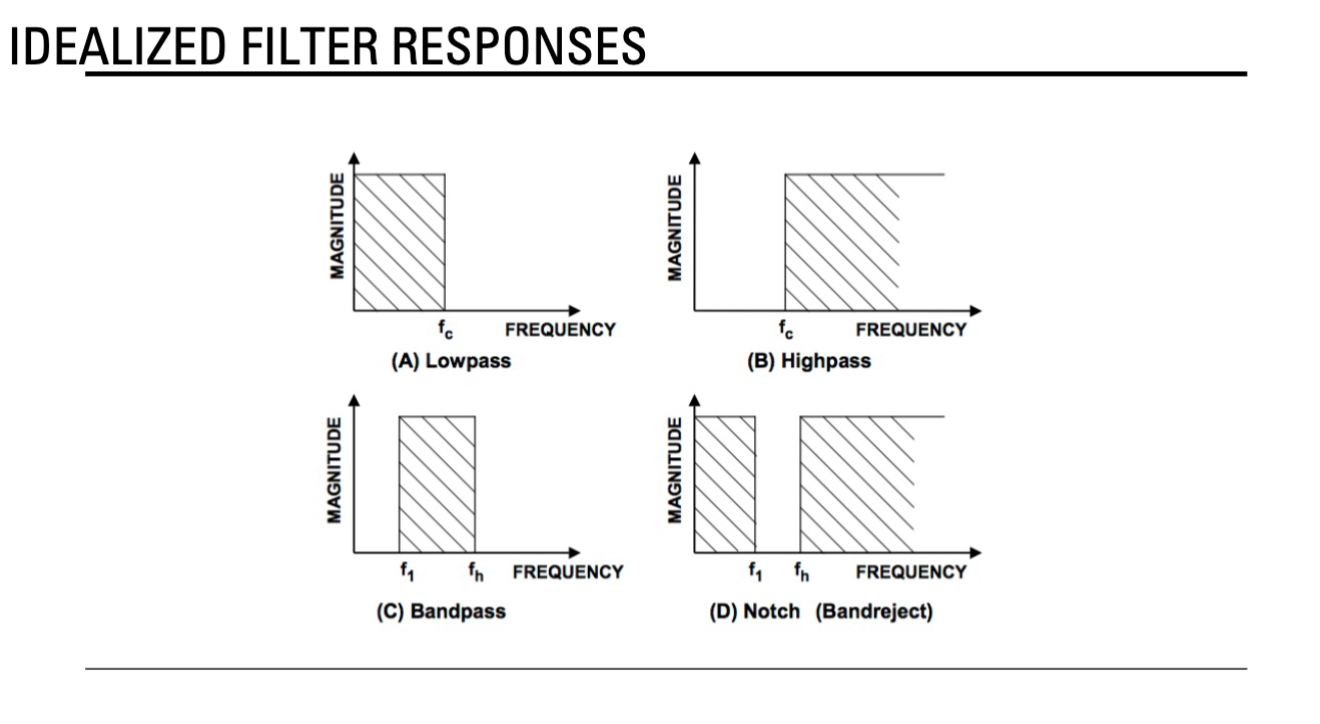
Idealized filters are impractical
Idealized filters are impractical because the impulse response of the filter in the time domain requires infinite time to remove the unwanted frequency components, and is anticausal
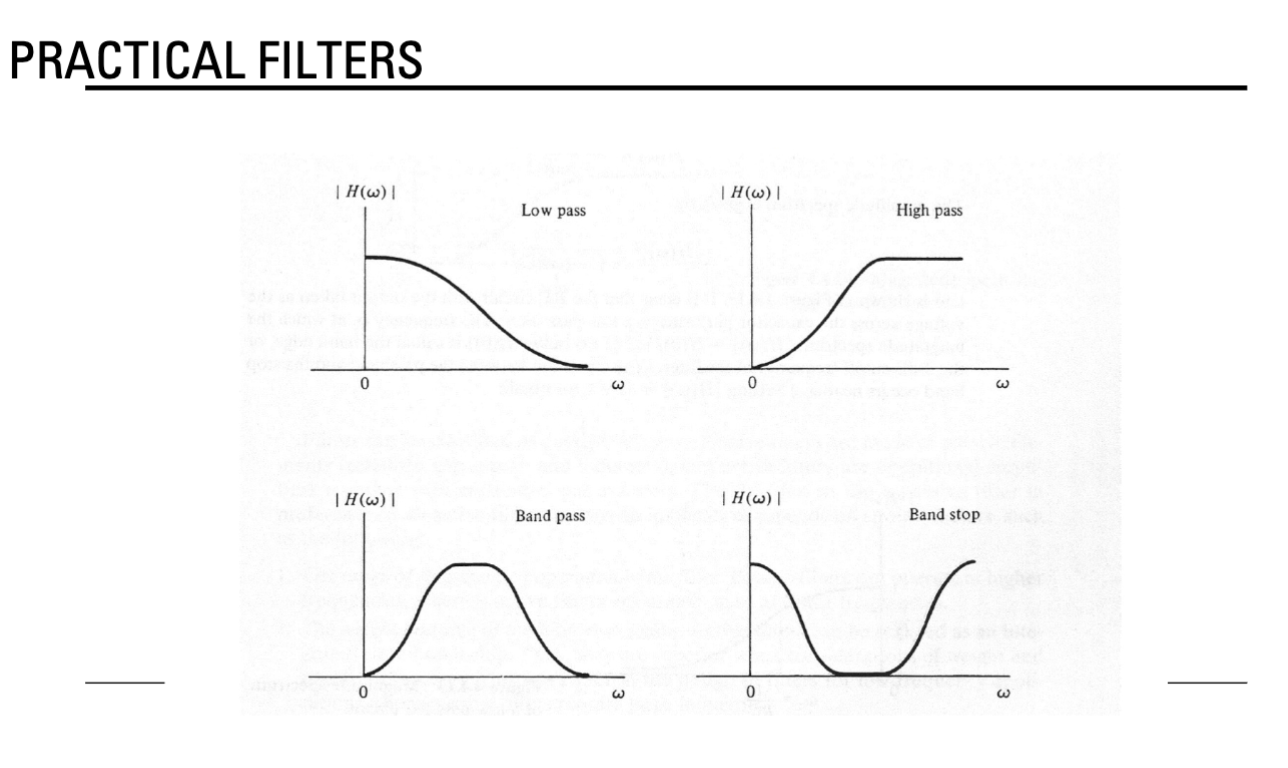
Fourier transform in image processing
Filter is applied in the Fourier domain, as it can be done using multiplication in Fourier domain rather than convolution in the space domain
Then, the inverse Fourier transform is used to obtain the filtered image
Nyquist Sampling Theorem
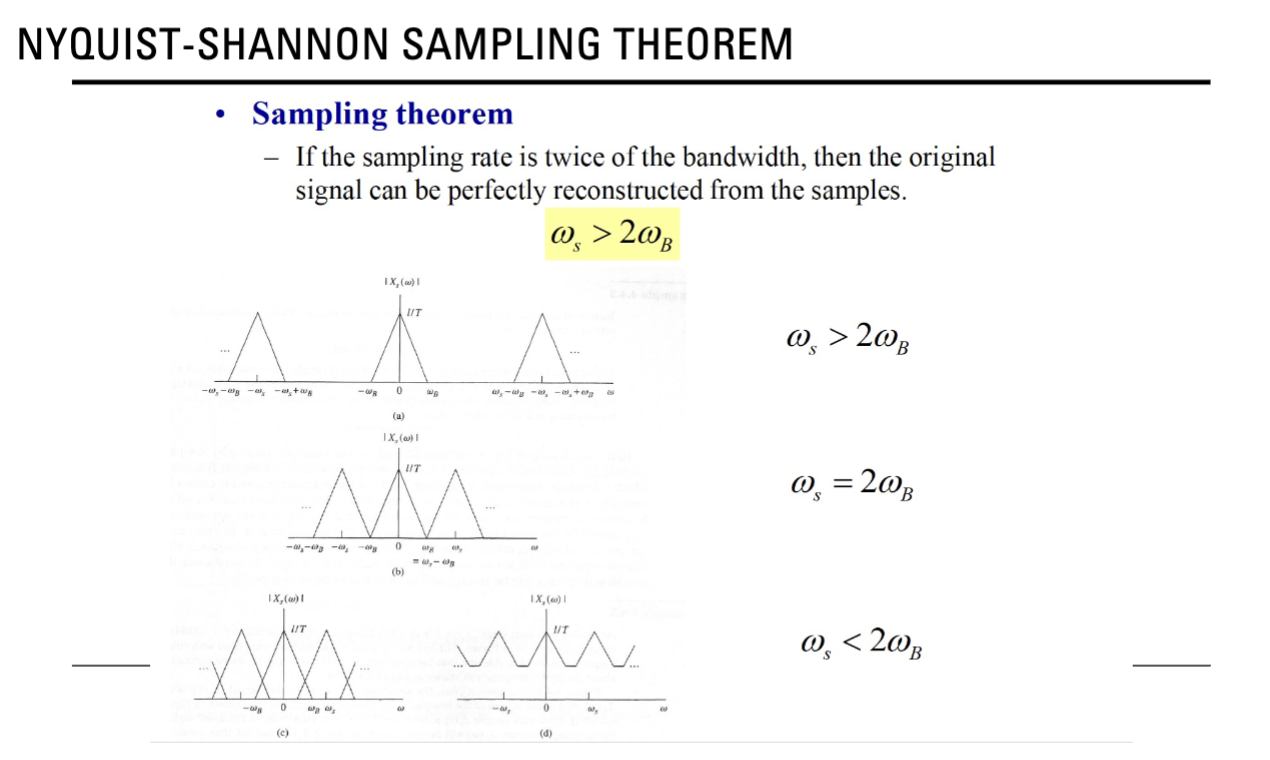
Effects of under/over sampling: aliasing
Aliasing occurs by undersampling
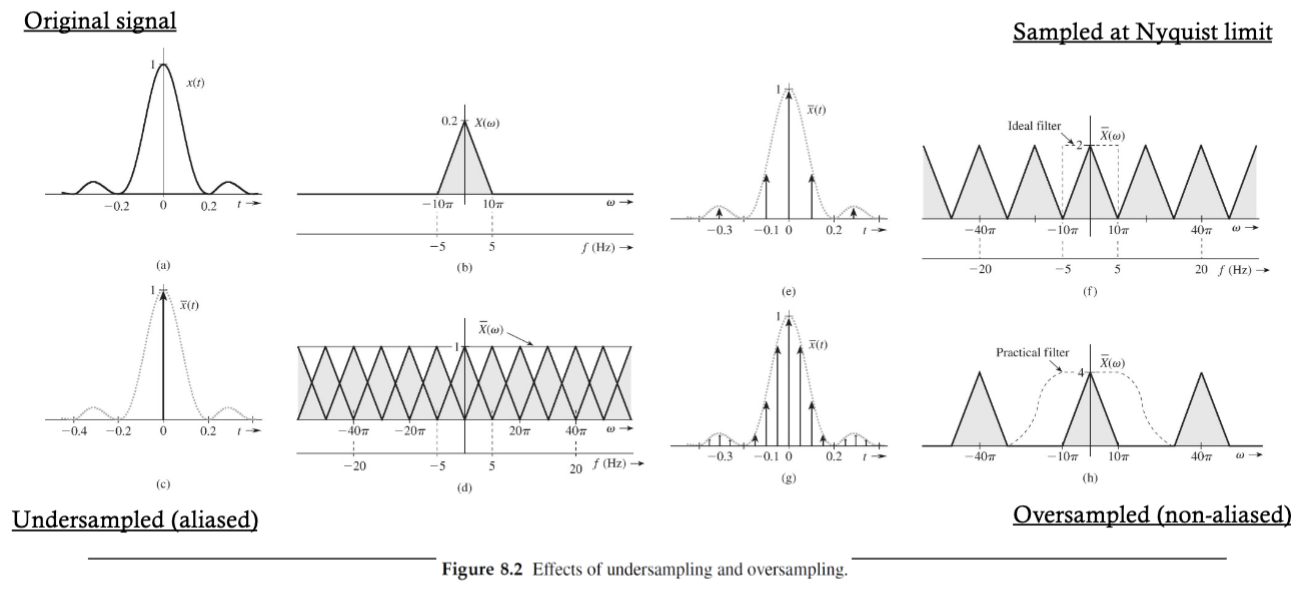
Overcoming aliasing
Sample at the Nyquist rate or greater
If sampling fast enough is not possible, then apply a low-pass filter to the input signal such that the sampling rate satisfies Nyquist for the filtered signal
Best to do both- can’t measure higher frequencies than ½ of sampling frequency accurately due to aliasing
Laplace Transform
Much like Fourier transform, converts time-domain signals into the frequency domain
LaPlace may be used to solve for transient analysis with unstable (exponentially growing) signals that cannot be accommodated by the Fourier transform
Relevance of Fourier transform in SIM imaging
Fourier analysis of raw data generated by the microscope in the rear focal plane of the objective
Deconstruction of observed fluorescence frequencies into their components, including the spatial frequency of the sinusoidal illumination structure, whose Fourier transform has three components
High frequency information may undergo frequency mixing with the illumination structure and be displaced into the observable region as moiré fringes

