Lecture 7- Food Safety Introduction
 Call Kai
 Learn
Learn Practice Test
 Spaced Repetition
 Match
Match Flashcards
 Knowt Play
1/74

There's no tags or description
Looks like no tags are added yet.
Name | Mastery | Learn | Test | Matching | Spaced | Call with Kai |
|---|
No analytics yet
Send a link to your students to track their progress
75 Terms
Food safety
The science of protecting our food supply from contamination by disease-causing bacteria, viruses, chemicals and other threats to health
1. Substantial and increasing portion of the U.S. food supply is imported
2. Consumers are eating more raw and minimally processed foods
3. Increasing at-risk populations
4. Consolidation of industry leading to amplification of food risks
What are the four major trends creating food safety challenges?
1. Increasing fraction of US food is imported
2. Consumers are eating more raw foods
3. Increasing fraction of Americans are immunocompromised
4. President assigned ~12 agencies to safeguard our food supply, none of which have central authority
5. Food recalls are coordinated by FDA, USDA, DHS, CDC, and States themselves
What are the food safety challenges as lined out by the GAO in February 2013?
Production -> processing -> distribution -> retail -> preparation -> consumption
What is the food safety chain?
1. Consumer
2. Food supply chain
3. Regulator
What three things make up the food safety triad?
Thomas Malthus
Who said "Population, when unchecked, increases at a geometrical ratio. Subsistence increases only in an arithmetical ratio. A slight acquaintance with numbers will show the immensity of the first power in comparison with the second."
Malthusian growth potential of subsistence vs population
What does this bar graph show?
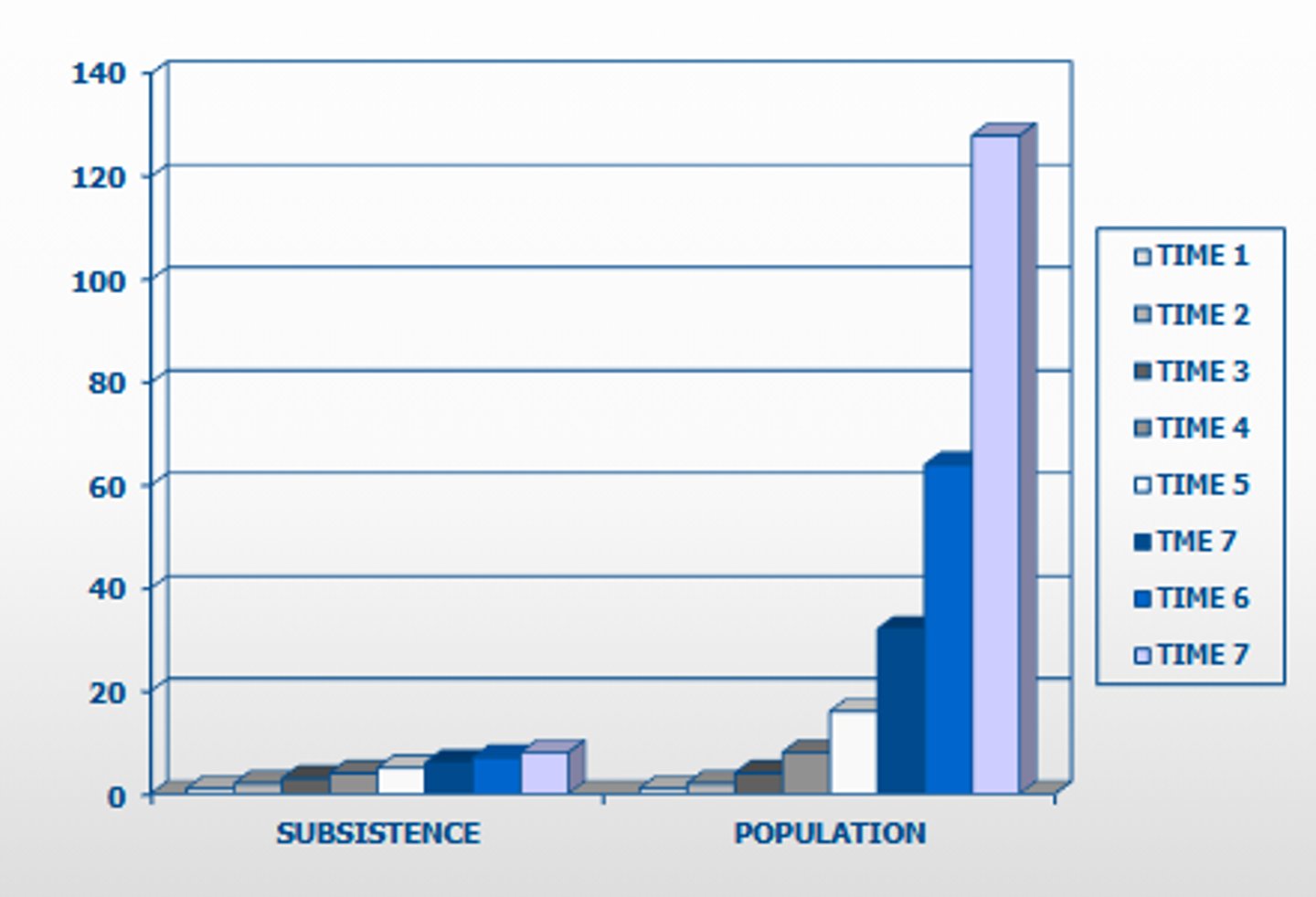
1. He did not foresee to what degree technology would increase food production
2. He assumed humans have no control over their reproductive behavior
3. He equated famine with a lack of food rather than an unequal distribution of available food
What were the poor assumptions that Malthus made?
~10%
The average American family spends _____ of its disposable income on food, which is the lowest in the world.
FATTOM
What is the acronym for remembering microorganisms growth requirements?
Food
Some source of energy
Acidity
Best growth between 4.6 and 7.5
Temperature
Danger zone is 40F to 140F
Time
Four hours is considered maximum
Oxygen
Required by most pathogens
Moisture
Safer foods have a w<0.85
Control
Each requirement of the FATTOM is a _____ opportunity
True
T/F - Nearly all foods are processed to some degree
1. Washed
2. Peeled
3. Sliced
4. Juiced
5. Frozen
6. Dried
7. Fermented
8. Pasteurized
What are some ways of minimally processing food?
1. Baked
2. Fried
3. Smoked
4. Toasted
5. Puffed
6. Shredded
7. Flavored
8. Colored
9. Fortified with vitamins
What are some ways of highly processing foods?
1. Preservation
2. Food safety
3. Variety
4. Convenience
5. Nutritional enhancement
6. Increase marketability
7. Organoleptic properties
Why process foods?
1. Reduce existing pathogen loads
2. Render food environment inhospitable to microorganisms
3. Provide physical barrier to contamination/inoculation
What are food preservation methods intending to accomplish?
1. Reduce water activity (aw)
2. Alter pH
3. Alter temperature
4. Lower oxygen content
What are some ways that food preservation methods render food environment inhospitable to microorganisms?
Food preservation
What is the process of treating and handling food to stop or greatly slow down spoilage in order to prevent food borne illness and extend its shelf-life?
1. Refrigeration and freezing
2. Irradiation
3. Freeze-drying
4. Pickling
5. Fermentation
6. Pulsed electric field electroporation
7. Biopreservation
8. Salt or sugar curing
9. Pasteurization
10. Smoking
11. Food additives
12. Modified atmosphere
13. 'Hurdle' technology
What are the twelve methods of food preservation in the lecture?
1. Perhaps the most common preservation method
2. Slows microbial growth and enzymatic action
3. Fosters longer life for transportation and storage
4. Storage of strategic food stocks for many nations
Describe refrigeration and freezing
1. Exposure to low-dose ionizing radiation (Co-60, Cs-137)
2. Kills nearly all surface pathogens and may even achieve sterilization
3. Food does not become radioactive and remains wholesome
4. Endorsed by WHO and FAO, approved by FDA
5. Not suitable for dairy products and some fruits
6. Since 1986, all irradiated food must display the radura
Describe irradiation food preservation
1. Combination of freezing and lowering ambient pressure to cause free water to sublimate
2. Has a water content of 1%-4%
3. Causes less damage than other drying methods
4. Used for pharmaceuticals such as vaccines
5. Does not cause shrinkage but reduces weight
6. Popular for hikers
Describe freeze-drying food preservation
Pickling
What preserves food in an edible, antimicrobial liquid to lower water activity and pH?
1. Salt brine
2. Vinegar
3. Alcohol
4. Vegetable oil
What are some chemical pickling solutions?
1. Cucumbers
2. Peppers
3. Corned beef
4. Herring
5. Eggs
6. Olives
What are some foods that are known for being pickled?
1. The food itself produces preservation agent
2. Facilitated by Lactobacillus organisms
3. Foods such as sauerkraut and kimchi
What are characteristics of fermentation pickling?
1. One of the oldest preservation techniques
2. Beneficial microorganisms compete with pathogens
3. Converts starch (sugars) to alcohol and lowers pH
4. Does not primarily reduce water availability
5. Produces vitamins (primarily B vitamins)
6. Foods such as beef, sour cream, kefir, kimchi and yogurt
What are characteristics of fermentation?
1. Treating food with brief pulses of strong electric field
2. Cell membrane pores are enlarged, killing cells
3. Most common for fruit juices
What are characteristics of pulsed electric field electroporation?
Biopreservation
What food preservation method uses natural or controlled microflora to preserve food and extend its shelf life by competing with bad pathogens?
Lactobacillus
What is the most common biopreservation organism?
1. Lactic acid
2. Acetic acid
3. Nisin
What are the natural byproducts that are preservatives produced by Lactobacillus?
Broad-spectrum
Most biopreservatives are ______ in action
Listeria monocytogenes
What is an organism that is specifically targeted by some biopreservatives?
Salt or sugar curing
What food preservation methods result in lowered water activity and osmotically pressure lyse cell membranes?
Pasteurization
What is the preservation technique for liquid food, originally for wine?
99.999%
Pasteurization kills _______ of microorganisms in milk
False
T/F - Pasteurization is a complete sterilization of milk
161F for 15 seconds or 145F for 30 minutes
What it is the high-temperature, short time pasteurization?
275F for 2 seconds
What it is the ultra high temperature pasteurization?
Extended shelf life
Lower temperatures than ultra high temperature but adds filtration step
60-90 days
Shelf life can reach _______ for high temperature short time pasteurization
180 days
Shelf life can reach ______ for ultra high temperature pasteurization
Mycobacterium bovis
Pasteurization originally targeted __________ which is a causative agent of zoonotic tuberculosis
Coxiella burnetti
The pasteurization process later adjusted to inactive __________ (Q fever) which is the most heat-resistant organism currently in milk
1. Developed in 1924 by the US Public Health Service
2. Now adopted as the national standard for milk production, processing and packages
Describe the pasteurization milk organized that established the production of grade A milk
1. Syringol
2. Gauiacol
3. Catechol
What are the natural preservatives that wood smoke deposits on meats and fish?
Surface
Smoking physically dries the ______ of the food item
Antimicrobials
Inhibits growth of microorganisms
Antioxidants
Inhibits the oxidation (spoilage) of food products
1. Calcium proprionate
2. Sodium nitrate
3. Sulfites
4. Disodium EDTA
What are some common antimicrobials?
1. Butylated hydroxyanisole (BHA)
2. Butylated hydroxytoulene (BHT)
3. Absorbic acid (C)
4. Tocopherol (E)
What are some common antioxidants?
1. Storing or packaging foods that spoil easily or age quickly
2. Reduces oxygen; replaces with carbon dioxide or nitrogen
3. Slows aging and prevents insect infestation
4. Eastern WA has MA space for > 100 million boxes of apples
5. MA grains can be stored for 4-5 years
What are some characteristics of modified atmosphere food preservation?
'Hurdle' technology
Controlling (or eliminating) food borne pathogens by the application of more than one approach giving pathogens more 'hurdles' to overcome
2000
Hurdle technology was defined in the year _______ although it was practically used for centuries prior
1. Appearance
2. Taste
3. Smell
4. Texture
Approaches are specifically selected to preserve what types of qualities?
1. Regulatory programs
2. Herd health programs
3. General programs
4. Appropriate use of antimicrobials
5. Veterinary feed directive
What are some roles of veterinarians in food safety?
1. Antemortem (animal welfare, disease triage, diagnostic testing post mortem)
2. Postmortem (carcass inspection, tissue residue determination)
What are some veterinary tasks in the meat production part of food safety?
1. Disease treatment and prevention
2. Husbandry/handling issues
3. Environmental control and modification
4. Reproductive efficiency
5. Vaccination regimens
6. Nutrition
7. Stress reduction
8. Commodity protocols
9. Biosecurity and biocontainment plans
What are some areas that veterinarians play an important role in a herd health program?
1. Appropriate/judicious use of antimicrobials
2. Disease surveillance programs
3. Epidemic/outbreak investigation
4. Collaboration with other health professionals
5. Import/export certifications
6. Health department involvement/leadership
7. Public health (risk) communication
8. Food supply following diasters
9. Food production research
What are some general roles that veterinarians play in food safety?
Animal Medicinal Drug Use Clarification Act of 1994 (AMDUCA)
What act allows veterinarians to prescribe extra-label drugs to all animals as long as the health of the animal is threatened and suffering or death may result if treatment is not provided?
Illegal
Prior to the passing of AMDUCA, extra-label drug use in veterinary medicine was _______
Food animals
Very few drugs were labeled for use in animals prior to AMDUC, especially which branch of veterinary medicine?
1. Careful diagnosis must be established
2. Ensure that no approved animal drug exists for that condition
3. Establish a substantially extended, scientifically derived withdrawal period
What are requirements for extra-label use?
Non-food-producing animals
In _______, a drug labeled for human use can be administered even if an animal-labeled drug exists
1. Created a new regulatory category for restricted feed-use drugs
2. Veterinary feed directive (VFD)
3. Prior to 1996, the only categories were OTC and prescription
4. Eliminates the sub-therapeutic use of medically important drugs in agriculture
What were the results of the 1996 Animal Drug Availability Act (ADAA)?
1. Places effective controls on certain antimicrobials
2. Limits potential for development of antimicrobial resistance
What are the primary purposes of VFD legislation?
VCPR
VFD legislation limited the use of antimicrobials by order of a licensed veterinarian with a valid ______
>17
Current there are ____ drugs approved for medicated feeds and more are coming
1. None are (or will be) approved for sub-therapeutic/growth promoting use
2. Are only approved to treat diagnosed clinical conditions
What are other results of veterinary feed directive?

