Healthcare Finance II Exam 2 -- Concepts
 Call Kai
 Learn
Learn Practice Test
 Spaced Repetition
 Match
Match Flashcards
 Knowt Play
1/87

There's no tags or description
Looks like no tags are added yet.
Name | Mastery | Learn | Test | Matching | Spaced | Call with Kai |
|---|
No analytics yet
Send a link to your students to track their progress
88 Terms
The price of stock is really just the `
Present value of all expected future dividends
How are future dividend payments estimated?
Constant Dividend
Constant Dividend Growth
Supernormal Growth
List the characteristics of Constant Dividends
A) Synonym to Zero-Growth
B) The firm will pay a constant dividend forever
C) The price is computed using the perpetuity formula
D) It is like preferred stock
According to the Dividend Growth Model (GGM), the stock price is calculated as P0 = D1 / R - g.
What would happen to the stock price (P0) if the growth rate (g) approached the required return (R)?
If g became equal to R then the denominator becomes zero, making the stock price undefined or infinite. However, if g > R then the price (Po) becomes negative. This is economically impossible — a company cannot grow faster than its discount rate
In the Dividend Growth Model (P0 = D1 / R - g), what is the mathematical consequence if the expected growth rate (g) is equal to or greater than the required return (R)?
The formula results in a negative or infinite value, making the model invalid.
A stock pays a constant dividend of $0.50 every quarter. If the required return (R) is 10% with quarterly compounding, what is the current stock price
$20
Which of the following best describes the valuation of "Preferred Stock" that pays the same dividend forever?
It is valued as a perpetuity where P0 = D/R
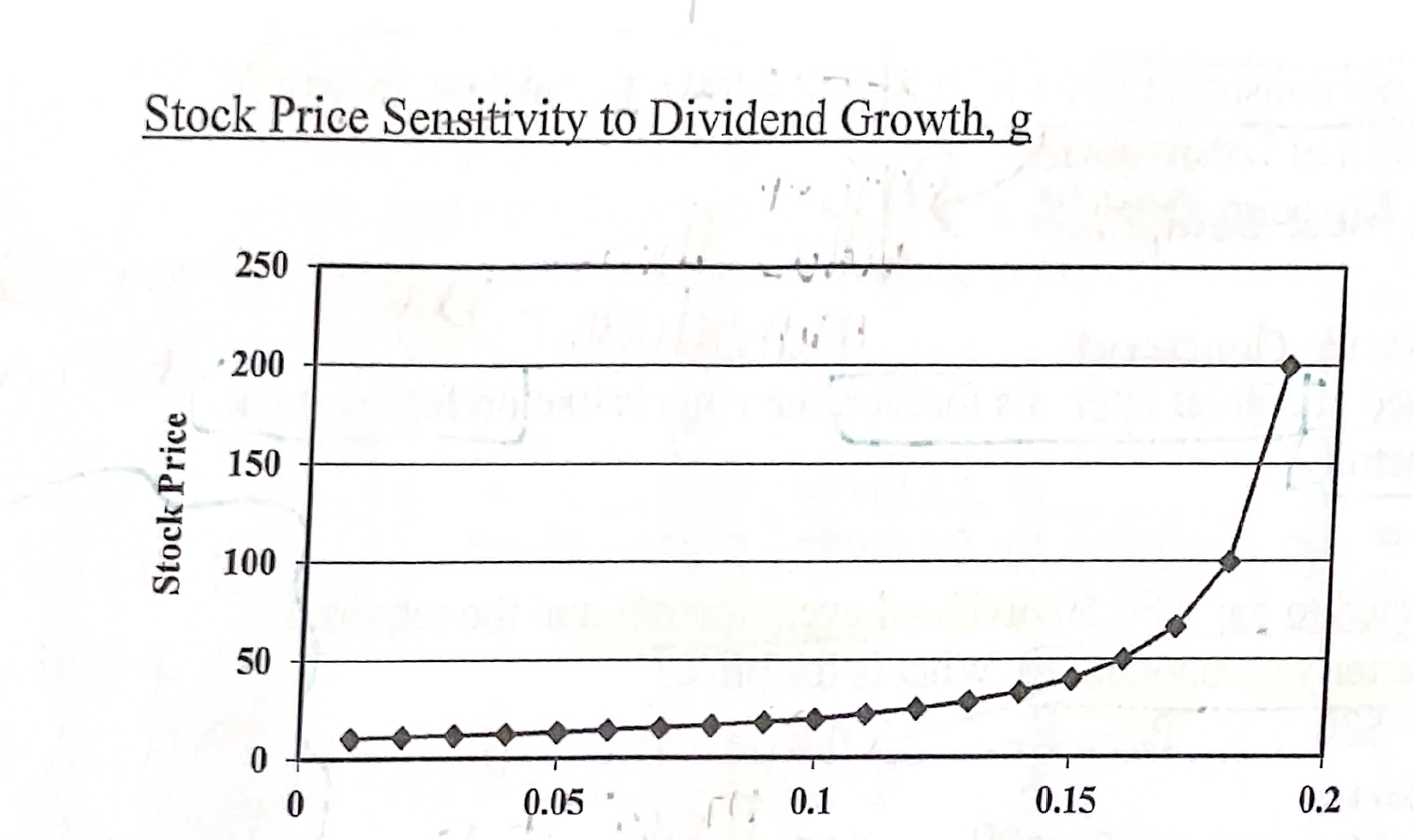
According to the “Stock Price Sensitivity to Dividend Growth” graph, what is the relationship between the growth rate (g) and the stock price (Po)?
As the growth rate increases, the stock price increases at an accelerating rate
Describe how stock price is sensitive to dividend growth?
Both share a direct relationship and move in the same direction. If growth rate increases or decreases, stock prices does the exact same.
Never inverses of each other
A firm "just paid" a dividend of $1.50. If the growth rate is 4% and the required return is 12%, which of the following is the correct numerator (D1) to use when calculating P0?
1.50 x (1+.0.04)
If investigators begin to view a company as more risky, what is likely the impact on the required return (R) and the resulting stock price?
R increases and stock price decreases

Why is the growth rate (g) not applied in the $2 dividend in the problem above?
Because the dividend is already expressed as D1
In a free economy, how the the price of debt capital primarily expressed?
The interest rate
interest rate
price paid to obtain debt capital, whereas for equity capital in for-profit firms, the price (i.e., investors’ returns) takes the form of dividends and capital gains (or losses).
The four fundamental factors that affect the supply and demand for investment capital
Investment opportunities
Time preferences for consumption
Risk
Inflation
Which of the following is not one of the four fundamental factors that affect the supply and demand for investment capital?
Financial Intermediation
An individual with a high time preference for consumption is most likely to
Only being willing to lend funds out of current income if the interest rate is high
How does risk inherent in a business plan affect the required return for lenders?
Higher risk leads lenders to demand a higher interest rate
If an entire population were living at the subsistence level (survival) what would be the expected result regarding interest rates?
Interest rates would be high because time preferences for current consumption would be high and capital would be scarce
What is a major advantage of a term loan over a public bond issue?
Term loans do not have to go through the SEC registration process
Most term loans are described as being "amortized." What does this mean for the borrower?
The loan is paid in equal installments, with a portion of the principal being retired with each payment.
If a business has a variable-rate term loan and the prime rate increases, what happens to the business's loan payments?
The interest rate on the outstanding balance of the loan will increase.
Which factor is likely to cause a rapid change in the prime rate in the US?
Changing inflation expectations and Federal Reserve Board Actions
If a 20-year T-bond was issued 15 years ago and now has only five years remaining until it matures, how is it classified today?
It is still classified as a bond because the names of these securities are fixed at the time they are issued.
Unlike most term loans, which are typically amortized, how do bonds usually handle the repayment of principal?
Only interest is paid over the life of the bond, with the entire principal returned at maturity.
An investor who buys a zero-coupon bond at a substantial discount from its face value earns a return primarily through:
Capital appreciation as the bond moves toward its face value.
Which type of bond is typically issued by companies in poor financial condition because they lack the cash to pay interest in currency?
PIK bonds pay "coupons" that grant the lender additional bonds instead of cash and are typically issued by risky companies with cash flow problems.
Step-up provision
Requires that the interest paid on the bond increases if the bond’s rating is downgraded
*Risky to business owners because they are required to pay higher rates when their are in poor financial conditions
A step-up provision in a bond contract is beneficial to bondholders because
It increases the interest rate paid if the bond's rating is downgraded
What is the primary characteristic that distinguishes a debenture from a mortgage bond?
It is an unsecured bond with no lien against specific property.
If a debenture is not backed by real property (like a building or equipment), what provides the "backing" for the lender's investment?
The revenue-producing power of the corporation.
Why might a firm with a weaker credit position be "forced" to use higher-cost debentures?
Because they have already used up their capacity to borrow in the lower-cost mortgage market.
Why might an investor in a high tax bracket prefer a municipal bond with a 2.9% yield over a corporate bond with a 4.77% yield?
Municipal bonds are exempt from federal and most state taxes.
Most not-for-profit healthcare providers issue revenue bonds. How are these bonds primarily secured?
By the revenues derived from the project being financed (e.g., hospital fees).
Municipal bonds are often sold in serial form. What does this mean for the repayment of the bond issue?
Portions of the bond issue mature at different times (e.g., every year) over the life of the issue.
If a taxable corporate bond offers a 6% yield and the investor is in a 25% tax bracket, what is the after-tax yield?
4.5%
Unlike corporate bonds, municipal bonds are not required to be registered with the SEC. What must they prepare instead?
An "official statement" containing financial information.
Which of the following is a primary characteristic of a 'private placement'?
The bonds are sold directly to a single buyer or small group of buyers
How do the administrative costs of a private placement compare to those of a public bond issue?
Private placement costs are lower because they avoid fees for legal, accounting, and printing.
Why might a borrower find the 'terms' of a private placement more favorable than those of a public issue?
There is an opportunity for direct negotiation between the borrower and lenders
Which statement is true?
Private placements generally have higher interest rates than public issues
If the market interest rate ($R$) for a 10-year healthcare bond rises above its coupon rate, what happens to the bond’s price and its "Current Yield"?
Price decreases; Current Yield increases
A "Call Provision" in a bond indenture is most valuable to the issuer when:
Interest rates are falling.
Which component of the interest rate specifically compensates for the risk that a borrower (like a hospital) might not make promised payments?
Default Risk Premium (DRP).
According to the Gordon Growth Model, what happens to a stock's price if the "Market Risk Premium" increases?
Price decreases because the required return increases.
Which of the following best describes the "Preemptive Right" for common stockholders?
The right to purchase a proportionate share of any new stock issuance
If a healthcare system transitions from a "Not-for-Profit" to a "For-Profit" status, how does its access to equity change?
It loses access to charitable contributions but gains access to private/public equity markets.
Why is the "Cost of Equity" generally higher than the "Cost of Debt"?
Equity holders have a residual claim on assets (they are paid last).
A "classified stock" system (e.g., Class A and Class B shares) is typically used t
Maintain control within a specific group (like founders) while still raising capital.
A "classified stock" system (e.g., Class A and Class B shares) is typically used to
Maintain control within a specific group (like founders) while still raising capital.
In a period of high inflation, why do "Fixed-Rate Bonds" suffer more than "Common Stocks" might?
Bonds have no growth potential to offset the loss of purchasing power
From a "Lessor’s" perspective, what is the primary risk of an operating lease?
The "Residual Value" of the asset at the end of the lease will be lower than expected
When calculating the "Net Advantage to Leasing" (NAL), what is the appropriate discount rate to use for the cash flows?
The after-tax cost of debt.
Which of the following is the primary goal of "Cash Management" in a hospital?
To minimize the time it takes to collect payments while maintaining sufficient liquidity.
If a hospital’s "Days in Accounts Receivable" (ACP) increases from 45 days to 60 days, what is the most likely impact?
The hospital may need to increase short-term borrowing to pay its bills.
If a bond is selling at a "Premium," which of the following mathematical relationships must be true?
Yield to Maturity < Current Yield < Coupon Rate.
A hospital decides to issue "Subordinated Debentures." Compared to "Senior Mortgage Bonds" from the same issuer, the debentures will likely have:
A higher DRP (Default Risk Premium) because they have a lower-priority claim on assets.
Under the "Efficient Markets Hypothesis" (EMH), if the market is "Semi-Strong Form Efficient," an investor can earn abnormal returns by:
Utilizing non-public, "inside" information.
In a "Lease vs. Buy" analysis, why is the depreciation tax shield excluded from the "Lease" cash flow stream?
Because the lessee does not own the asset and therefore cannot claim depreciation.
A "Sale and Leaseback" arrangement is most likely used by a hospital that:
Needs an immediate infusion of cash but wants to continue using its existing facilities.
Which of the following describes "Float" in the context of cash management?
The difference between the balance shown in a checkbook and the balance on the bank’s records.
Why might a not-for-profit hospital prefer to lease equipment even if the "Net Advantage to Leasing" (NAL) is slightly negative?
To shift the risk of technological obsolescence to the lessor.
If the "Yield Curve" is inverted (downward sloping), what is the market signaling about future interest rates?
Rates are expected to fall, likely due to an economic slowdown.
As a bond approaches maturity, what happens to its price if market rates remain constant?
Both B and C are correct.
Which asset's value is MOST sensitive to a 1% increase in interest rates?
A 20-year 0% coupon bond.
A "Call Premium" is:
The amount above par value an issuer must pay to redeem a bond early.
A "Zero-Coupon Bond" has a reinvestment rate risk that is:
Non-existent until maturity.
The "After-Tax Cost of Debt" for a for-profit hospital with a 20% pre-tax cost and a 40% tax rate is:
12%
If a not-for-profit hospital issues "Tax-Exempt Bonds" and a for-profit hospital issues "Taxable Bonds," at what tax rate would an investor be indifferent between an 8% for-profit bond and a 6% NFP bond?
25%
Interest Rate Risk
The overall risk created by changing interest rates
Bond Price and Coupon Rate Relationship
Inverse
According to your H353 Lecture Notes on Debt Financing and Bond Valuation, which of the following statements accurately describe the relationships between interest rates, bond features, and bond prices? (Select ALL that apply)
A) There is an inverse relationship between market interest rates and the price of an existing fixed-rate bond.
B) If a bond’s coupon rate is less than the required rate of return ($R$), the bond will sell at a premium.
C) Long-term bonds have more price risk (sensitivity to rate changes) than short-term bonds.
D) For variable-rate long-term loans (Prime rates), there is a direct relationship between the index rate and the interest payment.
E) All else equal, bonds with higher coupon payments are more sensitive to changes in interest rates than zero-coupon bonds.
F) As a bond approaches its maturity date, its market value will move toward its par (face) value, regardless of whether it was a discount or premium bond.
A, C, D, F
Which of the following are true regarding the legal and financial features of bonds?
A) A "Debenture" is a secured bond that has a specific claim on revenue-producing assets.
B) The "Indenture" is the legal document that spells out the rights of both the lenders and the borrowers.
C) "Restrictive Covenants" are designed to protect lenders by limiting certain actions of the borrower (the hospital).
D) "Call Provisions" are generally preferred by investors because they provide a guaranteed higher return if the bond is redeemed early.
B, C
Based on your "Equity Financing" notes, which of the following rights are typically held by common stockholders?
A) The right to receive a contractually fixed coupon payment every six months.
B) The "Preemptive Right" to purchase a proportionate share of any new stock issuance.
C) The right to vote for the board of directors.
D) A "Residual Claim" on the firm's assets in the event of liquidation (being paid last).
B, C, D
Which of the following statements accurately describe the "Lease vs. Buy" analysis?
A) Leasing is often considered a "substitute" for debt financing.
B) In a lease analysis, the depreciation tax shield is a cash flow benefit to the lessee.
C) A "Positive NAL" (Net Advantage to Leasing) indicates that the cost of leasing is less than the cost of owning.
D) The appropriate discount rate for a lease analysis is the hospital’s WACC (Weighted Average Cost of Capital).
A, C
Which of the following are components or goals of a hospital's Revenue Cycle and Cash Management?
A) Minimizing the "Average Collection Period" (ACP) to improve liquidity.
B) "Float" management, where the hospital aims to maximize disbursement float and minimize collection float.
C) "Trade Credit," which is spontaneous financing provided by suppliers (e.g., 2/10 net 30).
D) Ensuring that all accounts receivable are collected within 24 hours of the patient’s discharge.
A, B, C
According to the Efficient Markets Hypothesis (EMH) discussed in Chapter 12, which of the following are true?
A) In a "Weak-Form" efficient market, you can beat the market by analyzing historical price trends (technical analysis).
B) In a "Semi-Strong Form" efficient market, all publicly available information is already reflected in the stock price.
C) In a "Strong-Form" efficient market, even "insiders" with private information cannot earn abnormal returns.
D) Market "Equilibrium" exists when the expected rate of return equals the required rate of return.
B, C, D
When interest rates change, bondholders face two types of risk. Which of the following statements about these risks are true?
A) "Price Risk" is higher for long-term bonds than for short-term bonds.
B) "Reinvestment Rate Risk" is the risk that an investor will have to reinvest coupon payments at a lower rate if market interest rates fall.
C) "Zero-coupon bonds" have the highest level of reinvestment rate risk because they have no coupons.
D) Increasing interest rates causes bond prices to fall but increases the return on reinvested coupons.
A, B, D
Explain — Discount Bond Relation Coupon & Yield
If the YTM > Coupon Rate > then, Par Value ($ received at end of maturity) > Price of Bond ($ paid at the start)
Gives you a larger lump sum of money at the end compared to premium bonds
Great for those with low urgency
Explain — Premium Bond Relationship Coupon & Yield
if, YTM < Coupon Rate, then Par Value < Bond Price
Gives larger coupon payments but less lump sum money
Good for those with high urgency that need checks every six months
Par Value
Amount you recieve at the end of the bond’s term (maturity date)
*End
Bond Price
The amount paid to purchase the bond
*Start
What relationship do bond prices and market rates have?
Inverse Relationship
The Federal Reserve announces an increase in interest rates to combat inflation. You are holding a 20-year corporate bond in your portfolio. What happens to the market value (price) of your bond immediately following this announcement? Bonus: What relationship is this?
It will drop in price
Inverse Relationship
You are looking at two bonds from the same hospital. Bond A has a 4% Coupon and Bond B has an 8% Coupon. If the market interest rate for both is currently 6%, which bond will sell at a Premium, and which will sell at a Discount?
4% at a Discount
8% at a Premium
The economy enters a period of high uncertainty, and investors become much more risk-averse. As a result, the Required Return for all stocks increases. If a company's dividends and growth stay the same, what happens to its stock price?
It drops because you want to incentivize people to purchase the stocks deemed risky
In the formula P0 = D1 / (R - g), if the Gap between the Required Return and the Growth Rate gets smaller (narrower), does the stock price go Up or Down?
Up because there is less risk since there is not a huge gap between what investor want and what is being offered because it is growing
You own two bonds. Both have the same coupon. If market interest rates suddenly jump up by 2%, which bond's price will suffer the largest percentage drop?
Bond X: Matures in 2 years.
Bond Y: Matures in 25 years.
Bond Y

