The Building Blocks of Molecules and Macromolecules

0.0(0)
Studied by 0 people
call kaiCall Kai
learnLearn
examPractice Test
spaced repetitionSpaced Repetition
heart puzzleMatch
flashcardsFlashcards
GameKnowt Play
Card Sorting

1/12

encourage image

There's no tags or description

Looks like no tags are added yet.

Last updated 3:07 AM on 3/27/26
Name
Mastery
Learn
Test
Matching
Spaced
Call with Kai

No analytics yet

Send a link to your students to track their progress

13 Terms

1
New cards

Life is made up of matter.

Mater is made of elements, which is ___.

  • ex.

Matter is made up of elements, which is substances that can not be broken down into other substances.

  • ex. gold, carbon, etc.

2
New cards
  • Atom – ___

    • Protons are ____

    • Neutrons are ____

    • Electrons are ____

    • The + (protons) and – (electrons) charges ___ 

  • Atom – smallest unit of an element

    • Protons are positively charged atomic particles with a mass of 1 and +1 charge (located in nucleus).

    • Neutrons are atomic particles with no charge and a mass of 1 (located in nucleus).

    • Electrons are negatively charged atomic particles with negligible mass and -1 charge (located around the nucleus).

    • The + (protons) and – (electrons) charges balance each other in a neutral atom (0 charge). 

3
New cards

Periodic Table of Elements

  • Atomic number:

    • Changing this number would change the identity of the element.

  • Atomic mass =

    • Number of neutrons =

  • Atomic number: identifies the element and represents the number of protons. 

    • Changing this number would change the identity of the element.

  • Atomic mass = # of protons (atomic number) + # of neutrons

    • Number of neutrons = Atomic mass – Atomic number 
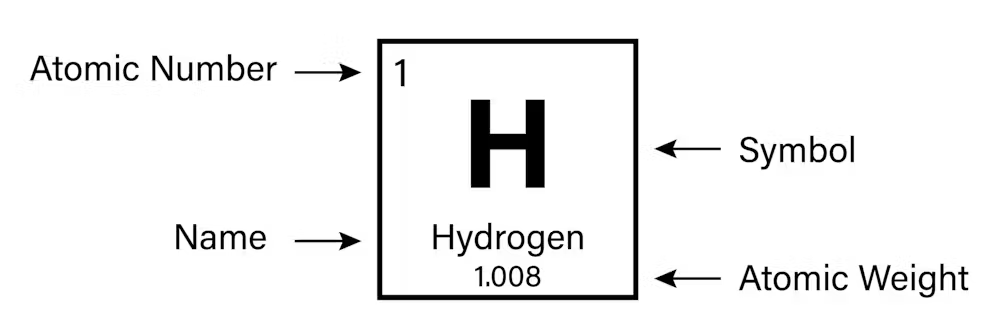
<ul><li><p><span style="background-color: transparent;"><strong>Atomic number</strong>: identifies the element and represents the number of protons.&nbsp;</span></p><ul><li><p><span style="background-color: transparent;">Changing this number would change the identity of the element.</span></p></li></ul></li><li><p><span style="background-color: transparent;"><strong>Atomic mass</strong> = # of protons (atomic number) + # of neutrons</span></p><ul><li><p><span style="background-color: transparent;"><em>Number of neutrons</em> = Atomic mass – Atomic number&nbsp;</span></p></li></ul></li></ul><p></p>
4
New cards

Isotopes are ____

  • Some isotopes, like ____, can be used to date fossils.

Ions result when ___

  • gaining electron(s) results in ___

  • losing electron(s) results in ___

Isotopes are different forms of the same element that have the same number of protons, but different numbers of neutrons.

  • Some isotopes, like those of carbon and potassium, can be used to date fossils.

Ions result when the number of electrons varies.

  • Gaining electron(s) results in a negative charge.

  • Losing electron(s) results in a positive charge.

5
New cards

Chemical Bond Types

Chemical bonds hold atoms together to form molecules.

  • Covalent bonds are the ____.

    • They form when two atoms ___.

      • Nonpolar covalent bonds

      • Polar covalent bonds

        • ex.

    • Do covalent bonds dissociate (come apart) in water?

  • Covalent bonds form when two atoms share an electron

    • They the strongest bond.

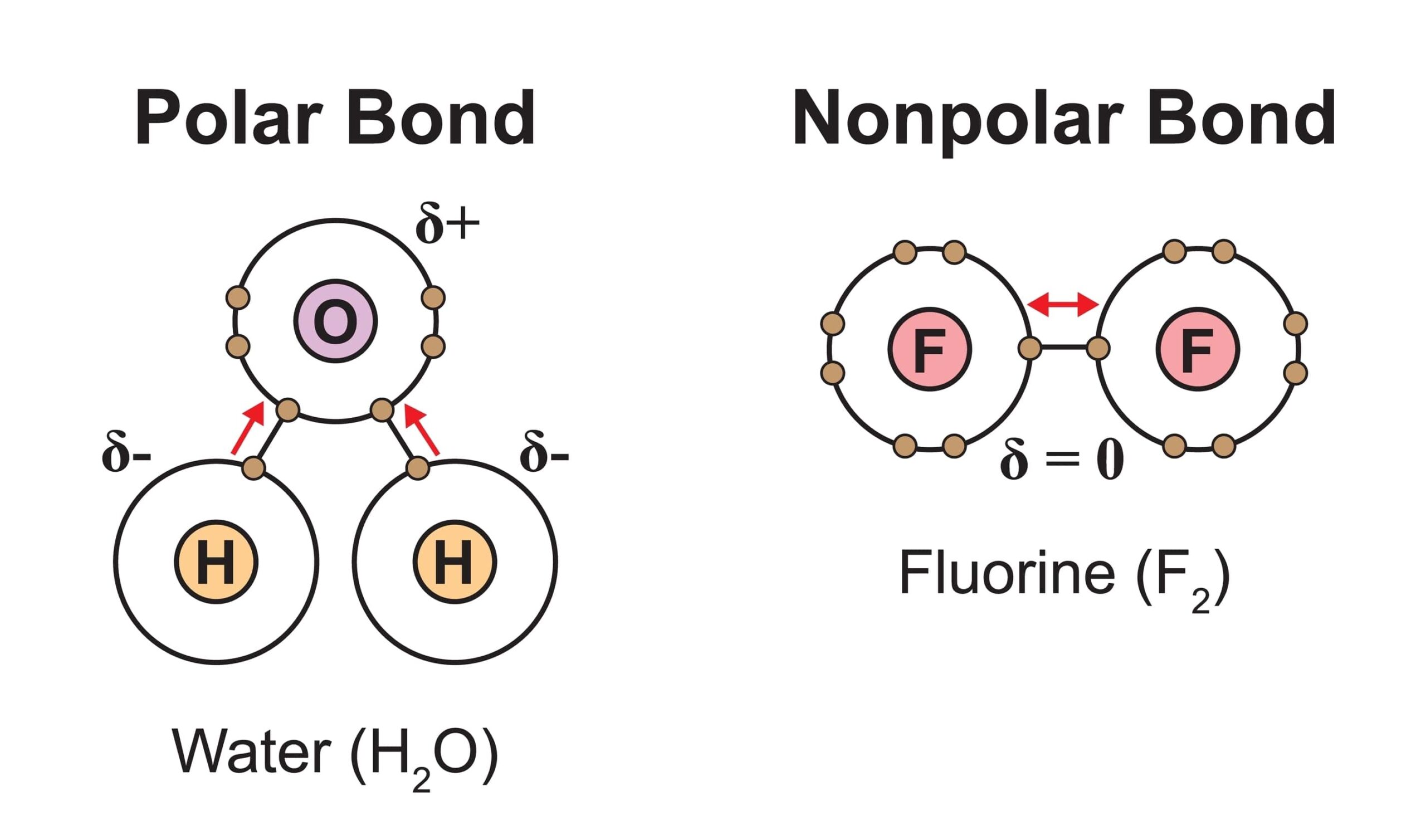
      • Nonpolar covalent bonds – the electrons are shared equally.

      • Polar covalent bonds – the electrons are shared unequally (the electron spends more time closer to one atom than the other)

        • Ex. a water molecule is held together by polar covalent bonds

      • They don’t come apart in water.

<ul><li><p><span style="background-color: transparent;"><strong>Covalent bonds</strong> form when two atoms share an electron</span></p><ul><li><p><span style="background-color: transparent;">They the <em>strongest </em>bond.</span></p><ul><li><p><span style="background-color: transparent;"><strong><em>Nonpolar covalent</em></strong><em> </em><strong><em>bonds</em></strong> – the electrons are shared equally.</span></p></li><li><p><span style="background-color: transparent;"><strong><em>Polar covalent bonds</em></strong> – the electrons are shared unequally (the electron spends more time closer to one atom than the other)</span></p><ul><li><p>Ex. a <u>water molecule</u> is held together by polar covalent bonds</p></li></ul></li><li><p><span style="background-color: transparent;">They don’t come apart in water.</span></p></li></ul></li></ul></li></ul><p></p>
6
New cards

Chemical Bond Types

Chemical bonds hold atoms together to form molecules.

  • Ionic bonds – ____

    • Ionic bonds are ____

    • Do they dissociate in water?

    • Ex.

  • Ionic bonds – form when an electron is transferred from one atom to another → Form ions of opposite charges → These opposite charges attract each other, which holds the ions together. 

    • Fairly strong bond.

    • They do dissociate in water. 

    • Ex. Table Salt: Na donates an electron to Cl → forming ions (Na+/Cl-) → ionic bond will hold them together to form NaCl (table salt). 
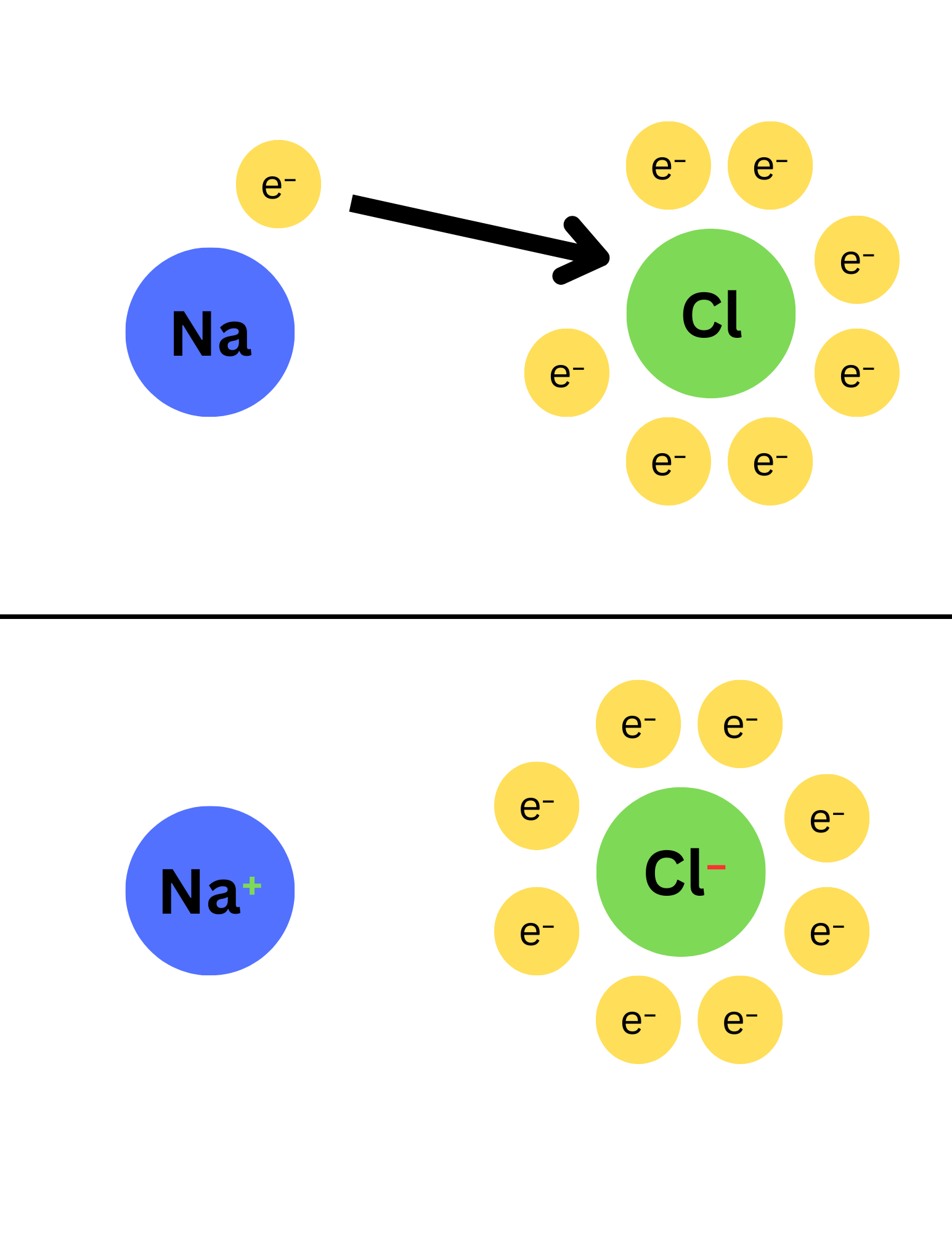
<ul><li><p><span style="background-color: transparent;"><strong>Ionic bonds</strong> – form when an electron is transferred from one atom to another → Form ions of opposite charges → These opposite charges attract each other, which holds the ions together.&nbsp;</span></p><ul><li><p><span style="background-color: transparent;"><em>Fairly strong</em> bond.</span></p></li><li><p><span style="background-color: transparent;">They do dissociate in water.&nbsp;</span></p></li><li><p><span style="background-color: transparent;">Ex. Table Salt: Na donates an electron to Cl → forming ions (Na<sup>+</sup>/Cl<sup>-</sup>) → ionic bond will hold them together to form NaCl (table salt).&nbsp;</span></p></li></ul></li></ul><p></p>
7
New cards

Chemical Bond Types

Chemical bonds hold atoms together to form molecules.

  • Hydrogen bonds

    • Is the ___ bond of them all.

    • Ex.

  • Hydrogen bonds – form between the slightly-positive hydrogen atoms from a polar molecule and the slightly-negative atoms from another polar molecule. 

    • Weakest bond of them all.

    • Ex. Water molecules are held together with hydrogen bonds. 

8
New cards

What are other words for “water loving” and “water fearing”?

What type of molecules are each?

  • Polar molecules are hydrophilic – “water loving”

  • Nonpolar molecules are hydrophobic – “water fearing”

9
New cards
  • Cohesion – the force that causes__

    • Surface tension is the capacity of a substance to __

  • Adhesion – the force that causes __

    • ex.

Cohesive and adhesive forces allow a plant to draw water in through its roots.

  • Cohesion – the force that causes similar molecules (ex. water molecules) to stick together due to hydrogen bonding

    • Surface tension is the capacity of a substance to hold together when under stress. 

  • Adhesion – the force that causes molecules of different substances to stick together

    • ex. Water molecules will also “stick” to other polar molecules by forming hydrogen bonds. 

Cohesive and adhesive forces allow a plant to draw water in through its roots.

10
New cards
  • Carbohydrates ___

    • Monosaccharides

    • Disaccharides

  • Polysaccharides ___

  • Carbohydrates are polymerrs made up of monomers called monosaccharides (simple sugars).

    • Monosaccharides simple sugars (ex. glucose & fructose_

    • Disaccharides 2 Monosaccharides bonded together (ex. sucrose and lactose)

  • Polysaccharides are complex carbohydrates; long chains of monosaccharides that are used to store energy (plants-starch and animals-glycogen) and to provide structure (cellulose).
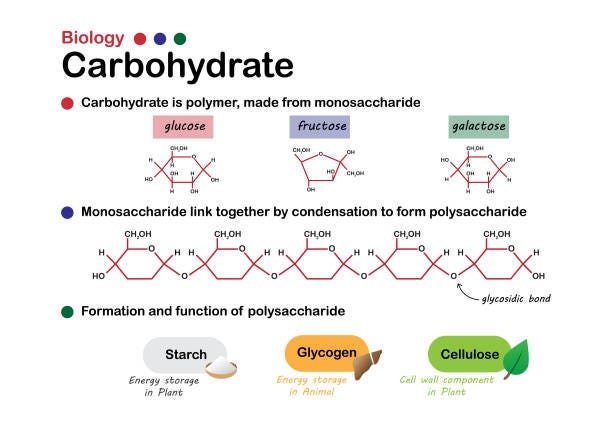
<ul><li><p><strong>Carbohydrates</strong> are polymerrs made up of monomers called monosaccharides (simple sugars).</p><ul><li><p><strong>Monosaccharides</strong> <span style="background-color: transparent;">– </span>simple sugars (ex. glucose &amp; fructose_</p></li><li><p><strong>Disaccharides </strong><span style="background-color: transparent;">–</span><strong> </strong>2 Monosaccharides bonded together (ex. sucrose and lactose)</p></li></ul></li></ul><ul><li><p><strong>Polysaccharides </strong>are complex carbohydrates; long chains of monosaccharides that are used to store energy (plants-starch and animals-glycogen) and to provide structure (cellulose).</p></li></ul><p></p>
11
New cards
  • Proteins ____

  • Functions:

  • The chemical bond between amino acids are ____.

  • Protein structure:

    • Primary Structure ___

    • Secondary Structure ____

    • Tertiary Structure _____

    • Quaternary Structure _____

      • Ex. _____

  • Proteins are polymers made of monomers called amino acids.

  • Functions: Structural, Regulatory, Contractile, Protective

  • The chemical bond between amino acids is peptide bonds.

  • Protein structure:

    • Primary Structure the sequence of a chain of the amino acids

    • Secondary Structure Hydrogen bonds folds the chain into “pleated sheets”

    • Tertiary Structure Further folding to a 3-dimensional structure

    • Quaternary Structure Sometimes more than one chain are put together, leading to a complex protein molecule

      • Ex. Hemoglobin (has four polypeptide chains).
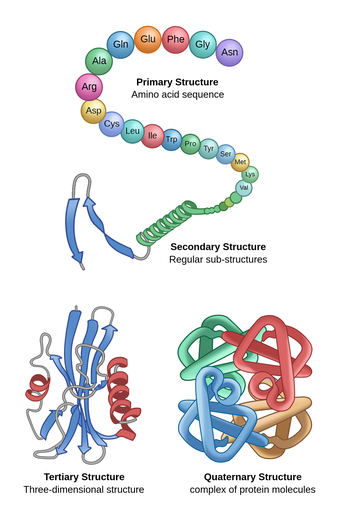
<ul><li><p><span style="background-color: transparent;"><strong>Proteins</strong> are polymers made of monomers called amino acids.</span></p></li><li><p><span style="background-color: transparent;"><strong>F</strong></span><strong>unctions</strong>: Structural, Regulatory, Contractile, Protective</p></li><li><p>The <strong>chemical bond</strong> between amino acids is <u>peptide bonds</u>.</p></li><li><p>Protein structure:</p><ul><li><p><strong>Primary Structure</strong> <span style="background-color: transparent;">–</span> the sequence of a chain of the amino acids</p></li><li><p><strong>Secondary</strong> Structure <span style="background-color: transparent;">–</span> Hydrogen bonds folds the chain into “pleated sheets”</p></li><li><p><strong>Tertiary</strong> Structure <span style="background-color: transparent;">– </span>Further folding to a 3-dimensional structure</p></li><li><p><strong>Quaternary</strong> Structure <span style="background-color: transparent;">– </span>Sometimes more than one chain are put together, leading to a complex protein molecule</p><ul><li><p>Ex. Hemoglobin (has four polypeptide chains).</p></li></ul></li></ul></li></ul><p></p>
12
New cards
  • Lipids are ___

    • How would the molecules be described?

Examples:

  • Triglycerides ____

  • Phospholipids ___

  • Steroids ___

  • Lipids are macromolecules made up of fatty acids

    • Nonpolar, hydrophobic molecules

Examples:

  • Triglycerides consists of 3 fatty acid chains and a glycerol.

  • Phospholipids consists of a polar phosphate group (head) and two nonpolar fatty acid chains (tails).

  • Steroids not made of fatty acid, but is hydrophobic, so is grouped as lipids.
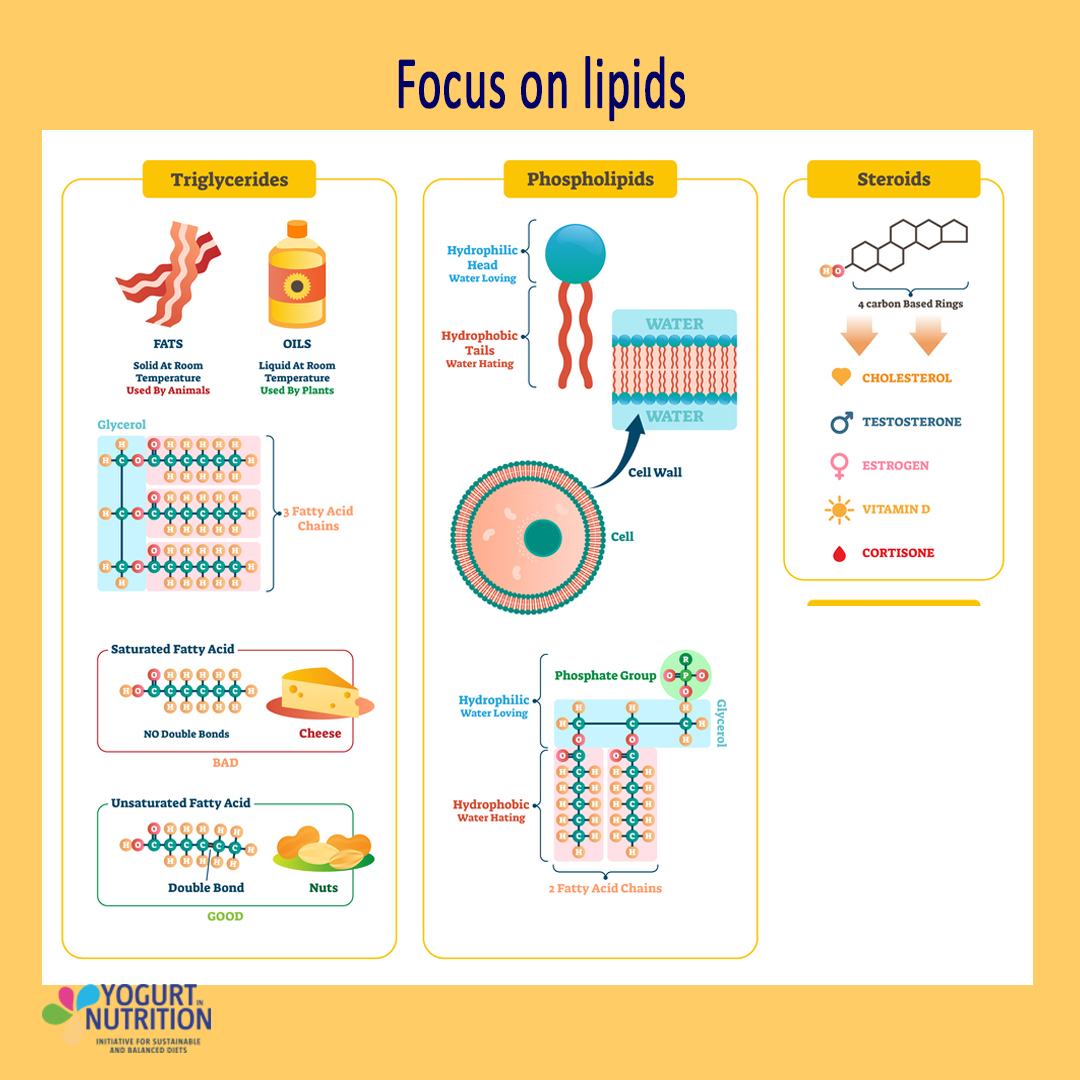
<ul><li><p><span style="background-color: transparent;"><strong>Lipids</strong> are macromolecules made up of fatty acids </span></p><ul><li><p><span style="background-color: transparent;">Nonpolar, hydrophobic molecules</span></p></li></ul></li></ul><p>Examples:</p><ul><li><p><span style="background-color: transparent;"><strong>Triglycerides </strong>– </span>consists<span style="background-color: transparent;"> of 3 fatty acid chains and a glycerol.</span></p></li><li><p><strong>Phospholipids </strong><span style="background-color: transparent;">–</span> consists of a polar phosphate group (head) and two nonpolar fatty acid chains (tails).</p></li><li><p><strong>Steroids </strong><span style="background-color: transparent;">–</span> not made of fatty acid, but is hydrophobic, so is grouped as lipids.</p></li></ul><p></p>
13
New cards

Nucleic acids are ____

  • Nucleic acids carry ___

  • Can ___ itself.

Nucleotides are ___

  • Made up of?

Example:

  • DNA

    • Structure?

    • The sugar is ____.

    • Nitrogenous bases pairs are:

  • RNA

    • Structure?

    • The sugar is ____.

    • Nitrogenous bases pairs are:

Nucleic acids (polymers) are made up of nucleotides (monomers)

  • Nucleic acids carry the a cells’ instructions.

  • Can replicate itself.

Nucleotides are made up of:

  • Phosphate group

  • 5-Carbon sugar

  • Nitrogenous base

Example:

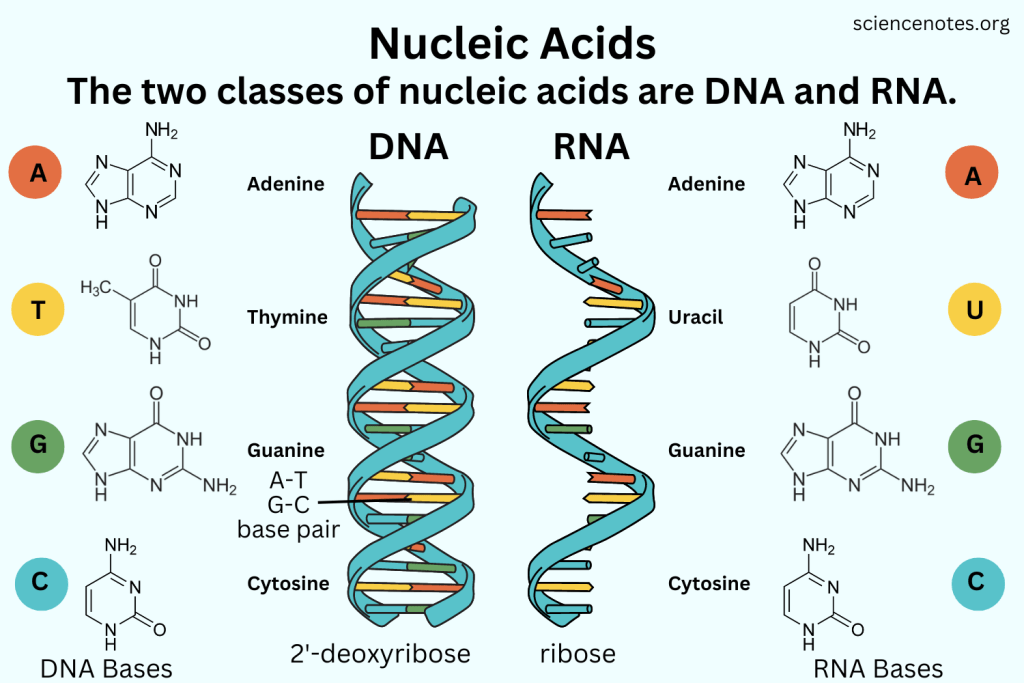
  • DNA

    • A double-helix molecule that has antiparallel strands

    • The sugar is deoxyribose.

    • Nitrogenous bases include:

      • Adenine (purine) - Thymine (pyrimidine) (2 hydrogen bonds)

      • Cytosine (pyrimidine) - Guanine (purine) (3 hydrogen bonds)

  • RNA

    • A single (stranded) helix molecule

    • The sugar is ribose

    • Nitrogenous bases include:

      • Adenine - Uracil

      • Cytosine - Guanine

<p><span style="background-color: transparent;"><strong>Nucleic acids</strong> (polymers) are made up of nucleotides (monomers)</span></p><ul><li><p><span style="background-color: transparent;">Nucleic acids carry the a cells’ instructions.</span></p></li><li><p><span style="background-color: transparent;">Can replicate itself.</span></p></li></ul><p><span style="background-color: transparent;"><strong>Nucleotides</strong> are made up of:</span></p><ul><li><p><span style="background-color: transparent;">Phosphate group</span></p></li><li><p><span style="background-color: transparent;">5-Carbon sugar</span></p></li><li><p><span style="background-color: transparent;">Nitrogenous base</span></p></li></ul><p></p><p>Example:</p><ul><li><p><span style="background-color: transparent;"><strong>DNA</strong></span></p><ul><li><p><span style="background-color: transparent;">A double-helix molecule that has antiparallel strands</span></p></li><li><p><span style="background-color: transparent;">The sugar is deoxyribose.</span></p></li><li><p><span style="background-color: transparent;">Nitrogenous bases include:</span></p><ul><li><p><span style="background-color: transparent;">Adenine <sub>(purine)</sub> - Thymine <sub>(pyrimidine)</sub> (2 hydrogen bonds)</span></p></li><li><p><span style="background-color: transparent;">Cytosine <sub>(pyrimidine)</sub> - Guanine <sub>(purine)</sub> (3 hydrogen bonds)</span></p></li></ul></li></ul></li></ul><ul><li><p><span style="background-color: transparent;"><strong>RNA</strong></span></p><ul><li><p><span style="background-color: transparent;">A single (stranded) helix molecule</span></p></li><li><p><span style="background-color: transparent;">The sugar is ribose</span></p></li><li><p><span style="background-color: transparent;">Nitrogenous bases include:</span></p><ul><li><p><span style="background-color: transparent;">Adenine - <u>Uracil</u></span></p></li><li><p><span style="background-color: transparent;">Cytosine - Guanine</span></p></li></ul></li></ul></li></ul><p></p>

Explore top notes

note
History Study
Updated 1037d ago
0.0(0)
note
Chapter 26 - Lipids
Updated 1283d ago
0.0(0)
note
Theology Unit 1 Test
Updated 1256d ago
0.0(0)
note
Spanish 3 1
Updated 559d ago
0.0(0)
note
Ethics in Health Care
Updated 1200d ago
0.0(0)
note
APUSH Unit 5
Updated 854d ago
0.0(0)
note
History Study
Updated 1037d ago
0.0(0)
note
Chapter 26 - Lipids
Updated 1283d ago
0.0(0)
note
Theology Unit 1 Test
Updated 1256d ago
0.0(0)
note
Spanish 3 1
Updated 559d ago
0.0(0)
note
Ethics in Health Care
Updated 1200d ago
0.0(0)
note
APUSH Unit 5
Updated 854d ago
0.0(0)

Explore top flashcards

flashcards
World History Quiz Part 3
61
Updated 1070d ago
0.0(0)
flashcards
Glossary 4
24
Updated 1046d ago
0.0(0)
flashcards
Bio p cr
39
Updated 1170d ago
0.0(0)
flashcards
anatomy ch 7 list 1
53
Updated 77d ago
0.0(0)
flashcards
Systems Pathology Exam 1
133
Updated 240d ago
0.0(0)
flashcards
MX history
48
Updated 1172d ago
0.0(0)
flashcards
World History Quiz Part 3
61
Updated 1070d ago
0.0(0)
flashcards
Glossary 4
24
Updated 1046d ago
0.0(0)
flashcards
Bio p cr
39
Updated 1170d ago
0.0(0)
flashcards
anatomy ch 7 list 1
53
Updated 77d ago
0.0(0)
flashcards
Systems Pathology Exam 1
133
Updated 240d ago
0.0(0)
flashcards
MX history
48
Updated 1172d ago
0.0(0)