Comparative Politics - Final Study Guide SAQ Questions
 Studied by 0 people
 Call Kai
 Learn
Learn Practice Test
 Spaced Repetition
 Match
Match Flashcards
 Knowt Play
1/13

There's no tags or description
Looks like no tags are added yet.
Name | Mastery | Learn | Test | Matching | Spaced | Call with Kai |
|---|
No analytics yet
Send a link to your students to track their progress
14 Terms
Within proportional representation (PR) Systems, does open-list or closed-list PR generate stronger parties? Briefly provide two arguments in support of you answer.
Closed-list PR. (1) Gives parties full control over candidate ranking and selection - which lets them discipline members, reward loyalists, and control legislative composition. (2) Open lists weaken parties by incentivizing intraparty competition since they are individually competing - this incentivizes personal vote seeking rather than party brand advocacy.
The mere existence of gender quotas is often not sufficient for advancing the descriptive representation of women in legislatures. What are two institutional features that are effective in promoting the representation of women?
Enforcement and placement mandate are two factors that are important for gender quotas. Enforcement punishes for not complying. Placement mandate is important because parties can set women up to lose.
Explain how the strategic behavior of two types of actors may generate outcomes consistent with Duverger's Law. Be sure to name the actors, describe their strategies, and explain how their actions may generate predictions consistent with Duverger's Law.
Duverger's Law predicts two-party competition under FPTP because both voters and candidates behave strategically. Voters engage in strategic voting -- rather than support their true first-choice small parties. Candidates and parties engage in strategic entry and withdrawal. Anticipating they cannot win in a winner-take-all race, minor party candidates often choose not to run, and doners avoid funding them. When voters desert nonviable parties and candidates stop contesting races, coordination emerges around two parties.
Consider a country with two cleavages: class (upper and lower) and ethnicity (groups A and B). Suppose further that gaining national office requires at least 50 percent of the vote. The distribution of the electorate across these groups is depicted in Table 1.
a. Which parties would you expect to form according to the logic of "least minimal winning coalitions" and why?
The most efficient least minimal winning coalition will be group A Rich and Group A Not Rich - which would be 54% of the vote. Party B would then not reach enough votes (46% added together), and as such, cannot form that coalition. There can also be a less efficient group of Group B Rich, Group B Not Rich, and Group A Rich if group wanted to form a coalition, or another less efficient group could be Group A Not Rich and Group B Not Rich, would would be 70% of the votes. They are less efficient because they require more seats, and as such, more catering to needs and wants.
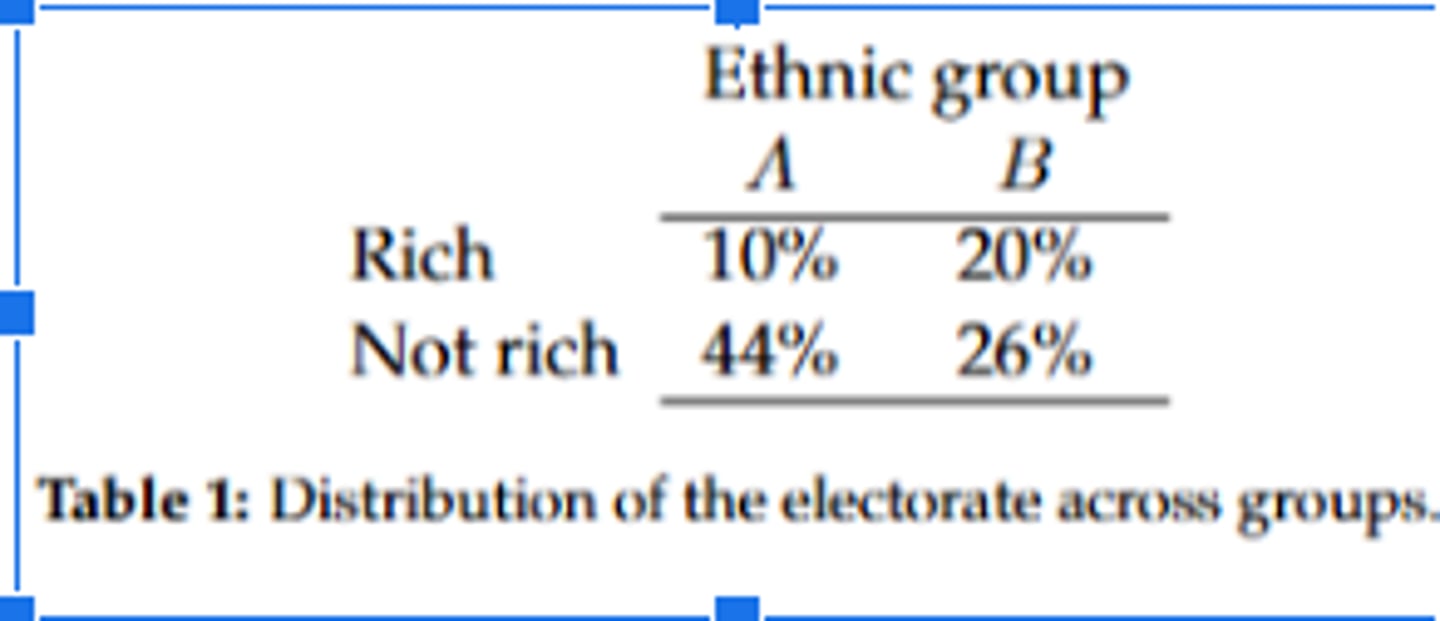
Consider a country with two cleavages: class (upper and lower) and ethnicity (groups A and B). Suppose further that gaining national office requires at least 50 percent of the vote. The distribution of the electorate across these groups is depicted in Table 1.
b. Are these cleavages reinforcing or cross-cutting? Briefly explain why.
These cleavages are reinforcing because knowing an individual's ethnicity gives you strong information about their class distribution, meaning the attributes are correlated. Group A is heavily not rich, where group B is more evenly distributed. Group A strongly predicts being not rich, and being group B is more predictive of being Rich relative to A.
Among coalition governments in Western European parliamentary democracies , minimum winning coalition governments are more frequent than surplus majority governments. First, explain why a formateur many prefer to form a minimum winning coalition over a surplus majority government. Second, provide one explanation for why minimum winning coalition governments endure longer (on average) than surplus majority governments.
Forming a minimum winning coalition is preferable to a surplus majority because the groups can make less compromises on seats and policy changes by including the minimal number of people to still gain a majority. This government type may endure longer because there are less competing parties' interests and therefore more stability.
Do presidential or parliamentary systems promote more party discipline? Provide two brief explanations to support your answer.
Parliamentary systems promote more party discipline because government survival depends on maintaining a legislative majority, meaning legislators have strong incentives to vote with their party to avoid bring down the government and lose office. In additions, candidate selection is more centralized in parliamentary systems, since parties must protect their seat to remain viable coalition partners, so legislators know that defection can threaten future placement on party lists or renomination.
International organizations and aid donors promoted decentralization in many developing countries in the 1990s and early 2000s. Provide one argument for and one argument against decentralization and briefly explain your reasoning.
One argument for decentralization is that local governments have better information about citizen needs and preferences, improving accountability and service delivery, especially where local elections allow voters to sanction poor performers. However, a key argument against decentralization is the danger of local capture: when subnational governments have weak bureaucratic capacity or low transparency, powerful local elites, or special interests can dominate policy, reducing equity and public-good provision.
Provide two way sin which a bureaucrat's goals might differ from those of his/her principal (i.e., a politician). Would the potential agency problem be more acute if the bureaucrat were appointed via a patronage or civil service system? Briefly explain your reasoning
Bureaucrats may differ from politicians because bureaucrats may prefer different policy outcomes based on professional norms or personal ideology, while politicians want policies aligned with party priorities. Secondly, bureaucrats may prefer to exert less effort, while politicians want diligent implementation. Agency problems tend to be more acute under civil service systems, where tenure protections reduce the ability of politicians to discipline agents for poor performance, whereas patronage appointees are more easily fired and often share the politician's policy preferences.
The median voter theorem invokes a number of assumptions. State two of these assumptions. For each assumption, briefly explain why the median voter theorem result does not obtain in the absence of that assumption.
Median voter theorem assumes single-peaked preferences, meaning each voter has one most preferred policy, and dislikes options as they move away from it; without this, majority cycling occurs, and no stable median outcome exists. It also assumes policy competition in a one-dimensional policy space, because in multidimensional spaces no single point beats all alternatives in pairwise votes, making the median voter's ideal point no longer a Condorcet winner. Additional assumptions include full voter information, and candidate office-seeking behavior, but removing any core assumption breaks the convergence prediction.
While the rich vote at substantially higher rates than the poor in the United States, recent scholarship has shown that this pattern does not hold in all countries. Provide one argument to explain why the poor might vote at higher rates than the rich. Then, describe the conditions that should hold for this argument to work.
The poor might vote at higher rates when political parties offer strong, targeted, and credible material benefits -- such as cash transfers or clientelist goods -- that increase the payoff to voting relative to abstaining. For this argument to work, parties must have (1) organizational capacity to monitor turnout, (2) credible mechanists for delivering benefits, and (3) a political environment where electoral competition hinges on mobilizing poorer voters rather than persuading wealthier ones.
Provide one specific argument about how a FPTP system interacts with ethnic demography (the distribution of ethnic groups in a given district) to influence relationships between ethnic groups. How might a change from FPTP to proportional representation affect this outcome?
Under FPTP, when an ethnic group is geographically concentrated within a district, parties have incentives to mobilize that group exclusively, producing ethnic bloc voting and potentially depending intergroup antagonism. Politicians gain by appealing to "their" ethnic group since victory requires only a plurality in a single district. Switching to PR weakens this logic: because seats are allocated proportionally and districts are larger, parties must appeal to multiple groups, encouraging cross-ethnic coalitions and reducing polarization driven by winner-take-all incentives.
Some scholars have argued that elections provide actors with incentives that shape the occurrence of ethnic riots. Provide one explanation for how elections might create pressures that increase the occurrence of this form of political violence. Then, provide one explanation for how elections might create pressures that decrease the occurrence of this form of political violence.
Elections may increase ethnic riots because elites sometimes use their ethnic outbidding or inflammatory rhetoric to mobilize co-ethnic voters -- especially in competitive districts where ethnic identities structure political support. However, elections may also decrease riots when they provide institutionalized, peaceful channels for conflict resolutions: parties representing different ethnic constituencies can compete for votes rather than resorting to violence , and credible electoral rules reduce uncertainty that might otherwise spark preemptive attacks.
Articulate (a) one motive/preference-based; and (b) one technology-based explanation for civil war outset. For each explanation identify one strength and one weakness of the explanation.
A motive-based explanation argues that groups rebel when they face severe grievances such as repression, exclusion, or inequality. Its strength is substantive plausibility -- grievances often correlate with conflict -- but its weakness is overpredictions since many highly aggrieved societies do not experience civil war. A technology-based explanation emphasizes the feasibility of rebellion -- e.g., weak state capacity, access to rough terrain or external financing-- making war materially possible. This approach strength is predictive power across cases, but its weakness is that it may understate the importance of ideological or emotional motivations.
 Note
Note  Flashcards (94)